Delightful Fear

Delightful FearThe 112th Psalm begins with an interesting idea that almost sounds like an oxymoron: delightful fear—

Blessed is the man who fears the Lord, who finds great delight in His commands. (v. 1)

  • Fear and delight
  • Worship and obedience
  • Reverence and action
  • Awe and love

These are not contrasting ideas, but two sides of the same coin. They are completions of each other, and they are essential to a healthy relationship with Jehovah. And then, oh!, the blessings that flow from God to me!

  • Mighty children (v. 2)
  • Abundant household (v. 3a)
  • Enduring righteousness (v. 3b)
  • Brightly shining life (v. 4)
  • Reciprocated generosity (v. 5)
  • Security in troubled times (v. 6a)
  • A lasting legacy (v. 6b)
  • No fear of calamity (v. 7)
  • Eternal life (v. 8)
  • Highly honored (v. 9)

After nine verses of these amazing blessings to the one who delightfully fears God, only one verse is left for the one who doesn’t—he is vexed, wasting away, and frustrated.

I don’t know about you, but I want to delightfully fear—worship, obey, revere and love—Jehovah my God!

Social Justice

Scales of social justiceThere is a lot of talk about “social justice”—speaking out and acting on behalf of those who are oppressed, marginalized and disenfranchised. This is close to God’s heart, too, as He describes “pure religion” in terms of caring for orphans and looking after widows (see James 1:27).

But we hinder our attempts at social justice if it’s not tied to God’s righteousness. Because without righteousness, we don’t have God’s unlimited help and are simply operating under our own limited power.

Surely the arm of the Lord is not too short to save, nor His ear too dull to hear. But your iniquities have separated you from your God; your sins have hidden His face from you, so that He will not hear. (Isaiah 59:1-2, emphasis added)

Justice is mentioned four times in this 59th chapter of Isaiah, but always in close proximity to righteousness

The opening verse is the perfect conclusion: God has the ability to help us (justice), but our lack of righteousness prevents Him from hearing our pleas and moving to action.

The single-best way to make social justice maximally effective is for each of us to pursue God’s righteousness. 

All efforts at social justice apart from God’s help will bring small, temporary gains at best. But even our smallest attempts at social justice with God’s help will bring lasting results for the greatest number of people.

“Mercy, King, Mercy!”

C.H. SpurgeonI love this passage from one of Charles Spurgeon’s sermons—

“Edward the Second, one of our kings, was exceedingly enraged against one of his courtiers; out hunting one day, he threatened the courtier with the severest punishment. There was a river between them at the time, and the courtier thinking that he was perfectly safe, ventured to offer some jeering remark against the king—telling him that at any rate he would not be likely to chastise him until he got at him. The king, feeling his anger hot within him, told him that the water should not long divide them, leaped into the middle of the stream, and with some difficulty gained the other side.

“The courtier in great alarm fled in terror, and the king pursued him with might and main, spurring his horse to the utmost. Nor did his anger cease; he carried his drawn sword in his hand with the intention of killing him. At last the courtier, seeing that there was no hope for any escape, knelt down upon the grass, and laying bare his neck, said, ‘I heartily deserve to die; mercy, King, mercy!’ The king sent back the sword into the scabbard in a moment, and said, ‘Whilst you sought to escape me I determined to destroy you, but when I see you humble at my feet I freely forgive you.’

“Even so it is with the King of heaven. Sinners, you say there is this life between you and God; but how soon will the white horse of Justice pass the stream, and then, flee as you may today, He will surely overtake you. He now is swift to destroy; let it be yours on your knees to make confession of your sin and say, ‘I deserve Thy wrath, great King;’ and if to this you are enabled to add the plea of the precious blood of Christ, the sword of justice will return into its scabbard, and He will say, ‘I am just, and yet the justifier of the ungodly.’”

Links & Quotes

link quote

Some good reading from today…

“As much as half of the water in Earth’s oceans could be older than the Sun, a study has found.” This report is more evidence of the accuracy of the account of Creation in the Bible. Of course the water has been around longer than the sun: Genesis says that God created water in Day 2, but the sun wasn’t created until Day 4.

“I have little fear that any nation or combination of nations could bring down the United States and Canada by military action from without. But this I do fear—we sin and sin and do nothing about it. There is so little sense of the need of repentance—so little burden for the will of God to be wrought in our national life. I fear that the voice of blood will become so eloquent that God Almighty will have no choice but to speak the word that will bring us down. I do pray often: ‘Oh God, send a revival of repentance and the fear of God that will sweep through the continent that we may be spared and that we may honor Thee!’” —A.W. Tozer

Max Lucado challenges us to invite God in.

Sarah Rainer, a PhD in psychology, shows how Christianity and psychology should be integrated.

It is unconscionable to me how my tax dollars are being diverted by a so-called “health care” program to destroy life. Read how Obamacare funds Planned Parenthood’s heinous, murderous activities.

Smashing Idols

Puny idolsWhen looking at God’s commandments, we must look at them through a lens of love. If God—the Lawgiver—is love, then all of His laws must be saturated in His love.

So what happens when we look at the Second Commandment through this lens? The wording is simple: “You shall not make for yourself an idol…” (Exodus 20:4-6). If the First Commandment says, “I love you so much that I want to be the One and Only God you have a relationship with” then the Second Commandment says, “Because of this loving relationship, don’t try to make Me smaller to fit your worldview, but let Me by fully Me!

This idolatry starts in our minds, long before we ever create anything with our hands. Idolatry is a mental state that says, “I can define the Creator. I can figure out all of His dimensions. I can predict what He’s going to do. God operates just as I expect Him to.”

But God says, “My thoughts are nothing like your thoughts. And My ways are far beyond anything you could imagine” (Isaiah 55:8).

The Apostle Paul warned us of exchanging God’s uncontainable glory and majesty for something that we can neatly contain in our box: …they exchanged the glory of the immortal God for images … they exchanged the truth of God for a lie, and worshiped and served created things rather than the Creator… (Romans 1:21-25).

William Barclay offers this commentary about the flimsiness of idols: “In Greek the word idol has in it the sense of unreality. Plato used it for the illusions of this world as opposed to the unchangeable realities of eternity.” Our puny thoughts about God can create the idols that keep us from the reality of God. 

So how do we avoid this idolatry? Quite simply: we smash every mental idol!

…We refute arguments and theories and reasonings and every proud and lofty thing that sets itself up against the true knowledge of God; and we lead every thought and purpose away captive into the obedience of Christ… (2 Corinthians 10:5).

So… what idols do you need to smash?

If you have missed any of the messages in our series The Love In The Law, you can find them all by clicking here.

Rappin’ For Love

MattyB & Sarah GraceI love the message in this video from MattyB, as he stands up for Sarah Grace, his sister with Down Syndrome.

Read more of MattyB’s thoughts by opening up the video in YouTube.

You can also read some behind-the-scenes info by clicking here.

Quotes From “No Idols”

No idolsAs requested, here are the quotes I shared in my message this morning…

“In Greek the word idol has in it the sense of unreality. Plato used it for the illusions of this world as opposed to the unchangeable realities of eternity.” —William Barclay

“What we think and believe, we are; not what we say we think and believe, but what we really do think and believe, we are; there is no divorce at all.” —Oswald Chambers 

“Until the love of God that knows no boundary, limit, or breaking point is internalized through personal decision; until the furious longing of God seizes the imagination; until the heart is conjoined to the mind through sheer grace, nothing happens. The idolatry of ideas has left me puffed up, narrow-minded, and intolerant of any idea that does not coincide with mine.” —Brennan Manning

Links & Quotes

link quote

Some good reading & watching from this weekend…

Eric Metaxas has a thought-provoking commentary: What Chuck [Colson] Would Say About The US and ISIS.

Ouch! What Gossip Says About God.

This isn’t a problem in far-away places: Forced Abortion In America.

“It was always meant to be more about marshalling enthusiasm for a cause than making firm pledges.” Yep, they even admit that so-called global warming is more hype than substance.

“Do not dilute the power of this new day with the hardship of yesterday. Greet this day with endless possibility.” —Steve Maraboli

This would give further evidence to why the Bible refers to a married couple as “one flesh”: How Your Spouse’s Personality Affects Your Success At Work.

“We are emotional people, but we don’t have to be controlled by our emotions.” Watch John Maxwell talk about anger.

“Always vote for principle, though you may vote alone, and you may cherish the sweetest reflection that your vote is never lost.” —John Quincy Adams

Poetry Saturday—Thou Sweet, Beloved Will Of God

Gerhard TersteegenThe Will of God
Thou sweet, beloved Will of God,
   My anchor ground, my fortress hill,
My spirit’s silent, fair abode,
   In Thee I hide me, and am still.

O Will, that willest good alone,
   Lead Thou the way, Thou guidest best;
A little child I follow on,
   And trusting lean upon Thy breast.

Thy beautiful, sweet Will, my God,
   Holds fast in Its sublime embrace
My captive will, a gladsome bird,
   Prisoned in such a realm of grace.

Within this place of certain good,
   Love ever more expands her wings;
Or, nestling in Thy perfect choice,
   Abides content with what it brings.

Oh, sweetest burden, lightest yoke,
   It lifts, it bears my happy soul,
It giveth wings to this poor heart:
   My freedom is Thy grand control.

Upon God’s Will I lay me down,
   As child upon its mother’s breast;
No silken couch, nor softest bed,
   Could ever give me such sweet rest.

Thy wonderful, grand Will, my God
   With triumph now I make It mine,
And Love shall cry a jealous Yes,
   To every dear command of Thine. —Gerhard Tersteegen


12 Quotes From “The Love Of God”

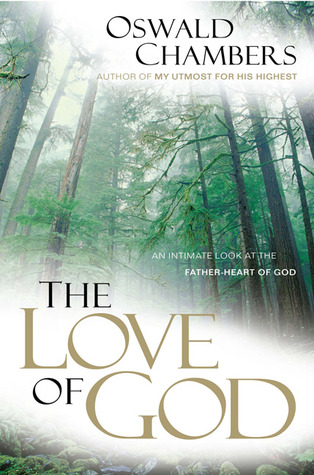
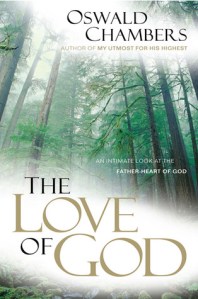
The Love Of GodOswald Chambers has a way of writing about biblical truths that satisfy both the head and the heart. You can read my review of Chambers’ book The Love Of God by clicking here. Below are just a few of the many, many quotes I highlighted in this amazing book.

“In the future, when trial and difficulties await you, do not be fearful, whatever and whoever you may lose faith in, let not this faith slip from you—God is Love; whisper it not only to your heart in its hour of darkness, but here in your corner of God’s earth and man’s great city, live in the belief of it; preach it by your sweetened, chastened, happy life; sing it in consecrated moments of peaceful joy, sing until the world around you ‘is wrought to sympathy with hopes and fears it heeded not.’ The world does not bid you sing, but God does. Song is the sign of an unburdened heart; then sing your songs of love unbidden, ever rising higher and higher into a fuller conception of the greatest, grandest fact on the stage of Time—God is Love.”

“God did not create man as a puppet to please a despotic idea of His own, He created us out of the superabundant flow of overflowing love and goodness, He created us susceptible of all the blessedness which He had ordained for us.”

“Drink deep and full of the love of God and you will not demand the impossible from earth’s loves, and the love of wife and child, of husband and friend, will grow holier and healthier and simpler and grander.”

“Love is difficult to define, but the working definition I would like to give is that ‘Love is the sovereign preference of my person for another person, embracing everyone and everything in that preference.’”

“The majority of us are unnoticed and unnoticeable people. If we take the extraordinary experience as a model for the Christian life, we erect a wrong standard without knowing it.” 

“God will use any number of extraordinary things to chisel the detail of His ‘lily work’ in His children. He will use people who are like hedgehogs, He will use difficult circumstances, the weather; He will use anything and everything, no matter what it is, and we shall always know when God is at work because He produces in the commonplace something that is inspiring.”

“A Christian is one in whom the indwelling Spirit of God shines out all the time.”

“Our Lord did not say to His disciples: ‘I have had a most successful time on earth, I have addressed thousands of people and been the means of their salvation; now you go and do the same kind of thing.’ He said: ‘If I then, your Lord and Master, have washed your feet; you also ought to wash one another’s feet.’ We try to get out of it by washing the feet of those who are not of our own set. We will wash the heathen’s feet, the feet in the slums; but fancy washing my brother’s feet! my wife’s! my husband’s! the feet of the minister of my church! Our Lord said one another’s feet. It is in the ordinary commonplace circumstances that the unconscious light of God is seen.”

“The reason we are going through the things we are is that God wants to know whether He can make us good bread with which to feed others. The stuff of our lives, not simply of our talk, is to be the nutriment of those who know us. … It is in the solitary life that we prove whether we are willing to be made the unadvertised life for the community to which we belong—whether we are willing to be made bread or to be simply the advertisement for bread? If we are to be made bread, then we must not be surprised if we are treated in the way Our Lord was treated.”

“For a man to lay down his life is not to lay it down in a sudden crisis, such as death, but to lay it down in deliberate expenditure as one would lay out a pound note. Not—‘Here it is, take it out in one huge martyrdom and be done with it.’ It is a continual substitution whereby we realize that we have another day to spend out for Jesus Christ, another opportunity to prove ourselves His friends.”

“The test of spiritual life is the power to descend; if we have power to rise only, there is something wrong. … Spiritual selfishness makes us want to stay on the mount; we feel so good, as if we could do anything—talk like angels and live like angels, if only we could stay there. But there must be the power to descend; the mountain is not the place for us to live, we were built for the valleys. … We never live for the glory of God on the mount, we see His glory there, but we do not live for His glory there; it is in the valley that we live for the glory of God. … The reason we have to live in the valley is that the majority of people live there, and if we are to be of use to God in the world we must be useful from God’s standpoint, not from our own standpoint or the standpoint of other people. … As disciples of Jesus we have to learn not only what Our Lord is like on the Mount of Transfiguration, but what He is like in the valley of humiliation, where everything is giving the lie to His power, where the disciples are powerless, and where He is not doing anything.”

“We shall find that the spheres God brings us into are not meant to teach us something but to make us something.”