“Friendship is a path that leads very close to the perfection which consists of the enjoyment and knowledge of God, such that a man who is a friend of man is made into a friend of God, according to what the Savior said in the gospel: ‘Now I will not call you servants, but My friends [John 15:15].’” —Aelred of Rievaulx
In studying the intense volcanic activity on Jupiter’s moon Io, the ICR concludes, “Since 2013, evidence of a youthful solar system has only gotten stronger. Scientists have been forced to acknowledge that Saturn’s rings are indeed young, and belief in deep time continues to pose real problems for conventional scientists.” The prestigious Nature concurs, saying, “Some such proposals make planetary researchers uncomfortable, because it is statistically unlikely that humans would catch any one object engaged in unusual activity—let alone several.”
Parents and teachers trying to keep up with the ever-changing lexicon of today’s youth will really appreciate this list of slang from Axis.
“Those who are really in earnest must be willing to be anything or nothing in the world’s estimation.” —Susan B. Anthony
The story of Esther in the Bible is one of my all-time favorites. “While Esther herself has not been identified, nor has the plot to destroy the Jewish people been confirmed, the absence of evidence is not evidence of absence.” To that point, here are 10 pieces of archeological evidence related to this amazing story.
Charisse Compton asks, “When was the last time meditating on your body elicited worship?” She goes on to make this case from Psalm 139: “Your body, as much as your soul, is one of God’s glorious works. It bears the unmistakable signature of the divine Artist so that, like creation, your body ‘declare[s] the glory of God’ (Psalm 19:1).”
Why should I fear when evil days come, when wicked deceivers surround me—those who trust in their wealth and boast of their great riches?No one can redeem the life of another or give to God a ransom for them—the ransom for a life is costly, no payment is ever enough—so that they should live on forever and not see decay. (Psalm 49:5-9)
There is only One who can ransom me from my death sentence. Jesus tasted death for me that I may live. Jesus became my sin and imputed to me His righteousness. It is only to Him that I look for my rescue!
But God will redeem me from the power of Sheol (the place of the dead); for He will receive me. Selah—pause, and calmly think of that! (Psalm 49:15 AMPC)
Listen to the podcast of this post by clicking on the player below, and you can also subscribe on Apple, Spotify, or Audible.
If the expected target metrics of today’s program are met, we expect significant workflow performance advancements from team lead positioned individuals.
Does that seem a little complicated? Jargon in the workplace can very quickly cause significant problems, leading to confusion and disengagement in your team. The solution is simple—clear, concise communication. So let’s try this again without the jargon: Greg and I hope that this episode inspires you to remove the jargon from your communication, and as a result you will see your leadership influence grows.
[0:41] Today we are returning to Leadership Builders and Killers with a topic inspired by a series of videos I saw online about business jargon.
[3:21] Greg asks, “Why all the jargon?”
[5:34] Jargon can take away from what you want to communicate, and can cause others to disengage from the conversation.
[8:26] Jargon is antithetical to a commitment to clarity.
[9:33] I share a story of a conversation with students that highlights wisdom we can take into the workplace.
[12:06] One of the lowest form of communication is assumption.
[14:03] It’s important to circle back with people after a meeting to maker sure they understood.
[15:13] Jargon frequently shows up when there’s bad news to share, and when leaders are trying to cast vision.
[16:50] Sometimes we use jargon to hide.
[19:30] I share a story from the life of John Wesley about how he became a better communicator.
[21:14] It’s important to communicate with everyone on an even playing field, and not use jargon to avoid being pinned down.
[22:39] Using jargon can negatively impact your influence as a leader. Conversely, clear communication will lift your influence.
[24:58] Jargon can creep into your communication without you being aware of it. A coach from outside your industry can help you notice these blind spots.
Check out this episode and subscribe on YouTube so you can watch all of the upcoming episodes. You can also listen to our podcast on Spotify and Apple.
Listen to the podcast of this post by clicking on the player below, and you can also subscribe on Apple, Spotify, or Audible.
There is one word that people seem to speak that is blocking the blessings that God wants to send to them.
Check out this latest episode of The Podcast.
Get into God’s Word, and let His Word build your faith to cling to Him in faith until His promise ultimately appears. Don’t let the negative people around you, or your current circumstance, or anything else cause you to walk away from the blessing God wants to give you!
Listen to the podcast of this post by clicking on the player below, and you can also subscribe on Apple, Spotify, or Audible.
I have always been both intrigued and encouraged by the blessing Moses was instructed to give the the priests to pronounce over God’s people.
Tell Aaron and his sons, “This is how you are to bless the Israelites. Say to them: ‘The Lord bless you and keep you;the Lord make His face shine on you and be gracious to you;the Lord turn His face toward you and give you peace.’” (Numbers 6:23-26)
After giving this blessing, God then says, “And they shall put My name upon the Israelites, and I will bless them” (Numbers 6:27 AMPC).
What does it mean to put God’s name on me?
I think the Bible shows that it means—
I feel the heaviness of His holiness AND
I feel the security of His surrounding presence.
I feel the unapproachableness of His perfect righteousness AND
I feel the welcoming embrace of His atonement.
I feel how unworthy I am AND
I feel how worthy He is.
I know that He knows everything about me AND
I know He still loves me with an unquenchable love.
I know He is the holy Judge AND
I know He is the Forgiver of my sins.
I know that His Holy Spirit convicts me of my sins AND
I know the His Holy Spirit helps me get free of those sins.
What an inexpressible, overflowing-with-joy, irrepressible, unshakable assurance I have in my relationship with my Heavenly Father, through the work of Jesus Christ, and the assurance of the Holy Spirit. This is indeed a blessing that the no one else but my God can put on me!
P.S. You may also be interested in another take on the priestly blessing in my post The Blessing.
Listen to the podcast of this post by clicking on the player below, and you can also subscribe on Apple, Spotify, or Audible.
Check out a couple of ways I could greet you in this post:
It’s great to see all of you today. I am really glad you stopped by my blog.
In fact, no one is as astute as you are. No one digs into the Scripture the way you do. There is no one else in the world that I would want visiting my blog today.
What did I just do? I went from genuinely complimenting you to flattering you. I bit you. Flattery is a sneaky bite that we need to be aware of.
A compliment is simply defined as an expression of praise or admiration.
Flattery, on the other hand, crosses the line. It’s defined as trying to please someone by excessive or insincere praise. The reason why I call flattery a bite is because the flatterer is only thinking about himself, not about you.
Flatterers are trying to get something for themselves. See how the rich young man tried to do this by flattering Jesus in Mark 10:17. The Amplified Bible brings out the man’s flattery more clearly: Teacher, You are essentially and perfectly morally good.
This man was looking for the secret formula that would get him into Heaven, so he wasn’t complimenting Jesus but flattering Him to get a favorable answer.
Jude described these pseudo-religious people as ones who “flatter others for their own advantage” (Jude 1:16). The NKJV says they use “great swelling words.” Peter describes these same kinds of people as speaking “great swelling words of emptiness” (2 Peter 2:18).
Flatterers are trying to trip you up so they are recognized as your superior. Once again, we can see how tricksters tried this tactic on Jesus in Mark 12:14. We know they are insincere because of the background information Mark gives us in vv. 12-13.
David described flatterers in Psalm 12:1-3. The AMPC says they talk “with flattering lips and double heart” and The Message paraphrases it, “Lies slide off their oily lips. They doubletalk with forked tongues” (v. 2).
Solomon warns us of the net they are setting for us: Those who flatter their neighbors are spreading nets for their feet (Proverbs 29:5).
Flatterers are trying to cover up their own sinfulness. David again diagnoses this in Psalm 36:1-4. This also means that sometimes we can flatter ourselves to avoid dealing with our own sin.
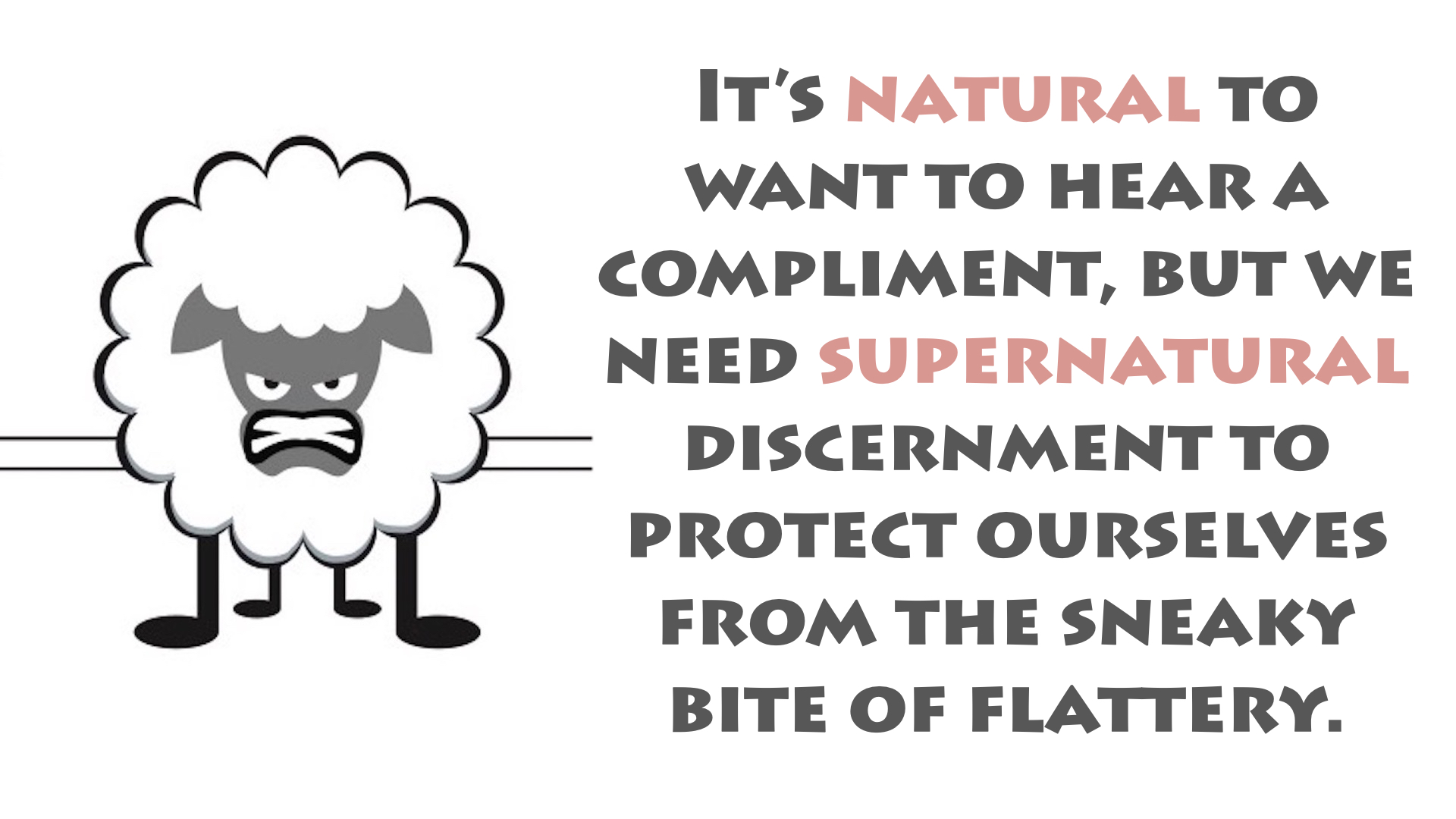
It’s natural to want to hear a compliment, but we need supernatural discernment to protect ourselves from the sneaky bite of flattery.
Look how Jesus did this in Mark 10:17-18. Remember the Amplified Bible that laid it on so thick? Jesus responded correctly: “There is no one essentially and perfectly morally good—except God alone” (v. 18). If we are going to do any comparing at all, let’s compare ourselves to our perfect God and Savior. Remember, we have done a self-check (Psalm 26:2) so we know what’s really there!
Swallowing this flattery only fuels the pride inside us. C.S. Lewis warned, “It was through Pride that the devil became the devil; it is the complete anti-God state of mind. … Pride is a spiritual cancer: it eats up the very possibility of love, or contentment, or even common sense.”
Look at the other example from Jesus in Mark 12:12-15. When Jesus sensed their flattery, He called it what it was: hypocrisy!
Flattery makes you feel like you’re on top of the world. Flattery makes you forget the things the Holy Spirit has revealed to you that needs work. But Jesus asked, “What do you benefit if you gain the whole world but lose your own soul?” (Mark 8:36 NLT).
The sincerest compliment we should all be living to hear is, “Well done, good and faithful servant! Enter into your Master’s happiness forever and ever!” No other voice matters!
Check out the other messages in this series called When Sheep Bite Sheep by clicking here. And if you are a pastor, check out my book When Sheep Bite.
Timothy D. Padgett asks, “Is there such a thing as Judeo-Christianity?” This is an interesting read, but I especially liked this passage: “This is key. When we speak of Judeo-Christianity, we’re not talking about salvation. We are talking about philosophy, even worldview. A Christian worldview must be just that: Christian. A faithful Jew apart from Christ is no more saved than a devout Muslim or an honest atheist, and any philosophy that leaves out the Incarnation will lack its ultimate hope.”
“A human being without a friend is like a beast: for he lacks someone with whom he can share his joy in prosperity and his sadness in adversity, to whom he may unburden his mind when he is preoccupied, with whom he may talk whenever he has had a particularly sublime or illuminating insight…That person is completely alone who has no friend.” —Aelred of Rievaulx
John Stonestreet and Dr. Glenn Sunshine point out that there are some “who believe that AI is a vehicle through which trans-dimensional, non-human intelligences are communicating with us.” Their post is called The Rise of Technopaganism. Of course, this is nothing new: The apostle Paul addressed mankind creating its own god and worshiping it, just as some are now doing with AI.
“It’s better to look ahead and prepare than to look back and regret.” —Jackie Joyner-Kersee
Listen to the podcast of this post by clicking on the player below, and you can also subscribe on Apple, Spotify, or Audible.
Christians should always be striving for a win-win in our relationships. If we try to “win” at the expense of other saints, we all end up losing. So it boils down to this: It’s either a win-win or it’s a lose-lose—there are no other options in God’s Kingdom.
If you would like to watch the full sermon that this clip came from, you can find it here.
You may also be interested in these related posts:
The word gospel simply means the good news about the salvation that comes only through Jesus.
Paul loves this word!
Interestingly, although we refer to the first four books of the New Testament as “The Gospels,” the word itself barely appears:
Matthew—4 times
Mark—8 times
Luke—0 times
John—0 times
And even though these four opening books are the Gospels about Jesus, He Himself only uses the word nine times, with the other three times attributed to someone else mentioning what Jesus was doing.
Peter only uses this word twice (Acts 15:7; 1 Peter 4:17). And John uses it just once (Revelation 14:6).
Paul, however, uses this word 64 times!
It becomes such a part of who he is and how he thinks, that he calls it “my gospel” twice (Romans 2:16, 16:25) and “our gospel” three times (2 Corinthians 4:3; Colossians 1:23; 2 Thessalonians 2:14).
For Paul and for us this Good News is—
God’s promises fulfilled
salvation power
the fullness of God’s blessing
the opening of mysteries
the guide for godly living
glorious light
the expression of God’s grace
the standard of all truth
a key part of the Christian’s spiritual armor
the empowerment for ministry
the anchor of unshakable hope
the means by which we experience Christ’s glory
the only door to life and immortality
For those of us who have been called to preach this Gospel, these thoughts should both humble and empower.
For those of us who have been saved by believing this Gospel, these thoughts should cause us to desire to know more, and more, and more about our Savior.
Listen to the podcast of this post by clicking on the player below, and you can also subscribe on Apple, Spotify, or Audible.
Far too many leaders spend more time making sure things look good on the outside than they do addressing whether things are good on the inside. Of course, I’m talking about issues like character, and humility, and servant-mindedness.
Greg and I addresses this on a recent episode of our leadership podcast The Craig and Greg Show.



 Why do you love the power? Servant leaders love what their leadership role allows them to do for other people.





 Craig T. Owens