15 More Quotes From “Run Today’s Race”

Oswald Chambers’ book Run Today’s Race was originally published as a thought-a-day calendar. Here are a few more short, thought-provoking quotes.

“When we say ‘Thy will be done,’ do we say it with a sigh? If so, we have never realized that the character of God is holy love; nothing can ever happen outside His purposeful will.”

“‘Why does God bring thunderclouds and disasters when we want to green pastures and still waters?’ Bit by bit we find, behind the clouds, the Father’s feet; behind the lightning, an abiding day that has no night; behind the thunder, ‘a still small voice’ that comforts with a comfort that is unspeakable.”

“Beware of interpreting Scripture in order to make it suit a pre-arranged doctrine of your own.”

“The New Testament view of a Christian is that he is one in whom the Son of God has been revealed, and prayer deals with the nourishment of that life.”

“In order to be able to wield the Sword of the Spirit, which is the Word of God, we must obey, and it takes a courageous heart to obey.”

“The Bible talks plentifully about joy, but it nowhere talks about a ‘happy Christian.’ Happiness depends on what happens; joy does not. Remember, Jesus Christ had joy, and He prays ‘that they might have My joy fulfilled in themselves.’”

“If God has made your cup sweet, drink it with grace; if He has made it better, drink it in communion with Him.”

“We must distinguish between the burden-bearing that is right and the burden-bearing that is wrong. We ought never to bear the burden of sin or doubt, but there our burdens placed on us by God which He does not intend to lift off. He wants us to roll them back on Him.”

“The reason we know so little about God’s wisdom is that we will only trust Him as far as we can work things out according to our own reasonable common sense.”

“Take time, strangle some other interests and make time to realize that the center of power in your life is the Lord Jesus Christ and His Atonement.”

“The essence of Christianity is that we give the Son of God a chance to live and move and have His being in us.”

“God rarely rebukes us for our impulsive plans because those plans work their own distress.”

“God will never begin to teach me His will in other matters until I do what I know.”

“‘Ye are the light of the world.’ We have the idea that we are going to shine in heaven, but we are to shine down here ‘in the midst of a crooked and perverse nation’ (Philippians 2:15). We are to shine as lights in the world in the squalid places, and it cannot be done by putting on a brazen smile, the light must be there all the time.”

“Have you ever noticed what Jesus said would choke the Word He puts in? The devil? No, the cares of this world. It is the little worries always. … All our fret and worry is caused by calculating without God.”

Please check out my full book review of Run Today’s Race by clicking here, and the first set of quotes I posted from this book is here.


God Takes Care Of You

“When God pardoned you He gave you His Son. And ‘how shall He not with Him also freely give us all things?’ (Romans 8:32). When a father gives his son the whole orchard, it is absurd for the child to ask for one apple. …

“On the other hand, a wise father may bequeath a huge estate to his child—but not let him control anymore of this inheritance than he can manage properly. In the same way, God gives believers a right to all the comforts of life, but His infinite wisdom proportions out smaller amounts for their actual use according to the needs of each soul. Thus if you should have much less than someone else, this does not mean God loves that person more, but that He cares enough to supply according to your ability to profitably use.” —William Gurnall, in The Christian In Complete Armor

Thursdays With Oswald—Hearing God’s Voice

Oswald ChambersThis is a weekly series with things I’m reading and pondering from Oswald Chambers. You can read the original seed thought here, or type “Thursdays With Oswald” in the search box to read more entries.

Hearing God’s Voice

     Very few of us hear the call of God because we are not in the place to answer. …

     Most of us have no ear for anything but ourselves, anything that is not “me” we cannot hear. We are dead to, and without interest in the finest music, we can yawn in a picture gallery, and be uninspired by a sunrise or a sunset. That is true not only of the soul’s denseness to natural beauties, or to music and art and literature, but true with regard to the awakening of the soul to the call of God. To be brought within the zone of God’s voice is to be profoundly altered. … 

     The call to service is the result of my obedience to the realized call of God. … God does not have to come and tell me what I must do for Him, He brings me into a relationship with Himself wherein I hear His call and understand what He wants me to do, and I do it out of sheer love to Him. To serve God is the deliberate love gift of a nature that has heard the call of God.

From So Send I You

According to Oswald Chambers, we can hear God’s voice clearly when: (a) we make it a priority to remain in His presence, and (b) we listen to God’s voice with an attitude of loving obedience. What do you think?

One thing absolutely clear: responding to God’s voice is always “I get to!” and never “I have to.”

Bill Hybels’ 10 Rules Of Respect

My mind and heart were expanded once again at this year’s Global Leadership Summit! Bill Hybels opened the conference with a call to leaders to promote civility in our areas of influence. Here are a few notes I jotted down.

“The solution to incivility must begin with me.” —Bill Hybels

“Christians do not get to chose whom they will respect [1 Peter 2:17].” —Bill Hybels

Bill Hybels’ 10 rules of respect:

  1. Leaders must set the standard of how to disagree without demonizing the other person.
  2. Leaders must allow spirited conversations without it getting personal.
  3. Leaders must not interrupt others who are talking.
  4. Leaders must limit their volume level and eliminate belittling words.
  5. Leaders must set the example of being courteous.
  6. Leaders must never stereotype.
  7. Leaders must apologize immediately if they are wrong.
  8. Leaders must form opinions carefully.
  9. Leaders must set the example of showing up on time and doing what they say they will do.
  10. Leaders must set rules of respect for the organization and enforce them relentlessly.

Bill Hybels closed with this challenge—“When was the last time I reflected deeply on my own convictions about respecting others?”

A Leader’s Most Powerful Resource

…Sanballat…mocked the Jews… (Nehemiah 4:1).

Sanballat mocked. How did Nehemiah respond to the mocking? He told Sanballat, “                .” Absolutely nothing!

At least he said nothing to Sanballat. But to God Nehemiah prayed, “Hear, O our God, for we are despised; turn their reproach on their own heads” (v. 4).

Once again the bad guys “conspired together to come and attack Jerusalem and create confusion” (v. 8). And once again Nehemiah said nothing to the conspirators; “nevertheless we made our prayer to our God” (v. 9).

When the gossip and rumors about the conspirators begin to discourage the Israelites, Nehemiah redirected them back to God: “Do not be afraid of them. Remember the Lord, great and awesome” (v. 14).

Even when the opposition was internal—with those who were looking out for themselves only and taking advantage of their brothers—Nehemiah again called them to look to God: “Should you not walk in the fear of our God?” (5:9).

Indeed, because of Nehemiah’s own example of the fear of the Lord, he had the moral authority to call them out, and to ask God for His blessing (vv. 14-19).

Whatever criticism or opposition Nehemiah faced, his first response was to turn to God.

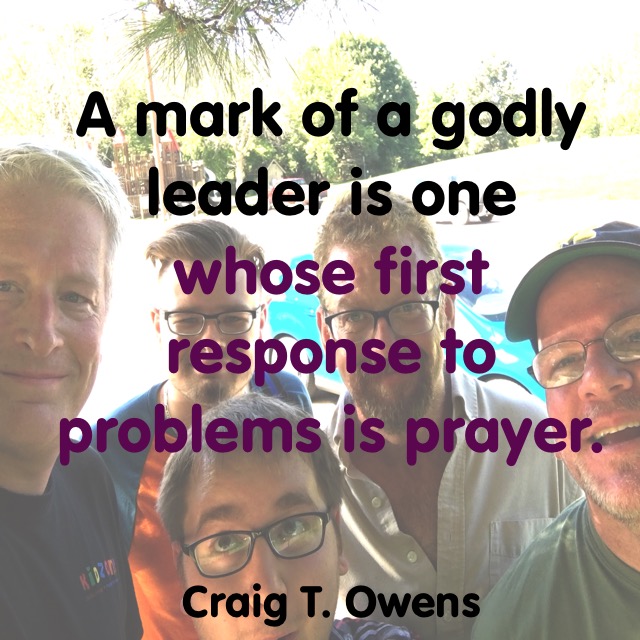
A mark of a godly leader is one whose first response to problems is prayer.

This is Part 6 in my series on godly leadership. To read my other posts, please click here.

Praying For Muslims (book review)

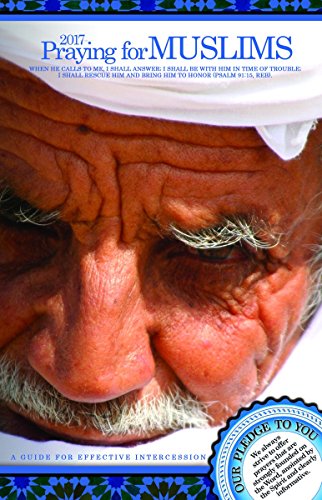
During 2017 I wanted to spend more time in prayer for our Muslim friends around the world, that they would accept Jesus as their Lord and Savior. My prayer guide every Friday afternoon this year has been Praying For Muslims by Sobhi Malek.

This book has opened my eyes and ears, and softened my heart, for Muslims. Each Friday I read a short, informative devotional that gives me greater insight into the Islamic community, and then I use the included prayer as a way to ask God to shine the light of His Son Jesus into dark places around the globe.

Sobhi Malek reminds us:

“This warfare is not against people of any religion or affiliation. Christ, who died for all human beings, instructed us to love our neighbors. Rather, this war is against the evil powers which control people and hinder them from seeing the light of the Gospel of Christ (Ephesians 6:12). In other words, we are warring against satan who ‘has blinded the minds of unbelievers.’ His goal is to keep people from seeing ‘the light of the Gospel of the glory of Christ, who is the image of God’ (2 Corinthians 4:4). When we pray and ask others to pray, this does not mean that we feel superior. We do not think we are better than Muslims or any other people.  Rather, we believe we are fallen human beings like all others, but we have been saved by God’s grace.”

I urge Christians everywhere to get a copy of this book and join other prayer warriors around the world in this concerted effort to see a revival breakout in Muslim strongholds.

“What Is Meant By Following Jesus?”

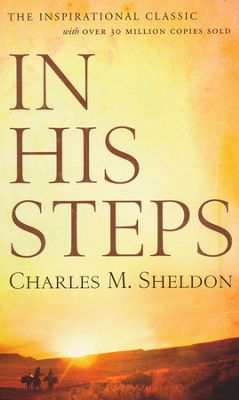
Charles Sheldon wrote an eye-opening, heart-challenging book in 1896 entitled In His Steps. From this book came the well-known phrase “What would Jesus do?”

In this book, Pastor Henry Maxwell challenges his congregation to ask this question regarding everything they do throughout their day. One skeptical man asked this pointed question: what is meant by following Jesus?

“I’ve tramped through this city for three days trying to find a job; and in all that time I’ve not had a word of sympathy or comfort except from your minister here, who said he was sorry for me and hoped I would find a job somewhere. 

“Of course, I understand you can’t all go out of your way to hunt up jobs for other people like me. I’m not asking you to; but what is meant by following Jesus? Do you mean that you are suffering and denying yourselves and trying to save lost, suffering humanity just as I understand Jesus did? What do you mean by it? 

“I see the ragged edge of things a good deal. My wife died four months ago. I’m glad she is out of trouble. My little girl is staying with a printer’s family until I find a job. Somehow I get puzzled when I see so many Christians living in luxury and remember how my wife died in a tenement in New York City, gasping for air and asking God to take the little girl too. Of course I don’t expect you people can prevent everyone from dying of starvation, lack of proper nourishment, and tenement air, but what does following Jesus mean? A member of a church was the owner of the tenement where my wife died, and I have wondered if following Jesus all the way was true in his case. 

“It seems to me there’s an awful lot of trouble in the world that somehow wouldn’t exist if all the people who sing your songs went and lived them out. I suppose I don’t understand. But what would Jesus do? It seems to me sometimes as if the people in the big churches have good clothes and nice houses to live in, and money to spend for luxuries, while the people outside the churches, thousands of them, I mean, die in tenements, and walk the streets for jobs, and grow up in misery and drunkenness and sin.”

So for you, what does it mean if you say you are following Jesus?

The Q Series—The Bible

Our annual Q Series is where folks send their questions to me on a variety of subjects and we do our best to answer them. This week many of the questions were about the Bible. Questions like:

  • What books should be included in the Bible?
  • What about Bible translations?
  • Is it okay for the Bible to have pictures in it?

Here’s what we discussed, along with the time this discussion appears on the video:

  • How was it decided what books would be included in the New Testament? [5:38] **Be sure to check out this post: How We Got The Bible on Biblegateway.
  • J. Warner Wallace’s list of criteria for New Testament books [9:45]
  • Did contemporary sources support or refute the New Testament authors? [11:45]
  • How did the final 27 books of the New Testament make the list? [15:02]
  • How was it decided what books would be included in the Old Testament? [18:22]
  • Evidence presented by the Apostle Paul [20:31]
  • How do we know the Scriptures were accurately transcribed? [22:50] **Be sure to check out this post: Why Trust The Bible? on Biblegateway.
  • The history surrounding the complete Latin Bible and the Dead Sea Scrolls [23:45]
  • What are Bible translations and paraphrases (with references to the Wycliffe Bible and the discovery of the Rosetta Stone)? [25:45]
  • Some cautions about Bible paraphrases [33:23]
  • Is it okay for a Bible to have pictures in it? [35:16]
  • Are icons of the Cross acceptable or a blasphemy? [37:42]
  • How can someone better understand the Bible when they read it for themselves? [41:32]
  • Why ask questions? [48:39]

We’ll be discussing more questions this upcoming Sunday, so be sure to send them my way. For all of the ways you can send questions, please click here.

9 More Quotes From “Marching Off The Map”

Tim Elmore’s insights on the youth culture are amazing. To synthesize such great insights he obviously needs to read lots and lots of research. In all of his books, Dr. Elmore freely shares the cream-of-the-crop quotes he’s uncovered in his research. Here are a few of those quotes which I appreciated.

“In the modern world we have invented ways of speeding up invention, and people’s lives change so fast that a person is born into one kind of world, grows up in another, and by the time his children are growing up, lives in still a different world.” —Margaret Mead

“We are morphing so fast that our ability to invent new things outpaces the rate we can civilize them.” —Kevin Kelly

“I beseech you to treasure up in your hearts these my parting words: Be ashamed to die until you have won some victory for humanity.” —Horace Mann

“The greatest gifts we can give our children are the roots of responsibility and the wings of independence.” —Denis Waitley

“Strangely, the world seems to be growing both more charitable and more selfish at the same time. I have a lot of faith that our children’s generation has the potential to rise to the unimaginable challenges that lie ahead. But at this fascinating crossroads in human history there’s also a sense that a traditional worldview and ethic will come under increasing assault in the western world.” —Chris Arias 

“[Generation Z] are the most connected, educated and sophisticated generation in history. They don’t just represent the future, they are creating it.” —Mark McCrindle

“In every society since the start of history, whenever you broke down any population this way, you’d always get a pyramid. But from 1960-2060, our pyramid will turn into a rectangle. We’ll have almost as many Americans over age 85 as under age 5. This is the result of longer lifespans and lower birthrates. It’s uncharted territory, not just for us, but for all of humanity. And while it’s certainly good news over the long haul for the sustainability of the earth resources, it will create political and economic stress in the short-term, as smaller cohorts of working age adults will be hard-pressed to finance the retirements of larger cohorts of older ones.” —Paul Taylor, Pew Research Center

“We are now at a point where we must educate our children in what no one knew yesterday, and prepare our schools for what no one knows yet.” —Margaret Mead

“The military tells us we must offer diversity training, but it seems to me what our sailors most need is unity training. How can we mesh our differences into a single unit and get results?” —Navy Captain Michael Abrashoff

Check out my review of Marching Off The Map by clicking here. And read some of Tim Elmore’s quotes which I shared here. I will be sharing more quotes from this book soon, so stay tuned!

A.W. Tozer On Reading Well

“To confine our reading to the works of a few favorite authors of today or last week is to restrict our horizons and to pinch our souls dangerously.” …

“To think without a proper amount of good reading is to limit our thinking to our own tiny plot of ground. The crop cannot be large. …

“Extensive reading without the discipline of practical observation will lead to bookishness and artificiality. Reading and observing without a great deal of meditating will fill the mind with learned lumber that will always remain alien to us. Knowledge to be our own must be digested by thinking.” …

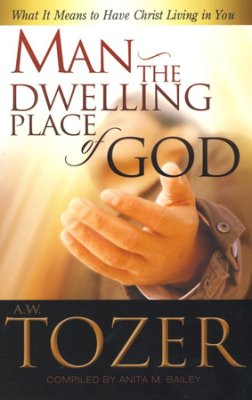
“The best book is not one that informs merely, but one that stirs the reader up to inform himself. The best writer is not one that goes with us through the world of ideas like a friendly guide who walks beside us through the forest pointing out to us a hundred natural wonders we had not noticed before.” —A.W. Tozer, in Man—The Dwelling Place Of God