11 Quotes From Important Islam Booklets

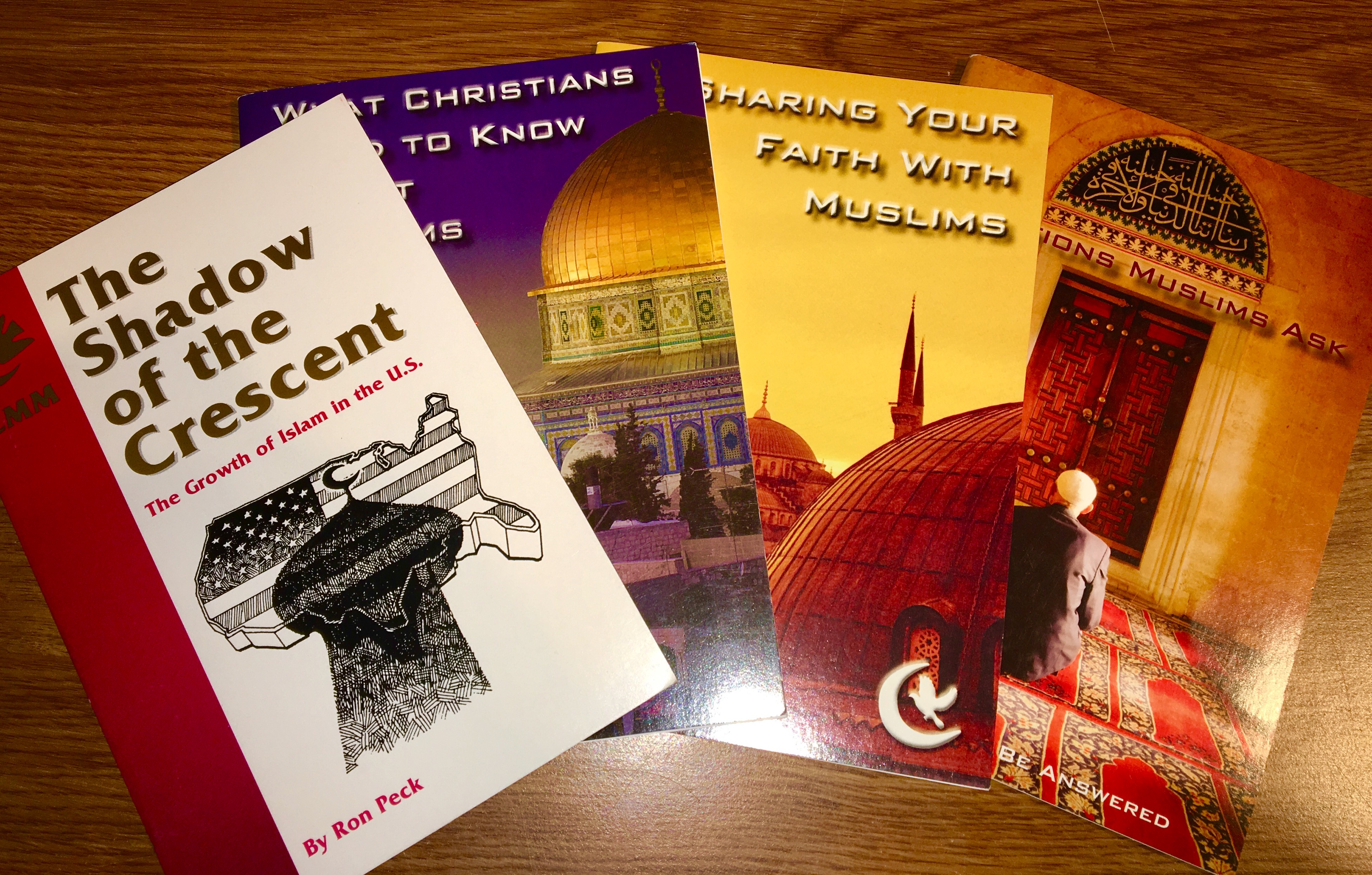
I recently read four very insightful booklets on how Christians can best prepare themselves to share their faith in Jesus with their Muslim neighbors. You can read my complete review of these booklets by clicking here. Below are just a few quotes that caught my attention.

“‘America’s mosques are loaded with people who grew up in church’ [says Carl Ellis]. Ellis says that many converts to Islam are African-American males who see traditional churches as male unfriendly and as failing to address their real needs.”

“God is bringing thousands of Muslim immigrants to our shores every year. These people are coming from Islamic nations where they could not be evangelized before. Yet here in America, they are free to listen and respond to the Gospel. In this ‘land of the free’ they do not have to fear horrible consequences if they believe the gospel and accept Jesus Christ as their Savior.”

“Our hearts should be increasingly burdened not only by the enormous spiritual need of the 1.4 billion Muslims, but also by the apathy of the missionary movement towards them. …  Instead of being evangelized, Muslims are evangelizing. …

“It is reported that Muslims are counting on Europe, the birthplace of the Reformation and the modern missionary movement, to become completely Islamic within the next few decades. In England more than 300 closed churches have been converted into mosques. … Muslims are now a majority in 44 countries of the world.”

“When you are discussing the Bible with the Muslim, it is important that you read the Bible verses in context. The Muslim has developed an intricate system of ‘abrogation’ or substitution of one verse for another, due to the random way the Qur’an is written. He will have a tendency to try to find verses in the Bible that ‘contradict’ each other. Anyone witnessing to a Muslim must know the Scriptures thoroughly and be able to lead the Muslim to understand the meaning of passages in relation to the setting in which they are found.”

“The Muslim will be impressed with a Christian’s words only if he experiences genuine friendship from the Christian and sees him living a consistent moral life. A Christian’s lifestyle must match his testimony.”

“It is better to win the Muslim as a friend than to win an argument and lose his friendship.”

“Christians should be aware that Muslims are people who seek after God!”

“Here, surely, is a key to witnessing to Muslims, both in the United States and around the world: Love them as Jesus loves us. … You must give your SELF to your Muslim friend—not just the gospel!”

“A cardinal rule is: Never become involved in arguments—especially theological ones! Nominal and even irreligious Muslims often become fanatical advocates of their faith when pushed by argument. The truth is: We have argued and debated for hundreds of years without success. Let us now become witnesses—not debaters!”

“No religion on the face of the earth deals with forgiveness of sins except Christianity. … The concept of God as a loving Heavenly Father is completely foreign to a Muslim. … Show him from the Bible how God has provided a way whereby all sins can be forgiven, and every trace of guilt can be completely removed. This is a very powerful tool in witnessing.”

“One way the power of the Holy Spirit is demonstrated is through physical healing. If your Muslim friend or a member of his family is sick, offer to go and pray for him. He will deeply appreciate your concern, and when the person is healed, this demonstration of the Holy Spirit’s power will be convincing—often the key to his accepting Christ as Savior and Lord.” 

Some other helpful resources on this topic are two books from Nabeel Qureshi: Seeking Allah, Finding Jesus and Answering Jihad. Also, check out Praying For Muslims.
Tuning Out Enemies

“…they thought to do me harm”Nehemiah

Nehemiah had enemies on almost every side as he attempted to complete his work (the rebuilding of the wall around Jerusalem). Check out his enemies’ strategy and his response to them—

Enemy’s tactic #1—Get Nehemiah preoccupied with attending meaningless meetings.

Nehemiah’s response—“I’m doing a great work; I can’t come down. Why should the work come to a standstill just so I can come down to see you?”

Enemy’s tactic #2—Send out letters slandering Nehemiah.

Nehemiah’s response—“There is no truth in any part of your story. You are making up the whole thing.” Then he prayed, “God, give me strength.”

Enemy’s tactic #3—Try to scare Nehemiah into running away.

Nehemiah’s response—“Should someone in my position run from danger? I know that God wouldn’t like that.”

Nehemiah had a vision from God and he stayed focused on that.

  • It determined his priority
  • It set his daily agenda
  • It gave him discernment
  • It gave him courage

The result: “When all our enemies heard [that we had completed our project]…they were frightened and humiliated. They realized this work had been done with the help of our God.”

A mark of a godly leader is one so focused on God’s plan that he pays no attention to his critics or enemies.

This is Part 7 in my series on godly leadership. To read my other posts, please click here.

Islam Booklets (book review)

Last week I reviewed a book calling Christians to pray for Muslims to come to a personal relationship with Jesus Christ. Prayer must be our first priority. But often times prayer will open the door for us to speak and act in love to share our faith with our Muslim friends.

I recently read a quarter of booklets that I would highly recommend to you—

  • The Shadow Of The Crescent 
  • What Christians Need To Know About Muslims
  • Sharing Your Faith With Muslims
  • Questions Muslims Ask

These booklets will help you understand the mindset of Muslims, learn more about the questions Muslims ask of Christians, some thoughtful ways to answer those questions, and the lifestyle that will be the most appealing for Muslims to open their hearts to Christians.

In one of the booklets, Ron Peck says, “It is our prayer that this knowledge [in these booklets] will encourage true believers in Jesus to reach out in love and share the life-changing gospel of Christ with Muslims God has brought to our shores. We also pray it will challenge Christ’s followers to take a stand against the missionary efforts of Islamic governments overseas as they endeavor to Islamize our nation.”

Given the fact that about 15 percent of all U.S. immigrants each year are followers of Islam, and that most statisticians agree that in the United States there are about 25,000 converts to Islam every year, now is the optimal time for Christians to be prepared to share their faith in Jesus with their Muslim neighbors.

Shortcut To Second Mile

Tim Elmore is always suggesting ways to help those who work with students—parents, teachers, coaches, youth workers—to more effectively interact with young people.

Many of us (adults and students) struggle with wanting things to happen NOW! As a result, we tend to look for shortcuts. Dr. Elmore suggests that a “second mile” mindset will serve us all better. Check this out:

“In order to move from the ‘shortcut’ mindset to the ‘second mile’ mindset, let me suggest these shifts:

Stop Asking Shortcut Questions…

  1. What can I get by with?
  2. What meets ‘expectations’?
  3. How little can I study and still pass?
  4. What can I get out of this job?
  5. Is my behavior justifiable?
  6. Is there an easier way to do this?

Start Asking Second Mile Questions…

  1. What would surprise my supervisor?
  2. What would ‘excellent’ look like?
  3. How much can I study to improve?
  4. What can I give to this job?
  5. Is my behavior helpful to others?
  6. Is there a better way to reach the goal?”

If you are leading students today, I would highly recommend you check out Dr. Elmore’s latest book Marching Off The Map.

The Q Series—Parables, End Times, And Prayer

Our annual Q Series is where folks send their questions to me on a variety of subjects and we do our best to answer them. This week we tackled questions like:

  • What does Christ’s Parable of the Sower mean?
  • Can people lose their salvation?
  • Are micro-chips implanted in humans the start of “the mark of the beast”?
  • What does “666” stand for?
  • Why aren’t all of my prayers answered?

Here’s what we discussed, along with the time this discussion appears on the video:

  • The Parable of the Sower [1:27]
  • What is a parable? [2:19] **Be sure to check out What Was Jesus Teaching In The Parables? on Biblegateway
  • Who is the farmer in this parable? [4:30]
  • “The best commentary on Scripture is Scripture” [5:14]
  • Can someone lose their salvation? [7:42]
  • Keep sowing seed [11:51]
  • Eternal security? [13:50]
  • The Scripture has “a lot of faces” [17:20]
  • Are micro-chips “the mark of the beast”? [20:37]
  • What is gematria? How does this fit with 666? [22:58]
  • 666 falls short of God’s perfection [25:54]
  • The antichrist is a parody of Jesus Christ [26:08]
  • What is the significance of 666 on the right hand and forehead? [27:31]
  • To understand the future, look to an historic event [29:05]
  • A lesson from the socialism of the Nazis and Adolf Hitler [29:49]
  • A quote from Dr. Erwin Lutzer [31:15]
  • Why did Jesus talk about material possession so much? [32:48]
  • Why aren’t all my prayers answered? [36:36] **Be sure to check out Praying With Authority on Biblegateway.
  • How do we pray “in Jesus’ name”? [37:07]
  • How did Jesus speak to His Father in prayer? [39:10]
  • James on unanswered prayers [41:32]
  • Perseverance in prayer [43:30]

We will be answering your questions one more time next Sunday. Please click here to find all the ways you can submit your questions.

15 More Quotes From “Run Today’s Race”

Oswald Chambers’ book Run Today’s Race was originally published as a thought-a-day calendar. Here are a few more short, thought-provoking quotes.

“When we say ‘Thy will be done,’ do we say it with a sigh? If so, we have never realized that the character of God is holy love; nothing can ever happen outside His purposeful will.”

“‘Why does God bring thunderclouds and disasters when we want to green pastures and still waters?’ Bit by bit we find, behind the clouds, the Father’s feet; behind the lightning, an abiding day that has no night; behind the thunder, ‘a still small voice’ that comforts with a comfort that is unspeakable.”

“Beware of interpreting Scripture in order to make it suit a pre-arranged doctrine of your own.”

“The New Testament view of a Christian is that he is one in whom the Son of God has been revealed, and prayer deals with the nourishment of that life.”

“In order to be able to wield the Sword of the Spirit, which is the Word of God, we must obey, and it takes a courageous heart to obey.”

“The Bible talks plentifully about joy, but it nowhere talks about a ‘happy Christian.’ Happiness depends on what happens; joy does not. Remember, Jesus Christ had joy, and He prays ‘that they might have My joy fulfilled in themselves.’”

“If God has made your cup sweet, drink it with grace; if He has made it better, drink it in communion with Him.”

“We must distinguish between the burden-bearing that is right and the burden-bearing that is wrong. We ought never to bear the burden of sin or doubt, but there our burdens placed on us by God which He does not intend to lift off. He wants us to roll them back on Him.”

“The reason we know so little about God’s wisdom is that we will only trust Him as far as we can work things out according to our own reasonable common sense.”

“Take time, strangle some other interests and make time to realize that the center of power in your life is the Lord Jesus Christ and His Atonement.”

“The essence of Christianity is that we give the Son of God a chance to live and move and have His being in us.”

“God rarely rebukes us for our impulsive plans because those plans work their own distress.”

“God will never begin to teach me His will in other matters until I do what I know.”

“‘Ye are the light of the world.’ We have the idea that we are going to shine in heaven, but we are to shine down here ‘in the midst of a crooked and perverse nation’ (Philippians 2:15). We are to shine as lights in the world in the squalid places, and it cannot be done by putting on a brazen smile, the light must be there all the time.”

“Have you ever noticed what Jesus said would choke the Word He puts in? The devil? No, the cares of this world. It is the little worries always. … All our fret and worry is caused by calculating without God.”

Please check out my full book review of Run Today’s Race by clicking here, and the first set of quotes I posted from this book is here.

God Takes Care Of You

“When God pardoned you He gave you His Son. And ‘how shall He not with Him also freely give us all things?’ (Romans 8:32). When a father gives his son the whole orchard, it is absurd for the child to ask for one apple. …

“On the other hand, a wise father may bequeath a huge estate to his child—but not let him control anymore of this inheritance than he can manage properly. In the same way, God gives believers a right to all the comforts of life, but His infinite wisdom proportions out smaller amounts for their actual use according to the needs of each soul. Thus if you should have much less than someone else, this does not mean God loves that person more, but that He cares enough to supply according to your ability to profitably use.” —William Gurnall, in The Christian In Complete Armor

Thursdays With Oswald—Hearing God’s Voice

Oswald ChambersThis is a weekly series with things I’m reading and pondering from Oswald Chambers. You can read the original seed thought here, or type “Thursdays With Oswald” in the search box to read more entries.

Hearing God’s Voice

     Very few of us hear the call of God because we are not in the place to answer. …

     Most of us have no ear for anything but ourselves, anything that is not “me” we cannot hear. We are dead to, and without interest in the finest music, we can yawn in a picture gallery, and be uninspired by a sunrise or a sunset. That is true not only of the soul’s denseness to natural beauties, or to music and art and literature, but true with regard to the awakening of the soul to the call of God. To be brought within the zone of God’s voice is to be profoundly altered. … 

     The call to service is the result of my obedience to the realized call of God. … God does not have to come and tell me what I must do for Him, He brings me into a relationship with Himself wherein I hear His call and understand what He wants me to do, and I do it out of sheer love to Him. To serve God is the deliberate love gift of a nature that has heard the call of God.

From So Send I You

According to Oswald Chambers, we can hear God’s voice clearly when: (a) we make it a priority to remain in His presence, and (b) we listen to God’s voice with an attitude of loving obedience. What do you think?

One thing absolutely clear: responding to God’s voice is always “I get to!” and never “I have to.”

Bill Hybels’ 10 Rules Of Respect

My mind and heart were expanded once again at this year’s Global Leadership Summit! Bill Hybels opened the conference with a call to leaders to promote civility in our areas of influence. Here are a few notes I jotted down.

“The solution to incivility must begin with me.” —Bill Hybels

“Christians do not get to chose whom they will respect [1 Peter 2:17].” —Bill Hybels

Bill Hybels’ 10 rules of respect:

  1. Leaders must set the standard of how to disagree without demonizing the other person.
  2. Leaders must allow spirited conversations without it getting personal.
  3. Leaders must not interrupt others who are talking.
  4. Leaders must limit their volume level and eliminate belittling words.
  5. Leaders must set the example of being courteous.
  6. Leaders must never stereotype.
  7. Leaders must apologize immediately if they are wrong.
  8. Leaders must form opinions carefully.
  9. Leaders must set the example of showing up on time and doing what they say they will do.
  10. Leaders must set rules of respect for the organization and enforce them relentlessly.

Bill Hybels closed with this challenge—“When was the last time I reflected deeply on my own convictions about respecting others?”

A Leader’s Most Powerful Resource

…Sanballat…mocked the Jews… (Nehemiah 4:1).

Sanballat mocked. How did Nehemiah respond to the mocking? He told Sanballat, “                .” Absolutely nothing!

At least he said nothing to Sanballat. But to God Nehemiah prayed, “Hear, O our God, for we are despised; turn their reproach on their own heads” (v. 4).

Once again the bad guys “conspired together to come and attack Jerusalem and create confusion” (v. 8). And once again Nehemiah said nothing to the conspirators; “nevertheless we made our prayer to our God” (v. 9).

When the gossip and rumors about the conspirators begin to discourage the Israelites, Nehemiah redirected them back to God: “Do not be afraid of them. Remember the Lord, great and awesome” (v. 14).

Even when the opposition was internal—with those who were looking out for themselves only and taking advantage of their brothers—Nehemiah again called them to look to God: “Should you not walk in the fear of our God?” (5:9).

Indeed, because of Nehemiah’s own example of the fear of the Lord, he had the moral authority to call them out, and to ask God for His blessing (vv. 14-19).

Whatever criticism or opposition Nehemiah faced, his first response was to turn to God.

A mark of a godly leader is one whose first response to problems is prayer.

This is Part 6 in my series on godly leadership. To read my other posts, please click here.