The Tactics Of Fear

Listen to the podcast of this post by clicking on the player below, and you can also subscribe on AppleSpotify, or Audible. 

Then the king of Assyria sent his field commander with a large army… (Isaiah 36:2).

The enemies of God’s people always use the same tactics.

(1) Sending an intimidating force that seems overwhelming and invincible. 

King Sennacherib didn’t send a small detachment of soldiers, but he sent “a large army” to try to intimidate the people of Judah. 

(2) Asking doubt-inducing questions. 

The field commander asked questions like…

  • On what are you basing this confidence of yours? 
  • On whom are you depending? 
  • Do you think Jehovah can save you from this? 

(3) Fomenting distrust in God’s wisdom and ability. 

Once the seeds of doubt had been sown, the field commander attempted to water those seeds by making accusations like…

  • Do not let Hezekiah deceive you: God can’t help you with this one! 
  • The gods of other nations didn’t help them, so what makes you think your God will help you? 

(4) Offering a compromise. 

Then came the offer to give in…

  • Come now, make a bargain with my master and I’ll give you more riches than you can imagine! 
  • Make peace with me while you have the chance, and I promise you will have a trouble-free life! 

All of these tactics attempted to play on the fears of people who felt surrounded and overwhelmed. 

But I love to remember that the acrostic of the word F.E.A.R. is False Evidence Appearing Real. The field commander in King Hezekiah’s time, and satan today, use the tactics of fear to try to get us to compromise. 

King Hezekiah gave us a great example to follow. When he received the field commander’s letter with all of the threats listed, he “spread it out before the Lord” (Isaiah 37:14)! Isaiah reminded the people not to be afraid of the threats of the enemy, because those threats were actually blasphemy against God. And then God tells Hezekiah quite simply, “I will take care of this!” 

And God did indeed take care of it. 

Without the armies of Judah ever having to lift a sword or a spear or shield, God broke the power of the enemy and sent them away in shame! 

When the enemy seems to be surrounding you today, he will use these same tactics. He will try to overwhelm you, get you to doubt what God has said, try to induce you to distrust God, and then offer you a compromise. All the devil has on his side is false evidence that he attempts to make look real.

So do what King Hezekiah did: Spread out those threats before God. Go to His Word and read again what He has already promised you. Then stand firm in faith. God will take care of your adversary! 

Our God always gets the final word, the decisive word, and the best word.

Let me repeat it one more time: Don’t give into fear, but stand firm in your faith in God! 

►► Would you please prayerfully consider supporting this ministry? My Patreon supporters get behind-the-scenes access to exclusive materials. ◀︎◀︎
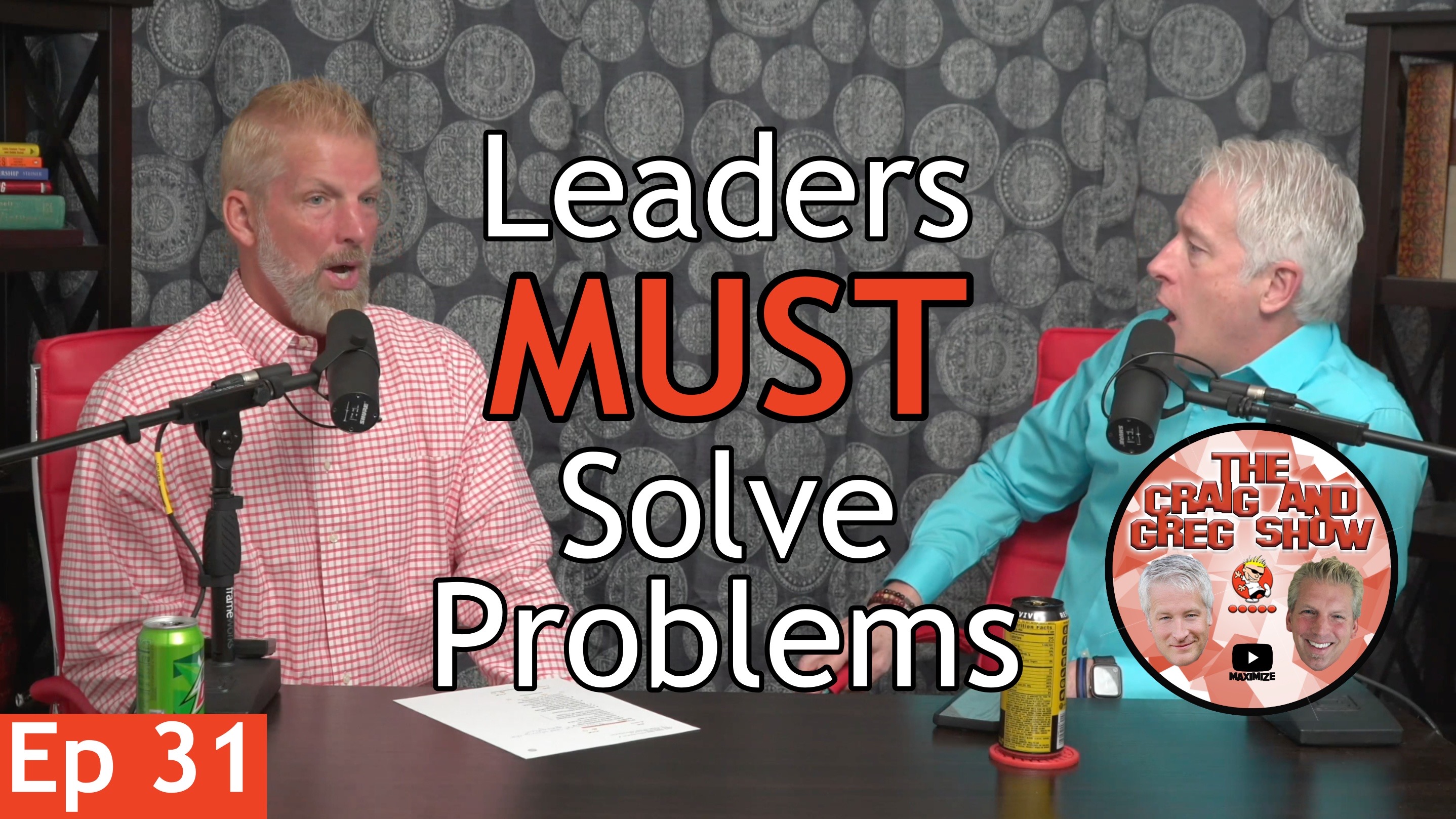
The Craig And Greg Show: The Types Of Problems Leaders Face

Listen to the audio-only version of this podcast by clicking on the player below, or scroll down to watch the video.

On this episode of “The Craig And Greg Show” we talk about: 

  • [0:54] Effective problem solving is a skill every leader should maximize
  • [1:52] Why do leaders choose to avoid problems?
  • [3:03] Greg tells a story about leadership burnout 
  • [4:46] Obvious problems are simple fixes, so don’t delay!
  • [5:57] Who can help you with your complicated problem?
  • [6:40] How should new leaders deal with problems in a transition period?
  • [8:23] What should you do about someone who’s always part of the problem?
  • [9:12] Do you have kids in your river?
  • [10:22] Are you aware of the complexities in the culture of those you lead?
  • [11:52] Leaders must address chaotic issues, no matter the cost
  • [13:16] How can leaders navigate around unchangeable facts? 
  • [14:05] Leaders should scale their response to the immediacy of the issue
  • [14:40] Is your problem obvious, complicated, chaotic, or complex?
  • [15:55] How can your changes as a leader solve problems?
  • [16:28] Do you need to move on without some people?
  • [17:20] Are you a leader of a “problem enjoyer”? 
  • [18:45] Are you asking powerful questions?
  • [20:08] How our our Coaching Huddles can help you grow

Check out this episode and subscribe on YouTube so you can watch all of the upcoming episodes. You can also listen to our podcast on Spotify and Apple.

Was Church Successful This Week?

Listen to the podcast of this post by clicking on the player below, and you can also subscribe on AppleSpotify, or Audible. 

It is quite disheartening for me to hear how many pastors contemplate their resignation on Monday morning. Just one day after pouring out their heart to their congregation, they are thinking about throwing in the towel.

I think one of the major contributing factors to this is our inaccurate measurements of success.

Far too many pastors measure success by noses and nickels: what was the attendance and what was the offering? When either of these dip, pastors tend to feel unsuccessful. 

But no where in the Bible do we see these metrics of success.

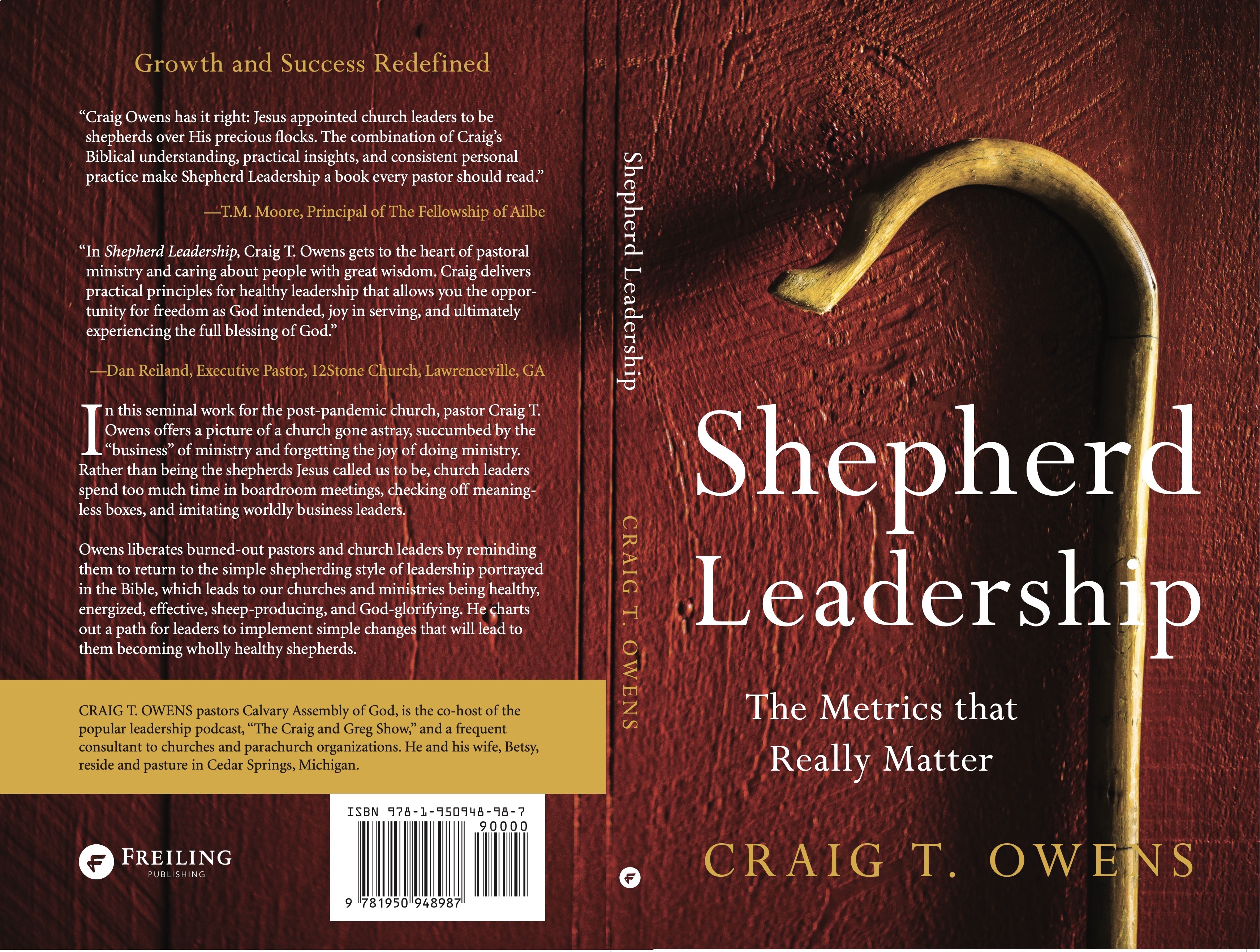
I wrote Shepherd Leadership: The Metrics That Really Matter to help ministry leaders refocus on what God calls success. If you are a pastor—or if you love your pastor—please pick up a copy today.

My book is available in print or ebook, and in audiobook through either Audible or Apple.

The Incomparable Jesus

Listen to the podcast of this post by clicking on the player below, and you can also subscribe on AppleSpotify, or Audible. 

C.S. Lewis, like many atheists, wondered if the God of the Bible might be an egomaniac because He is always encouraging people to praise Him. In his book Reflections on the Psalms, Lewis wrote a thoughtful response to this after he had become a Christian: 

“Just as men spontaneously praise whatever they value, so they spontaneously urge us to join them in praising it. ‘Isn’t she lovely? Wasn’t it glorious? Don’t you think that magnificent?’ … I think we delight to praise what we enjoy because the praise not merely expresses but completes the enjoyment; it is its appointed consummation. It is not out of compliment that lovers keep on telling one another how beautiful they are; the delight is incomplete till it is expressed. … This is so even when our expressions are inadequate, as of course they usually are. But how if one could really and fully praise even such things to perfection—utterly ‘get out’ in poetry or music or pain the upsurge of appreciation which almost bursts you? Then indeed the object would be fully appreciated and our delight would have attained perfect development. The worthier the object, the more intense this delight would be.” 

His phrase, “our expressions are inadequate” is especially true when we are attempting to appreciate and praise the Infinite, the Eternal, the Omnipresence, the Omnipotence of our God and Savior! But the biblical authors call for Christians to mature in this—we want to keep praising, keep expressing, until we finally find the perfect fulfillment in His presence. 

Paul talks about the maturing nature of love—when I was a child, I talked like a child, I thought like a child, I reasoned like a child (1 Corinthians 13:11)—but then he prays for us to grow in both our understanding and our expressions of our Savior’s love (Ephesians 1:17-19). 

I like the wording of Ephesians 1:19 in the King James Version: the exceeding greatness of His power to us-ward. The word “exceeding” means God pours out in a way that is beyond human imagining. The Greek word that Paul uses for “greatness” is only used here, and it reinforces the truth that God is beyond our full comprehension. And then Paul adds that this overflowing, incomparable power is directed “to us-ward”! 

Paul then prays for us to be able to understand ever-increasing new dimensions of this transcendent power and ability that God directs to us through His Son Jesus, and for us to be able to express it (Ephesians 3:14-19). In other words, we are to grow in our experience of Jesus so that we can grow in our praise to Jesus. 

The incomparable Jesus means at least four things for us. It means Jesus is…

  1. …beyond comparison. Isaiah, God Himself, and the psalmists ask rhetorically, “Who is like God? Who could ever compare to Him?” (Isaiah 40:13-14, 18, 25; Psalm 89:5-8).  
  1. …matchless in His power. Isaiah 40:12 says God holds the waters of the world in the hollow of His hand. How much water is this? Scientists estimate the Earth’s water supply to be 326 quintillion gallons of water (that’s 326 followed by 18 zeros)! Not only does God hold all of the water, but He directs its activities on behalf of His children (Exodus 15:11-13). 
  1. …unequaled in knowledge. Isaiah 40:12, 26 tell us that all of the stars in our universe fit onto God’s outstretched hand, and that He knows all of the stars by name. How many stars is this? Astronomers calculate the heavens to contain 10 septillion stars (that’s 10 followed by 24 zeros)! Not only does God know each star by name, He knows each human by name, and the smallest of details about each of them (Isaiah 49:16; Matthew 10:29-31). 
  1. …inimitable in His care. We humans can get to the end of our strength, but God never does. He cares for us unlike anyone else or anything else ever can (Isaiah 40:28-31). The Lord hears His people when they call to Him for help. He rescues them from all their troubles (Psalm 34:17). 

Knowing we have a Savior like this, why would you ever settle for anything less The Genuine?! 

Our incomparable Jesus wants us to pray in His incomparable name so that our incomparable Father can answer in a way that brings Him incomparable glory! We’re helped, He’s lifted up, and others are drawn to Him. 

►► Would you please prayerfully consider supporting this ministry? My Patreon supporters get behind-the-scenes access to exclusive materials. ◀︎◀︎

If you’ve missed any of the messages in this series on prayer, you can find a list of all of the messages by clicking here. 

Poetry Saturday—The Red Flannel Clergy Group

Listen to the podcast of this post by clicking on the player below, and you can also subscribe on AppleSpotify, or Audible.

(A little background for this poem. I live in Cedar Springs, MI, which has been called the Red Flannel Town for years because of the one-piece red flannel long undearwear which was manufactured here. Cedar Springs is also home to one of the most amazing ministerial groups I have ever had the privilege of working with.)

There was a group of clergy from a Red Flannel town
and one of their goals was to lift up people who were down.

And so together in word and deed
bringing people closer to Jesus they did lead.

They worked together even cross-denominationally
and through their partnership, they were as happy as can be!

They were a wonderful and fantastic Christ-centered group
discussing ministry matters monthly over pizza or sometimes soup.

Through laughter, hard work and sometimes even a shed tear
they supported each other and proclaimed the Gospel for all to hear.

The town may have been noted for its Red Flannel zeal,
but it was the work of the clergy that was its greatest appeal. —Rev. Jim Alblas

►► Would you please prayerfully consider supporting this ministry? My Patreon supporters get behind-the-scenes access to exclusive materials. ◀︎◀︎

Links & Quotes

In 1 Timothy 3:1, Paul writes, “This is a faithful saying: If a man desires the position of a bishop [overseer], he desires a good work.” T.M. Moore commented on this verse—

“The Greek word for ‘bishop’ translates literally to ‘overseer.’ Overseers—pastors, elders, anyone in a leadership role in the congregation—is charged with watching over the souls of God’s people for good (Hebrews 13:17; Acts 20:28; 1 Thessalonians 5:12-13). While the primary duty of watching over the Lord’s flock falls on pastors and elders, all who serve with them function in a role of overseeing, that all the members of the congregation might benefit from the continuous care and shepherding of those who lead them.”

I am so grateful for T.M.’s endorsement of my book Shepherd Leadership: The Metrics That Really Matter in which I expound more on this 1 Timothy verse, and talk about how shepherd leaders should be raising up more leaders around them.

Our church purchased a building to use as our new homebase for ministry in our city. I am super excited about the possibilities!

Tiny bacteria declare loudly the genius of the Creator. This new study on the ability of bacterium to protect its own DNA from mutations is fascinating!

Dan Reiland says, “Good character takes a lifetime to build and a moment to destroy.” Dan shares 5 practices that build leadership character to last for a lifetime.

Amenhotep I was the second pharaoh of the 18th dynasty, and ruled from ca 1525-1504 BC during the time the Israelites were slaves in Egypt. Using 3-D CT scans, Amenhotep has been unwrapped for the first time in over 3000 years!

How are you supposed to follow God when obedience feels impossible? John Piper explains in this post

How Does One Write A Book?

Listen to the podcast of this post by clicking on the player below, and you can also subscribe on AppleSpotify, or Audible.

At a Q&A event for my my book Shepherd Leadership: The Metrics That Really Matter, I explained how I started writing this book. The bottom line is you learn to write by writing!

Check it out…

In all seriousness, the process of writing goes something this:

  1. Start writing. 
  2. Write something every day. 
  3. Read your work to others who really care about you. 
  4. Be humble enough to accept honest, loving feedback. 
  5. Use that feedback to improve what you have written. 
  6. Go back to step #1. 

Shepherd Leadership: The Metrics That Really Matter is available in print or ebook, and in audiobook through either Audible or Apple.

►► Would you please prayerfully consider supporting this ministry? My Patreon supporters get behind-the-scenes access to exclusive materials. ◀︎◀︎
Thursdays With Spurgeon—Hypocrites Who Hurt The Church

This is a weekly series with things I’m reading and pondering from Charles Spurgeon. You can read the original seed thought here, or type “Thursdays With Spurgeon” in the search box to read more entries.

Listen to the podcast of this post by clicking on the player below, and you can also subscribe on AppleSpotify, or Audible. 

Hypocrites Who Hurt The Church

Only let your conversation be as it becometh the gospel of Christ (Philippians 1:27 KJV). 

     Dear friends, I might just continue, for the subject is a very wide one. But I stop because, unhappily for me, though perhaps happily for your patience, my time has gone. Having just indicated what the Christian life ought to be, I must, in a few words, plead with you that by the power of God’s Holy Spirit you will seek to make your lives such. I could mention many reasons, but I will only give you one or two. 

     The first is, if you do not live like this, you will make your fellow members who are innocent of your sin, suffer. … It is very hard when [skeptics] can say to you, ‘Look at So-and-So, he is a church member! Look at what he did. You are all a parcel of hypocrites!’ … 

     And then, remember, dear friends, unless your conversation is such, you will pull down all the witness that you have ever borne for Christ. … Oh, the great thing the church needs is more holiness! The worst enemies of the church are not the infidels. … No, the worst enemies of the church are the hypocrites, the formalists, the mere professors, and the inconsistent walkers. …  

     May the Eternal Spirit, Who still winnows His church, blow away the chaff and heave only the good golden wheat upon the floor! And if you know yourselves to be living in any sin, may God help you to mourn over it, to loathe it, to go to Christ about it….

From The Gospel’s Power In A Christian’s Life

I have defined a hypocrite as a Christian who carries the name of Jesus Christ but not the nature of Jesus Christ. 

I remember once when a man who was virtually a stranger to me—but apparently knew that I was a pastor—walked up to me and said, “What do you think about your boy So-and-So?” The So-and-So he mentioned was a prominent pastor in another state who had just been caught doing some very sinful and embarrassing things. This stranger quickly painted me with the same brush! 

The phrase “one another” is so prominent in the New Testament, which means that we truly are all in this together. That’s why Charles Spurgeon warns us that a hypocritical lifestyle is not only damaging to the hypocrite’s life, but to the entire Christian community as well. 

So I also call for every Christian to “examine themselves” (1 Corinthians 11:28) for both known and hidden sins. We ought to regularly ask the Holy Spirit to point them out so that we can repent of them, make restitution, and strengthen the testimony of all Christians everywhere! 

Let me close with a final word from Dwight Moody, “The world finds plenty of difficulties on the way; let us see that we Christians do not add more stumbling-blocks by our un-Christlike walk.” 

To that I add a heartfelt “Amen!”

►► Would you please prayerfully consider supporting this ministry? My Patreon supporters get behind-the-scenes access to exclusive materials. ◀︎◀︎

A Safe Place For Mistakes

Listen to the podcast of this post by clicking on the player below, and you can also subscribe on AppleSpotify, or Audible. 

Josh had just graduated from high school when I came to pastor in Cedar Springs. As I sat with this outstanding young man I asked him what he wanted to do next. 

“I’m not exactly sure,” he told me, “but I really feel like it’s something involved with ministry.” 

“Great!” I responded. “Let’s start experimenting.” 

I told Josh that our church was going to be a safe place to experiment: to plan new things, to try new things, to prayerfully evaluate the results, and then to use those results to plan new things. Josh jumped in right away, and over a short period of time we were eventually able to ascertain just how God had wired Josh for his niche of ministry. 

But this would have never happened without some missteps along the way. 

That’s okay. 

Leaders need to create an environment where it’s safe to make mistakes, because mistakes are a vital component of learning. 

My wife is a 3rd Grade teacher. A bulletin board in her classroom lovingly tells her students, “Our classroom is a safe place to make mistakes,” and then she gives them the keys to their successful learning. 

Leaders can help those around them grow through their mistakes by constantly reinforcing these six principles: 

  1. When someone complains, “This is too hard,” remind them, “This may take some time and effort.” 
  2. When someone says, “I’m not good at this,” prompt them to ask, “What am I missing?” and then encourage them to add, “I’m not good at this yet.” 
  3. When someone wants to settle with, “It’s good enough,” challenge them to ask themselves, “Have I given this my best effort?” 
  4. When someone wants to throw in the towel by saying, “I made a mistake,” remind them, “I failed is not the same thing as I am a failure,” and then remind them, “Mistakes help me learn.” 
  5. When someone is exasperated and says, “I give up,” come alongside them with, “Let’s try a strategy we’ve already learned.” 
  6. When someone says, “I can’t do this,” you need to lovingly encourage them with, “You can do this!” 

These responses will help foster an abundance-mindset environment where people aren’t defeated by their mistakes, but they’re energized to reengage and try again. As the brilliant inventor Thomas Edison quipped, “I’ve had a lot of success with failure.” 

Leaders, let’s make our spaces the safest places for the mistakes that lead to discovery, growth, and success. 

►► Would you please prayerfully consider supporting this ministry? My Patreon supporters get behind-the-scenes access to exclusive materials. ◀︎◀︎

Susanna Wesley (book review)

Listen to the podcast of this post by clicking on the player below, and you can also subscribe on AppleSpotify, or Audible. 

I think most people are familiar with the saying, “Behind every good man there is a good woman.” In the case of Samuel and Susanna Wesley almost the opposite is true: Susanna excelled as a godly mother despite the obstinacy and shortcomings of her husband Samuel. Arnold A. Dallimore delivers a fair overview of their lives in his biography of Susanna Wesley. 

Rev. Dallimore does an admirable job of telling Susanna’s story through the first person accounts of almost all of the Wesley family members. He has culled through the historical records, reading the letters of Samuel, Susanna, their children, and their relatives to give us a fairly unbiased look at this notable family. The subtitle of the book is, “The mother of John and Charles Wesley,” which is no small gift to the world! The preaching and song-writing ministries of these two brothers has had a huge impact on both the secular and church worlds, which is still being felt today. 

Samuel Wesley at times was distant from his family, to the extent of even abandoning them for a period of time, and was a very poor provider for his family. They were constantly in debt and struggling for the basic necessities. But despite these obstacles, Susanna created her own curriculum to instruct her children, and continued to correspond with them into their adulthood to give them her motherly wisdom. 

What a debt of gratitude we owe to this godly woman for not only persevering but thriving in the face of challenges that would have thwarted most people. And we also should be grateful to Arnold Dallimore for his well-researched biography of this amazing woman. 

(I previously reviewed Rev. Dallimore’s biography of George Whitefield.) 

►► Would you please prayerfully consider supporting this ministry? My Patreon supporters get behind-the-scenes access to exclusive materials. ◀︎◀︎