


Listen to the podcast of this post by clicking on the player below, and you can also subscribe on Apple, Spotify, or Audible.
 Right at the beginning of his book of prophecy, Micah asks four penetrating questions—
What is Jacob’s transgression? Is it not Samaria? What is Judah’s high place? Is it not Jerusalem? (Micah 1:5)
Idolatry is the elevation of anyone or anything to a place of adoration. Any place, person, or practice can become my god if I give it more attention than I give Jehovah.
In Micah’s prophetic warning, idolatry had become symbolized by the capitol cities of Samaria and Jerusalem. The people were looking to the leaders and cultural practices in those cities instead of looking to God.
I wonder if we do the same thing today?
- Do we look to Washington DC for political help?
- Do we find our financial wisdom on Wall Street?
- Does the culture of Hollywood inform how we should live?
- Does the music of Nashville determine the song in our hearts?
- Do Harvard, Berkeley, or Stanford tell us how to think?
When I’m in trouble, when I need answers, when I’m looking for comfort, where do I turn first? My first reaction—my go-to source—is a good indication of who my deity is. When Micah became aware of the idolatry of his people, his response was to weep, wail, howl, and moan over their sin (v. 8). This should be our response as well whenever we see idols replacing Jehovah in our heart or in the hearts of others.
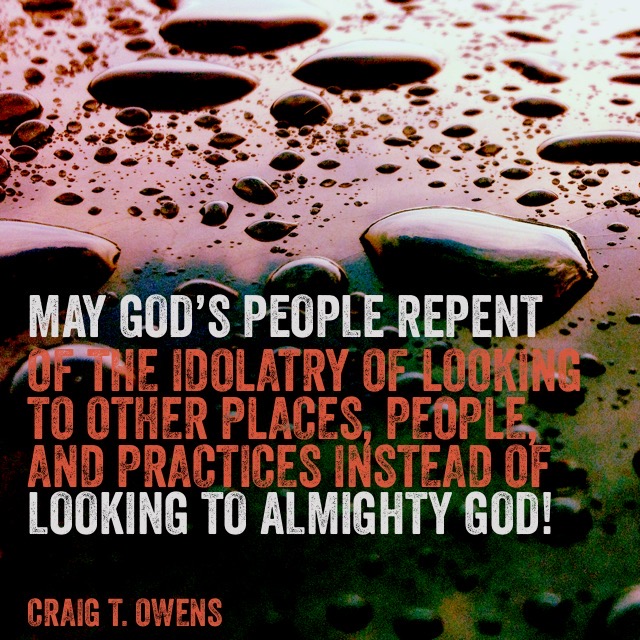
May God’s people repent of the idolatry of looking to other places, people, and practices instead of looking to Almighty God!
►► Would you please prayerfully consider supporting this ministry? My Patreon supporters get behind-the-scenes access to exclusive materials. ◀︎◀︎






 Craig T. Owens
Spurgeon And The Psalms (book review)
June 7, 2022 — Craig T. OwensListen to the podcast of this post by clicking on the player below, and you can also subscribe on Apple, Spotify, or Audible.
After I opened the cover, I was not disappointed. I love the format of each chapter. For each chapter your eyes go to Charles Spurgeon’s commentary first, and then you can read the chapter itself. The reason why I like this layout is because Spurgeon has a tendency to tell us not what the psalmist says, but what we should look for as we read that psalm. This remains true to what Spurgeon himself felt about biblical commentaries.
I always make my Bibles my own. By that I mean that I underline, highlight, circle, and write margin notes throughout my Bible. The wide margins in this book make it ideal to use as a prayer companion. I believe the Bible is not a Book to be read through, but a Book to be prayed through. Nowhere is that more true than in the Psalms, where such deep emotions are poured out in God’s presence, helping us give voice to our deepest prayers.
If you have never read anything from Charles Spurgeon, this is an excellent place to get started. After you have read his insights here, I’m confident that you will want to read more. Even if you are familiar with Spurgeon’s sermons and books, this book is going to be an excellent addition to your library.
I am a member of the Bible Gateway Blogger Grid and I reviewed this book at their invitation.
►► Would you please prayerfully consider supporting this ministry? My Patreon supporters get behind-the-scenes access to exclusive materials. ◀︎◀︎
Share this: