Listen to the podcast of this post by clicking on the player below, and you can also subscribe on Apple, Spotify, or Audible.
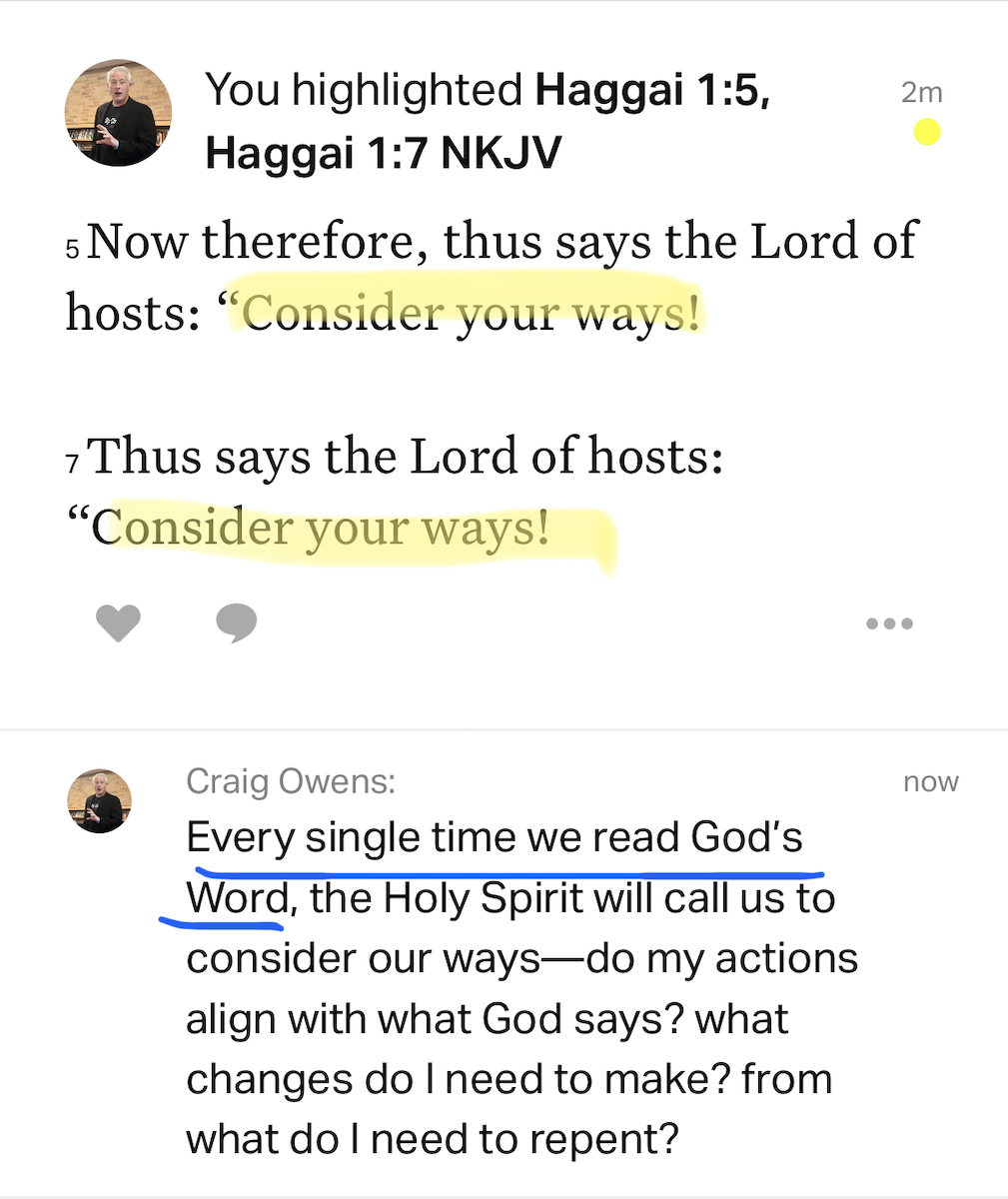
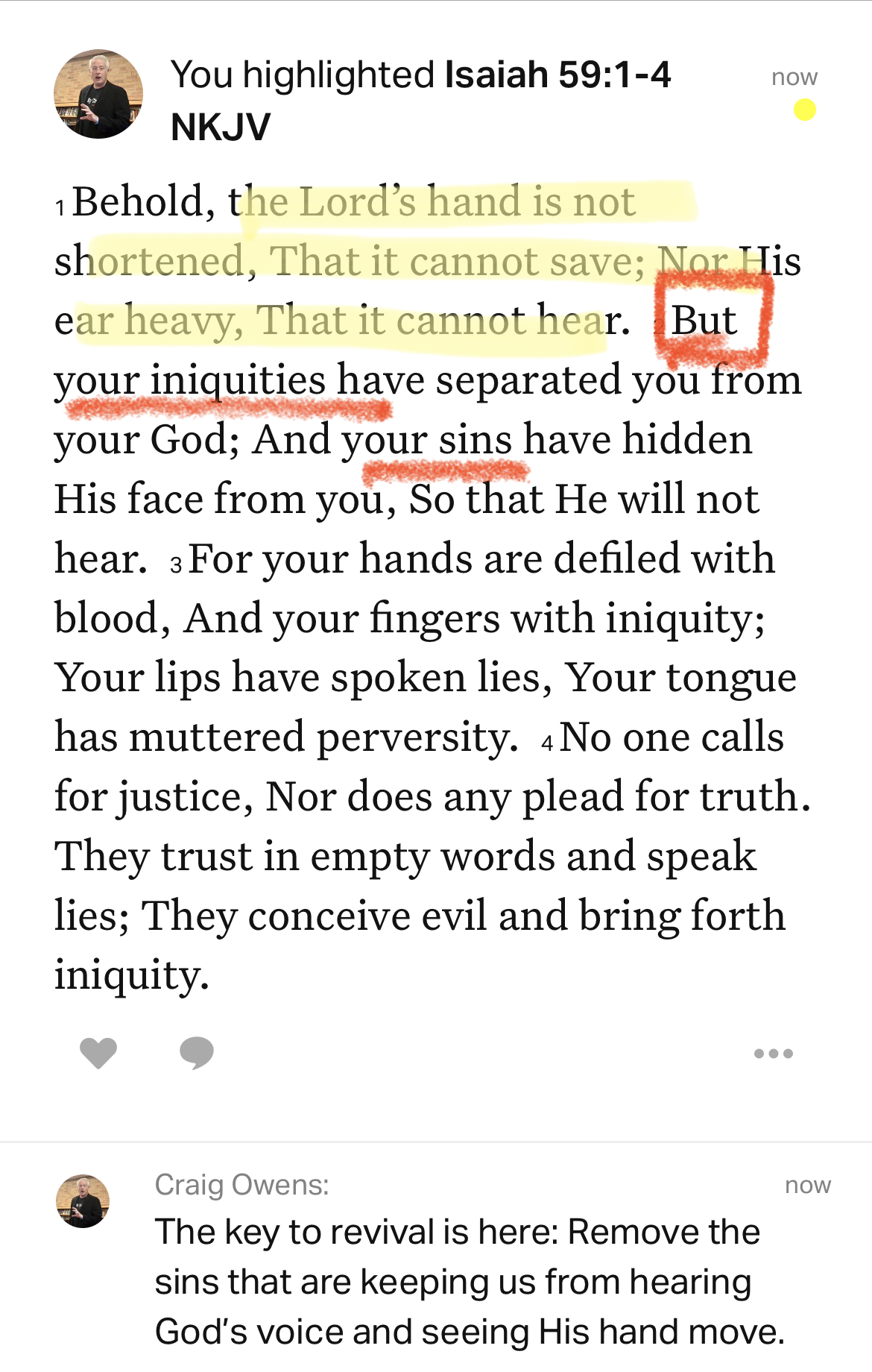
Although the Jews had been released from exile in Babylon to return to their homeland, things still were not going well for them. The prophet Haggai came on the scene and offered this solution from God to their national adversity.
Listen to the podcast of this post by clicking on the player below, and you can also subscribe on Apple, Spotify, or Audible.
“When you become a leader, you lose the right to think about yourself.” —Gerald Brooks
Sadly, I encounter far too many “leaders” (at least they are leaders in title only) who think being a leader means they have more rights. It might be the right to a better parking place, or to be first in line, or to ignore some of the rules that others have to follow.
That certainly wasn’t the attitude of the apostle Paul in 1 Corinthians 9, a chapter which the NIV gives the heading ‘Paul Gives Up His Rights’:
Since we have planted spiritual seed among you, aren’t we entitled to a harvest of physical food and drink? If you support others who preach to you, shouldn’t we have an even greater right to be supported? But we have never used this right. We would rather put up with anything than be an obstacle to the Good News about Christ. (1 Corinthians 9:11-12 NLT)
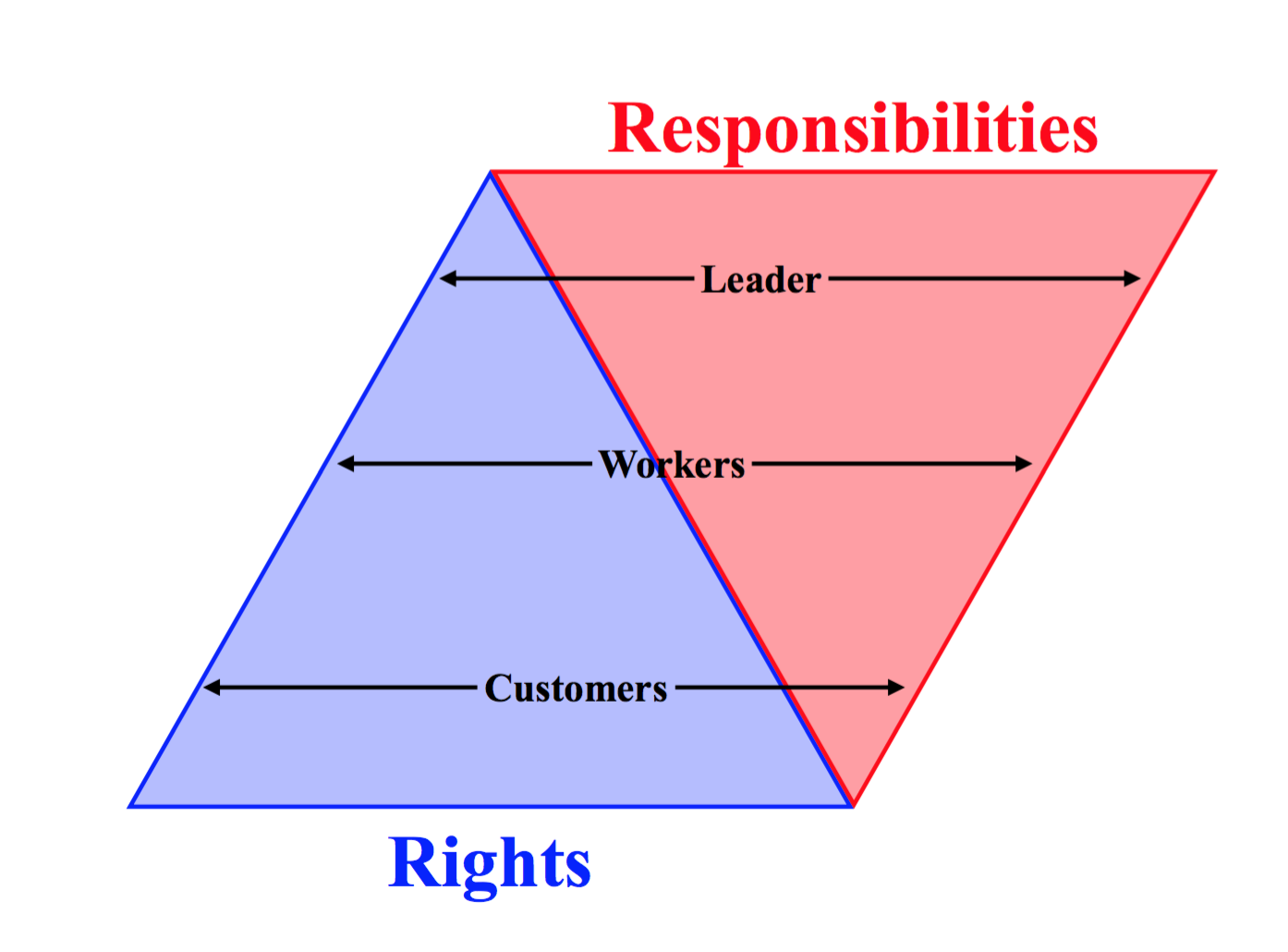
Paul said the natural thing was for those in leadership to feel entitled to certain rights, but the spiritual thing is to turn those rights into responsibilities toward the people around us.
Spiritual leadership is not about gaining more rights, it’s about fulfilling God-given responsibilities. In fact, the higher you progress in a leadership role, the fewer rights you have. Godly servant leaders gladly trade rights for responsibilities.
A mark of a godly leader is one who has stopped demanding his “rights.”
To trade our rights for responsibilities is a sacrifice. But I don’t mean a sacrifice that comes with a “Woe is me!” feeling. God will only ask us to sacrifice what is holding us back. God wants to use His leaders to minister to His people. He will not give us a larger position if we are only going to use that for our own benefit.
Consider the rights Jesus had because He was fully God. Yet He made the ultimate rights-for-responsibilities sacrifice by going to the Cross in our place. “The Son of Man did not come to be served, but to serve, and to give His life as a ransom for many” (Mark 10:45).
Leaders, I encourage you to ask the Holy Spirit to show you where you may be clinging to your rights, and how you can exchange those rights for responsibilities to the people God has placed under your care.
This is part 65 in my series on godly leadership. You can check out all of my posts in this series by clicking here.
Listen to the podcast of this post by clicking on the player below, and you can also subscribe on Apple, Spotify, or Audible.
As we rejoin our series looking at the Selahs in the Psalms, let me remind you of the definition of Selah: (a) a pause to reflect—or “pause, and calmly think of that,” as the Amplified Bible says; (b) notice the contrasts; or (c) get ready for a crescendo.
Psalm 85 is a longing for revival. Not only longing for it but giving us the path to revival.
Many Christians say they want revival, but I’m not so certain they have the biblical definition in mind. When most people define revival, they use descriptions about exuberant worship, manifestations of the gifts of the Holy Spirit, the church reenergized for ministry, and non-believers flocking to see what’s happening and then accepting Jesus into their hearts as a result.
But those are actually the results of revival, not the revival itself.
Take a look at this overview of Psalm 85:
a look back (vv. 1-3)
a look around (vv. 4-6)
a look ahead (vv. 8-13)
I am aware that I skipped verse 7 in that overview. That is the middle verse of this psalm, so it is presenting us with the main idea. It’s a longing to see the path forward, the path to revival. It’s not about “getting saved” again because verses 1-3 already thank God for His salvation.
But let’s notice the Selah. It seems to come mid-thought in the backward look. I think this is both a pause to consider deeply, and also a pause to look at the contrasts. It’s almost as if the sons of Korah, who wrote this psalm, have their breath taken away as they consider the immensity of God’s love that covers our sins!
That word “cover” means to cover our nakedness, conceal our shame, and hide us from our forgiven sins. The alternative is to live in fear of God’s righteous judgment on our unforgiven sin.
The sons of Korah long for this again. They long for a crescendo of righteousness, which is why in the “look around” section we see the phrases “restore us again” (v. 4) and “revive us again” (v. 6).
This Hebrew word for “restore” always means a turning:
men turning backfrom God (apostasy)
men turning away from God (backsliding)
men turning away from evil (repentance)
men turning back to God (revival)
The ball is in our court. God has remained faithful; we are the ones who have sinned and turned away from Him. God hasn’t gone anywhere; we have!
So revival begins with the recognition of our sin and profound repentance from that sin. Revival is a recognition that I have turned back from God, and now I need to turn away from evil and turn wholeheartedly back to God.
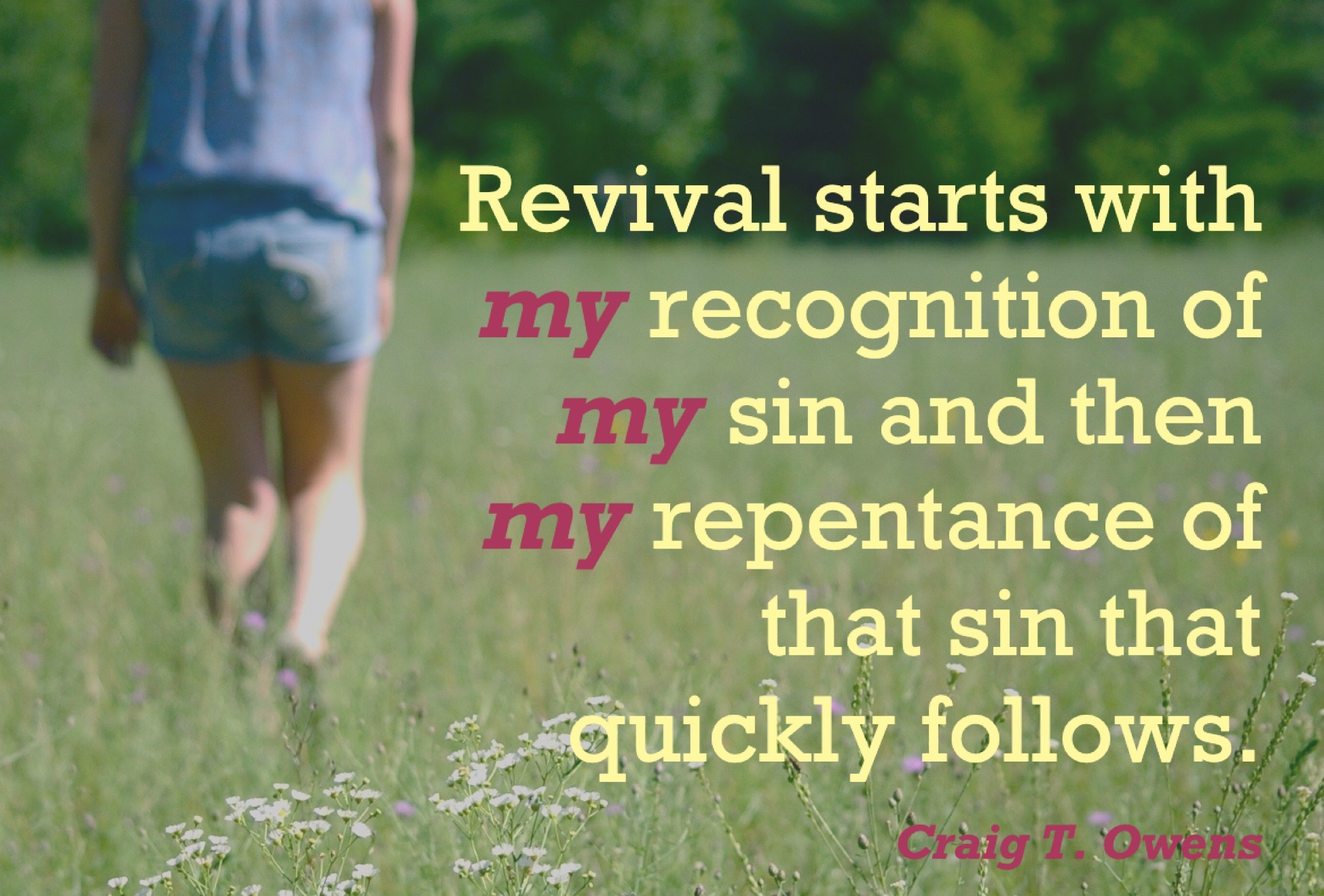
Immediately following thatmiddle verse notice the personal, singular pronoun “I” in verse 8. Revival starts with my recognition of my sin and then my repentance of that sin quickly follows.
The “show us the way” prayer of verse 7 is answered in verse 13: “Righteousness will go before Him, and shall make His footsteps our pathway” (NKJV). God Himself shows us the way! His footsteps mark the path for us to walk!
According to Romans 12, all Christians have been given a unique gift package by God. We are to use these motivational gifts to make God’s Kingdom more visible and more desirable.
This is the introductory lesson in this series. You may download the participant’s notes and the gifts assessment I use in this lesson:
If you would like to join us in person for this class, here is where you can find us. If you have missed any of the classes in this series, check them out here:
Scott Klusendorf wrote, “If Roe and Casey are struck, it will be a truly historical moment, and pro-lifers should indeed celebrate. Nine unelected judges on the Supreme Court will no longer have sole legal authority to determine abortion policy. Rather, the legislative and executive branches of the federal government, along with those in the individual states, will now decide how the practice is governed. Put simply, the American people—your friends, your classmates, your coworkers, and your family members—will now determine if unborn humans enjoy the same legal protections as you and I, or get relegated to the dumpster.” This is a fascinating article about how pro-life Christians should prepare for a post-Roe America.
Even the pro-abortion research firm The Guttmacher Institute reports “an estimated 100,000 children are killed after the first trimester of pregnancy each.” Let that sink in: 300 lives are snuffed out every day by burtual, inhumane abortion techniques!
Dr. Tim Clarey at the Institue for Creation Research explains how the dinosaurs in the Juassic Park series are “imaginary dinosaur science.” He then lays out the facts.
J. Warner Wallace is a cold-case detective. His investigation into the biblical claims of the death and resurrection of Jesus led him to become a Christian. In this video he explains his thought process as an atheist—
The word Selah appears nearly 70 times in the Bible, almost exclusively in the Psalms. Although it is primarily a musical term, it applies beautifully to our summer series.
Selah can mean…
a pause from the noise to reflect;
a preparation for an exciting accent; or
a reflective time of consideration
Throughout the Psalms, Selah appears at the end of a verse, at the end of the psalm, or sometimes even mid-sentence. But each one of them is perfectly placed by the Spirit-inspired authors to get us to take a breath and deeply contemplate what we just read or sang.
Summertime is typically a time for us to pause from our regular routine. Perhaps it’s a vacation, time with friends and family, driving around with the windows down and the music blasting, or just a quiet walk through woods or along a beach. In any case, whether we realize it or not, we’re actually doing Selah in these break-from-the-routine activities.
Join me this Sunday as we continue our summertime look at each of the Psalms that ask us to Selah. I think you will find that this Sunday summertime pause will be both refreshing and encouraging. You can join me either in person or on Facebook or YouTube.
Since this is a continuation of our summer series, you can check out the Selahs we discussed by clicking here for the 2018 messages, here for the 2019 messages, here for the 2020 messages, and here for the 2021 messages.
Listen to the podcast of this post by clicking on the player below, and you can also subscribe on Apple, Spotify, or Audible.
I just love it when science catches up with what God has already pronounced in the Bible!
I’ve blogged previously about psychology, archeology, and astronomy uncovering truths that have already been stated in the Bible, but there are also numerous recent medical discoveries that confirm what Scripture has already been telling us.
Like the fact that there is a healthy way to relieve stress, and that retaining the stress hormone cortisol in our bodies for too long has serious implications. The apostle Paul tells us to not “be anxious about anything” but to enjoy “the peace of God which transcends all understanding” (Philippians 4:4-7).
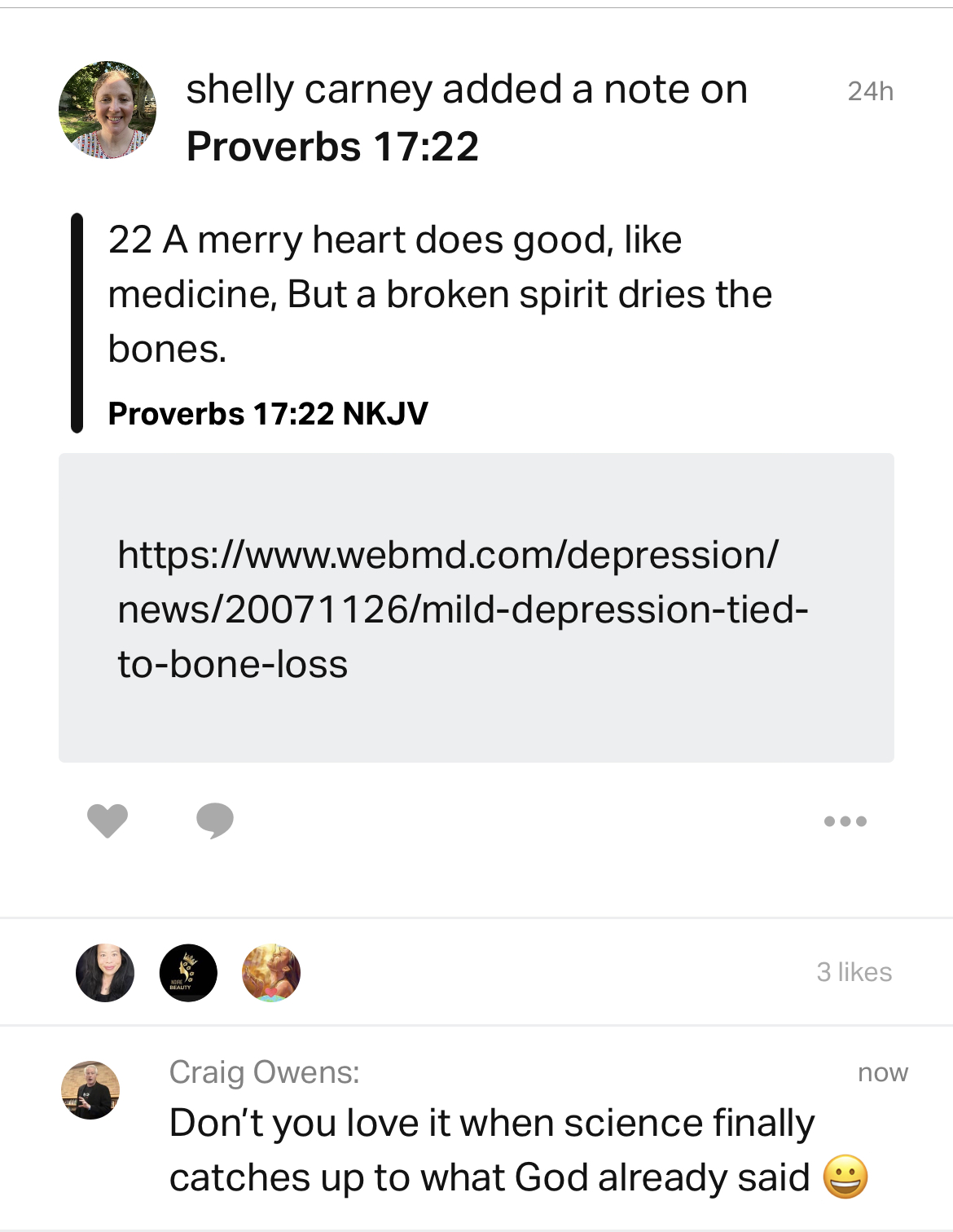
And then there is this finding that my YouVersion friend Shelly pointed out. “A happy heart is good medicine and a cheerful mind works healing, but a broken spirit dries up the bones” (Proverbs 17:22 AMP).
In a WebMD article, medical science confirms this truth of dried-up bones resulting from depression. They wrote, “Even mild depression may significantly increase a woman’s risk for developing osteoporosis. … The level of bone density loss attributed to depression in the study was similar to that previously associated with other well-known osteoporosis risk factors, including smoking cigarettes and getting little or no exercise. … Bone mineral density testing revealed that 17% of the depressed women showed evidence of bone thinning at a particularly vulnerable area of the thigh bone, compared to 2% of women who were not depressed.”
The Bible is God’s inspired Word to humankind, which means it is never out of date. The principles God has shared with us stand the test of time and are continually verified by the brightest scientific minds.
So here is my challenge to you: Take God at His Word, and apply the principles He has given you. I think you will find how much better your life will go when you live God’s way.
[5:40] Greg reminds leaders that there isn’t an award for not taking a vacation
[6:46] Greg has seen the fallout from overly-tired leaders, and I share some ideas for leaders to help themselves and their teammates de-stress
[9:31] How do leaders build playtime into their regular work schedule?
[11:10] Share your ideas with us!
[11:34] Greg shared some playtime activities he used in his organizations
[12:27] Why do leaders think they have to be so serious?
[15:15] Some thoughts for leaders to help their teams
[16:51] Greg emphasizes again the importance of self-care and they guys talk about how we can help other leaders practice self-care
[19:03] Our coaching huddles can help you grow your leadership
[20:02] Is it possible to find work-life balance?
Check out this episode and subscribe on YouTube so you can watch all of the upcoming episodes. You can also listen to our podcast on Spotify and Apple.
Listen to the podcast of this post by clicking on the player below, and you can also subscribe on Apple, Spotify, or Audible.
John Maxwell was right: “Everything rises and falls on leadership.”
As the leader goes, so goes the family, the neighborhood, the business, the church, the country. Just as Israel’s leaders fell into sin and took the people down with them, so too the religious and political leaders in America are leading people to sin.
God told Ezekiel, “See how each of the princes of Israel who are in you uses his power to shed blood” (Ezekiel 22:6). These ungodly leaders were described as:
The bottom line: God says, “You have forgotten Me” (v. 12).
This kind of evil must be punished by an All-Righteous God.
But God is still merciful. He is still looking for just one who will turn away from the sins of the culture and live righteously. He is looking “for someone among them who would build up the wall and stand before Me in the gap on behalf of the land so I would not have to destroy it” (v. 30).
God is looking for just one leader who will seek God’s glory and not personal gain, who will stand for righteousness even if he has to stand alone.
Will you be that one?
I pray I may be that one!
I pray for godly leaders to stand up! “Holy God, may we stand for You in this evil culture. May Your Holy Spirit strengthen us to stand unmoved against the onslaught of depravity. Strengthen us against the evil one and against evil people, knowing that greater are You in us than the evil that is in the world. May we be the ones that refuse to bend our knee to anyone or anything but You. In the powerful name of Jesus, I pray this. Amen!”
Listen to the podcast of this post by clicking on the player below, and you can also subscribe on Apple, Spotify, or Audible.
Last week I mentioned that there are numerous people who only appear in the Bible once. They come on the scene—many of them nameless to us—to play their part and then we never hear aboutthem again.
But we still hear fromthem because their lives are still teaching us.
There are several “one-timers” listed by Luke in the Advent story. Luke was a first-rate historian, researching his subject and talking to eyewitnesses to the events. Some of these one-timers have a few details Luke shared with us:
Zechariah and Elizabeth—we know their family lineage (priestly), Zechariah’s role in the temple, and the fact that Elizabeth was barren
Shepherds—we know where they came from (the fields surrounding Bethlehem) and their occupation.
Anna—we know her tribe (Asher), her father (Phanuel), and role (prophetess), and that she had been married and is now widowed.
But all Luke can say of Simeon is, “There was a man called Simeon…” (Luke 2:25-35).
Although, even that short introduction is packed with meaning.
Simeon in Greek means harkening while Simeon in Hebrew means heard. So he was both one who heard God and one who was heard by God. This speaks to me of an intimacy of relationship. Simeon didn’t view his conversation with God as a monologue but as a dialogue. I think that far too often we view our Bible reading time as God simply speaking to us, and our prayer time as us speaking to God. But both of these activities should be a two-way dialogue.
A.W. Tozer has a great definition of a godly leader that I believe accurately portrays Simeon: “A true and safe leader is likely to be one who has no desire to lead but is forced into a position of leadership by the inward pressure of the Holy Spirit and the press of the external situation.”
I think this means that a safe, godly leader is one who sees what is happening in a Christ-less culture, who then cries out in pain to God, and then who hears the Holy Spirit telling him how to live a holy life in that Christ-less culture.
We could call this external pressure grief over unrighteousness. Simeon so stood out in his culture that Luke calls him “righteous.” This is one whose way of thinking, feeling, and acting is wholly conformed to the will of God.
He also calls Simeon “devout.” This is a compound Greek word that only Luke uses in the New Testament which means to catch good things and make them your own. Simeon took hold of the things of God, made them his own, and then observed them carefully.
Finally, Luke tells us that Simeon was “waiting for the consolation.” He was living expectantly to see God’s Word come to its fulfillment. He could do all of this because the Holy Spirit was upon him and the Holy Spirit had revealed truth to him.
That phrase “revealed to him by the Holy Spirit” again speaks to the intimate relationship Simeon had with God.
Simeon knew that what God promises, He fulfills. He knew the consolation God had promised through Isaiah (Isaiah 40:1-2), and then Simeon saw its fulfillment in Jesus the Christ—
“Sovereign Lord, as You have promised, You may now dismiss Your servant in peace.For my eyes have seen Your salvation,which You have prepared in the sight of all nations:a light for revelation to the Gentiles, and the glory of Your people Israel.” (Luke 2:29-32)
In today’s darkening, Christ-less culture, godly men like Simeon are needed again.
Dads, do you feel the external pressure of today’s culture? If so, I pray that you will also feel the inward strengthening of the Holy Spirit drawing you into a more intimate relationship with Himself.
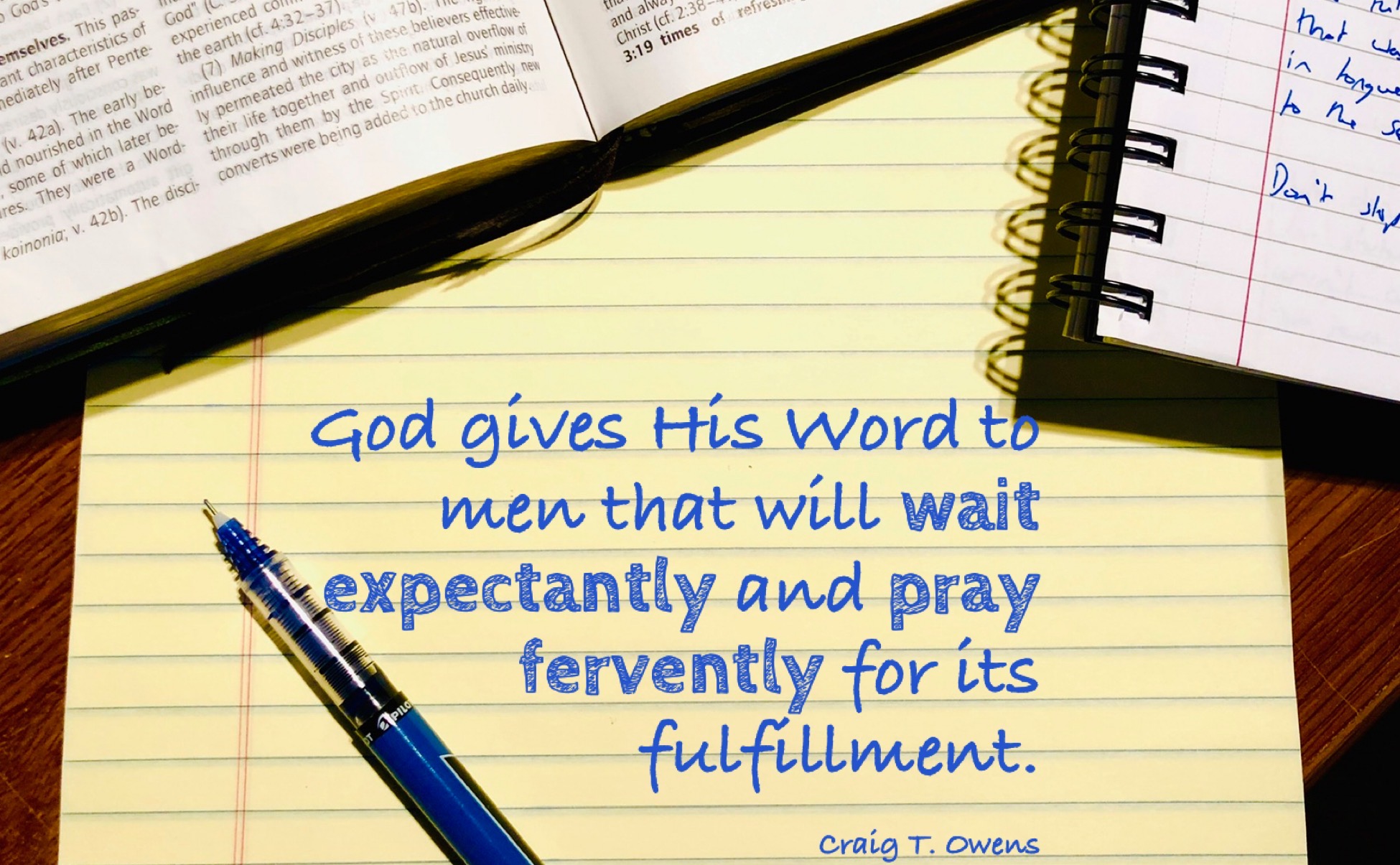
God gives His Word to men that will wait expectantly and pray fervently for its fulfillment. God is looking for men—for Dads—that will not cave in to cultural pressure.
Guys, let the Holy Spirit’s inward pressure strengthen you to stand strong. As you see the external downward spiral away from God, don’t collapse, don’t complain, but hear God’s Word and remain a righteous and devout man for your family and your community.



 Although the Jews had been released from exile in Babylon to return to their homeland, things still were not going well for them. The prophet Haggai came on the scene and offered this solution from God to their national adversity.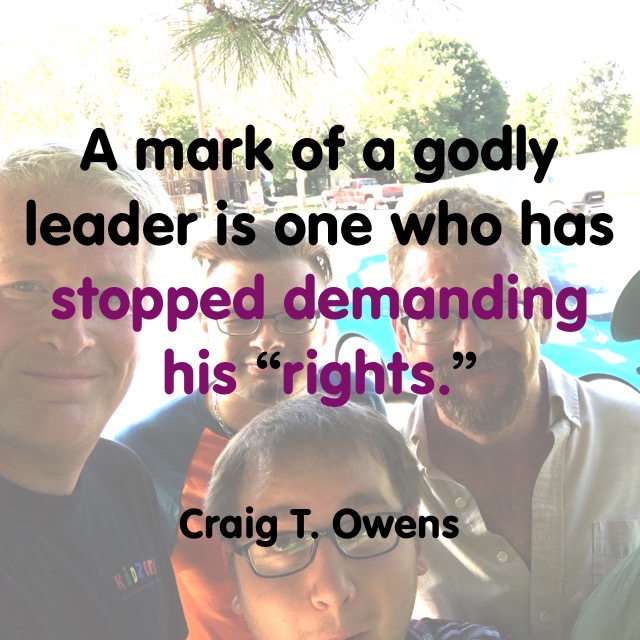





 Craig T. Owens