Dealing With Anonymous

Listen to the podcast of this post by clicking on the player below, and you can also subscribe on AppleSpotify, or Audible. 

I have never met Mr. Anonymous, but I sure would like to!

It appears to me that Mr. Anonymous is one of the wisest people in the world. He has an expert opinion about everything. And apparently he’s never wrong and never at fault for anything.

Have you ever received a letter or an email from Mr. or Mrs. Anonymous?

How do you respond when you get one of these letters? Does it make you angry? Defensive? Depressed? Do you feel like you need to defend yourself against this so-called expert?

Personally, I think Mr. Anonymous is a coward, so I choose not to respond to anything that he says. Although that’s easy to say because I don’t even know who he is! So even if I did have something to say I would have no one to say it to.

Anyway you look at it, it’s frustrating!!

Here’s how King Hezekiah in the Bible chose to respond to a letter. Although the letter was not anonymous, the principle is still very good for us today:

Hezekiah received the letter from the messengers and read it. Then he went up to the temple of the Lord and spread it out before the Lord, and Hezekiah prayed to the Lord: “Give ear, O Lord, and hear; open Your eyes, O Lord, and see; listen to the words [he] has sent to insult the living God.” (2 Kings 19:14-16)

God knows who Mr. Anonymous is! And He is the only one who can justify you in Mr. Anonymous’ eyes.

So the next time you receive a letter from Mr. Anonymous, read it and allow God to show you anything in there that may be true. Then lay the letter before the Lord, and let God take it from there!

UPDATE: I discuss the bites of critics and criticism in my book When Sheep Bite.

►► Would you please prayerfully consider supporting this ministry? My Patreon supporters get behind-the-scenes access to exclusive materials. ◀︎◀︎

Thursdays With Oswald—A Moral Lavatory

This is a weekly series with things I’m reading and pondering from Oswald Chambers. You can read the original seed thought here, or type “Thursdays With Oswald” in the search box to read more entries.

A Moral Lavatory

     The Bible does not deal with sin as a disease; it does not deal with the outcome of sin, it deals with the disposition of sin itself. … We have cheapened the doctrine of sin and made the Atonement a sort of moral ‘lavatory’ in which men can come and wash themselves from sin, and then go and sin again and come back for another washing. …

     All Heaven is interested in the Cross of Christ, all Hell terribly afraid of it, while men are the only beings who more or less ignore its meaning.

From Biblical Ethics

This hits me in two areas.

First, as a sinner saved by grace. I am so grateful for the gift of grace. I want to treat this gift with all of the gratitude I can. It was purchased for me with such a high price: The blood of the sinless King of kings. May my sin break my heart as much as it breaks my Heavenly Father’s heart. I’m grateful grace is there when I blow it, but I don’t want to blow it ever again.

Dietrich Bonhoeffer described cheap grace like this:

“Cheap grace is the preaching of forgiveness without requiring repentance, baptism without church discipline, Communion without confession, absolution without personal confession. Cheap grace is grace without discipleship, grace without the Cross, grace without Jesus Christ, living and incarnate. … Cheap grace is the grace we bestow on ourselves.”

Second, as a pastor who teaches about the atonement and grace. I know that I will have to give account before God if the people who hear me teach about these gifts are ones who “ignore its meaning.” I want to do everything I can to make sure everyone who listens to me understands the inestimable value of the Cross of Jesus Christ.

In his book Costly Grace, Jon Walker writes:

“Costly grace justifies the sinner: Go and sin no more. Cheap grace justifies the sin: Everything is forgiven, so you can stay as you are.”

Grace is powerful stuff. May we always treat it that way.

Do You Know Your Community?

Jesus called His followers to be salt and light. It’s pretty easy to figure out that the salt cannot season the food if it stays in the saltshaker, and the light cannot illuminate the darkness if it stays covered up. In order to season and shine in your community, you have to know your community.

And, pastor, that starts with you.

What you do is a much more effective sermon that what you say. Pastor, you need to know your community, so that you can be involved in your community, so that you and your church can season and shine in your community together.

So let me ask a couple of questions:

  • Do you know your Mayor / City Manager / Township Supervisor? If you don’t know them, how can you affirm their leadership (Romans 13:1-7)?
  • Do you attend City / Township Council meetings? If you don’t, how will you know what issues they’re wrestling with? If you don’t know those issues, how can you pray effectively for them (1 Timothy 2:1-2)?
  • Are you involved in your community? Don’t just assume people in your community will come to your church to sit among stranger to hear a stranger speak; instead, be so involved in your community that they will come to church to fellowship with friends and hear a friend speak (John 2:1-2).

I opened with the question, “Do you know your community?” But maybe a better way to ask this is, “Does your community know you?”

Does the community come to you to ask for help? This may be the best barometer of your involvement in your community: how often they seek your help or assistance in addressing issues within your community.

If you’re not as involved as you should be, the good news is that it’s never too late to start! Go get involved—go season and shine!

Harmless

When a story from the past is so well known, we can easily insert ourselves into it with a certain bias. When we do this, we read things into the story because of the facts we know now.

For instance, we know Judas betrays Jesus. So when we see his name in any story in the Bible, we immediately associate the word traitor with him, and we can only view him through that lens. Therefore, it’s easy for us to put ourselves in the place of one of the other eleven disciples of Jesus, and assume that they too knew Judas was a traitor.

Except they didn’t.

Look at this verse after Jesus says, “One of you will betray Me”—

His disciples stared at one another, at a loss to know which of them He meant. (John 13:22)

The Eleven were not suspicious of Judas. They didn’t say, “Well, I just knew it was him,” or “I kinda expected that from Judas.”

One of the things Jesus taught His followers was for them to be gentle as doves. I like how the King James Version says it: harmless as doves (Matthew 10:16).

Pastor, I know you especially have been hurt by people in your church. They have betrayed you, gossiped about you, turned on you. If people did that to Jesus, why would you expect anything less? And yet we are still to remain harmless as doves.

The Eleven never suspected a traitor. They were innocent. I think they were so focused on Jesus, they didn’t have time to be cynical about others. We view Judas cynically; they didn’t.

What a testimony to others when we are harmless:

That ye may be blameless and harmless, the sons of God, without rebuke, in the midst of a crooked and depraved nation, among whom ye shine as lights in the world. (Philippians 2:15)

You may have been hurt many (many, many, many…) times in the past. But being harmless means that, like the disciples, we are “at a loss” as to whom it could be when someone tells us there is a traitor in our midst.

  • Stay focused on Jesus, so you may love others as He loves them.
  • Allow God to heal the wounds others have inflicted on you.
  • Ask the Holy Spirit to reveal any cynicism in your heart.
  • Repent of your suspicion of people.
  • Be harmless toward everyone.
  • Grieve over the traitor.
  • Then stay focused on Jesus, not the traitor and not your wound.

My High Wire Act

“Ladies and gentleman, high above you, balanced precariously on the tightrope high over your heads—and performing it all without a net—is your pastor!”

Well, that’s sorta what it feels like to me!

Last year, I took a couple of Sundays to field questions from our congregation. My hope was that lots of people would turn in their questions early, to give me a little time to prepare (that’s like performing with a net). But instead, most of the questions came as I was standing at the front of the church with the microphone in my hand. That’s definitely performing without a net!

But it was very well received, so we’re trying this high wire act again. Beginning next Sunday The Q Series allows anyone in attendance to ask their questions about the Bible, God, or anything else that’s on their mind about spiritual matters. People can either ask their question verbally, or they can text their question anonymously to the techs in our sound booth.

Of course, if you’d like to help me perform with a net, please ask a question or two (or three, or four…) in the comments below. If you’d like to see me perform without a net, join us at 10:30am this Sunday morning.

Here are some of the questions we have addressed:

“Too Long”?

Check out these words of insight from Seth Godin:

“Too long.” You’re going to hear that more and more often.

The movie, the book, the meeting, the memo… few people will tell you that they ran short.

(Shorter, though, doesn’t mean less responsibility, less insight or less power. It means less fluff and less hiding.)

As a pastor, I laughed when I read few people will tell you that [your sermon] ran short. That is so true!

But Seth’s conclusion is right on target. In the attempt to keep our message at just the right length, we must be cautious of reducing the insight or the power. Instead, get rid of the fluff and the posturing.

Cry Before You Confront

Listen to the podcast of this post by clicking on the player below, and you can also subscribe on AppleSpotify, or Audible.

As a pastor, one of your responsibilities is to point out what may be harmful in someone’s life. We have a word for that: confrontation.

Handled correctly, confrontation can lead to restoration and newfound maturity. Handled incorrectly, and, well, let’s just say it can get very ugly!

I just heard the story of a pastor who felt like he needed to confront one of his board members. I don’t really know this pastor, nor do I know the board member; I don’t know what was said in their meeting, but I have heard about the outcome, and it got ugly.

Samuel was going to be sent by God to confront King Saul about the sin he had committed. Look at this passage:

Then the word of the Lord came to Samuel: “I am grieved that I have made Saul king, because he has turned away from Me and has not carried out My instructions.” Samuel was troubled, and he cried out to the Lord all that night. (1 Samuel 15:10-11)

Did you catch how Samuel responded? He cried out to the Lord all that night.

Perhaps if we, as pastors, cried before we confronted the results might be more healthy.

“Tears shed for self are tears of weakness, but tears shed for others are a sign of strength.” —Billy Graham

Nehemiah was another pastoral/prophetic figure that was going to confront the inhabitants of Jerusalem about their sin.

When I heard these things, I sat down and wept. For some days I mourned and fasted and prayed before the God of heaven. Then I said: …I confess the sins we Israelites, including myself and my father’s house, have committed against You. (Nehemiah 1:4-6)

Before Nehemiah confronted the sins of the people, he tearfully took a hard look at himself, and then asked for forgiveness. Jesus shared this same concept with these words:

Why do you look at the speck of sawdust in your brother’s eye and pay no attention to the plank in your own eye? How can you say to your brother, “Let me take the speck out of your eye,” when all the time there is a plank in your own eye? You hypocrite, first take the plank out of your own eye, and then you will see clearly to remove the speck from your brother’s eye. (Matthew 7:3-5)

So before you confront your brother or sister, let the Holy Spirit confront you. Then, if it’s needed, confess your sin and ask God’s forgiveness. Let the Holy Spirit remove things in your life so that you can see clearly how to lovingly confront your brother.

Cry before you confront. Cry over your sin. Cry over the sinful state of your brother or sister. Plead with the Lord for this time of confrontation to lead to restoration and maturity.

►► Would you please prayerfully consider supporting this ministry? My Patreon supporters get behind-the-scenes access to exclusive materials. ◀︎◀︎

What’s Your Point?

As I am preparing my message for each Sunday, I have one point that I want everyone to have clear in their hearts and minds when they leave. It’s sort of my “finish line.” I say, “If they get only one thing from this message, what should it be?” This is the part where I spend quite a bit of time.

Then I read this from the Apostle Paul:

When I came to you, brothers, I did not come with eloquence or superior wisdom as I proclaimed to you the testimony about God. For I resolved to know nothing while I was with you except Jesus Christ and Him crucified. (1 Corinthians 2:1-2)

So what’s my point?

Something clever and witty?

Something that shows how eloquent I am?

Perhaps another rule to follow?

Or another application to make?

Oswald Chambers says, “To say that we are called to preach holiness or sanctification is to miss the main point. We are called to proclaim Jesus Christ….” (emphasis mine)

My point should be only this:

To help people see Jesus more clearly.

Anything less than this is to miss the point.

Anything more than this is attempting to make myself sound eloquent.

Pet (Pastoral) Peeve

One of my biggest pet peeves is hearing pastors say, “Ministry would be great if it weren’t for the people.”

Pastor: People ARE your ministry!

After Christ’s resurrection, He wanted to help restore Peter. Jesus asked Peter a simple question, “Do you love Me?” When Peter acknowledged that he did, Jesus gave Peter a way to show it: “Feed My sheep.” I believe this exchange is what Peter had in mind when he penned the words,

Be shepherds of God’s flock that is under your care, serving as overseers—not because you must, but because you are willing, as God wants you to be; not greedy for money, but eager to serve; not lording it over those entrusted to you, but being examples to the flock. (1 Peter 5:2-3)

Is it hard to be a shepherd? Yes.

Are some sheep difficult to shepherd? Yes.

Is it worth it to shepherd them? Yes, yes, YES!!

I love Oswald Chambers’ insight on this:

“Jesus has some extraordinarily peculiar sheep: some that are unkempt and dirty, some that are awkward or pushy, and some that have gone astray! But it is impossible to exhaust God’s love, and it is impossible to exhaust my love if it flows from the Spirit of God within me. The love of God pays no attention to my prejudices caused by my natural individuality. If I love my Lord, I have no business being guided by natural emotions—I have to feed His sheep.”

Jesus, increase my capacity to love Your sheep. All of Your sheep—the ones that bite; the ones that are nice; the ones that are untidy; the ones that are clean; the ones that are thankful; the ones that are ungrateful; the ones that “get it”; the ones that don’t. All of YOUR sheep. Thank You, Lord, for the supreme honor and heavy responsibility of serving as Your under-shepherd.

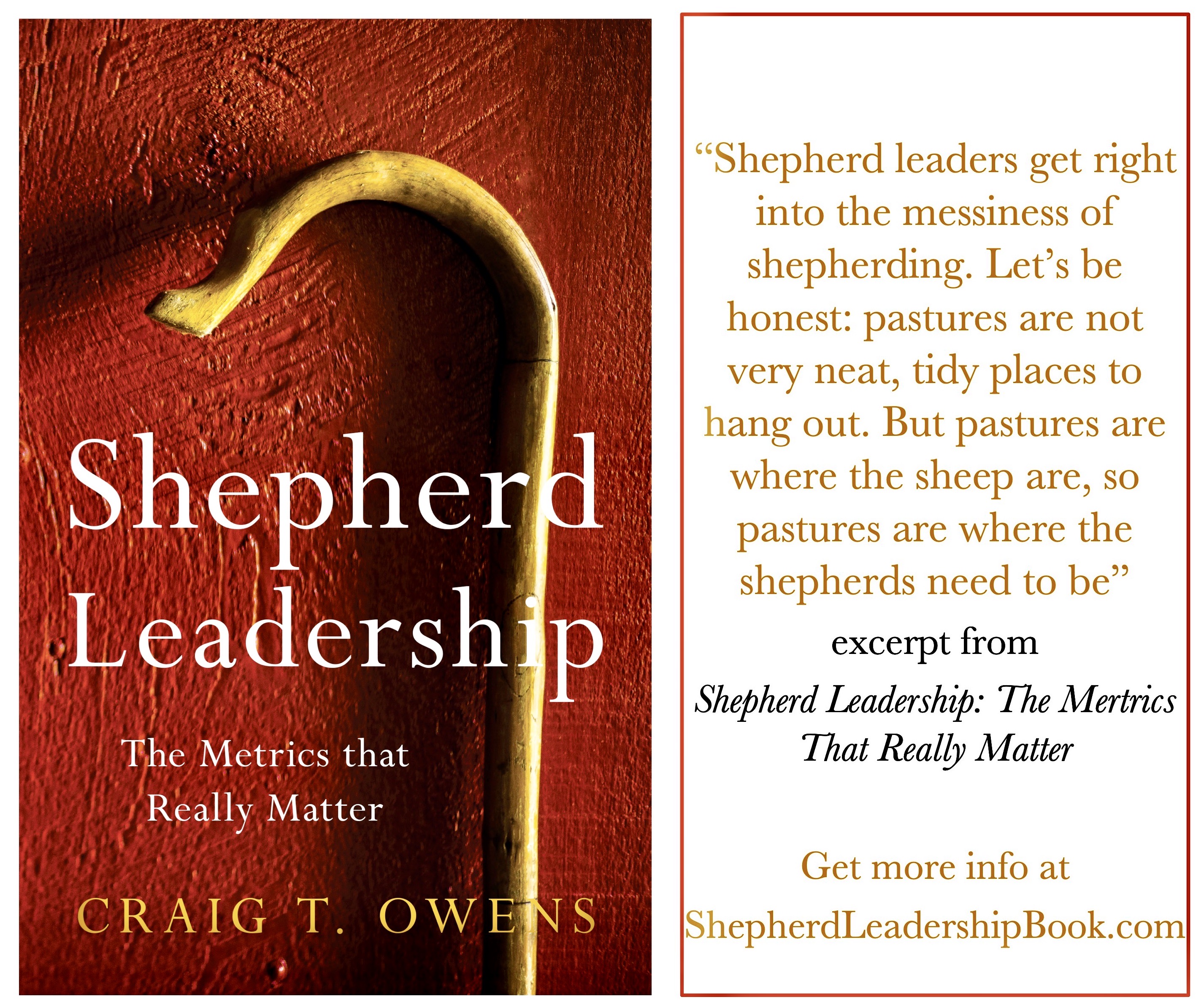
UPDATE: This idea of pastors as shepherds is what drove me to write my book Shepherd Leadership: The Metrics That Really Matter. I hope you will pick up a copy today!

Who Are You?

This is another post especially for pastors (but I think others will find this helpful too).

John the Baptizer had no credentials, and yet people flocked to hear him speak.

He had no formal training, and yet people hung on his every word.

He had no authority from a sanctioning body, and yet he spoke with such power.

This perplexed the religious leadership. After all, they had credentials, training, and authority. So they came to John asking, “Who are you? What do you have to say about yourself?” (John 1:21-22).

If God has called you to the pastorate, He will equip you.

There’s nothing wrong with credentials, training, or sanctioning, per se. But when you think your call to preach has authority because of your title, your training, or your denominational appointment, you have missed the point! John had none of these, and yet Jesus said, “There’s never been a greater prophetic voice!”

So, pastor, who are you?

Are you the one who is credentialed, or trained, or sanctioned?

Or are you the one who has been called and equipped by God?

There’s a huge difference!

Who are you? I hope you can answer, “I am only a servant of the Most High, equipped by the Holy Spirit to make Jesus known in my city.”

UPDATE: I use John the Baptist as a prominent example in my book Shepherd Leadership: The Metrics That Really Matter.