Listen to the podcast of this post by clicking on the player below, and you can also subscribe on Apple, Spotify, or Audible.
What does it mean when we really believe the words, “The Lord is my Shepherd, I lack nothing” (Psalm 23:1)?
When the sheep is utterly dependent on the shepherd, it lacks nothing. A sheep without any lack glorifies the Good Shepherd.
God is glorified when I remain in utter dependence on Him, and I continue to have to lack because of His perfect provision. I am quiet, restored, on the right path, fearless, secure, provisioned, blessed, and forever hopeful.
To try to provide for my own needs dishonors the Good Shepherd, but to come to Him for absolutely everything glorifies Him as eternally satisfying and reliable.
The more my needs are satisfied by God alone, the more He is glorified.
Listen to the podcast of this post by clicking on the player below, and you can also subscribe on Apple, Spotify, or Audible.
Ahab, king of Israel, and Jehoshaphat, king of Judah, are strategizing a battle plan against Syria when they call for God’s prophet to share with them God’s counsel in this matter.
Then Micaiah said, “I did see all Israel scattered upon the mountains as sheep that have no shepherd, and the Lord said, ‘These have no master. Let each return to his house in peace.’ … Now, you see, the Lord put a lying spirit in the mouths of your prophets; and the Lord has spoken evil concerning you. … If you return at all in peace, the Lord has not spoken by me” (2 Chronicles 18:16, 22, 27).
You would think this would cause these kings to scrap their battle plans and keep their armies at home. But the next verse says they utterly rejected the prophet’s warning. “So Ahab king of Israel and Jehoshaphat king of Judah went up to Ramoth-gilead” (v. 28).
What in the world is Jehoshaphat doing?!
He asked for a prophet from God and then when he hears from God that this combined army will be defeated, Jehoshaphat still goes with Ahab?!
But let’s back up: Why was Jehoshaphat even here hanging out with Ahab? And before even hearing from Micaiah, why does he commit his army and cavalry to this joint-venture (v. 3)?
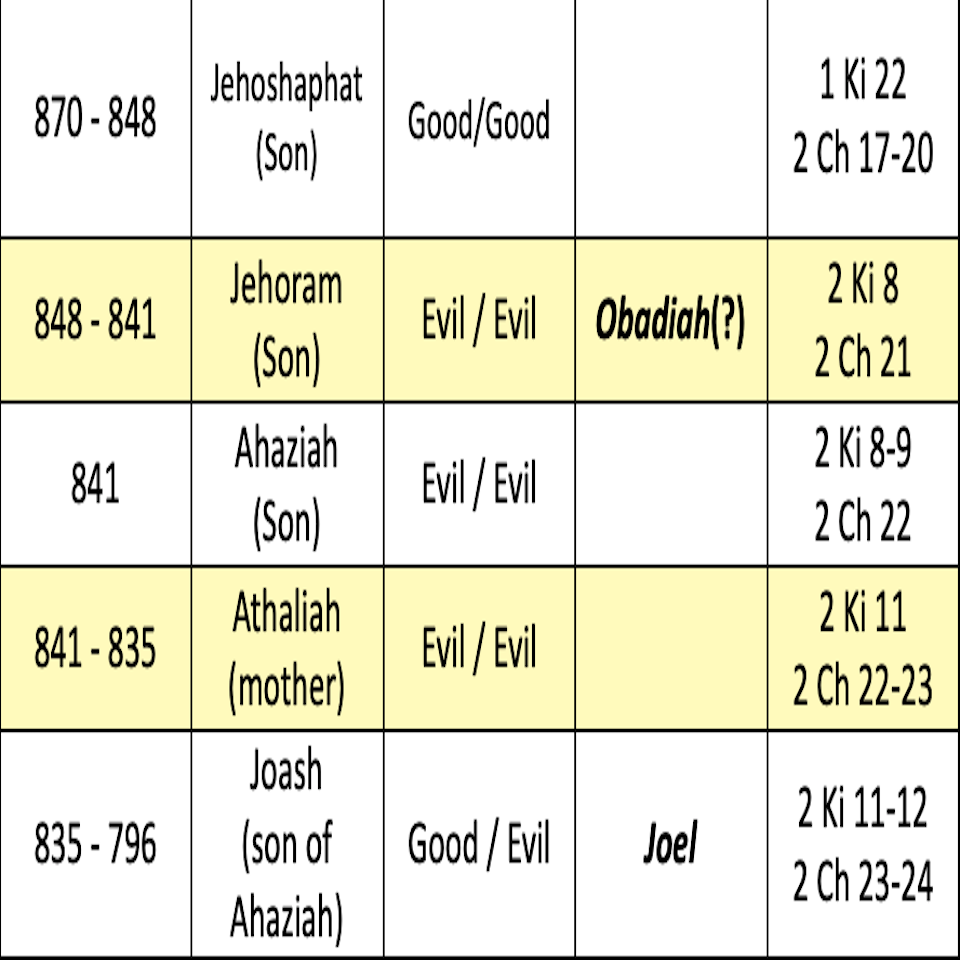
I think the clue is in v. 1: Jehoshaphat “was allied by marriage to Ahab.” Jehoshaphat’s son Jehoram is married to Ahab’s daughter Athaliah (2 Kings 8:18).
Jehoshaphat thought this was a strategic move. Like a chess master moving his pieces on the board, he calculated that this alliance would give him an advantage. But instead this move resulted in years of heartache and destruction.
First, Jehoshaphat feels trapped into allying with Ahab in this ill-fated battle against the Syrians. Ahab is killed in this battle, and Jehoshaphat barely escapes with his life, although his army is embarrassed in defeat.
As he is returning to Jerusalem, another prophet meets him and pronounces this heartbreaking message, “Should you help the ungodly and love those who hate the Lord? Because of this, wrath has gone out against you from the Lord” (2 Chronicles 19:2).
Later on, Jehoshaphat again partners with Ahab’s son, “After this, Jehoshaphat king of Judah joined with Ahaziah king of Israel, who did very wickedly” (20:35).
After Jehoshaphat died, his son Jehoram ascends the throne.
His reign as king is only eight years long, and is noted for him walking “in the ways of the kings of Israel” by doing evil in God’s sight (2 Kings 8:15). Jehoram was killed in battle.
Ahaziah his son then sits on the throne in Jerusalem for only a year, manipulated by his mother Athaliah. “He walked in the ways of the house of Ahab and did evil in the sight of the Lord, as did the house of Ahab, for his father was son-in-law of Ahab” (2 Kings 8:27). This alliance led to another disastrous joint military campaign with Israel. Ahaziah was killed by Jehu shortly after this.
Look what happens next: “When Athaliah the mother of King Ahaziah of Judah saw that her son was dead, she arose and destroyed all the royal descendants (2 Kings 11:1). This began a six-year reign of terror in which Athaliah assumed the throne.
Where did all of this mayhem begin? When Jehoshaphat calculated his own destiny.
We have such a limited view; whereas, God is timeless, all-knowing, all-powerful. It is the highest form or arrogance to think we can out-maneuver God’s plan, or that we can even begin to know what’s best for our lives.
The One who has all of our days written in His book is also the One who tells us that we can call to Him to learn things we don’t know and access the wisdom we don’t have (Psalm 139:16; Jeremiah 33:3; James 1:5).
Think of the misery that could have been avoided if Jehoshaphat would have heeded the counsel of his forefather Solomon: “Lean on, trust in, and be confident in the Lord with all your heart and mind and do not rely on your own insight or understanding. In all your ways know, recognize, and acknowledge Him, and He will direct and make straight and plain your paths” (Proverbs 3:5-6 AMPC).
What a miserable strategist I am when I make plans that I think are clever! Instead, I’m trying my best to follow Solomon’s counsel, and I pray you are too.
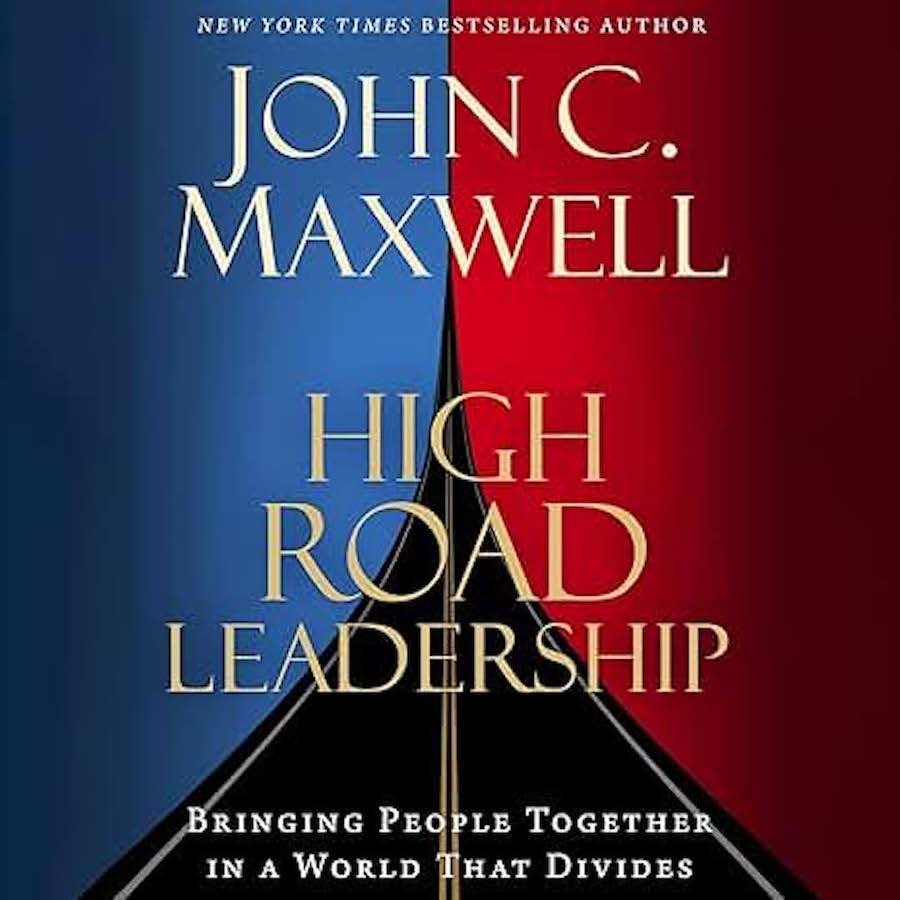
The subtitle of this John Maxwell book is “Bringing People Together in a World That Divides.” That is so needed today! Check out my review of High Road Leadership, and may these quotes inspire you to pick up a copy of this book to learn how you can be a part of healing a divided world.
“Leadership can be a blessing or a curse. It can help people rise to a better life, or it can cause people to fall into despair.”
“One of the reasons we don’t come together and work with one another is that we no longer see people on the other side as merely disagreeing. We see them as disagreeable human beings. We assume their motives are wrong. And the moment we think a person’s motives are wrong, we lose trust. … Good leaders need to rise above this attitude and help the people they lead do the same. How? We need to possess a strong collaboration bias. We need to bring people together to increase our understanding of each other and broaden our perspective.”
“We can’t divide people and expect to accomplish positive results. Conversation and collaboration will always come up with better answers than isolation and exclusion.”
“In my opinion, as a culture we lost our way when we went from simply disagreeing with others to devaluing them because we disagree. That’s when we crossed the line into low-road leadership. It’s one of the reasons so many people are so angry all the time. And when others take the low road with them, they become even angrier. It’s always easier to make a negative point than to make a positive difference.”
“High-road leaders who value people have a strong, healthy sense of self-worth, yet at the same time they are humble, meaning they don’t think too much of themselves or about themselves too much.”
“Accepting our humanness and possessing humble confidence does nothing to diminish our leadership ability. In a study of medical students, those who possessed doubts about their ability were just as effective in diagnosing illnesses as their more confident counterparts. Furthermore, the more humble students rated higher in bedside manner, empathy, respect, and professionalism.”
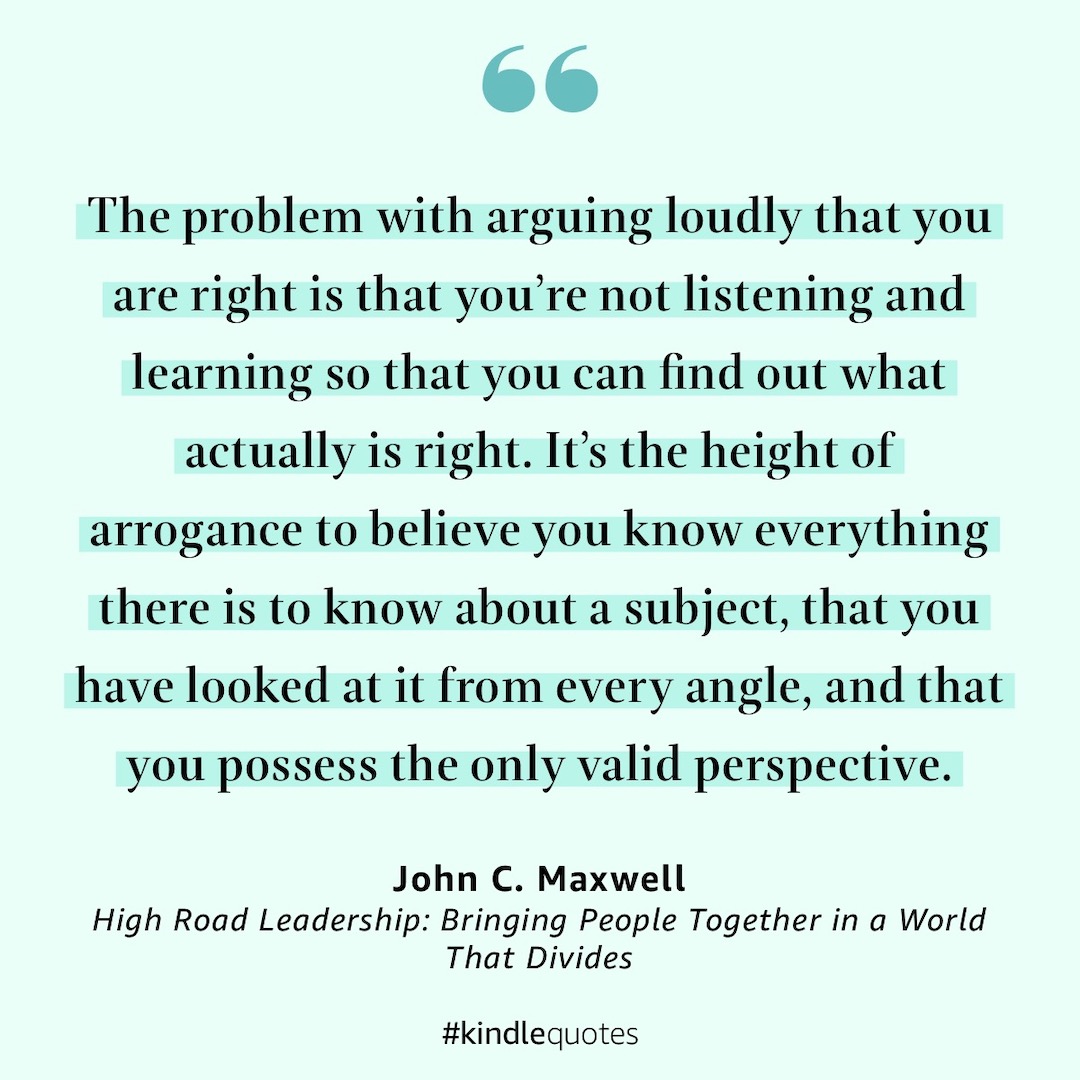
“The problem with arguing loudly that you are right is that you’re not listening and learning so that you can find out what actually is right. It’s the height of arrogance to believe you know everything there is to know about a subject, that you have looked at it from every angle, and that you possess the only valid perspective.”
My Patreon supporters have access to 25+ quotes from this book. They also get exclusive content and early access to public content. Join them today.
Listen to the podcast of this post by clicking on the player below, and you can also subscribe on Apple, Spotify, or Audible.
Calvary Assembly of God joined with Hillcrest Community Church of God for a service to send a message. We want to show that the Body of Christ is more than just multiple buildings where people meet on Sundays.
Pastor Caleb Claybaugh and I are going to be joining our congregations together again for two more outdoor gatherings over the next two months, and I would love to have you join us! Leave me a comment and I will get back to you with all of the details.
Leaders would do well to remember that they lead a group of unique individuals. Let the unique gifts of those unique people be used in unique ways, and watch both the individuals and the organization grow!
“As Tyler Cowen wrote in The Free Press, ‘Whether or not you work in the AI sector, if you put any kind of content on the internet, or perhaps in a book, you are likely helping to train, educate, and yes, morally instruct the next generation of what will be this planet’s smartest entities. You are making them more like you—for better or worse.’ Now, maybe someone thinks, ‘I’ve hardly got any followers, who cares what I post? It probably won’t matter.’ But the principle means we should care. The philosopher Immanuel Kant famously offered his ‘categorical imperative’ as a test for ethical decisions: ‘Act only according to that maxim whereby you can at the same time will that it should become a universal law.’ In other words, we should only do what we think would be good for everyone to do.” —Axis.org
How much good inside a day?
Depends how good you live ’em.
How much love inside a friend?
Depends how much you give ’em. —Shel Silverstein
A fantastic mini-biography of Otto J. Klink who went from being a Christian, to an atheist socialist, to failed presidential assassin, to a Pentecostal author and evangelist. Wow!
“My acceptance of the universe is not optimism, it is more like patriotism. It is a matter of primary loyalty. The world is not a lodging-house at Brighton, which we are to leave because it is miserable. It is the fortress of our family, with the flag flying on the turret, and the more miserable it is the less we should leave it. The point is not that this world is too sad to love or too glad not to love; the point is that when you do love a thing, its gladness is a reason for loving it, and its sadness a reason for loving it more.” —G.K. Chesterton
Marshall Segal said this about our daily Bible reading time, “I want to walk through a five-step prayer you could pray when you sit down with your Bible to meet with God. The five steps are built on an acronym for FEAST. Focus my mind; Enlighten my eyes; Address my sin; Satisfy my soul; Train my hands.”
“A man of character will make himself worthy of any position he is given.” —Mahatma Gandhi
“A retentive memory may be a good thing, but the ability to forget is the true token of greatness. Successful people forget. They know the past is irrevocable. They’re running a race. They can’t afford to look behind. Their eye is on the finish line. Magnanimous people forget. They’re too big to let little things disturb them. They forget easily. If anyone does them wrong, they consider the source and keep cool. It’s only the small people who cherish revenge. Be a good forgetter. Business dictates it, and success demands it.” —Elbert Hubbard
“Leadership is not about being in charge, but about taking care of the people in your charge.” —Simon Sinek
Flowing Data has a fascinating look at how people spend their time during the day. Their adjustable chart shows activities by age, sex, and time of day. It reminds me of a blog post I shared about time management, where I noted, “You cannot add more Tick, Tocking! time to your day, but you can keep more of your day from Drip, Dropping! away.”
“We might think, ‘Well, hey, if I’m devoting myself all the time to looking out for others’ needs, who’s going to be looking out for mine?’ The Lord, of course, because He knows what you need even before you ask Him, and He has ways of meeting your needs that are more wonderful than you in your cleverness or strength could ever conjure or provide (cf. Matthew 6:25-34).” —T.M. Moore
“We all know that exercise makes us feel better, but most of us have no idea why. We assume it’s because we’re burning off stress or reducing muscle tension or boosting endorphins, and we leave it at that. But the real reason we feel so good when we get our blood pumping is that it makes the brain function at its best, and in my view, this benefit of physical activity is far more important—and fascinating—than what it does for the body. Building muscles and conditioning the heart and lungs are essentially side effects. I often tell my patients that the point of exercise is to build and condition the brain.” —Dr. John Ratey
T.M. Moore has a hard but good word for Christians: “If this day, and this expectation and hope [when we heard King Jesus say, ‘Well done, good and faithful servant’], are not the driving force for every aspect of our lives and work, then it is doubtful we have really understood the Good News of the Kingdom or received the salvation freely offered to us by the King. I say this again: If we are not motivated and driven, day by day, by the prospect of hearing ‘Well done, good and faithful servant,’ then we need to examine ourselves, whether we truly know the Lord of glory. That’s pretty hard language, I know, but let’s face the reality: If we have not submitted to Jesus as Lord of every area of our life, all the work we’ve been given to do, then we are still living for ourselves, not Him.” —T.M. Moore
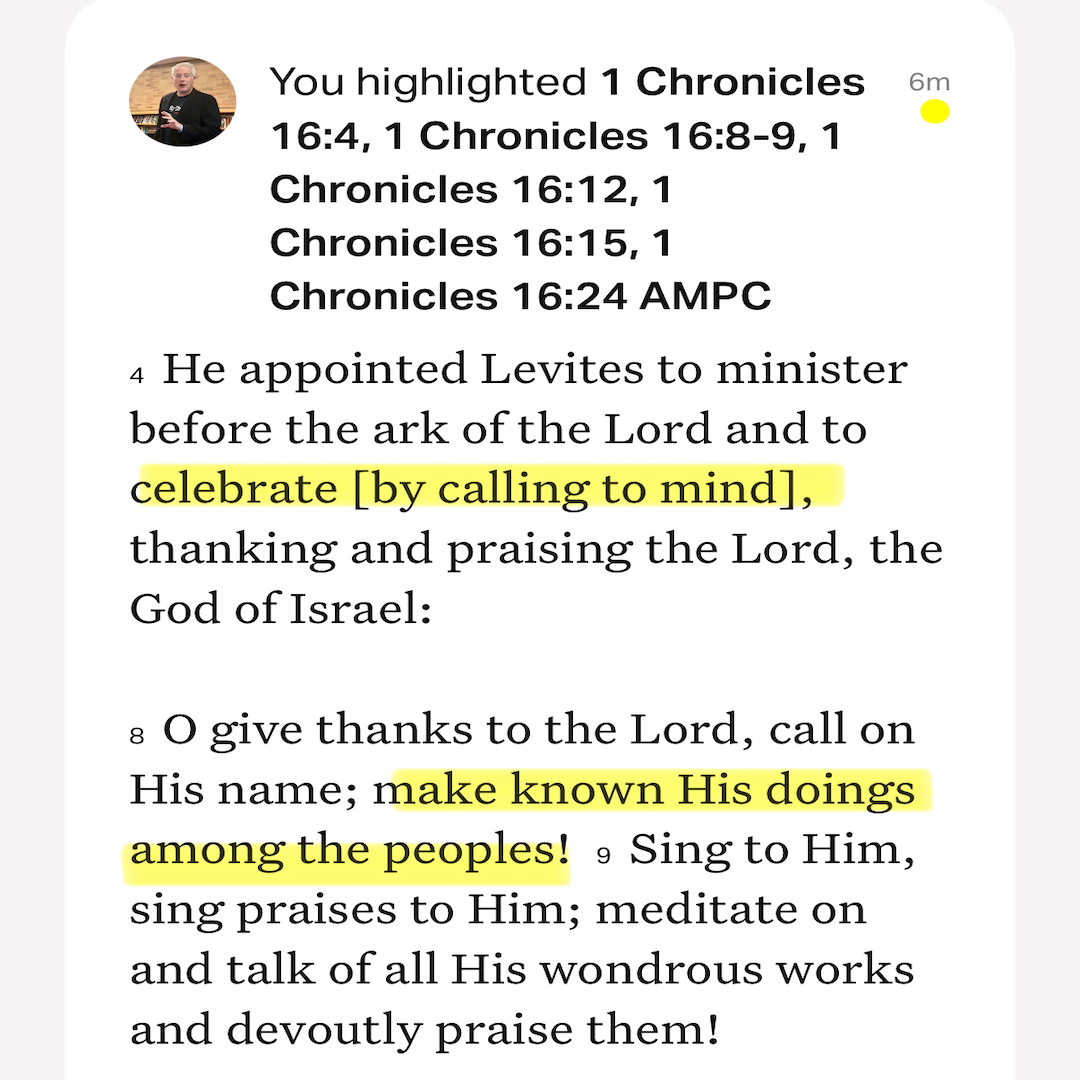
[King David] appointed Levites to minister before the ark of the Lord and to celebrate by calling to mind, thanking and praising the Lord, the God of Israel: … O give thanks to the Lord, call on His name; make known His doings among the peoples! Sing to Him, sing praises to Him; meditate on and talk of all His wondrous works and devoutly praise them! … Earnestly remember the marvelous deeds which He has done, His miracles, and the judgments He uttered as in Egypt. … Be mindful of His covenant forever, the promise which He commanded and established to a thousand generations. … Declare His glory among the nations, His marvelous works among all peoples. (1 Chronicles 16:4, 8-9, 12, 15, 24 AMPC)
Calling to mind … meditate … earnestly remember … be mindful. All these things lead to both worship and proclamation.
Recalling to mind all that God has done for us in the past, all that He is for us now, and all that He will do in the future gives us a song of praise. This praise is to be proclaimed among all people—both fellow worshipers and those who don’t know God as their Savior yet.
The more we meditate on Who God is, the more we praise Him; the more we praise Him, the more compelling our testimony to the nations becomes.
Listen to the podcast of this post by clicking on the player below, and you can also subscribe on Apple, Spotify, or Audible.
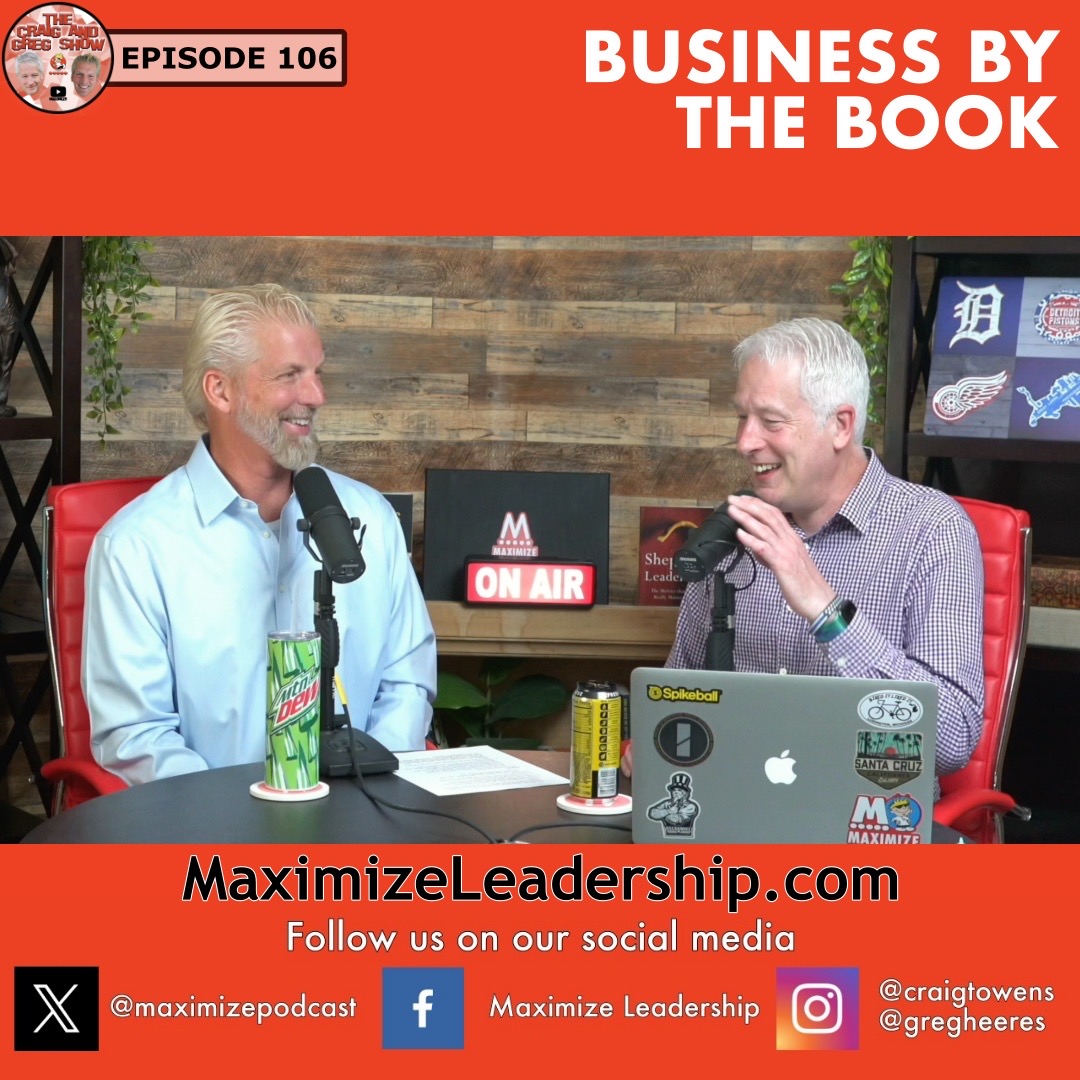
The multitude of books written about business and leadership is nearly incalculable. If you began reading now and did nothing else you could spend the rest of your life reading business books and still have many unread at the end of your life. Yet the wealth of knowledge contained within these books still pales in comparison to the insights provided to us by THE book—the Bible. In today’s episode Greg and I are happy to announce we are working on a new project called Business By The Book, which combines biblical insights with real-world applications.
[0:00] Introduction
[0:40] Greg and I are working on a project that we are so excited to be doing!
[1:50] We cover all the “boxes” on a corporate flowchart with this project. We start with the CEO box.
[3:56] We have been working as leadership coaches before there even was such a term.
[5:34] I will be writing from the Bible side and Greg will be writing from the business side in all of these books.
[8:21] If you are the point leader in your organization, you need to go first in reading this book and getting copies for others.
[9:10] We need your help for future books in this series.
Listen to the podcast of this post by clicking on the player below, and you can also subscribe on Apple, Spotify, or Audible.
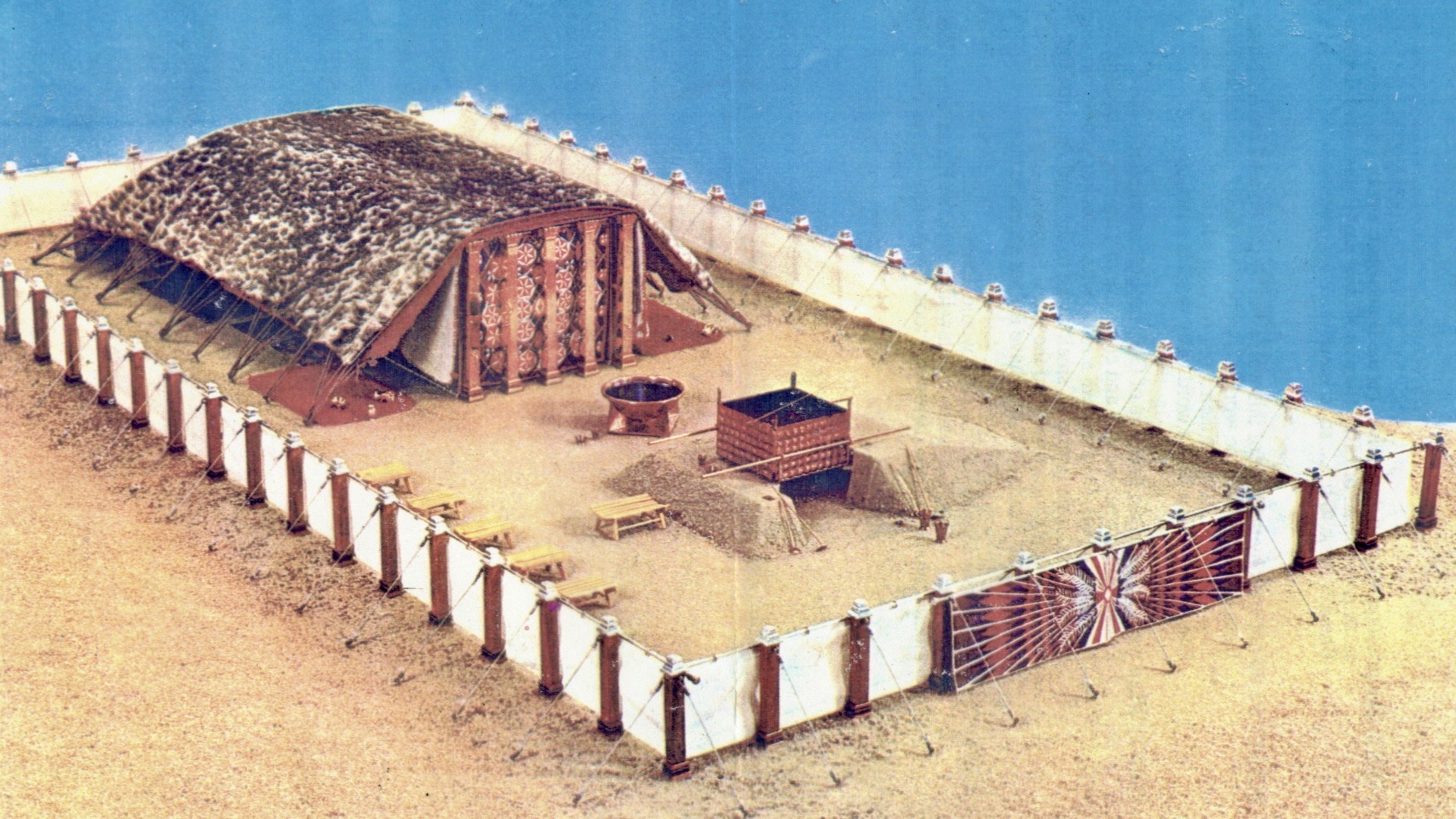
I was absolutely fascinated by a Messianic Jew’s insights on the Old Testament Tabernacle, and how every aspect of it pointed to Jesus the Messiah.
The overview of the construction of the Tabernacle starts in Exodus 25 and covers the next fifteen chapters in that book. Here are a few of my main takeaways from my friend’s teaching.
The materials for the Tabernacle are brought as a freewill offering given by freed slaves (Exodus 25:1-2). This gold, silver, bronze, linens, and other materials were gifts from the Egyptians when the Israelites left on the night of the Passover.
The Tabernacle is at the center of the Israelite camp (Numbers 2:1-34), signifying God’s presence in the center of our lives. When the Israelite community moved out, the tribe of Judah went first. Judah means “praise.” What a great reminder to let praise to God be at the forefront of all we do!
In Exodus 27:16, the materials to be used for the curtains compromising the entrance to the Tabernacle are blue, purple, and scarlet. The blue is for sky (Heaven), the purple designates royalty, and the scarlet signifies the blood of the sacrifices. Jesus came to earth as royalty from Heaven, and by His shed blood He opens the way for all of us to be with Him in Heaven forever! Jesus said He was the only way to Heaven (Hebrews 2:14-15; John 14:6).
The bronze altar for cleansing was just inside the entrance (Exodus 27:1-8). The worshiper offered this sacrifice in place of their sin. The priests would then move to the laver to wash off the dirt of the world. It’s important to note that the priests wash at the laver, not in the laver. Jesus is the One who washes us and cleanses us (Ephesians 5:26).
There are four different coverings over the Holy Place. As the priest progresses farther into the Holy Place, the coverings become thicker, so less outside light is visible.
First covering (Exodus 26:1) was blue, purple, and scarlet yarns (like the colors at the entrance) with cherubim woven into the fabric. The priests looking up would see these angels.
Second covering (v. 7) was goat’s hair. Goats were used for sin offerings, reminding the priests that there was a sacrifice to cleanse them so they could approach the presence of God.
Third covering (v. 14) was a red-dyed ram skin, showing the blood that covers us.
Fourth covering (v. 14) was the durable leather of a badger. Now there would have been very little light from outside, but the angels would still be seen for those inside the Holy Place.
In the Holy Place was the showbread (sometimes called the bread of presence) pointing to Jesus as our Bread of Life (Exodus 25:23-30; John 6:35). Also in the Holy Place was the lampstand filled oil (vv. 31-37). Only one stick holds the oil and supplies the other six branches. The priests could only work by the light of God. Jesus is our light (John 8:12). And we also find the altar of incense here (30:1-7). This was a unique perfume that wasn’t used anywhere else. The prayers of the saints that arise before the throne in Heaven as said to rise as incense (Psalm 141:2; Revelation 5:8). Worshipers in God’s presence are saturated with the aroma of Jesus (2 Corinthians 2:14-15).
In the Holy of Holies is the ark of the covenant of the Lord (25:10-22). Inside the ark were the stone tablets that contained the Ten Commandments. On top of the ark, overshadowed by the wings of two huge cherubim angels, was the mercyseat or atonement cover. Notice that mercy is over the Law, and that the blood of the sacrifice of Jesus covers my disobedience and makes me at one with God (the literal definition of atonement).
How beautifully all of these aspects of the earthly Tabernacle point to Jesus (Hebrews 8:5, 10:1)! And even more amazingly, Jesus fulfilled every requirement in this Tabernacle to make it possible for all who put their faith in Him to enter the Heavenly Tabernacle and remain in His presence for ever and ever!
Listen to the podcast of this post by clicking on the player below, and you can also subscribe on Apple, Spotify, or Audible.
I have been a longtime fan of John Maxwell. His ability to distill so many insights into accessible action steps is a true gift. High Road Leadership is no exception to this, and it is a timely read at this cultural moment.
I was recently talking with a friend about the stark divide in American politics today. I was recalling a time when a US President would nominate someone for a cabinet position or an opening on a judicial bench, and the vote in the Senate would be something like 89-8 in favor of the nominee. Now it is more likely that the vote will end in a 50-50 tie with the vice president stepping in to cast the tie-breaking vote. It’s become axiomatic that a senator’s vote has to be a “nay” if the president making the nomination was of a different political party.
As a pastor, I’ve even experienced people moving to a different church because someone else in the church is perceived to support something that they are against. It’s heartbreaking, to say the least!
This is why I said that Maxwell’s book is timely in this cultural moment.
As with all of his books, the focal point is leadership. More specifically, John Maxwell calls leaders to continue to grow in their ability to serve more people; with the emphasis on “serve.”
High Road Leadership challenges leaders on ways to take the high road. One illustration that encapsulates the ideas in this book comes from Maxwell’s observation on the well known story of the good Samaritan. The thieves took the low road by saying to the man they robbed, “What’s yours is mine.” The leaders who passed by the man who was injured took the middle road by exempting themselves from action by saying, “What’s mine is mine.” However, the good Samaritan who helped the injured man at his own expense took the high road in saying, “What’s mine is yours.”
High road leaders are always looking for ways to bring people together, to go above and beyond what would be culturally expected of them, to embrace those who are different, to find common ground that can unite disparate groups.
This is the consistent example and teaching of Jesus Christ Himself, but it is an attitude and lifestyle that is routinely ignored. Everyone seems to be waiting for “them” to go first, but high road leaders always take the Christ-like initiative of going first.
High Road Leadership is a practical guide to help all of us consistently operate on the high road.If you are ready to help heal what divides us, this book will become your go-to resource.
Listen to the podcast of this post by clicking on the player below, and you can also subscribe on Apple, Spotify, or Audible.
How many of you have taken time to watch a royal wedding? It captivates the attention of so many people when actress Grace Kelly becomes Princess Grace of Monaco, or when a Kate Middleton becomes the Princess Catherine of Wales. There is something that enthralls us when someone who isn’t born to royalty is elevated to such a special place in a fairy tale-like romance and wedding.
Remember that these Royal Psalms are pointing through the earthly representative to the heavenly Reality. Psalm 45 is a wedding song, quite probably a wedding march for King David’s bride.
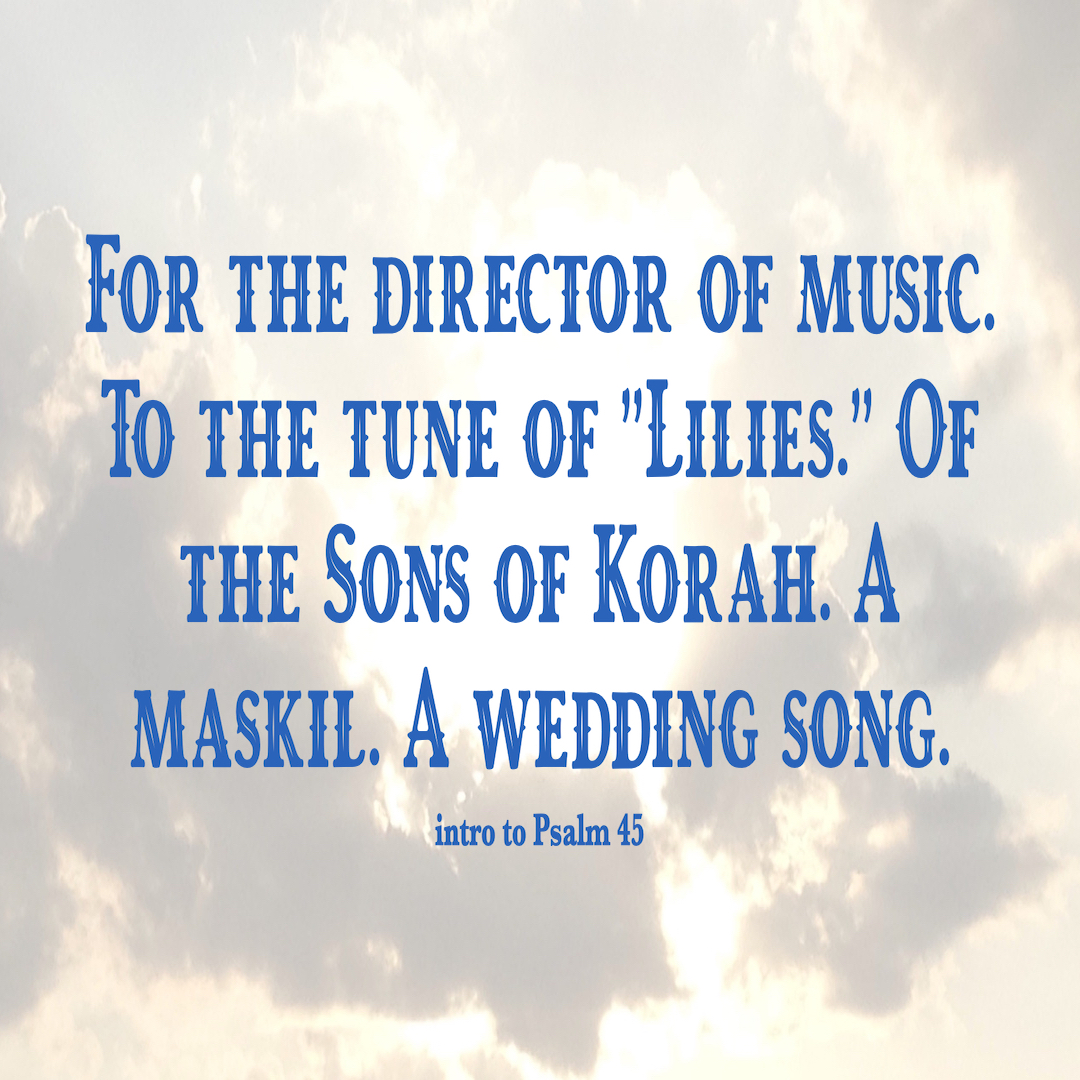
I’m intrigued by the preamble to this Psalm, as it is longer and more descriptive than most.
For the director of music—appears 55x in the Psalter.
To the tune of “Lilies”—appears only here and Psalms 69 and 80.
Of the Sons of Korah—these are the skilled worship leaders. There are 11 songs written by them or for them.
A maskil—this means it is to be a reflective song and is used 13 times.
A wedding song—sometimes called a “song of love” in some translations. This Hebrew word is used 9 times in the Old Testament, always in poetic form, but Psalm 45 is the only instance it is said to be a wedding song.
When we combine the beauty of lilies, the reflection of a maskil, and the skill of the Sons of Korah, we have a unique arrangement for a fairy tale-like romance that is culminating in a royal wedding.
So I ask you to imagine this royal wedding ceremony where this song is sung from the perspective of the bride who is about to become royalty. As we see King David standing at the front awaiting his bride, let’s watch the scene expand to find King Jesus standing and awaiting His Church.
Psalm 45:1-2 … Hear the bride, “How handsome You are, my Beloved! Oh, how charming!” (Song of Songs 1:16), and hear the wedding guests Revelation 19:6-7.
vv. 3-7 … see the King standing with all the trophies of victories He has won. Verse 7 is quoted by the writer of Hebrews, specifically stating, “But about the Son [God] says…” (Hebrews 1:8-9). Also see Revelation 19:11-16.
v. 8 … the aroma of victory is on the King and imputed to the Bride (Song 1:3; 2 Corinthians 2:14-15; Song 1:12).
vv. 9-15 … the King is enthralled with the beauty of His Bride (Revelation 19:7-8; Song 1:15; Ephesians 5:25-27).
vv. 16-17 … a blessing is pronounced on the couple (Ephesians 5:32).
When we are enthralled with our King—when we only have eyes and hands and heart for Him—we are a pure virgin in His sight (2 Corinthians 11:2). But we are also a testimony to those who watch us watching our King.
Just as royal weddings on earth captivate people who are watching the fairy tale-like wedding celebration, so will our devotion to the King intrigue and captivate a watching world. Notice again verse 17, “the nations will praise You for ever and ever.” When we love our King with all our heart, soul, mind, and strength, and then love others with that same love, we will draw the nations to our King (Revelation 22:17).
If you have missed any of the other messages in our series looking at the Royal Palms, you can find them all here.








 Craig T. Owens