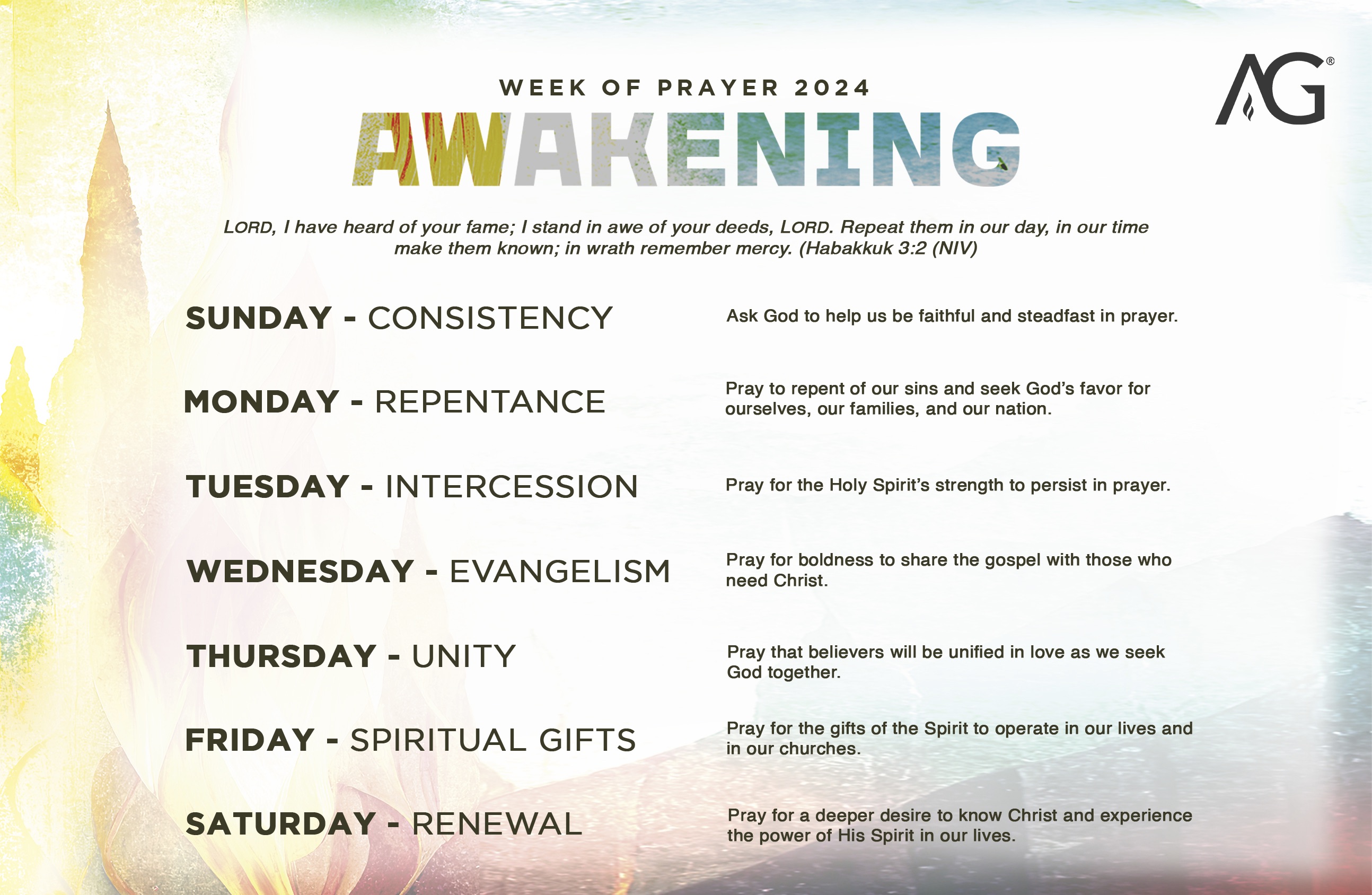
I grew up with a phrase ringing in my ears, “The Church moves forward on its knees.”
I believe this is true! We cannot expect to be effective in any kingdom-building endeavor if we are not empowered by heavenly help. So we like to begin each new year with a dedicated week of prayer. I invite you to join us in kicking off the new year with a renewed passion for prayer.
My friend Douglas Carmel shared this amazing article in one of his recent ministry newsletters. I have reprinted it here with his permission—
Has this ever happened before in the history of the world? That a people should go into exile, be dispersed, and yet survive for 2000 years without a national homeland. And then to come back again—speaking their same language and returning to their same capital city. This alone should make an atheist question their atheism. Why? This is a miraculous, singular event. No country had ever done such a thing before in the history of mankind, except Israel. And yet, this is exactly what was foretold in the Hebrew Scriptures.
The prophet Ezekiel also stated God’s promise: “For I will take you from the nations, gather you from all the lands and bring you into your own land” (Ezekiel 36:24).
Also, in Ezekiel 37, there is an unforgettable vision of a valley of dry bones. The bones come to life in stages: first sinews on the bones, then flesh, then skin, and finally, the breath of life (Ezekiel 37:6–10).
God then explains this vision to Ezekiel: “Son of man, these bones are the whole house of Israel” (Ezekiel 37:11). In other words, this is a prophecy about the Jewish people’s restoration to their Promised Land from all around the world. It is well in keeping with what we see actually occurring during our lifetime. Namely, the regathering of Israel will occur in stages, which it has done and is still doing.
So how did we get to the State of Israel today?
Let’s go back to the first and second centuries, just past the time of Jesus/Yeshua. Deuteronomy 28 contains prophecies regarding this second dispersion. It should be noted that this second dispersion was “…from the one end of the earth even unto the other” (v. 64). This was to be a global dispersion, unlike the first one, which was just to Assyria and Babylon.
Just after the time of Yeshua/Jesus, Israel rebelled against Roman rule. In 70 AD and again in 135 AD, Jewish rebels sought to fight against Rome. In response, the Roman army destroyed Jerusalem and its Temple under Titus in 70 AD, and the Jewish people were either killed or expelled from their land by Roman force. Under the rule of the Roman Emperor Hadrian, the Jews were dispersed all over the world by 135 AD. These facts are well-known in secular history sources as well.
At this time, it was the Romans who changed the name of the land of Israel to Palestine. That was done to rub salt in the wounds of the Jews by changing the name of their beloved homeland to that of their ancient foes, namely, the Philistines (think Goliath’s people).
It is important to note that while the Jewish people as a whole were dispersed by the second century, there always remained a small remnant of Jewish people scattered throughout the land, living in small communities. (Note: There is much more history involved than we can list here in this short article.)
After the Romans, came the Muslims. Except for a short time during the Crusades, the land was continuously ruled by Muslim Empires. That brings us to modern times. The British won the land of “Palestine” from the Ottoman Empire during World War I. About this time, Jewish people began to return in large numbers in the late 1800s. Eventually, the British army pulled out of “Palestine” in 1948 after the UN had given Israel the right to exist (as if they needed that approval). On May 14th, 1948, the State of Israel was reborn, and the name “Palestine” was dropped.
Israel was attacked the very next day by all their neighbors, and guess what? Against all odds, Israel won!
After several more wars that Israel had to fight for their survival, they still exist, and thus you see the headlines today. As you can deduce, this is an extremely short breakdown of Jewish history in the land. There were many more details involved, which we skipped over.
Now, mind you, we are not saying that Israel today is just fine without their Messiah (they are not), nor are we saying that the secular government of Israel is perfect (they are not). But we are saying that, in the big picture of things, Israel being back in her land after 2000 years is something to take note of.
It is indeed a miracle, and those who call for her eviction again “from the land to the sea” are unknowingly fighting against God’s miracle.
Listen to the podcast of this post by clicking on the player below, and you can also subscribe on Apple, Spotify, or Audible.
I once worked with a guy that was the epitome of “all talk and no action.” After a while people just stopped listening to him or believing anything he said. But something worse is someone who says he will do something but doesn’t have the power to finish what he started. In that case, you may have believed him and not taken any steps of your own, so when he finally admits defeat, you are totally unprepared to step in to help finish the task.
I think that comes close to the two attitudes people had prior to the First Advent of Jesus in Bethlehem. Some people thought all of God’s promises had just become “all talk and no action.”
But after Jesus began His public ministry, His skeptics may have originally thought He was also“all talk and no action,” but when they saw how the people responded to Him, they realized He at least had the power to sway a crowd. But they certainty didn’t think He could finish what He started.
The religious elite—the Sanhedrin—had their own plans in the works, and it appeared to them that Jesus was just going to get in the way. So they hatched a plan to have Pontius Pilate, the Roman governor, have Jesus crucified. As Jesus is hanging on the Cross, you can hear the skepticism and derision in the voices of these religious elite—
In the same way the chief priests, the teachers of the law and the elders mocked Him. “He saved others,” they said, “but He can’t save Himself! He’s the King of Israel! Let Him come down now from the Cross, and we will believe in Him. He trusts in God. Let God rescue Him now if He wants Him, for He said, ‘I am the Son of God.’” (Matthew 27:41-43)
After all, they had experienced “messiahs” before (Acts 5:35-37) so they thought this Jesus from Nazareth was just the next in a long line of pretenders. “King of Israel, indeed! Ha!”
But when someone tells you what they are going to do, and then they actually do it, skeptics are turned into believers. We see this happen in people like Nathaniel, a whole village of Samaritans, and one of the thieves that was crucified alongside Jesus (John 1:43-51; John 4:9-42; Luke 23:39-42)
Even though Jesus told His disciples exactly what was going to happen to Him in Jerusalem—and then it did!—they were still skeptical of the claims of His resurrection until they saw it for themselves (Matthew 20:18-19; John 20:3-8).
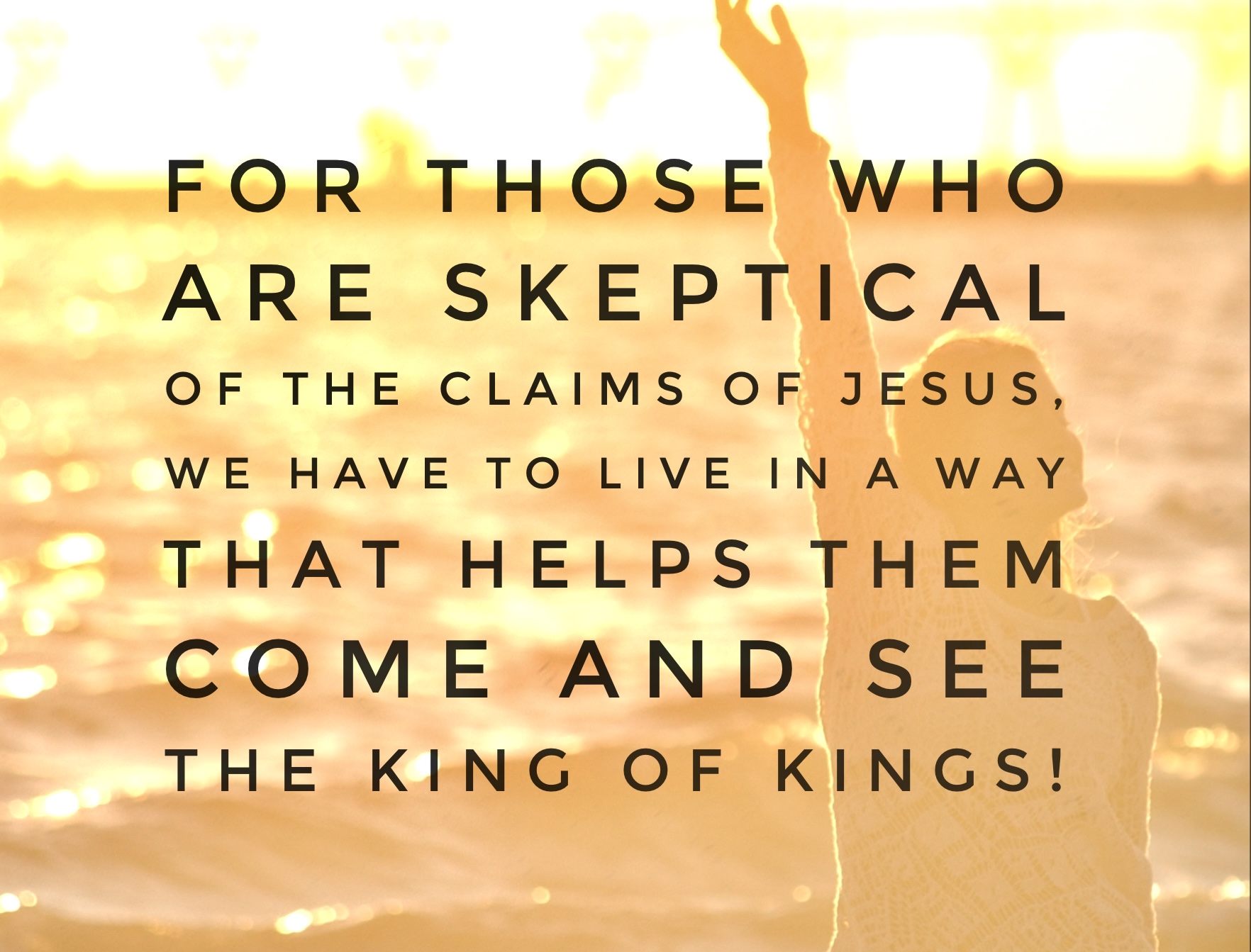
Skeptics need to see and hear for themselves that Jesus has the power to do what He says He will do. We are the ones that preach this Good News to them by the way we live.
We have to live as good citizens of the King of kings so that people will “come and see” what a good and loving King He is. For those who are skeptical of the claims of Jesus the King, we have to live in a way that makes it real. We have to help them see the King of kings!
Advent isn’t just a long-ago event that we fondly remember. The First Advent is proof that God has the power to keep His word. And just as wehave seen the First Advent, so we will see the Second Advent.
King Solomon has two phrases that help us keep a biblical perspective. If we miss this, Solomon says, we are going to experience a lot of frustration. I have lots of new content every week, which you can check out on my YouTube channel.
The angel told Joseph what he needed to do, and Joseph responded immediately. This is how we should live too—No complaints, no excuses, just obedience.
“If we as leaders do not model, we lose moral authority. … The goal of teaching and preaching is not to inspire, but to transform, and transformation at the spiritual and moral level can only be instigated and maintained if the speaker is authentic. We cannot call others to abide if we do not abide, to holiness if we are not holy, to sacrifice if we do not sacrifice, to evangelism if we do not evangelize, or to Jesus if we are not with Him ourselves. … The steady legitimacy of our deeds prove the worth of our words. We demonstrate our words are worthy by living them.” —Dick Brogden, in Proverbs: Amplified and Applied
T.M. Moore writes, “In ancient Israel the tithe was a uniform rate for all people, regardless of income, social standing, or need. Everyone was expected to bring a tenth of his wealth—much of this in the form of property (animals or harvests)—to be administered by priests and Levites for the upkeep of the spiritual life of the nation. In our country, graduated tax rates, accompanied by a variety of flat taxes, have become the means for creating an ever-expanding central government and an entitlement society in which nearly half the population pay no income taxes at all and, thus, receive many services from the State at the expense of those who do pay taxes. (As an aside, it’s interesting to note that one of the early arguments for a graduated income tax appeared not in The Federalist Papers but in The Communist Manifesto.) It’s not difficult to see how such a system of taxation can be used to curry favor and purchase political power.” Check out all of T.M.’s posts in this excellent series.
J. Warner Wallace proposes that we should look at the fact that our Earth is “just right” as evidence of an intelligent Creator.
Listen to the podcast of this post by clicking on the player below, and you can also subscribe on Apple, Spotify, or Audible.
The book of Judges in the Bible records a dark time in Israel’s history. There is a phrase that is repeated multiple times in that book, “In those days Israel had no king; everyone did as they saw fit” (Judges 17:6, 18:1, 19:1, 21:25). The absence of godly leaders setting a God-honoring example for the people led to some ugly behaviors!
The Book of Ruth (which is set during this same time period) opens with the words, “In the days when the judges ruled, there was a famine in the land” (Ruth 1:1). This famine of both godly leadership and good harvests led Elimelech to leave Israel and allow his sons to marry women they shouldn’t have married. It also prompted opportunity seekers to seize Elimelech’s land, so that when his widow Naomi returned with her daughter-in-law Ruth, there was no source of income for them.
One godly leader, a prophetess named Deborah, held firmly to God’s word. Her unwavering devotion to God was an encouragement to Barak to lead his armies to victory over their oppressors. In her song after the victory was secured, Deborah sang—
When leaders lead in Israel, when the people willingly offer themselves, bless the Lord! … My heart is with the rulers of Israel who offered themselves willingly with the people. Bless the Lord! (Judges 5:2, 9 NKJV)
Notice this vital principle:
A mark of a godly leader is one whose obedience toward God helps others obey God.
Deborah’s obedience helped Barak obey God.
We see this again in the Book of Ruth when Boaz obeys God’s command to fulfill his responsibility as Naomi and Ruth’s kinsman-redeemer. His obedience helped Ruth also obey God.
Even in the New Testament, Joseph is a phenomenal example of this principle. Every single time the angel of God speaks to him about what he should do, Joseph’s immediate response is obedience. And then Matthew records that Joseph’s obedience is directly tied to prophecies about Jesus being fulfilled (Matthew 1:20-24; 2:13-15, 19-23).
Godly leaders must go first! When we are the first in obedience—no matter how difficult it may seem in the moment—we make it possible for others to obey God themselves.
This is part 75 in my series on godly leadership. You can check out all of my posts in this series by clicking here.
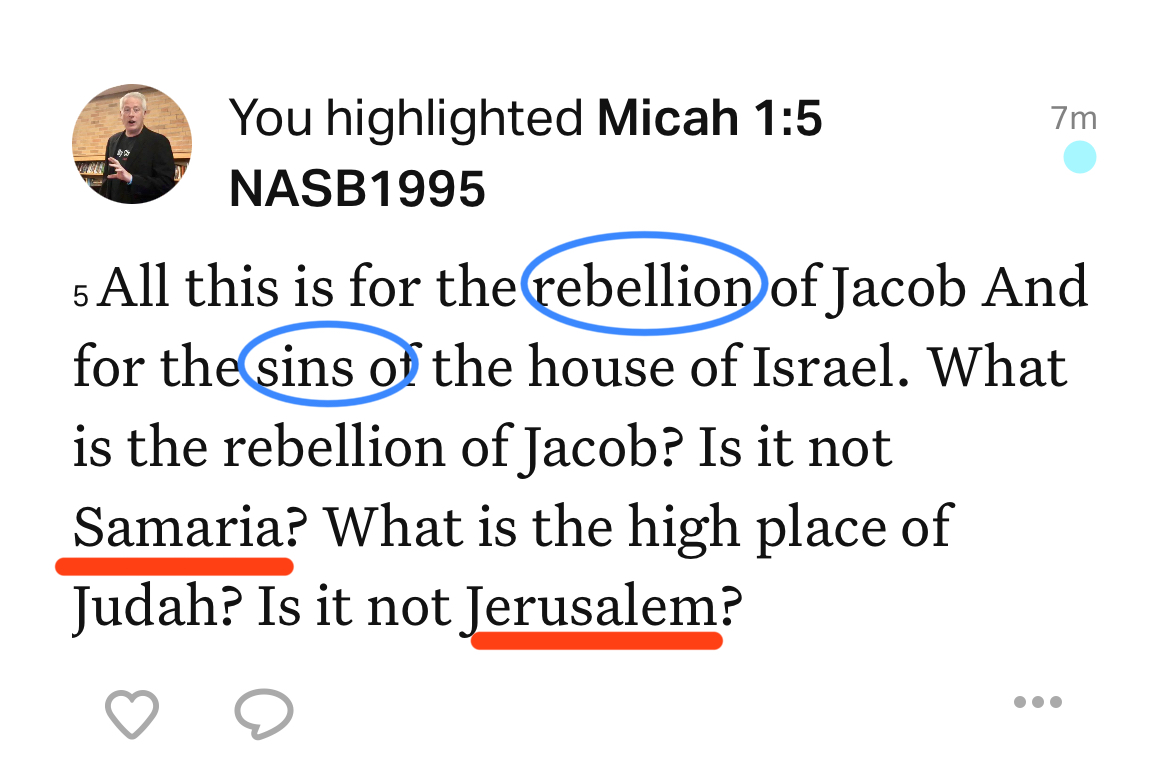
Micah the prophet said that the “high places” (or the places everyone looked to for their directions for how to live) had become Samaria and Jerusalem. These are the places where the kings sat—the political places, the places where men exerted their influence.
We can make politicians our gods—our high places—when we allow their words to carry more weight than God’s Word. As Chuck Colson used to say, “Salvation doesn’t arrive on Air Force One.”
Our problem is a singular problem: sin.
Our solution is just as singular: Jesus.
Stop elevating man’s opinion. Stop looking to humans to fix a spiritual problem. Don’t make high places on earth, but look to our Heavenly Father to bring His Kingdom on earth.
”Though all the peoples walk each in the name of his god, as for us, we will walk in the name of the Lord our God forever and ever.“ (Micah 4:5).
Listen to the podcast of this post by clicking on the player below, and you can also subscribe on Apple, Spotify, or Audible.
I did a series of Advent messages a few years ago called “The Carols of Christmas” with the premise that many of our old familiar carols had become too familiar and we had lost the true meaning in those beautiful songs.
I think the same is true with the sentiment of wanting to experience the glory of God. Sometimes you will hear people say, “We just want to see God’s glory!” but I’m not sure they really mean this or really want it.
Throughout the Bible, “glory” comes from the Hebrew word which means weightiness. When God appears—or even one of His angels glowing with His glorious presence—people collapse under the weight of His glory. Look at the examples of Moses, Isaiah, Daniel, and even John the beloved disciple of Jesus (Exodus 3:6; Isaiah 6:3-5; Daniel 8:15-17; Revelation 1:12-17).
In the light of Christ’s glory everything is exposed. We have no excuses for our sin. We are seen exactly as we are, and the fear of God’s judgment causes us to collapse under that weight.
But the First Advent story is filled with the phrase “Fear not.” Let me show you two examples. First, notice the strong emotions when the angels appear to the shepherds—
An angel of the Lord appeared to them, and the glory of the Lord shone around them, and they were terrified. But the angel said to them, “Do not be afraid. I bring you good news that will cause great joy for all the people.” (Luke 2:9-10)
What was this good news that would turn their fear into joy? Listen to the angelic message to Joseph—
Joseph son of David, do not be afraid to take Mary home as your wife, because what is conceived in her is from the Holy Spirit. She will give birth to a Son, and you are to give Him the name Jesus, because He will save His people from their sins. (Matthew 1:20-21)
Notice the phrase, “HE will save His people from their sins.” Part of what contributes to our fear of God’s glorious presence is knowing that we are helpless to remove our sins. The fact that Jesus would do this for us was foretold in prophecies like Isaiah 25:7-9 and 59:15-16.
How will Jesus do this? In 1 Corinthians 15:53, Paul says that in order to enter into God’s presence our perishable, mortal lives have to be exchanged for something imperishable and immortal. We are unable to do this, but in the Incarnation, the immortal God put on mortal flesh!
Paul goes on in 1 Corinthians 15 to say, “When the perishable has been clothed with the imperishable, and the mortal with immortality, then the saying that is written will come true: “Death has been swallowed up in victory.” Where, O death, is your victory? Where, O death, is your sting?” (1 Corinthians 15:54-55)!
If our sins were still clinging to us, spending eternity in the presence of the King of Glory would be torturous! Our fear of His weighty glory is only changed into joy when we accept that He has saved us from the penalty of our sins. Now our fear of His glory isn’t a crippling fear, but as we worship Him for His salvation our fear becomes reverential worship.
Or we could say it this way—When we fear the King of Glory we fear nothing else!
Charitie Lees Bancroft captures that idea in these stanzas of her poem:
When satan tempts me to despair
And tells me of the guilt within,
Upward I look and see Him there
Who made an end of all my sin.
Because the sinless Savior died,
My sinful soul is counted free;
For God the Just is satisfied
To look on Him and pardon me.
Behold Him there! The risen Lamb,
My perfect, spotless righteousness;
The great unchangeable “I AM,”
The King of glory and of grace!
One with Himself I cannot die,
My soul is purchased by His blood;
My life is hid with Christ on high,
With Christ, my Savior and my God.
With our sins forgiven by our faith in Jesus, we can now enjoy an eternity in the weighty, awesome presence of the King of Glory!



 I grew up with a phrase ringing in my ears, “The Church moves forward on its knees.”





 Craig T. Owens