Jesus—100% God And 100% Human

Listen to the podcast of this post by clicking on the player below, and you can also subscribe on AppleSpotify, or Audible.

On paper, it seems so simple: “We believe in the Deity of the Lord Jesus Christ. As God’s Son, Jesus was both human and divine.” But trying to wrap our finite human minds around the concept of the full humanity and the full deity of Jesus is challenging!

First off, Jesus was fully human. Both Matthew and Luke record details about Christ’s physical birth, and the writer of Hebrews says that Jesus was made every bit as human as us (Hebrews 2:17).

But Jesus was also fully God. John records how God became flesh in the Person of Jesus (John 1:1-2, 14), and Paul tells us how Jesus chose not to use His deity when He came to earth as a human (Philippians 2:6-8).

I know that anytime we say, “God is like…” we’ve already sold ourselves short, but I’d like to try one analogy that’s been helpful for me.

Imagine a coin that has two distinct sides. While we are looking at one side (heads), we cannot see the other side (tails) but that doesn’t mean the other side has ceased to exist. In fact, if we were able to split that coin in half, so that there was only a heads and a tails, we haven’t cut the value of the coin in half, but we’ve made the coin of no value at all! 

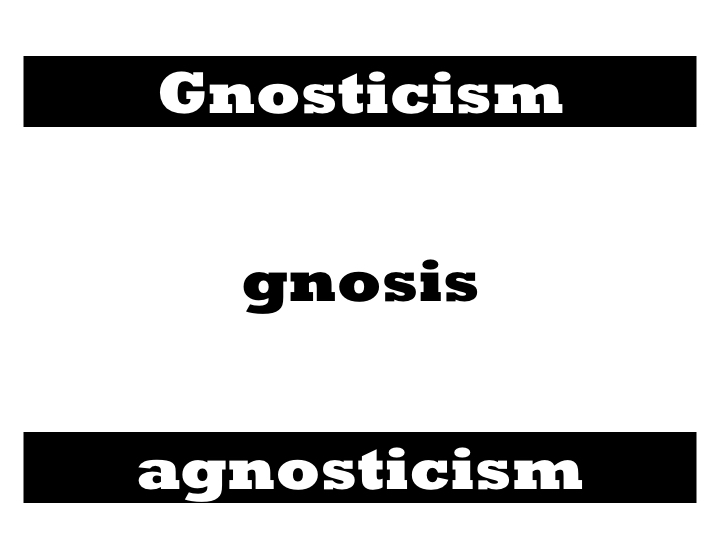
In the Greek language of the New Testament, there are a couple of words for “knowing”: one is gnosis and the other oido. Together these words combine head knowledge and heart knowledge, or knowledge by study and knowledge by experience.

C.S. Lewis captures the idea this way: “It is Christ Himself, not the Bible, who is the true Word of God. The Bible, read in the right spirit and with the guidance of good teachers, will bring us to Him.”

Just as Jesus was both God and Man, we are to use both our mind and our heart to know Him.

To focus on the “heads” side—the deity of Jesus—is to pervert gnosis into gnosticism, and deny the humanity of Jesus. To focus on the “tails” side—the humanity of Jesus—is to pervert gnosis into agnosticism, and deny the deity of Jesus. True gnosis keeps both sides in mind: Deity and humanity.

To truly know THE Word of God (Jesus) in all His humanity and in all His deity, we need to study the Word of God. We also need the help of the Holy Spirit. I like the Old English wording of this verse—Ye have an unction [charisma] from the Holy One, and ye know [gnosis] all things (1 John 2:20).

So read your Bible, but not just to read your Bible. Ask the Holy Spirit to make THE Word known to you. Live in the balance of gnosis as you get to know Jesus more deeply and personally.

(When Jesus proclaimed His “I Am” statements in the New Testament, He was tying Himself to all of the “Jehovah” titles of the Old Testament. Check out I Am Jehovah.)

This post is a part of our series studying our foundational beliefs. If you would like to read more about the first foundational beliefs we have discussed, check out this post on the inspiration of Scripture, and this post on the Trinity.

►► Would you please prayerfully consider supporting this ministry? My Patreon supporters get behind-the-scenes access to exclusive materials. ◀︎◀︎

Poetry Saturday—Wait, Trust, Rest

butterflyWait patiently wait,
God never is late;
Thy budding plans are in Thy Father’s holding,
And only wait His grand divine unfolding.
Then wait, wait,
Patiently wait.
Trust, hopefully trust,
That God will adjust
Thy tangled life; and from its dark concealings,
Will bring His will, in all its bright revealings.
Then trust, trust,
Hopefully trust.
Rest, peacefully rest
On thy Savior’s breast;
Breathe in His ear thy sacred high ambition,
And He will bring it forth in blest fruition.
Then rest, rest,
Peacefully rest! —Mercy A. Gladwin

Real Faith Is Dangerous

the-bad-habits-of-jesus“We all need to learn the relationship between real faith that could put us into dangerous situations and the real danger of misinterpreting the Scriptures to our own advantage. Wrong interpretations can yield pharisaical commitments to practices and rituals rather than to the Person of Jesus. But true faith that walks the talk and toes the line of true discipleship can be downright dangerous. This is the line the Jesus regularly walked, and it is the same line that He still calls His followers to find and walk today.

“Faith is not a synonym for fail-safe.” —Leonard Sweet, in The Bad Habits Of Jesus

Thursdays With Oswald—A Biblical View Of Government

Oswald ChambersThis is a weekly series with things I’m reading and pondering from Oswald Chambers. You can read the original seed thought here, or type “Thursdays With Oswald” in the search box to read more entries.

A Biblical View Of Government

     The Bible point of view about government is that God compels men to govern man for Him, whether he likes it or not. The ordinance of government, whether it is a bad or good government, does not lie with men, but is entirely in God’s hands; the king or the government will have to answer to God (cf. 1 Peter 2:13-14). … 

     In politics also it is difficult to steer a course; there is a complication of forces to be dealt with which most of us know nothing about. We have no affinity for this kind of thing, and it is easy to ignore the condition of the men who have to live there, and to pass condemnation on them. … It is easy to condemn a state of things we know nothing about while we make excuses for the condition of the things we ourselves live in. … 

     We say, “Why does God allow these things? Why does He allow a despot to rule?” In this dispensation it is the patient long-suffering of God that is being manifested. God allows men to say what they like and do what they like (see 2 Peter 3:14). Peter says that God is long-suffering, and He is giving us ample opportunity to try whatever line we like both in individual and national life. If God were to end this dispensation now, the human race would have a right to say, “You should have waited, there is a type of thing You never let us try.”

     God is leaving us to prove to the hilt that it cannot be done in any other way than Jesus Christ’s way, or the human race would not be satisfied.” 

From Shade Of His Hand

Oswald Chambers wrote these words during The Great War (what we now call World War I), when everyone was questioning how governments could do such horrendous things.

I think Chambers sums up how a Christian should respond to earthly governments:

  1. Remember they are placed in their positions by God, so treat them with respect (Romans 13:6-7).
  2. Don’t condemn government officials, but pray for them  (1 Timothy 2:1-2).
  3. Clean up the areas where we can clean up, and let the politicians clean up their own areas.

9 Quotes From “Take Your Life Back”

take-your-life-backStephen Arterburn and David Stoop have given us a great resource if we are struggling to free ourselves from the wounds that are trapping us in a reactive life. I truly believe Take Your Life Back will start many people on a journey of healing. Check out my full book review by clicking here, and then check out a few quotes from this helpful book.

“When we’re constantly looking at what’s happening with other people and measuring our satisfaction based on how fairly we feel we’ve been treated, we are forever at the mercy of what is going on over there. We’ve wired ourselves to react to whatever scale of comparison we’ve established.”

“The real self, quite simply, is the self that God sees. He sees it all, with all its flaws. He does not approve of or endorse everything He sees, but He loves the person He sees. He does not see an idealized self, free of sin. He sees the real self—sinful, doubtful, and flawed—and yet He accepts the reality of it and loves us in spite of it all.”

“Our reactions to pain and our adaptations to it are unique to ourselves; we are not all the same. But we have several things in common: In one way or another, we have turned our back on reality, and we have allowed all, or portions, of our lives to be controlled by another person, a destructive pattern, or unrealistic expectations. We live on the edge of almost. We are almost breaking free, or we are almost free. We are almost fed up or almost ready to take our lives back.” 

“Denial keeps us from addressing the things we can change, causing us to think that our inability to change everything means we can’t change anything. … Because we either don’t or won’t see how far we are from living the life that God intends for us, we stay in our denial and wait for the magic cure that never materializes. But when we admit that we’re in denial, and when we are willing to break through it, we can begin to move into recovery.”

“When we talk about the elephant in the room, we have a way of describing it as a small rodent. Our internal application for minimizing language automatically converts words like pain into irritation; devastating into difficult; abusive into insensitive; and horrific into unpleasant. Our self-talk is unrealistic, so whenever we communicate with someone else, we present our overwhelming problems as manageable situations that we have completely under control. Because we don’t acknowledge the full scope and intensity of our struggles, we don’t act in realistic ways to free ourselves and take our lives back. We minimize in order to give ourselves permission to do little or nothing to change.”

“Toxic shame undermines our will and our power to stand up for ourselves. … Toxic shame carves out a new normal for those who partake of its poisonous fruit. Rather than seeing themselves as human beings who have made a few mistakes—maybe even some really big mistakes—people who are saturated with toxic shame see their failures as an objective expression of who they are. Before long, they don’t even try to avoid future mistakes. They don’t learn from their errors because they don’t think they can, or need to, learn anything. Repeated mistakes are simply a self-fulfilling prophecy that their shame as written for them. …

“Toxic shame…blinds us to wisdom and insight. It prevents us from cleaning up after ourselves. We start to live in the debris of past mistakes, and that leads us to more debris-producing decisions. We fill our lives with problem after problem because we don’t think we can do any better.”

“There is such a thing as good shame. A better term for it might be godly sorrow. …

“Godly sorrow is a warning sign that we are on the wrong path and need to make some adjustments. Any mistakes we make are not seen as the inevitable result of who we are but as stark reminders that—because of who we are, created in the image of God—we can do better. We are genuinely sorry that we fell short, hurt ourselves or other people, or simply created a lot of hassle that has kept us from living in the good things that God has for us. However, our defective behavior is rightly seen as separate from our identity. Making a mistake doesn’t mean that we are a mistake; it’s simply evidence that we are like every other human being—completely capable of many things, including mistakes. …

“Godly sorrow is a prompt from God, and from a well-developed conscience, that we need something more to achieve all that we want to accomplish. We respond to healthy shame with the desire to get better or do better….”

“Tough love says that I will choose to not give you what you want if it prevents you from attaining what you need.”

“Taking your life back is not just about deciding to defend yourself. It is about finding and removing roadblocks, sinkholes, and dead ends that have disconnected you from other people and stopped your journey from going forward together.”