Notes From The Global Leadership Summit

I had an amazing time last week at the Willow Creek Global Leadership Summit. Every year I came away with some many thoughts, and a brand new passion for the various leadership roles in which I get to serve.

Below are just a few of my notes that I jotted down during an intense two days.
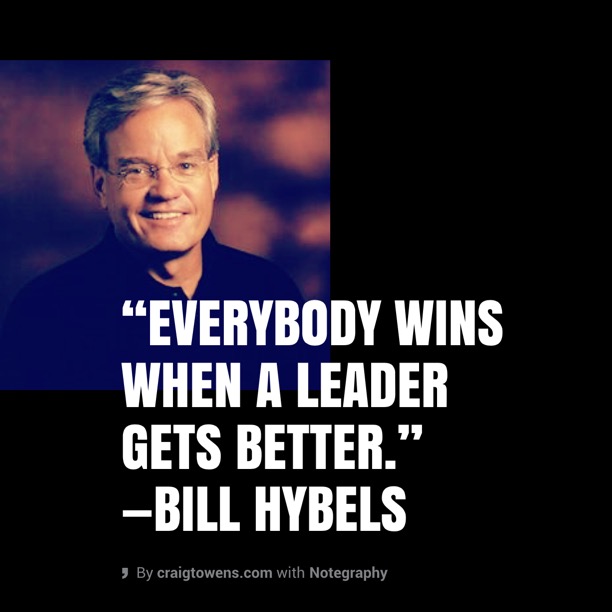
Hybels - everybody winsBill Hybels—The Lens Of Leadership

“Everybody wins when a leader gets better.”

“Armed with enough humility, leaders can learn from anyone.”

Hybels discussed four leadership lenses:

1.   Passionate leader (depicted by vibrant bright red frames)

  • They understand unbridled passion in leadership.
  • “Passion is like protein for the team.”
  • A motivated worked will outperform an unmotivated worker by 40%.
  • People are more motivated by working for a passion-filled leader than they are by compensation or perks.
  • Passion comes from a mountain-top dream, or a valley-deep frustration of current settings.

2.   People leader (cool frames, but cracked lenses)

  • An organization will only be as healthy as the top leader wants it to be.
  • This world needs more pastors of businesses, factories, medical offices, military units, etc.

3.   Performance leader (self-adjusting glasses)

  • Leaders ask: what progress should be made? how do we measure this? what doesn’t need to be measured?
  • Every worker wants to know how they are doing. For the leader, it’s cruel to hire someone and never let them know how they’re doing. Every staff member should get an update at least every six months.

4.   Legacy leader (sunglasses with a rearview mirror [cyclist])

  • Every once in awhile we need to look behind to see what legacy we’re leaving behind.
  • Leaders should reflect on this annually.
  • If my leadership assignment were to end today, what legacy would I leave?
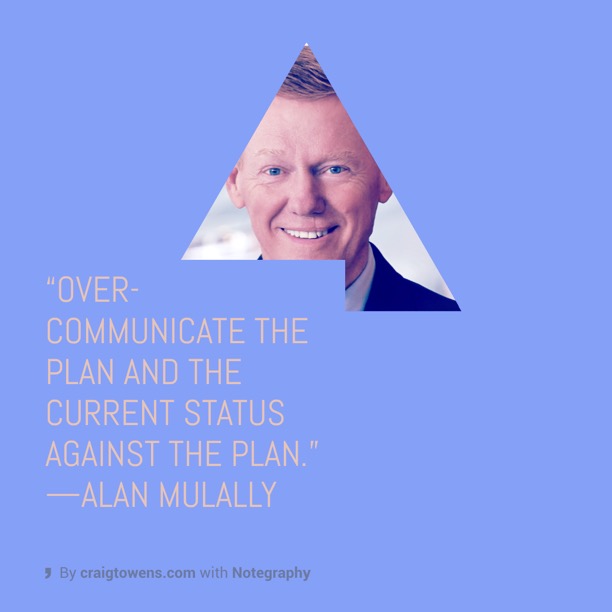
Mulally - overcommunicateAlan Mulally—CEO Boeing and Ford Motor Company

An average commercial airline has 4 million parts!

  • People first
  • Include everyone
  • Create a compelling vision
  • Present a workable strategy
  • Set clear performance goals
  • Relentless implementation
  • Share lots of data
  • “Over-communicate the plan and the current status against the plan.”
  • Instill a positive can-do attitude
  • Keep your emotional resilience
  • Have fun


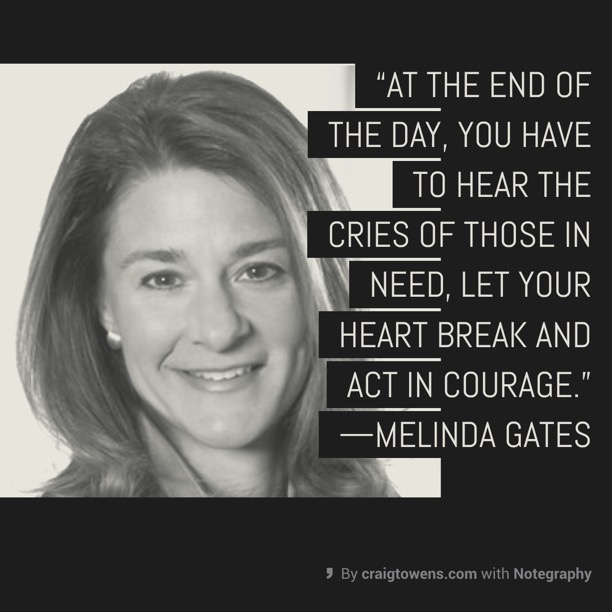
Melinda Gates - hear the criesMelinda Gates—Gates Foundation

Melinda says of herself, “I am an impatient optimist. We are changing the world, but we need to change it faster.”


“At the end of the day, you have to hear the cries of those in need, let your heart break and act in courage.”

Jossy Chacko—Empart

“All of us have been entrusted with something. What are we doing to leverage it?”

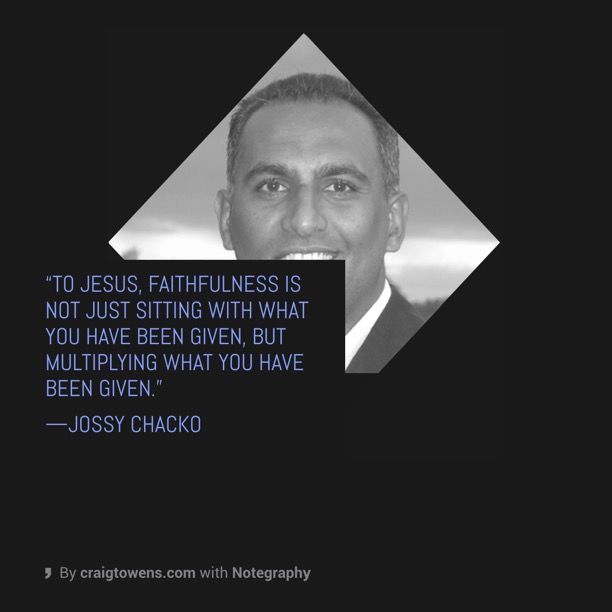
In thinking about the parable of the talents … “To Jesus, faithfulness is not just sitting with what you have been given, but multiplying what you have been given. God’s mission is not maintaining.”

“Playing it safe is not enough for a follower of Jesus Christ.”

Three principles for expanding our leadership reach:
Jossy Chacko - faithfulness1. Enlarge your vision

  • “When people hear my vision, they should know the size of my God.”
  • “An enlarged vision should keep us driven.”
  • “Do not be confused about what people say about your vision; trust what God has said to you.”

2. Empower your people

  • “Leadership is about taking wise chances and giving people opportunities.”
  • “Your leadership reach will be determined by your empowerment choices.”
  • Three things to keep in mind: (1) Focus on building their character before empowering them; (2) Empowerment has to be through relationship; and (3) Make sure we have agreed on the right outcomes, and have the right way to measure them.

3. Embrace risk

  • Faith = risk. Without faith it is impossible to please God = without taking risks it is impossible to please God.
  • Paradigms to be changed: (1) See risk as your friend to love, not as your enemy to be feared; (2) See comfort and safety as your enemies; and (3) Increase your pain threshold.
  • “Your leadership capacity is in direct relationship to your pain threshold.”
  • “Don’t allow the fear of losing what we have to lose what God has in store for you.”
  • “By me not taking risks, who is missing out?”
Bradberry - EQDr. Travis Bradberry—TalentSmart

All inputs into the brain travel through the limbic system first (emotional center) before the inputs travel to the frontal cortex. The EI (emotional intelligence) center is in the front of the brain, just above the left eye.

Only 36% of people are able to accurately identify their emotions as they happen.

EQ (the Emotional Quotient that measures emotional intelligence) is not IQ.

EQ can be improved all throughout life.

Four components of emotional intelligence:

 1. Self-awareness: knowing my emotions, and knowing my tendencies. I need to lean into my discomfort if I want to improve.

   2. Self-management: what I do with this increased self-awareness. This is not “stuffing” my feelings. The biggest mistake is only trying to manage negative emotions; positive emotions need to be managed too.

   3. Social awareness: focusing more on others than on myself.

   4. Relationship management: using the first three skills in concert. Seeing how my behavior is affecting the other person, and then adjusting accordingly.


How to increase my EQ:

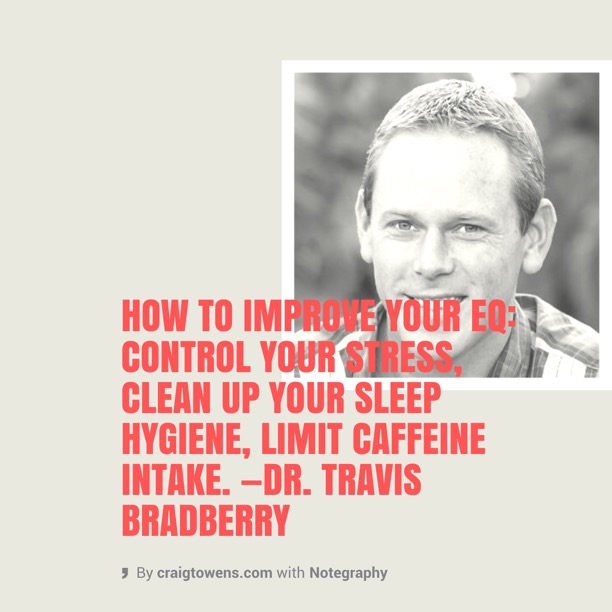
  1. Control stress—stress under control is healthy; chronic stress is unhealthy. Gratitude reduces the stress hormone cortisol.
  2. Clean up my sleep hygiene—sleep cleans up toxic hormones in the brain. To get better sleep: (1) Don’t take any kind of sleeping pill; and (2) Reduce “blue lights” in the evening.
  3. Reduce my caffeine input—especially after noon.
Ideal team playerPatrick Lencioni—Author

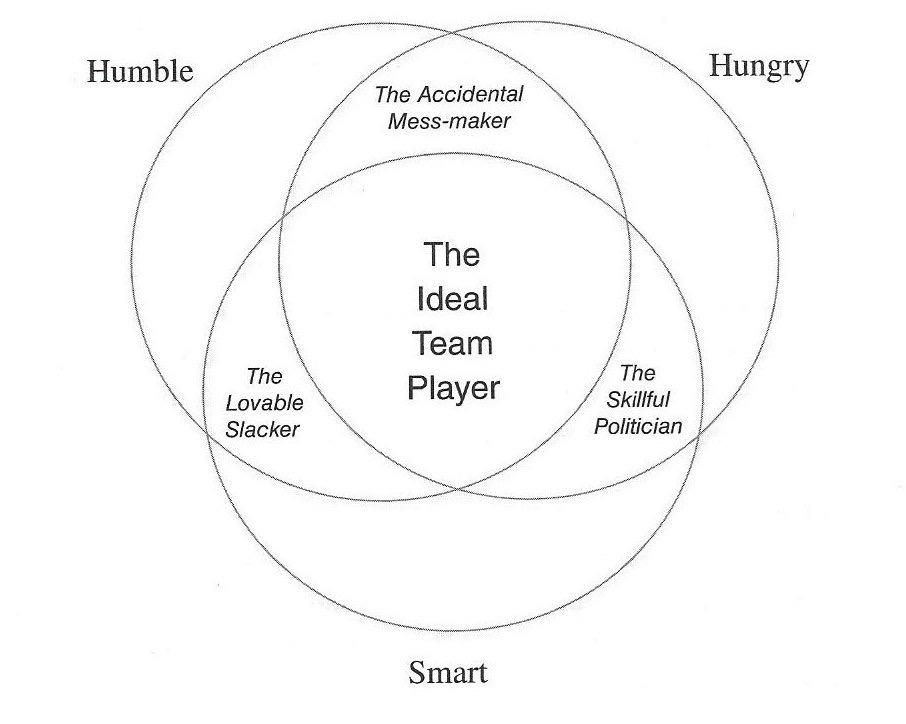
Three qualities of an ideal team player:

1.   Humble

  • Lacking self-confidence is not humility.
  • “Denying skills and downplaying abilities is not humility.”

2.   Hungry

  • Strong work ethic
  • Driving hard

3.   Smart

  • Not intellectual smarts, but people smarts = EQ

“To develop people, we have to have the courage to humbly and constantly talk to people about their ‘stuff.’”
McChesney - execution disciplinesChris McChesney—Franklin Covey

Rahm Charan asked:

  • Q: Do leaders struggle more with strategy or execution? A: Execution.
  • Q: Are leaders more educated in strategy or execution? A. Strategy.

“The hardest thing a leader will ever do is drive a strategy that changes someone’s behavior.”

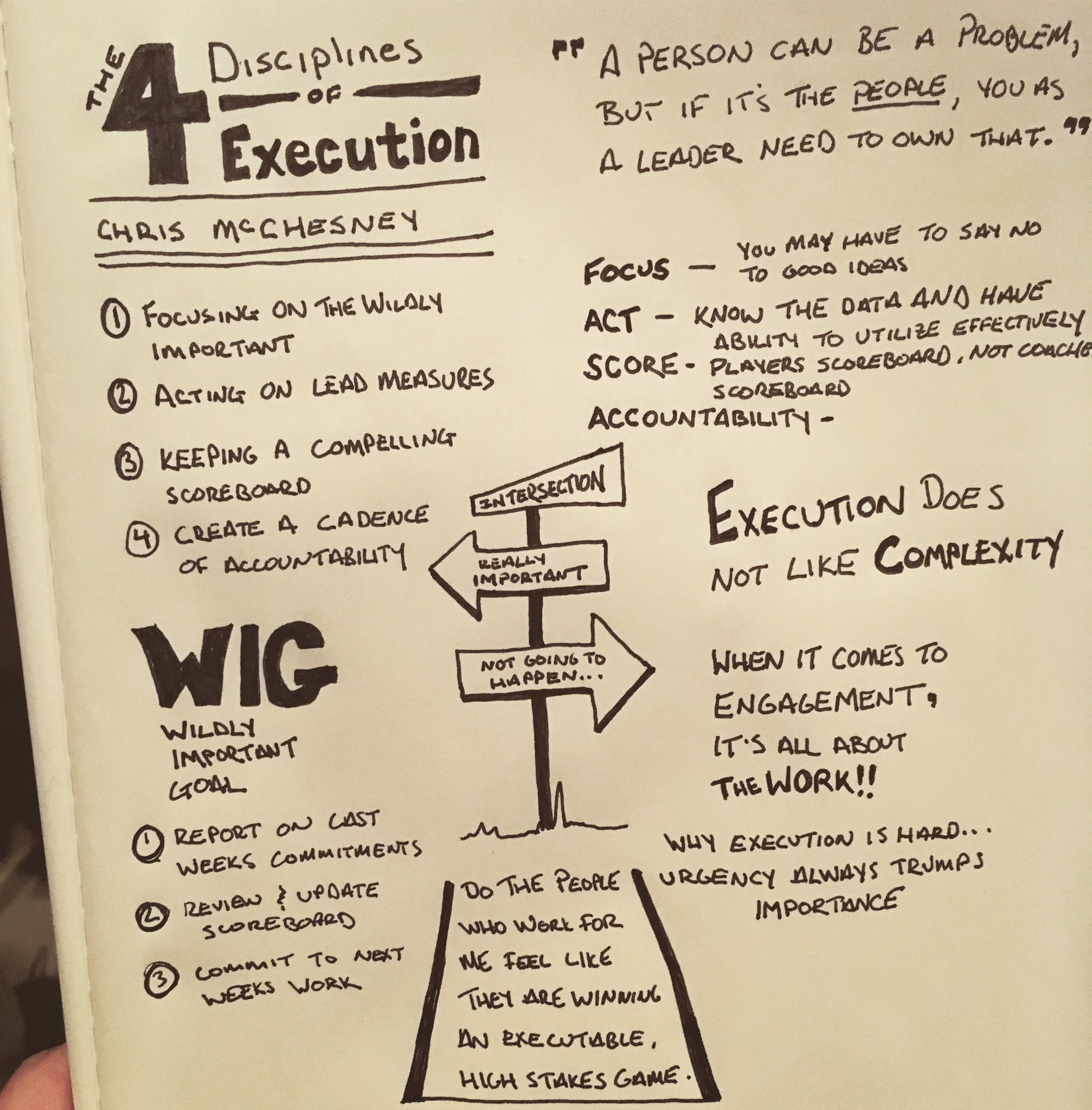
There are four disciplines for making changes in human behavior:

1.  Focus

  • “Focus on the wildly important.”
  • If a team focuses on 2-3 goals, they are likely to get them done. But if there are 4-10 goals, momentum is killed. At 11+ goals, the team is going backward.
  • We narrow the focus by coming up with a WIG: wildly important goal (this lives at the intersection of ‘really important’ and ‘not going to happen’).

2.  Leverage

  • “What are the fewest number of battles necessary to win the war?”
  • “When you want to go big, don’t think big, think narrow.”
  • One WIG per team at the same time. Everything else is in sustainment mode.
  • Make goals like this—“From x to y by when.”

3.  Engagement

  • “The biggest driver of engagement is when people feel like they’re winning.”
  • “Do the people who work for me feel like they’re playing a winnable game?”

4.  Accountability

  • Everyone needs to answer: “What are the things I do that have the biggest impact on the WIG?”
  • After sharing the scoreboard, allow people to determine what they need to do next. The people need to determine their own next moves, not the leader. The leader pulls this out of people.
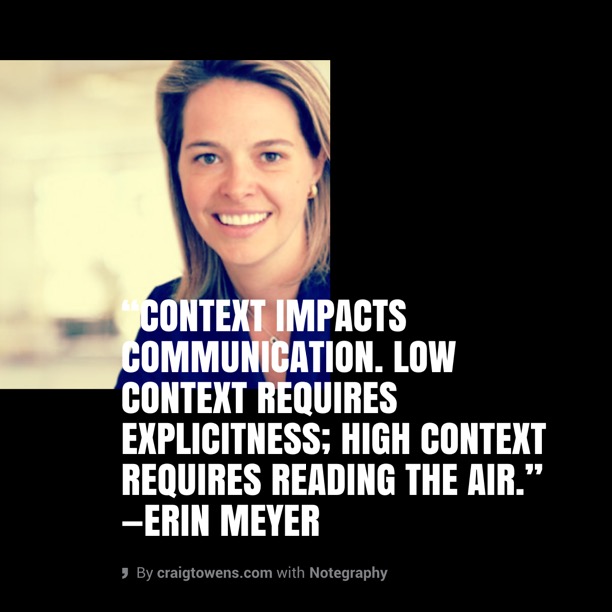
Erin Meyer - contextErin Meyer—INSEAD

On The Culture Map communication is divided into Low vs. High Context:

  • Low = feel we don’t have the same context or relationship. We feel we need to explain things very simply and explicitly.
  • High = we assume we have a larger body of shared reference points. We feel communication is more implicit or nuanced.

Anglo-Saxon countries are typically low context.

Latin American are mid-low.

Asian countries are usually high context.

In low context we tend to nail things down in writing, where in high context we leave things more open to later interpretation.

“Context impacts communication. … We need to read both the messages ‘in the air’ as well as the explicitly stately messages.”

“In a high context culture, repeat things less, ask more questions, learn to ‘read the air.’”
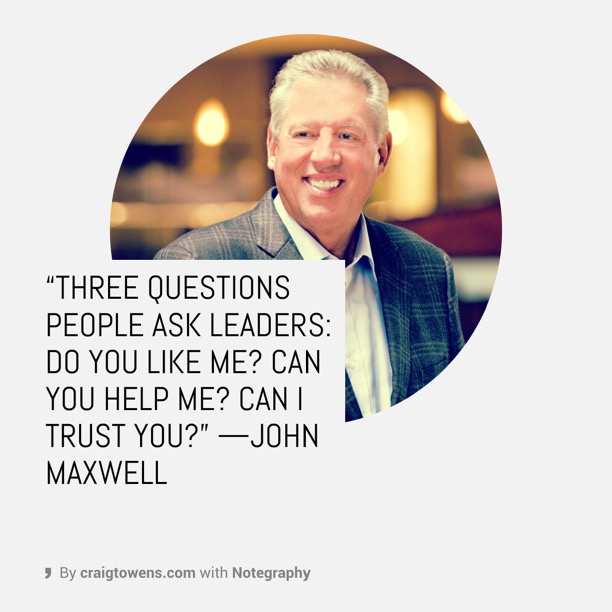
 

Maxwell - 3 questionsJohn Maxwell—Author 

“Good leaders lift.”

“You have to find the people before you lead the people.”

“The one thing leaders have to get right—they must intentionally add value to people every day.”


Five things that intentionally adds value to people:

  1. Value people—“God values people I don’t know; He even value people I don’t like.” “Are we going to spend our lives connecting with people, or correcting them?”
  2. Think of ways to add value to people—“Intentional living is thinking upfront on how to help people.”
  3. Look for ways to add value to people.
  4. Do things that add value to people.
  5. Encourage others to add value to people.

If you attended the GLS, please share in the comments below something amazing / challenging / paradigm-busting that you learned. Let’s all keep on learning!

Poetry Saturday—If We Could See Beyond Today

Field and sunIf we could see beyond today
As God can see;
If all the clouds should roll away,
The shadows flee;
O’er present griefs we would not fret.
Each sorrow we would soon forget,
For many joys are waiting yet
For you and me.

If we could know beyond today
As God doth know,
Why dearest treasures pass away
And tears must flow;
And why the darkness leads to light,
Why dreary paths will soon grow bright;
Some day life’s wrongs will be made right,
Faith tells us so.  

“If we could see, if we could know,”
We often say,
But God in love a veil doth throw
Across our way;
We cannot see what lies before,
And so we cling to Him the more,
He leads us till this life is o’er;
Trust and obey. —Norman J. Clayton

The Lesson Of The Lost Brooch

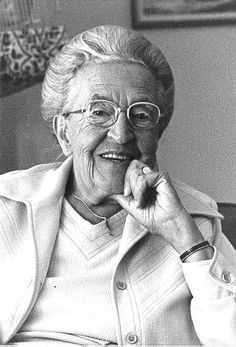
Corrie ten BoomCorrie ten Boom shares this memorable story about patience in her book I Stand At The Door And Knock

The old story of the lost brooch really helped me.

A lady lost a valuable brooch at the theater. She noticed it was missing when she arrived home. Early the next day she rang the caretaker of the theater and asked if he had found the brooch. “No,” he said, “but where was your seat? I will go and have a look if it is under your seat.”

“My seat was on the fifth row, number two.” The man went to have a look and found the brooch.

He went to the telephone and said, “Yes, I am pleased to tell you I found your brooch. Hello? Hello?”

There was no reply; she had impatiently hung up the phone. She will never know that her brooch was found.

The Holy Spirit teaches us to have great expectations for the Lord. Listen to the Lord. If you don’t hear His voice immediately, wait patiently. Waiting for the Lord is a blessing too. He is a good Shepherd. And a good Shepherd speaks to His sheep. Don’t put the receiver down too quickly. He loves you and has so much to say to you.

Thursdays With Oswald—Are You Self-Made Or God-Made?

Oswald ChambersThis is a weekly series with things I’m reading and pondering from Oswald Chambers. You can read the original seed thought here, or type “Thursdays With Oswald” in the search box to read more entries.

Are You Self-Made Or God-Made?

     It is possible to be perfectly real to ourselves but not real to God; that is not reality. It is possible to be perfectly real to ourselves and real to other people, but not real in our relationship to God; that is not reality. The only reality is being in harmony with ourselves and other people and God. That is the one great reality towards which God is working, and towards which we are working as we obey Him. … 

     The critical moment in a man or woman’s life is when they realize they are individually separate from other people. When I realize I am separate from everyone else, the danger is that I think I am different from everyone else. Immediately I think that, I become a law to myself; that means I excuse everything I do, but nothing anyone else does. ‘My temptations are peculiar,’ I say; ‘my setting is very strange; no one knows but myself the peculiar forces that are in me.’ … This sense that I know what other people do not know, that I have a special intuition that tells me things, is even more dangerous than the sense of individualism because it leads to spiritual deception in a religious nature and to hard intellectual conceit in a natural nature. … 

     Self-realization naturally cares nothing about God, it does not care whether Jesus lived or died or did anything at all. For ourselves we live and for ourselves we die; that is self-realization that leads to death and despair; it is absolutely and radically opposed to Christ-realization. True self-realization is exhibited in the life of Our Lord, perfect harmony with God and a perfect understanding of man; and He prays “that they may be one, even as We are one.” … 

     God’s purpose is to make us real, that is, to make us perfectly at one with all our own powers and perfectly at one with God, no longer children but understanding in our heads as well as in our hearts the meaning of the Redemption, and slowly maturing until we are a recommendation to the redeeming grace of our Lord Jesus Christ.

From The Philosophy Of Sin

Oswald Chambers says we have a choice: Will we try to be a self-made man or woman, OR will we allow the Holy Spirit to make us a God-made man or woman? Only the second option puts us in touch with ourselves, others, and God.

10 Quotes From “The Psychology Of Redemption”

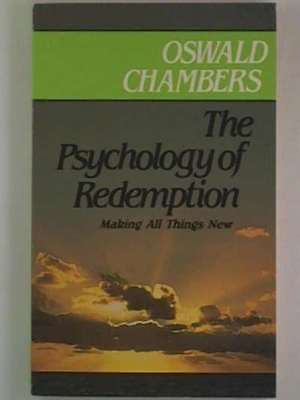
The Psychology Of RedemptionOswald Chambers always gives me a paradigm-expanding look at the Bible and Christianity. In The Psychology Of Redemption (see my book review here), he does so in a unique way, by joining psychology and theology. Here are just a few of the many, many passages I highlighted in this fascinating book.

“Christian Psychology is the study of a supernatural life made natural in our human life by the Redemption.” 

“Sin dwells in human nature, but the Bible makes it very clear that it is an abnormal thing, it has no right there, it does not belong to human nature as God designed it. Sin has come into human nature and perverted and twisted it. The Redemption of God through our Lord Jesus Christ delivers human nature from sin, and then begins the possibility of the manifestation of the life of Jesus in our mortal flesh. We are saved by God’s grace, but, thank God, we have something to do. We must take care to meet God’s supernatural work of grace by our human obedience.”

“The vital relationship which the Christian has to the Bible is not that he worships the letter, but that the Holy Spirit makes the words of the Bible spirit and life to him.” 

“The practicing is ours, not God’s. God regenerates us and puts us in contact with all His divine resources, but He cannot make us walk according to His will. If we will obey the Spirit of God and practice through our physical life all that God has put in our hearts by His Spirit, then when the crisis comes we shall find that we have not only God’s grace to stand by us but our own nature also, and the crisis is passed without any disaster, but exactly the opposite happens, the soul is build up into a stronger attitude towards God.”

“Jesus Christ sets the standard of God’s life in us. We have not to ask what good men have experienced, but to go direct to the Lord Jesus Christ and study His exhibition of the character of God’s normal man.”

“When Christ is formed in us, we are a satisfaction to our Lord and Master wherever He places us. The point of importance is to know that we are just exactly where He has engineered our circumstances. There is no ‘foreign field’ to our Lord.”

“Another evidence of new birth is that we see the rule of God. We no longer see the haphazard of chance for fate, but by the experience of new birth we are in able to see the rule of God everywhere. … We all see the common occurrences of our daily life, but who amongst us can perceive the arm of the Lord behind them? The saint recognizes in all the ordinary circumstances of his life the hand of God and the rule of God, and Jesus says we cannot do that unless we are born from above. … Nothing happens by chance to a saint, no matter how haphazard it seems. It is the order of God.”

“The Sermon on the Mount is a statement of the life we will live when the Holy Spirit is getting His way with us.”

“We have to nourish the life of the Son of God in us, and we do it by obedience, that is, by bringing our natural life into accordance with His life and transforming it into a spiritual life.”

“The curse of much modern religion is that it makes us so desperately interested in ourselves, so overweeningly concerned about our own whiteness. Jesus Christ was absolutely interested in God, and the saint is to be a simple, unaffected, natural human being in dwelt by the Spirit of God. If the saint is paying attention to the Source, Jesus Christ, out of him and unconsciously to him are flowing the rivers of living water wherever he goes (John 7:37-39). Men are either getting better or worse because of us.”

To read more Oswald Chambers quotes, you may want to subscribe to my blog. Every Thursday I publish a lengthy passage from the current Chambers book I am reading. You can subscribe by simply filling in your email address in the blank on the right side of the screen.

I also share Oswald Chambers quotes frequently on both Twitter and Tumblr.

F.B. Meyer On The Purpose Of Obstacles

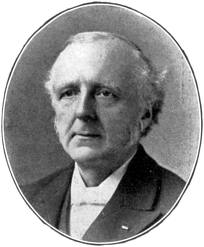
F.B. Meyer“God will make our obstacles serve His purposes. …

“The obstacles may be untruths told about us; a difficult occupation; ‘a thorn in the flesh’ (2 Corinthians 12:7); or our daily cross. And often we pray for their removal, for we tend to think that if only these were removed, we would live a more tender, pure, and holy life. … These are the very conditions we need for achievement, and they have been put in our lives as the means of producing the gifts and qualities for which we have been praying so long.

“We pray for patience for many years, and when something begins to test us beyond our endurance, we run from it. We try to avoid it, we see it as some insurmountable obstacle to our desired goal, and we believe that if it was removed, we would experience immediate deliverance and victory. This is not true! We would simply see the temptations to be impatient end. This would not be patience.

“The only way genuine patience can be acquired is by enduring the very trials that seem so unbearable today. Turn from your running and submit. … There is nothing in your life that distresses or concerns you that cannot become submissive to the highest purpose. Remember, they are God’s mountains. He puts them there for a reason, and we know He will never fail to keep His promise.” —F.B. Meyer

The Psychology Of Redemption (book review)

The Psychology Of RedemptionTo put psychology (a social science) and redemption (a decidedly theological term) together in the same title seems a bit paradoxical. Yet Oswald Chambers was such a well-rounded, well-studied man, that The Psychology Of Redemption seems like a perfect topic for him to tackle!

Chambers himself described these collection of thoughts this way: “Christian Psychology is based on the knowledge of the Lord Jesus Christ, not on the knowledge of ourselves. It is not the study of human nature analyzed and expounded, but the study of the new life that is born in us through the Redemption of our Lord, and the only standard of that new life is our Lord Himself.”

Chambers goes on to explain in this outstanding work that our true self was marred when Adam sinned. We were made by God, so we can best understand ourselves (psychology) when we are reestablished in our original relationship with God (redemption). So the topics that Oswald Chambers goes into in this book are some of the deepest topics of any I have read to-date in his books. But he does it in such an accessible way, that anyone from a novice, to a trained psychologist, to a trained theologian will find value in his thoughts.

Editor David Lambert further advises us: “To profit by this book demands concentrated thought, with Bible in hand, and with a humble eagerness to ‘act on the Word, instead of merely listening to it and deluding yourselves’ (James 1:22).’”

The Experiment That Spooked Einstein

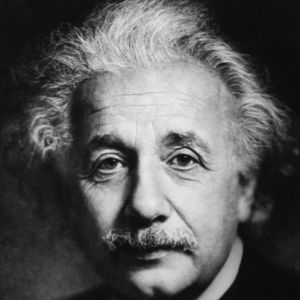
Albert EinsteinScience does not have all the answers (despite what many scientists want to tell us!). Here is a quantum physics mystery that has baffled the best and brightest minds. Even Albert Einstein called this “spooky actions at a distance.”

Watch this short video and see what you think…

https://youtu.be/DfPeprQ7oGc

A few other Einstein quotes come to mind:

“There are only two ways to live your life: one is as if everything is a miracle, the other is as though nothing is a miracle.”

“The important thing is not to stop questioning. Curiosity has its own reason for existing. One cannot help but be in awe when he contemplates the mysteries of eternity, of life, of the marvelous structure of reality. It is enough if one tries merely to comprehend a little of this mystery every day. Never lose a holy curiosity.”

“Even though the realms of religion and science in themselves are clearly marked off from each other, nevertheless there exist between the two strong reciprocal relationships and dependencies … The situation may be expressed by an image: science without religion is lame, religion without science is blind.”

“Every one who is seriously engaged in the pursuit of science becomes convinced the laws of nature manifest the existence of a spirit vastly superior to that of men, and one in the face of which we with our modest powers must feel humble.”

Spend This Week For God

Joseph AlleineJoseph Alleine was very concerned about using every moment of his time to honor God. He wrote, “Give me a Christian that counts his time more precious than gold.” To help him do this, he built in reminders to his weekly journaling and prayer times.

At the beginning of each week he wrote in his journal—“Another week is now before us, let us spend this week for God.”

And each morning he wrote in his journal—“Let us live this one day well!”

The Bible instructs us to:

What can you do this week to make sure that you spend this week for God?

Charles Spurgeon – Resolve to Keep Close to Christ

Bentley's avatarThe Old Guys

Spurgeon

There is yet another stone wall which I will mention, namely, firmness of character. Our holy faith teaches a man to be decided in the cause of Christ, and to be resolute in getting rid of evil habits. “If thine eye offend thee”—wear a shade? No; “pluck it out.” “If thine arm offend thee”—hang it in a sling? No; “cut it off, and cast it from thee” True religion is very thorough in what it recommends. It says to us, “touch not the unclean thing.” But many persons are so idle in the ways of God that they have no mind of their own: evil companions tempt them, and they cannot say, “No.” They need a stone wall made up of noes. Here are the stones, “no, no, NO.” Dare to be singular. Resolve to keep close to Christ. Make a stern determination to permit nothing in your life…

View original post 88 more words