The Duty Of Pastors (book review)

The Duty Of PastorsJohn Owen is one of the influential and powerful voices of the Puritans from the mid-17th century. One of the things that makes him influential is the source of his wisdom: Everything he writes is thoroughly grounded in Scripture. This is especially true for his book The Duty Of Pastors.

Originally this book was entitled The Duty Of Pastors and People Distinguished. As you might be able to tell from this original title, Owen lays out from Scripture the roles of ministers and pastors. These two titles and roles are distinct, although many people want to lump them together. Owen points out that any one who is a Christian can minister to people (and thus be called a “minister”), but there are special God-appointed roles for those called “pastors.”

Owen writes, “The first and principal duty of a pastor is to feed the flock by diligent preaching of the Word.” Indeed, this is one of the main thing which distinguishes pastors from ministers.

Owen also takes to task those in religious circles who would put artificial (in other words, things not commanded in Scripture) barriers for people to answer God’s call to the pastorate.

This is not a very long book, but given that fact that it is older, it is a bit of a challenging read. But for anyone who is interested in the roles of pastors and ministers, or for anyone who wants to know how to support their pastors, The Duty Of Pastors is well worth your time and effort.

Don’t Try To Change Your Bad Behavior

Thoughts to beahviorsAs I wrote previously, I believe Christians should be the best at getting along with others. First of all, Christians have been empowered by the Holy Spirit with the skills necessary to live at peace with everyone, IF we will only allow the Spirit to do the necessary work in us. And second, the way Christians treat others goes a long way toward either attracting or repelling others from a relationship with Jesus.

But here’s an important thing: If you don’t get along well with others now, don’t try to change your behavior!

Stephen Covey wrote, “To try to change outward behaviors does very little good in the long run if I fail to examine the basic paradigms from which those attitudes and behaviors flow.”

You see, behavior is the fruit. If we want to change the fruit, we need to back up a few steps.

The Apostle Paul used the life of Jesus as an example for Christians on how we can get along with others. But notice this: most of what Paul discusses is the “inside stuff.”

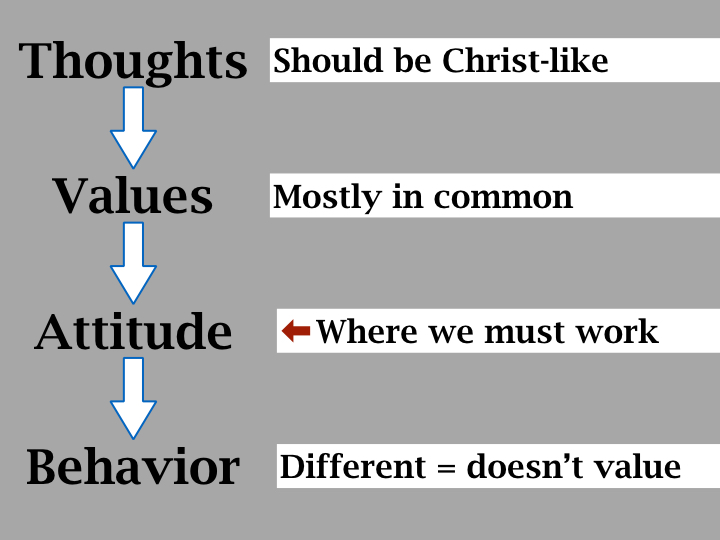
The progression goes like this (see Philippians 2:1-13)—

Thoughts → Values → Attitudes → Behaviors

(1) Thoughts—These need to be humble thoughts about God’s love toward us (v. 1).

(2) Values—Paul tells us to be “one in spirit and purpose” with others (v. 2). The definition of the Greek words here mean valuing the well-being of everyone. Paul then explains how our humility can lead to these win-win relationships (vv. 3, 4).

(3) Attitudes—“Your attitude should be the same as Christ Jesus” (v. 5). Jesus showed us what it was to have an attitude related toward obedience to God’s will.

(4) Behavior—If our thoughts, values and attitudes are rightly aligned to God, then our behavior will naturally be Christ-like as well. We see the example of Jesus in verses 6-8, and God’s reward for that behavior in verses 9-11. Then Paul calls on Christians to follow that pattern in our own lives (vv. 12, 13).

Most decent, reasonably-thinking human beings share the same values. Harry Truman said, “When we understand the other fellow’s viewpoint—understand what he is trying to do—nine times out of ten he is trying to do right.”

The problem is this: When the other person behaves differently from me, my natural tendency is to assume he doesn’t value what I value. In other words, I’m judging his value system on the way I normally behave.

The break-down is in my attitude. That’s the area I need to address. That’s the attribute of Jesus that Paul told us to copy.

So if I want to get along better with others, I shouldn’t try to change my behavior, but my attitude. My prayer should be: “I want this same attitude to be in me which was also in Christ Jesus. He served God and others, so I too want to follow His example of obedience, and I want to demonstrate my appreciation for all that Jesus has done for me by working hard to better get along with others. Help me change my attitude!”

Check out this video of the full message…

I hope you can join us next Sunday as we continue learning how to get along with others. Please join us in person or on Periscope.

12 More Quotes From “The Place Of Help”

The Place Of HelpAs always, there are more quotes from Oswald Chambers’ books than I have space to share them. So here are a few more from The Place Of Help.

“If we are going to be used by God, He will take us through a multitude of experiences that are not meant for us at all, but meant to make us useful in His hands. There are things we go through which are unexplainable on any other line, and the nearer we get to God the more inexplicable the way seems. It is only on looking back and by getting an explanation from God’s Word that we understand His dealings with us.”

“The essence of Christianity is that we give the Son of God a chance to live and move and have His being in us, and the meaning of all spiritual growth is that He has an increasing opportunity to manifest Himself in our mortal flesh.”

“Temptation is a short cut to what is good, not to what is bad. satan came to our Lord as an angel of light, and all his temptations center around this point—‘You are the Son of God, then do God’s work in Your own way; put men’s needs first, feed them, heal their sicknesses, and they will crown You King.’ Our Lord would not become King on that line; He deliberately rejected the suggested short cut, and choose the long trail, evading none of the suffering involved (cf. John 6:15).”

“God expects His children to be so confident in Him that in a crisis they are the ones upon whom He can rely. … God expects of us the one thing that glorifies Him—and that is to remain absolutely confident in Him, remembering what He has said beforehand, and sure that His purposes will be fulfilled.”

“God has never promised to keep us immune from trouble; He says ‘I will be with him in trouble,’ which is a very different thing.”

“The Bible characters never fell under weak points but on their strong ones; unguarded strength is double weakness.”

“Do we trust in our wits or do we worship God? If we trust in our wits, God will have to repeat the same lesson until we learn it.”

“The coming of Jesus Christ is not a peaceful thing, it is a disturbing thing, because it means the destruction of every peace that is not based on a personal relationship to Himself.” [Matthew 10:34]

“The peace that Jesus gives is never engineered by circumstances on the outside; it is a peace based on a personal relationship that holds all through. ‘In the world ye shall have tribulation: … in Me … peace.’”

“God is a holy God, and the marvel of the Redemption is that God the Holy One puts into me, the unholy one, a new disposition, the disposition of His Son.”

“In the Sermon on the Mount our Lord teaches us not to look for justice, but never to cease to give it. That is not commonsense, it is either madness or Christianity.”

“When the love of God is in me I must learn how to let it express itself; I must educate myself in the matter; it takes time. Acquire your soul with patients, says Jesus [Luke 21:19]. Never give way to this spirit—‘Oh well, I have fallen again, I will stay down now.’ Have patience with yourself, and remember that this is salvation not for the hereafter, but for the here and now.”

You can read the first set of quotes from The Place Of Help by clicking here.

My review of The Place Of Help is here.

And be sure to look for “Thursdays With Oswald” to read quotes and thoughts from the current Chambers’ book I am reading.

Thursdays With Oswald—Work Out What God Has Worked In

Oswald ChambersThis is a weekly series with things I’m reading and pondering from Oswald Chambers. You can read the original seed thought here, or type “Thursdays With Oswald” in the search box to read more entries.

Work Out What God Has Worked In

     If we have experienced regeneration, we must not only talk about the experience, we must exercise it and work out what God has worked in (Philippians 2:12-13). We have to show it in our finger-tips, in our tongue, and in our bodily contact with other people, and as we obey God we find we have a wealth of power on the inside. … 

     The practicing is ours, not God’s. God regenerates us and puts us in contact with all His divine resources, but He cannot make us walk according to His will. If we will obey the Spirit of God and practice through our physical life all that God has put in our hearts by His Spirit, then when the crisis comes we shall find that we have not only God’s grace to stand by us but our own nature also, and the crisis is passed without any disaster, but exactly the opposite happens, the soul is build up into a stronger attitude towards God.

From The Psychology Of Redemption

God doesn’t make us a new person, but He gives us the power to become a new person. The key is our obedience to what the Holy Spirit reveals to us from the Bible. Will we obey what He shows us? If we do, we can expect “a wealth of power on the inside.” If we don’t, people will probably call us hypocrites.

Will you obey? Will you work out what God has worked in?


12 Quotes From “The Place Of Help”

The Place Of HelpAs always, any Oswald Chambers book I read is thoroughly highlighted. There is always so much great content! On this blog, I have a weekly series called “Thursdays With Oswald” where I share quotes and thoughts from his book I’m currently reading. Be sure to check that out. Below are just a few of the quotes I noted from The Place Of Help. (By the way, you can read my review of this book by clicking here.)

“This is the age when education is placed on the very highest pinnacle. In every civilized country we are told that if we will educate the people and give them better surroundings, we shall produce better characters. Such talk and such theories stir aspirations, but they do not work out well in reality. The kingdom within must be adjusted first before education can have its true use. To educate an unregenerate man is but to increase the possibility of cultured degradation.”

“Not what the disciple says in public prayer, not what he preaches from pulpit or platform, not what he writes on paper or in letters, but what he is in his heart which God alone knows, determines God’s revelation of Himself to him. Character determines revelation (see Psalm 18:24-26).”

“Our Lord never gives private illuminations to special favorites. His way is ever twofold: the development of character, and the descent of Divine illumination through the Word of God.”

“The voice of the Lord listened to in darkness is so entrancing that the finest of earth’s voices are never afterwords mistaken for the voice of the Lord.”

“Jesus Christ distinctly stated that He came to do the will of His Father. ‘I must work the works of Him that sent Me.’ His first obedience was not to the needs of men, but to the will of God. He nowhere chose the altar of His sacrifice, God chose it for Him. He chose to make His life a willing and obedient sacrifice that His Father’s purpose might be fulfilled. … ’For we preach not ourselves, but Christ Jesus as Lord, and ourselves as your servants for Jesus’s sake,’ as Paul says in 2 Corinthians 4:5. We are the servants of men, says Paul, not primarily because their needs have arrested us, but because Jesus Christ is our Lord.” 

“If you become a necessity to a soul you have got out of God’s order, your great need as a worker is to be a friend of the Bridegroom. Your goodness and purity ought never to attract attention to itself, it ought simply to be a magnet to draw others to Jesus.”

“Suppose you talk about depending on God and how wonderful it is, and then others see that in your own immediate concerns you do not depend on Him a bit, but on your own wits, it makes them say, ‘Well, after all, it’s a big pretense, there is no Almighty Christ to depend on anywhere, it is all mere sentiment.’ The impression left is that Jesus Christ is not real to you.” 

“The highest Divine love is not only exhibited in the extreme amazement of the tragedy of Calvary, but in the laying down of the Divine life through the thirty years at Nazareth, through the three years of popularity, scandal, and hatred, and furthermore in the long pre-incarnate years (cf. Revelation 13:8).”

“The Cross is the supreme moment in Time and Eternity, and it is the concentrated essence of the very nature of the Divine love. … The Self-expenditure of God for His enemies in the life and death of our Lord Jesus Christ, becomes the great bridge over the gulf of sin whereby human love may cross over and be embraced by the Divine love, the love that never fails.” 

“Christian experience does not mean we have thought through the way God works in human lives by His grace, or that we are able to state theologically that God gives the Holy Ghost to them that ask Him—that may be Christian thinking, but it is not Christian experience. Christian experience is living through all this by the marvelous power of the Holy Ghost. The Holy Ghost working in me does not produce wonderful experiences that make people say ‘What a wonderful life that man lives’; the Holy Ghost working in me makes me a passionate, devoted, absorbed lover of the Lord Jesus Christ.”

“It is not the baptism of the Holy Ghost that changes men, but the power of the Ascended Christ coming into men’s lives by the Holy Ghost that changes men. The baptism of the Holy Ghost is the evidence of the Ascended Christ.” 

“There is only one Lover of the Lord Jesus and that is the Holy Ghost; when we receive the Holy Ghost He turns us into passionate human lovers of Jesus Christ. Then out of our lives will flow those rivers of living water that heal and bless, and we spend and suffer and endure in patience all because of One and One only.”

More quotes from this book coming soon…

The Place Of Help (book review)

The Place Of HelpThe Place Of Help is one of the longest of Oswald Chambers’ books, compromised almost entirely of sermons he delivered in various settings. Half of these sermons are from the YMCA Hut in Zeitoun, Egypt, where Chambers ministered to British, Australian and New Zealand troops during “The War” (what we now call World War I).

The title of the first chapter is also the title of this book. Oswald’s wife, Biddy, describes how the title came about—

I recall vividly the place of the ‘birth’ of this article; my husband dictated it to me during our stay in America in 1910, when we spent a little while in the exceedingly grand and beautiful Catskill mountains, amidst scenery which left us with the sense of worship expressed by Isaiah ‘The whole earth is full of His glory.’ May every thought of the one, who so continually lifted our eyes from the ‘hills’ to God Himself, be a mighty inspiration to us all to so ‘dwell in the shadow of the Almighty’ that our lives may be a sacrament whereby God can be revealed as our ‘refuge and strength and very present Help.’ 

Indeed these sermons are a challenging read. Chambers is delivering these messages in the build-up to The Great War, and even near the front lines of the War itself. These are not messages to those cloistered in safety, but those feeling the weight of the battle bear down upon them. Much like Christians today, who stand on the front lines of a very real cultural and spiritual battlefront, some of whom even face a very real physical danger because of their faith in Jesus Christ.

This collection of real, inspiring, soul-stretching messages are timely for any Christian today. A true faith expander!

Charles Spurgeon On Difficulties

C.H. Spurgeon“O tested soul, perhaps the Lord is sending you through this trial to develop your gifts. You have some gifts that would never have been discovered if not for trials. Do you not know that your faith never appears as great in the warm summer weather as it does during a cold winter? … Afflictions are often the dark settings God uses to mount the jewels of His children’s gifts, causing them to shine even brighter. …

“For how can you know if you have faith, until your faith is exercised? You can depend upon the fact that God often sends trials so our gifts maybe discovered and so we may be certain of their existence. And there is more than just discovering our gifts—we experience real growth in grace as another result of our trials being sanctified by Him.

“God trains His soldiers not in tents of ease and luxury but by causing them to endure lengthy marches and difficult service. He makes them wade across streams, swim through rivers, climb mountains, and walk many tiring miles with heavy backpacks.

“Dear Christian, could this not account for the troubles you are now experiencing? Could this not be the reason He is dealing with you?” —Charles Spurgeon

You Are An Empowered Peacemaker

My new attitude“The whole world—with one minor exception—is made up of others,” says John Maxwell. The ‘one minor exception’ is that person who’s looking back at you from the mirror every morning, so if you want to be successful in life, you better learn to get along with ‘the others.’

I believe this is especially important for those who call themselves Christians. Here are three reasons why—

  1. Our interaction with other Christians is a testimony to outsiders—John 13:34-35.
  2. Our positive interaction with outsiders can draw others to Christ—Colossians 4:5.
  3. Our negative interaction with outsiders can repel others from Christ—1 Peter 2:12.

So although it can be very (sometimes very, very!) challenging, we are called to find ways to get along with others. The Apostle Paul said:

Be careful to do what is right in the eyes of everybody. If it is possible, as far as it depends on you, live at peace with everyone (Romans 12:17-18, emphasis added).

When you see the phrase “if it is possible” you may think that Paul has given us an “out.” We could say, “I tried really hard to get along with that guy, but it just hasn’t worked, so I’m off the hook!”

But consider how another translation of the Bible states this phrase: Do all that you can to live in peace with everyone.

Jesus was asked to do something that had never been done before: heal two men born blind. Jesus asked these men, “Do you believe I am able to do this?” (Matthew 9:28). The men answered an emphatic, “Yes!” On another occasion a father asked Jesus to heal his son by saying, “If You can, please help us.” Jesus said, “‘If I can? All things are possible to those who believe.” The father immediately replied, “I do believe; please help my unbelief” (Mark 9:22-24).

If you are Christian, the Spirit of Jesus lives in you. So the question Jesus asks us about our difficult relationships is, “Do you believe I am able to help you?” Or perhaps more accurately He asks us, “Will you let Me help you?”

So the part of the verse which says, “if it is possible, as far at it depends on you” is really saying, “If you really believe Jesus is stronger than this strained relationship, will you let Him do something in you to bring about peace?”

We aren’t asking Jesus to change the other person; we’re asking Him to change us. We aren’t asking someone else to get on our page, or to see the world from our perspective; we’re asking the Holy Spirit to help us get on their page, to help us see the world they way they see it.

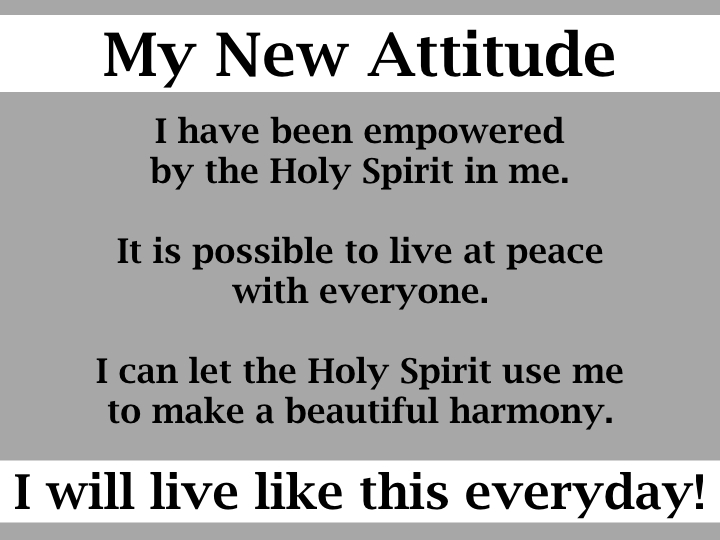
We need to have a new attitude. And I believe that attitude comes from a prayer like this—

I have been empowered by the Spirit of Christ in me. 
It is now possible for me to live at peace with everyone. 
I can let the Holy Spirit use to me make a beautiful harmony. 
I will keep on living like this every day.

Next Sunday we will be looking at some practical techniques and more biblical insights to help us excel in getting along with all ‘the others’ that make up the world. Please join us in person or on Periscope.

9 Quotes On Socialism From “Churchill’s Trial”

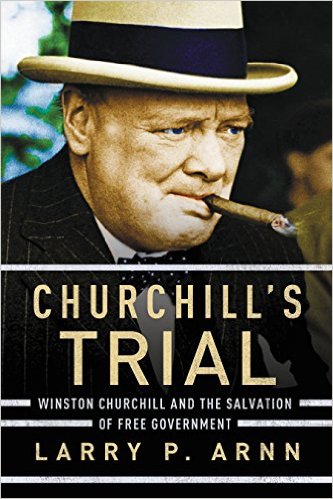
Churchill's TrialWinston Churchill waged a lifelong battle against Socialism creeping into a democratic government. He felt it would ultimately undermine the freedoms of individual citizens. In Churchill’s Trial by Larry Arnn, significant space was given to this topic. Here are a few of the most noteworthy quotes on the evils of socialism.

“Human relations are not a contest in which the advantage of some requires the disadvantage of others. That means in turn that government need not have the authority to allocate resources, at least not comprehensively. A government with such power would be in one sense at war with any citizens who have more than others, effectively with all citizens but the few poorest.” —Larry Arnn

“I declare to you, from the bottom of my heart, that no Socialist system can be established without a political police. Many of those who are advocating Socialism or voting Socialist today will be horrified at this idea. That is because they are short-sighted, that is because they do not see where their theories are leading them. No Socialist Government conducting the entire life and industry of the country could afford to allow free, sharp, or violently-worded expressions of public discontent. They would have to fall back on some form of Gestapo, no doubt very humanely directed in the first instance.” —Winston Churchill

“The inherent vice of capitalism is the unequal sharing of blessings. The inherent virtue of socialism is the equal sharing of miseries.” —Winston Churchill

“Churchill’s differences with socialism proceed from this fundamental difference about nature. He thought that the equality for which socialism aimed was unnatural. He thought that it could not be achieved except by suppressing nature, including human nature, which would require the suppression of humans. He thought that because of this fundamental difference, socialism would result in impoverishment in economics, corruption in personal character, and despotism in politics. He thought that by nationalizing these areas of private life in which most human beings do their most urgent and fulfilling tasks, socialism would truncate the lives of ordinary people. For that reason he regarded socialism as dehumanizing.” —Larry Arnn

“A state that attempts to equalize things that are not inherently equal will be at war with human excellence. Some people are in fact wiser, braver, more generous, more skillful, more beautiful, stronger, and more active than others. This does not make them different in their rights, if those rights are defined as the right to employ their ability and gain or lose by their efforts. Both the equality of rights and the differences of human makeup are natural phenomena, and they must be accorded their sway. The attempt to equalize unequal things would, Churchill argued, produce resistance, which in turn would call forth from socialism more vigorous laws. This cycle will continue until all the rights of the people were gone.” —Larry Arnn

“Socialism knows that it can only operate through an agency of bureaucracy under the direction of an autocratic sect.” —Winston Churchill

“If you make 10,000 regulations you destroy all respect for the law.” —Winston Churchill 

“Property [means] every thing to which a man may attach a value and have a right; and which leaves to everyone else the like advantage.” —James Madison (emphasis in original)

“If evil systems corrupt good men, it is no less true that base men will dishonor any system, and while no bond of duty more exacting than that of material recompense regulates the relations of man and man, while no motion more lofty and that of self-interest animates the exertions of every class, and no hope beyond the limits of this fleeting world lights the struggle of humanity, the most admirable systems will merely succeed in transferring, under different forms and pretexts, the burden of toil, misery, and injustice from one set of human shoulders to another.” —Winston Churchill 

You can read my review of Churchill’s Trial by clicking here.

My first set of quotes from this book can be found by clicking here.

Thursdays With Oswald—Don’t Rush God’s Timing

Oswald ChambersThis is a weekly series with things I’m reading and pondering from Oswald Chambers. You can read the original seed thought here, or type “Thursdays With Oswald” in the search box to read more entries.

Don’t Rush God’s Timing 

     Moses was learned in all the wisdom of the Egyptians, he was a mighty man and a great statesman, and when he saw the oppression of his people he felt that God had called him out to deliver them, and in the righteous indignation of his own spirit he started to right their wrongs. God is never in a hurry. After the first big strike for God and for the right things, God allowed Moses, the only man who could deliver his own people, to be driven into the desert to feed sheep—forty years of blank discouragement. 

     Then when God appeared and told him to go and bring forth the people, Moses said—“Who am I, that I should go?” … At first, Moses was certain he was the man, and so he was, but he was not fit yet. He set out to deliver the people in a way that had nothing of the stride of God about it. Moses was right in the individual aspect, but he was not the man for the work until he had learned communion with God, and it took forty years in the desert while God worked through him in ways of terrific personal enlargement before he recognized this.

     We have to learn that our individual effort for God is an impertinence, our individuality must be rendered incandescent by a personal relationship to God, and that is not learned easily. 

From The Place Of Help (emphasis added)

Do you feel like God has called you to do something great for Him? You’re right, He has! But don’t rush His timing. Listen to the counsel of wise people in your life, pray about it, count the cost, and let God prepare you for it. He has perfect timing … don’t rush Him!