4 Ways To Evaluate Biblical Evidence

Reliability of the GospelsTo be honest, if someone hasn’t heard the biblical account of the life of Jesus Christ before, it can sound quite fantastic! Jesus was born of a virgin, lived a sinless life, performed miracles no one had seen before, died a horrific martyr’s death, was raised back to life three days later, and then ascended back into heaven until He returns to Earth again.

But as fantastic as this sounds, there is still enough evidence to reasonably believe it’s all true. An unreasonable faith believes in something in spite of the evidence; a blind faith believes in something without any evidence; and reasonable faith believes in something because of the evidence.

The Bible gives us eyewitness testimony about the life of Jesus which we can matter-of-factly evaluate. 

In a modern-day court of law, eyewitness testimony is evaluated on…

  • …the determination that the witnesses were actually present.
  • …the ability to corroborate their testimony.
  • …the consistency of their testimony over time.
  • …any biases they have that would cause them to exaggerate or misrepresent their testimony.

Let’s consider the testimony of the four Gospel writers: Matthew, Mark, Luke and John.

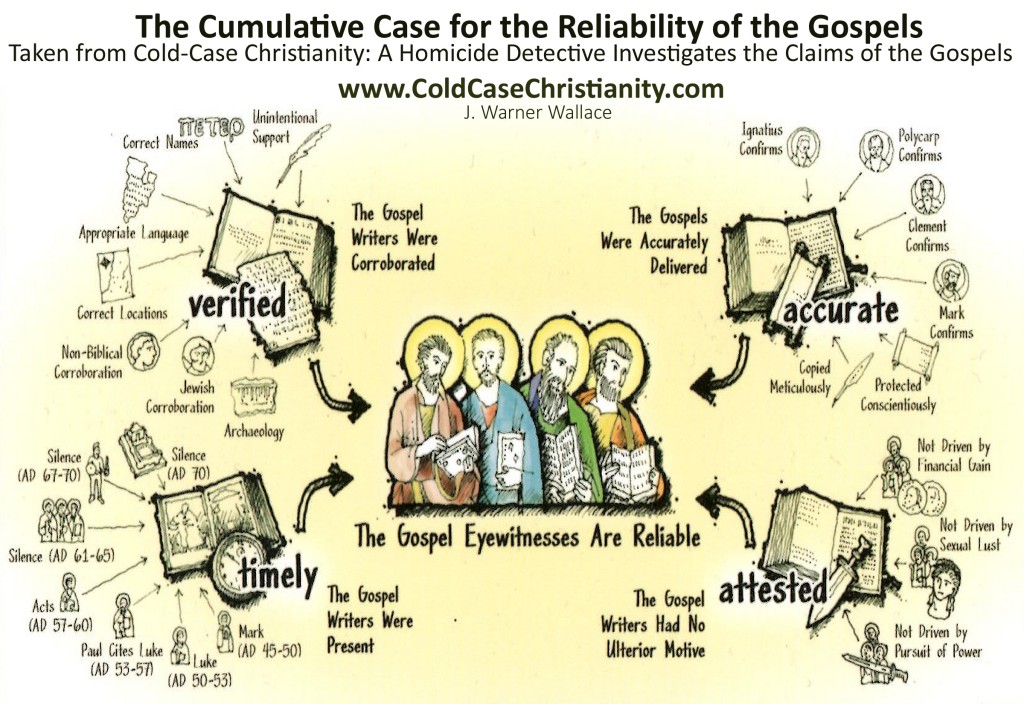
(1) Were The Eyewitnesses Present?

  • Luke is considered a credible historian, even by modern standards. He wrote the book of Acts following the ascension of Jesus into Heaven. Because he did not mention three major events in Jewish history (the Jewish uprising, the Roman siege of Jerusalem in response to that uprising, and the Roman destruction of the temple), we can determine that Acts was written before 61 AD.
  • Luke wrote the Gospel that bears his name before he wrote Acts. The Apostle Paul referenced portions of Luke’s Gospel in letters we can date by Paul’s Roman imprisonment, which means Luke was written prior to 53-57 AD.
  • Luke uses the Gospel of Mark as one of his references, which means Mark was probably written in 45-50 AD, just 10-15 years after the events of Christ’s life.
  • Mark was closely associated with the Apostle Peter, who was most assuredly Mark’s “source” in writing his Gospel, and Peter was one of the original twelve apostles called by Jesus.
  • Matthew and John were both apostles of Jesus, living and working closely with Jesus for over three years.

(2) Is Their Testimony Corroborated?

  • Archeological finds continually demonstrate the accuracy of the people, titles, places and details the Gospel writers mention.
  • Outside—or extra-biblical—sources like Josephus (a Jewish historian who wanted to preserve the purity of Judaism), Tacitus (a Roman historian), and Mara Bar-Serapion (a Syrian historian)—all who wrote between 40-70 AD—affirm things like where Jesus lived, the miracles He performed, the manner of His death, His resurrection, and the changed lives of people who believed in Jesus Christ.
  • In addition, Paul wrote of the “five hundred of the brothers” who were also eyewitnesses to the resurrected Christ (1 Corinthians 15:3-8).

(3) Has Their Testimony Remain Unchanged Over Time?

  • The history and accuracy of the scribes had already been demonstrated in the preservation and transmission of the Old Testament over a period of 1400 years.
  • These same scribal techniques were not only used in the transmission of the New Testament, but in subsequent years the Masoretic scribes became even more meticulous in the techniques they used.
  • The “chain of custody” of evidence can be absolutely traced from the Gospel authors, to their students, and to the writings of the Church Fathers.
  • In fact into the third-century AD, the writings of the Church Fathers contain so many direct quotations from the New Testament, that we can almost completely reconstruct the New Testament from their writings.

(4) Is Their Testimony Unbiased?

  • These eyewitnesses didn’t gain anything financially by their testimony. In fact, many of them lost or gave up all their possessions to tell others about Jesus.
  • They didn’t gain political power or influence that could save their own lives. All of the original apostles (except John) died a gruesome martyrs’ death.
  • In short, they had nothing to gain by making up and reporting a false story about Jesus.

All of these points make it reasonable to believe the evidence presented in the Bible about Jesus Christ is true. Check out this video where I elaborate a little more on each of these points—

If you live in the Cedar Springs area and don’t have a home church, I would love for you to visit with us Easter Sunday morning at 10:30am. We’ll be examining the evidence for Christ’s resurrection from the dead. Click here to get more details.

“The Thing Really Happened”

I shared this quote from C.S. Lewis this morning in my message…

C.S. Lewis at his desk“Now, as a literary historian, I am perfectly convinced that whatever else the Gospels are they are not legends. I have read a great deal of legend and I am quite clear that they are not the same sort of thing. They are not artistic enough to be legends. From an imaginative point of view they are clumsy, they don’t work up to things properly. Most of the life of Jesus is totally unknown to us, as is the life of anyone else who lived at that time, and no people building up a legend would allow that to be so. Apart from bits of the Platonic dialogues, there are no conversations that I know of in ancient literature like the Fourth Gospel. There is nothing, even in modern literature, until about a hundred years ago when the realistic novel came into existence. In the story of the woman taken in adultery we are told Christ bent down and scribbled in the dust with His finger. Nothing comes of this. No one has ever based any doctrine on it. And the art of inventing little irrelevant details to make an imaginary scene more convincing is a purely modern art. Surely the only explanation of this passage is that the thing really happened. The author put it in simply because he had seen it.” ―C.S. Lewis (emphasis added)

Poetry Saturday—Forgive

 F.B. Meyer

If my soul has turned perversely to the dark;
If I have left some brother wounded by the way;
If I have preferred my aims to Yours;
If I have been impatient and would not wait;
If I have marred the pattern drawn out for my life;
If I have cost tears to those I loved;
If my heart has murmured against Your will,
O Lord, forgive. —F. B. Meyer

Thursdays With Oswald—The Power Of Your “Say So”

Oswald ChambersThis is a weekly series with things I’m reading and pondering from Oswald Chambers. You can read the original seed thought here, or type “Thursdays With Oswald” in the search box to read more entries.

The Power Of Your “Say So” 

     Many of us are on the verge of a spiritual vision the realization of which never becomes ours because we will not open our mouths to “say so.” We have to “say so” before we “feel so.” … If I will not confess with my mouth what I believe in my heart, that particular phase of believing will never be mine actually. Assurance of faith is never gained by reserve but only by abandonment. 

     If you want to encourage your own life in spiritual things, talk about them. … If you have not received, ask; if you have not found, seek; if the door is shut, knock. When you are up against the barriers, the way out is to “say so,” then you will be emancipated, and your “say so” will not only be an emancipation for yourself, but someone else will enter into the light.

From The Place Of Help

Oswald Chambers is urging Christians to not just believe what they believe, but say what they believe. Say it out loud!

The tongue has the power of life (Proverbs 18:21).

For the accuser of our brothers and sisters, who accuses them before our God day and night, has been hurled down. They triumphed over him by the blood of the Lamb and by the word of their testimony (Revelation 12:10-11).

O give thanks to the Lord, for He is good; for His compassion and lovingkindness endure forever! Let the redeemed of the Lord say so (Psalm 107:1-2).

You need to hear your “say so” in your own ears to energize your faith. The enemy needs to hear your “say so” to defeat him. Others in need around you need to hear your “say so” to encourage them.

Don’t keep quiet! “Assurance of faith is never gained by reserve but only by abandonment.” Abandon your reserve and “say so” for all to hear!

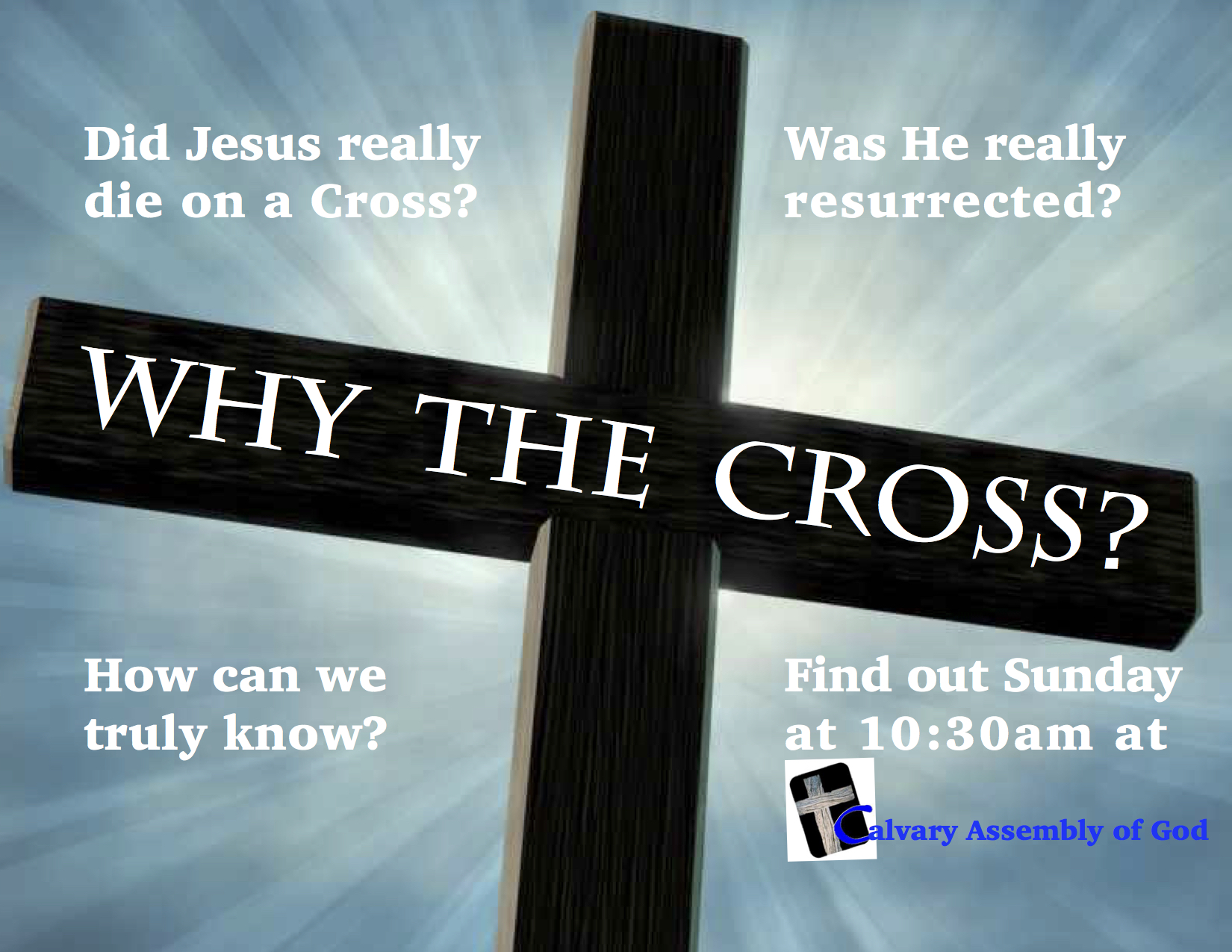
Why The Cross?

Why The CrossCrucifixion seems so extreme (click here to read The Horrors of Crucifixion)! Why would God allow His Son to go through this?

But perhaps we should back up a step or two. Before asking why the Cross maybe there are some other questions we should explore. Questions like…

  • Did Jesus actually die?
  • Is the account true that Jesus came back to life?
  • How can we know for sure?
  • Is this just too fantastic to believe? Or is the evidence reasonable?

These are questions we must all wrestle with, especially those who call themselves Christians. After all, Christian means a follower of Jesus Christ who believes that Jesus in fact died on a Cross and was raised back to life three days later.

Join me this Sunday was we explore the reliability of the evidence. Then on Easter Sunday morning we will consider the claims that Jesus died and came back to life, as well as the claims that this is all make-believe stuff.

You won’t want to miss this! Click here to find a map to our meeting place. If you cannot join us in person, we will be broadcasting live on Periscope (click here to find the account to follow to be notified when the broadcast begins).

Use Your Body To Honor God

C.H. Spurgeon“God paid a great price for you. So use your body to honor God [1 Corinthians 6:20]. You young men who come to London amidst its vices, shun everything that is akin to lewdness or leads on to unchasity, for your bodies were bought with your Lord’s lifeblood, and they are not yours to trifle with. Shun the strange woman, her company, her wine, her glances, her house, her songs, her resorts. Your bodies are not yours to injure by self-indulgence of any sort. Keep them pure and chaste for that heavenly Bridegroom who has bought them with His blood. And then your soul is bought too.

“I was obliged to mention the body, because it is mentioned here, and it is so needful it should be kept pure. But keep the soul pure. Christ has not bought these eyes that they should read novels calculated to lead me into vanity and vice, such as are published nowadays. Christ has not bought this brain of mine that I may revel in the perusal of works of blasphemy and filthiness. He has not given me a mind that I may drag it through the mire with the hope of washing it clean again.…

“Your whole manhood belongs to God if you are a Christian. Every faculty, every natural power, every talent, every possibility of your being, every capacity of your spirit.… It is all bought with blood. Therefore keep the whole for Jesus, for it belongs to Him.”

—Charles Spurgeon

The American Patriot’s Almanac (book review)

The American Patriot’s AlmanacI feel so blessed to live in the United States of America! With the blessing of living in this great country comes the responsibility of knowing as much as I can about our country’s founding and guiding principles. A wonderful help on this journey of discovery is The American Patriot’s Almanac: Daily readings on America by William Bennett and John Cribb.

I am now on my second time through this book, and I’m still discovering how much there is to love about the USA. Each day Bennett and Cribb present a snapshot of a notable event in our nation’s history, that makes me so proud of our heritage all over again. There are cool stories about both the well-known and little-known folks who sacrificed and invested to make this country what it is.

At only a page a day, there’s no excuse for American patriots not to read this book through over the course of a year, and re-discover what a privilege it is to live in the land of the free and the home of the brave. We all owe it to our future generations to keep these memories alive, so that no one forgets our amazing heritage.

2 More Bible Studies For You To Try

Character studiesLast week I shared three types of Bible studies you could try to go a little deeper in your time studying Scripture. Today I’d like to share two more studies.

Remember that I’m a big proponent of reading systematically through the Scripture. I recommend that you begin reading in Matthew (the first book of the New Testament), and read all the way through the New Testament. Then return to Genesis, the first book of the Bible, and read straight through to the end of the Bible.

Here’s why? (1) Jesus said that all of Scripture pointed to Him, so in reading the NT first, you will get to know Jesus through His own life, and then through the lives of His first followers. (2) Then when you are reading anything in the OT that is confusing, you can ask yourself, “How does this point to Jesus? What do I learn about man’s fallen state? How do I see the need for a Savior?”

As you reading systematically through the New and Old Testaments, here are two Bible studies for you to try.

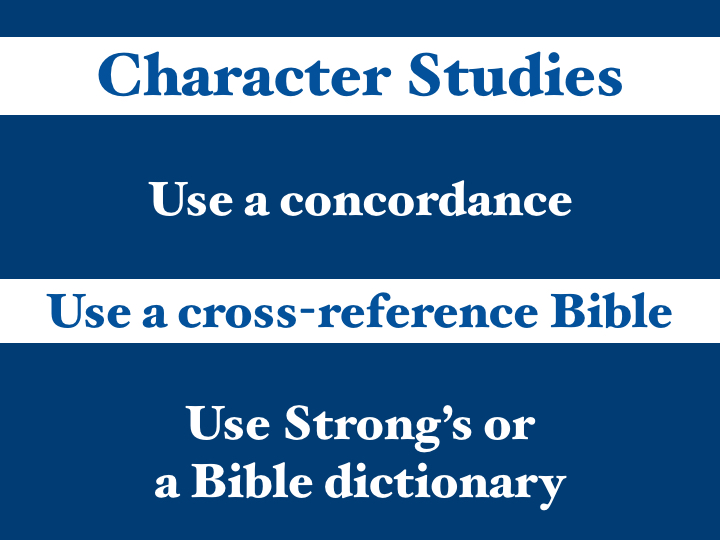
Character Studies

When you come across someone’s name in your systematic reading, use a concordance to find all the other places they may be mentioned. You may also want to look up their name in a Bible dictionary, or Strong’s Concordance to find out about their ancestors or meaning of their name.

As an example, let’s look at King David. He first shows up in Ruth 4:17 in a brief genealogy. Then beginning in 1 Samuel 16, we read page after page of his entire life.

Using a concordance, you would also spot some of the Psalms that were written by David, and you would see how David’s life and words were used in the New Testament setting. For instance, in Matthew 1:1 you would see another genealogy that traces Jesus Christ through King David’s family line.

Another example is a man named Barnabas. He first shows up in Acts 4:36. But unlike David, we don’t read consecutive pages about Barnabas. Instead, he sort of pops into the narrative of the early church as recorded in the book of Acts (Acts 9:27; 11:22-26; 12:25-13:3; 15:37-39).

In the Acts 15 passage, we see that Mark’s behavior was a point of serious disagreement between Barnabas and Paul. As a result, they went on separate missionary journeys, and we don’t  read anything explicitly written about Barnabas. But continuing to use our concordance of the Bible, we find that Barnabas was still at work behind the scenes to reconcile Mark and Paul (see Colossians 4:10 and 2 Timothy 4:11).

Prophesy

The easiest way to see prophesy at work is noticing what OT passages are recorded in the NT. Here is where you might want to make use of a Bible with cross references in the margins. For example, in Matthew 1:22-23, you see the words, “All this took place to fulfill what the Lord has said through the prophet….” Looking at the verses in my reference Bible, I find mentioned Isaiah 7:14, where the prophesy of Christ’s virgin birth was foretold. Keep your eyes open for phrases like “to fulfill” or “it is written.”

When you are reading in the OT, you will come across certain passages that the Holy Spirit will use to remind you of something that sounds familiar from the NT. Here you would use your concordance or Bible software to search out NT references. Here’s a couple of exampled:

  • In Isaiah 9:6, there is a reference to Prince of Peace. I used my concordance to search for the word peace and I found passages like Romans 5:1-2; Philippians 4:7.
  • In Isaiah 11:1-3 the phrases about God’s Spirit resting on the Messiah intrigued me, so I used my concordance to search for the words Spirit and rest, and I found Matthew 3:16-17.
  • Isaiah 61:1-2 sounded very familiar to me, so when I searched for Lord’s favor I found Jesus used this phrase in Luke 4:16-19.

Check out this video to see how I describe these Bible studies in more detail.

You can also check out this video to watch how I described the three previous Bible studies. I hope you grow deeper in God by studying His Word more in-depth!

Poetry Saturday—Through

Annie Johnson Flint“When you pass through the waters”
   Deep the waves may be and cold,
But Jehovah is our refuge,
   And His promise is our hold;
For the Lord Himself has said it,
   He, the faithful God and true:
“When you come to the waters
   You will not go down, but it THROUGH.”

Seas of sorrows, Seas of trial,
   Bitter anguish, fiercest pain,
Rolling surges of temptation
   Sweeping over heart and brain—
They will never overflow us
   For we know His Word is true;
All His waves and all His billows
   He will lead us safely THROUGH.

Threatening breakers of destruction,
   Doubt’s insidious undertow,
Will not sink us, will not drag us
   Out to ocean depths of woe;
For His promise will sustain us,
   Praise the Lord, whose Word is true!
We will not go down, or under,
   For He says, “You will pass THROUGH.” —Annie Johnson Flint

Rewards And Consequences

Rewards and ConsequencesThe Bible consistently gives us—right up front—the rewards for right living, and the consequences for wrong living. No one ever has to be surprised. 

For example, take this message from Jesus in Luke 6.

  1. If you don’t want others to judge you, don’t be judgmental (v. 37).
  2. If you don’t want to be condemned by others, don’t condemn others (v. 37).
  3. If you want to be forgiven, forgive others first (v. 37).
  4. If you want to receive, be the first to give to others (v. 38).
  5. If you want to teach, find a good teacher and then be a good learner first (vv. 39-40).
  6. If you want to help others with their problems, first look in the mirror at yourself (vv. 41-42).
  7. If you want to speak good words, put good words inside yourself (vv. 43-45).
  8. If you want to stand strong through adversity, build on the right foundation (vv. 46-49).

God doesn’t miss a thing! He told us how to stay in the place where He can bless us, and how we can avoid life’s negative consequences.

We would all do well to hear these words and put them into practice (v. 47)!