‘Before All Worlds’

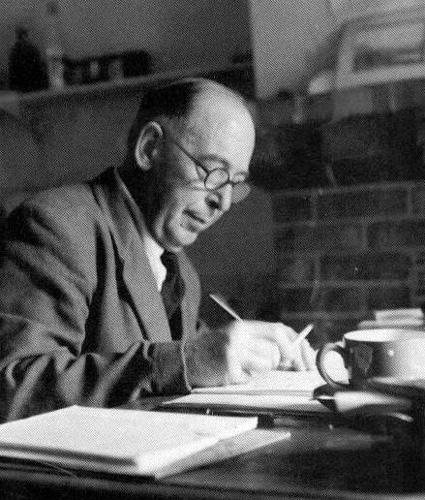
C.S. LewisI re-read C.S. Lewis′ book Miracles earlier this year (you can read my full book review by clicking here). As you may have noticed, after reading and reviewing books on this blog, I also like to share some quotes that caught my attention. This particular quote is fairly long in itself, but I think you will understand the context within the quote—

“When we are praying about the result, say, of a battle or a medical consultation the thought will often cross our minds that (if only we knew it) the event is already decided one way or the other. I believe this to be no good reason for ceasing our prayers. The event certainly has been decided—in a sense it was decided ‘before all worlds.’ But one of the things taken into account in deciding it, and therefore one of the things that really cause it to happen, may be this very prayer that we are now offering. Thus, shocking as it may sound, I conclude that we can at noon become part causes of an event occurring at ten a.m. (Some scientists would find this easier than popular thought does.) The imagination will, no doubt, try to play all sorts of tricks on us at this point. It will ask, ‘Then if I stop praying can God go back and alter what has already happened?’ No. The event has already happened and one of its causes has been the fact that you are asking such questions instead of praying. It will ask, ‘Then if I begin to pray can God go back and alter what has already happened?’ No. The event has already happened and one of its causes is your present prayer. Thus something does really depend on my choice. My free act contributes to the cosmic shape. That contribution is made in eternity or ‘before all worlds’; but my consciousness of contributing reaches me at a particular point in the time-series.”

 For other quotes from this book see Miracle Or “Cheating”?Miracles And NatureChristianity And PantheismCorrecting The PantheistAbsolute FactThe Central MiracleThe Miracle of Freewill, Checkmate and Doctors Don’t Heal.
Come, Thou Long-Expected Jesus

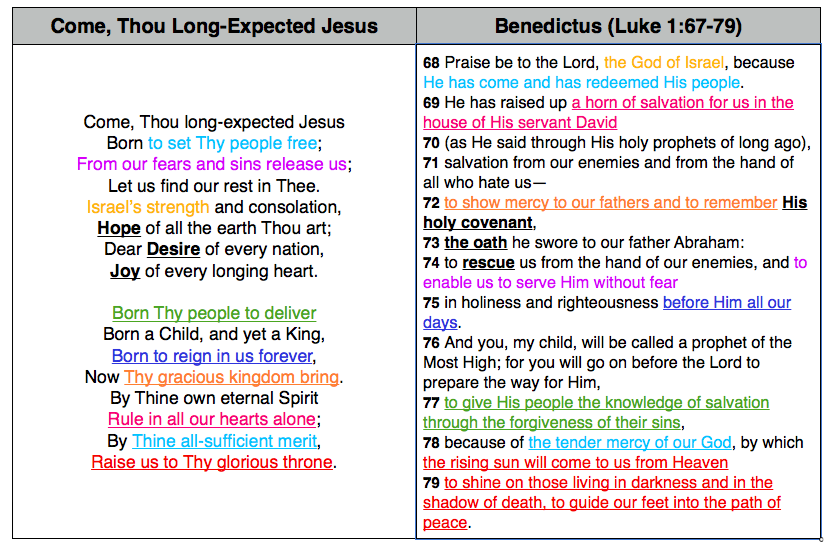
AdventWe began our series on The Carols Of Christmas by looking at the poem written by Charles Wesley in 1744: Come, Thou Long-Expected Jesus. As far as I can find, Wesley never shared where he got his inspiration for this prose, but I have a hunch that it might be from a song in the Bible called The Benedictus.

Zechariah had been unable to speak for nearly a year because of his doubt over the message God sent him through the angel (see Luke 1:5-20). When his son was born and Zechariah named him John, his tongue was loosed and he “was filled with the Holy Spirit” and burst into song (Luke 1:67-79). The first word of his song in Latin is benedictus, from which the name is derived.

Here’s what I love about both Zechariah’s and Wesley’s songs—they both look forward to Christ’s First Advent and His Second Advent. Mary was still pregnant with Jesus when Zechariah sang his song, but his lyrics reflect the Redemption story that Jesus would fulfill as Emmanuel, God with us. Charles Wesley picks up this same theme, rejoicing over Christ’s birth and His imminent return.

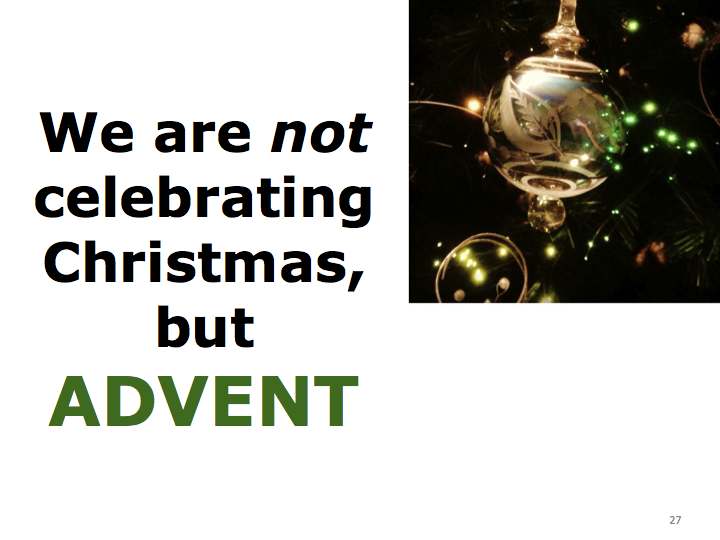
In fact, that’s exactly the point! We aren’t celebrating Christmas as much as we are celebrating Advent. Jesus was born “when the time had fully come” for His First Advent (Galatians 4:4-5), and “this same Jesus, Who has been taken from you into Heaven, will come back in the same way you have seen Him go into Heaven” (Acts 1:11). That’s the message that should encourage us (see 1 Thessalonians 4:13-18).

Check out the remarkable parallels between the Benedictus and Wesley’s hymn—

Come Thou Long-Expected Jesus & Benedictus

If you’d like to download a PDF of this side-by-side comparison, here it is → Come Thou Long-Expected Jesus & Benedictus ←

If you’ve missed any of the messages in this series, you may check them out by clicking here.

Links & Quotes

link quote

Some good reading and watching from this weekend…

“Malice needs nothing to live on; it can feed on itself. A contentious spirit will find something to quarrel about. A faultfinder will find occasion to accuse a Christian even if his life is as chaste as an icicle and pure as snow. A man of ill will does not hesitate to attack, even if the object of his hatred be a prophet or the very Son of God Himself. If John comes fasting, he says he has a devil; if Christ comes eating and drinking, he says He is a winebibber and a glutton. Good men are made to appear evil by the simple trick of dredging up from his own heart the evil that is there and attributing it to them.” —A.W. Tozer

“Let not thy peace depend on the tongues of men, for whether they judge well or ill, thou art not on that account other than thyself.” —Thomas á Kempis

[VIDEO] John Maxwell on the energy in synergy—

Living Nativity

Poetry Saturday—Saint Paul

F.W.H. MyersOh, could I tell, ye surely would believe it!
   Oh, could I only say what I have seen!
How should I tell, or how can ye receive it,
   How, till He bringeth you where I have been?

Therefore, O Lord, I will not fail nor falter;
   Nay but I ask it, nay but I desire,
Lay on my lips thine embers of the altar,
   Seal with the ring, and furnish with the fire.

Give me a voice, a cry, and a complaining,—
   Oh, let my sound be stormy in their ears!
Throat that would shout, but cannot stay for straining,
   Eyes that would weep, but cannot wait for tears.

Quick, in a moment, infinite forever,
   Send an arousal better than I pray;
Give me a grace upon the faint endeavor,
   Souls for my hire, and Pentecost today!

Scarcely I catch the words of His revealing,
   Hardly I hear Him, dimly understand;
Only the Power that is within me pealing
   Lives on my lips, and beckons with my hand.

Whoso has felt the Spirit of the Highest,
   Cannot confound, nor doubt Him, nor deny;
Yea, with one voice, O world, though thou deniest,
   Stand thou on that side, for on this am I. —F.W.H. Myers


Links & Quotes

link quote

Some good reading & watching from today…

For my pastor friends, this is worth pondering for awhile: “We have often a number of good and affectionate but very weak hearers. They are always afraid that we shall offend other hearers. Hence, if the truth be spoken in a plain and pointed manner, and seems to come close home to the conscience, they think that surely it ought not to have been spoken, because So-and-so took offense at it. Truly, my brethren, we are not slow to answer in this matter. If we never offended, it would be positive proof that we did not preach the gospel. They who can please men will find it quite another thing to have pleased God. Do you suppose that men will love those who faithfully rebuke them? If you make the sinner’s heart to groan, and waken his conscience, do you think he will pay you court and thank you for it? Not so; in fact, this ought to be one aim of our ministry, not to offend, but to test men and make them offended with themselves, so that their hearts may be exposed to their own inspection.” —Charles Spurgeon

Dr. Tim Elmore shares a great I.D.E.A. in his post The Battle For Our Youth.

An amazing video about the joy and value that can be found in every God-created human being—

Dwight Moody On Prayer

D.L. MoodySome powerful quotes from D.L. Moody on prayer—

“I firmly believe a great many prayers are not answered because we are not willing to forgive someone.”

“Use me, my Savior, for whatever purpose and in whatever way You may require. Here is my poor heart, an empty vessel: fill it with Your grace. Here is my sinful and troubled soul; quicken it and refresh it with Your love. Take my heart for Your abode; my mouth to spread abroad the glory of Your name; my love and all my powers for the advancement of Your believing people; and never allow the steadfastness and confidence of my faith to abate.”

“If we do not love one another, we certainly shall not have much power with God in prayer.”

Jesus Daily (book review)

Jesus DailyIn just a minute I’ll tell you how to win a FREE copy of the Jesus Daily book, and one other winner will get a free copy of the book and a really cool Jesus Daily t-shirt.

Some people have asked, “Would Jesus tweet?” The answer, I believe, is a resounding yes! Jesus used all of the methods available to Him to share the Good News. Dr. Aaron Tabor is essentially doing the same thing. What has become the Jesus Daily book began by Dr. Tabor asking, “What more can I do to share the good news about Jesus Christ?” That turned into a Facebook page, which has now become this inspirational book.

Jesus Daily is a 365-day devotional book. Each day you will find a verse from the Bible, a short 1-page devotional thought which springs from that verse, followed by a way to interact with others online in sharing the good news.

For example, on my birthday I see, “Surely, O Lord, You bless the righteous; You surround them with Your favor as with a shield” (Psalm 5:12). The devotional thought reminds me that God as my Heavenly Father loves spending time with me, and that in His surrounding presence I find restoration. I don’t have to “earn” time with Him, but He longs for me to come to Him. Then I’m challenged to post one of my favorite verses on-line, and ask others to do the same.

It’s a powerfully-simple concept. Just a few minutes each day, and you will not only draw closer to God, but you will share the good news about Jesus with all of your on-line connections.

Okay, here’s how you can win one of the two prizes. To be entered into the drawing, do as many of the following as you’d like. You will be entered one time for each of these things:

  • Post a comment below with one of your favorite Bible verses.
  • Click one of the share buttons to share this post on one or all of your social media outlets. Make sure that you use the hashtag #JesusDailyBook, and also tag me (@craigtowens) so I can get you entered.

Winners will be selected by a random drawing at 5pm EST on Saturday, December 6, 2014. If your name is drawn, I will contact you. Even if you don’t win a free copy, Jesus Daily will make a great devotional book for you.

I am a FaithWords book reviewer.

The Carols Of Christmas

Carols Of ChristmasI heard the bells on Christmas Day
Their old familiar carols play,
And wild and sweet the words repeat
Of peace on earth, goodwill to men. (Henry Wadsworth Longfellow)

How many “old familiar carols” have you heard Christmas after Christmas, until the words have almost lost their meaning? If we’re not careful, any song repeated too often can lose the richness of its original intent.

There are some amazing messages in many of our old familiar Christmas carols, because many of those messages are saturated with the old familiar story of Redemption that the Bible tells over and over again.

Please join me this Sunday as we take a new look at the old familiar messages in our Christmas carols. These messages will bring a new appreciation of God’s love that was sung at Christ’s Advent, and reawaken the sweetness of meaning for this Christmas Day.

If you’ve missed any messages in this series, check them out here:

10 Quotes From “How Do You Kill 11 Million People?”

How Do You KillAndy Andrews pulls no punches in this amazing book: How Do You Kill 11 Million People? You can read my full book review by clicking here. Below are some of the more noteworthy quotes I highlighted in this book.

“The punishment which the wise suffer who refuse to take part in the government, is to live under the government of worse men.” —Plato

“The past is what is real and true, while history is merely what someone recorded.”

“How fortunate for leaders that men do not think. Make the lie big, make it simple, keep saying it, and eventually they will believe it.” —Adolf Hitler

“It is a fact that fewer than 10 percent of Germany’s population of 79.7 million people actively worked or campaigned to bring about Hitler’s change. Even at the height of its power in 1945, the Nazi political party boasted only 8.5 million members. So the remaining 90 percent of Germans—teachers and doctors and ministers and farmers—did . . . what? Stood by? Watched? Essentially, yes.”

“The danger to America is not a single politician with ill intent. Or even a group of them. The most dangerous thing any nation faces is a citizenry capable of trusting a liar to lead them.”

“Have you ever wondered why America doesn’t have a balanced budget? Have you ever in your life heard of a politician who wasn’t for a balanced budget? Have you ever heard a politician speak in favor of a complicated tax code that ordinary citizens would find difficult to understand? Then why do we have a complicated tax code that ordinary citizens find difficult to understand? Meet the 545 men and women who enact every law, propose every budget, and set every policy enforced on the citizens of the United States of America: one president, nine Supreme Court justices, one hundred senators, and 435 members of the House of Representatives. By the way, have you ever noticed that if any one of us lies to them, it is a felony? But if any one of them lies to us, it is considered politics.”

“During the past quarter century, no presidential election has been won by more than ten million ballots cast? Yet every federal election during the same time period had at least one hundred million people of voting age who did not bother to vote!”

“History shows that any people who are sheeplike in following their leadership (so long as their personal self-interests are satisfied) may one day awaken to find that their nation has changed in dramatic ways.”

“If we don’t demand honesty and integrity from America’s leadership now—and reward that integrity with our votes—our leaders will lack the fortitude to make the hard decisions that must be made to change course.”

“Now, more than ever before, the people are responsible for the character of their Congress. If that body be ignorant, reckless, and corrupt, it is because the people tolerate ignorance, recklessness, and corruption. If it be intelligent, brave, and pure, it is because the people demand these high qualities to represent them in the national legislature. … If [one hundred years from now] the next centennial does not find us a great nation … it will be because those who represent the enterprise, the culture, and the morality of the nation do not aid in controlling the political forces.” —President James A. Garfield, in his address to Congress on the centennial of our country (1876)