Christmas Wisdom From Ebenezer Scrooge

Scrooge and ghostI have been listening to an audio production of Charles Dickens’ Christmas Carol. The one I’m listening to is a podcast performed by Patrick Horgan (very well done!).

Two things have stood out to me—

(1) The genius of Charles Dickens. Check out this brilliant piece of wit.

“Marley was dead, to begin with. There is no doubt whatever about that. The register of his burial was signed by the clergyman, the clerk, the undertaker, and the chief mourner. Scrooge signed it. And Scrooge’s name was good upon change for anything he chose to put his hand to. Old Marley was as dead as a door-nail. Mind! I don’t mean to say that I know, of my own knowledge, what there is particularly dead about a door-nail. I might have been inclined, myself, to regard a coffin-nail as the deadest piece of ironmongery in the trade. But the wisdom of our ancestors is in the simile; and my unhallowed hand shall not disturb it, or the Country’s done for. You will, therefore, permit me to repeat, emphatically, that Marley was as dead as a door-nail.”

(2) The biblical message which comes through so vividly.

“But you were always a good man of business, Jacob,” faltered Scrooge, who now begin to apply this to himself.

“Business!” cried the Ghost, ringing its hands again. “Mankind was my business. The common welfare was my business; charity, mercy, forbearance, and benevolence were, all, my business. The dealings of my trade were but a drop of water in the comprehensive ocean of my business!”

It held up its chain at arm’s length, as if that were the cause of all its unavailing grief, and flung it heavily upon the ground again.

“At this time of the rolling year,” the spectre said, “I suffer most. Why did I walk through crowds of fellow-beings with my eyes turned down, and never raise them to that blessed Star which led the Wise Men to a poor abode? Were there no poor homes in which its light would have conducted me?” (emphasis mine)

How To Be Wise With Your Mouth And Ears

A fool finds no pleasure in understanding but delights in airing his own opinion. (Proverbs 18:2)

One’s open mouth—and closed ears and mind—says a lot of one’s heart! In this 18th chapter of Proverbs, Solomon draws a pretty stark contrast between the mouth and ears of a fool and of a wise person. Check out the links on each of the verses to Bible Gateway to get a full picture of both the fool and the wise person.

Big MouthThe fool…

  • His lips bring him trouble, a smack on the jaw, and may even cost him his life. And yet he keeps on spouting foolishness. He’s not interested in getting any better (vv. 6, 7).
  • His ears gobble up the latest gossip (v. 8).
  • He fires off an answer before really listening (v. 13).
  • His quick, careless words creates the poison food that he continues to eat (v. 21).

The wise…

  • He is always learning how to use his words in a God-honoring, soul-benefitting way (v. 4).
  • He avoids “cheap candy” gossip (v. 8).
  • He listens fully before trying to respond (v. 13).
  • He asks good, clarifying questions (v. 17).
  • His wise words creates the healthy food that nourishes him (v. 20).

So… are you being wise or foolish with your mouth and ears?

8 Quotes Worth Studying From “Proverbs”

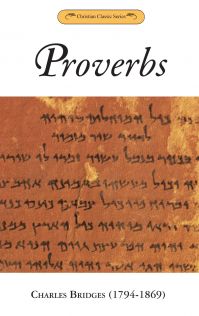
ProverbsIn my review of Proverbs by Charles Bridges (which you can read by clicking here), I noted how he weaved the principles in the biblical book of Proverbs into the teaching that occurs throughout the Scripture. In others words, he showed that the wisdom in Proverbs wasn’t just a “stand-alone” wisdom, but integrated into the whole.
In the quotes I’m sharing today, I trust you will get a glimpse of what I mean. The reference in brackets before the quote indicate the Proverb to which Bridges is commenting. I have also linked all of the Scripture references to my friends at Bible Gateway, so you can look them up easily (and I encourage you to do so!).

[Proverbs 1:10-16] “If the temptation prevail, charge it not on God; no—nor on the devil. As the worst he can do, he can only tempt, he cannot force us, to sin. When he has plied us with his utmost power, and most subtle artifice, it is at the choice of our own will, whether we yield or no (see James 1:13-15). The habitual resistance of the will clears us of responsibility (cp. Romans 7:14-17, 19-20, 23). The consent, even if it be not carried out into the act, lays the responsibility at our own door.”

[Proverbs 2:10-11] “The forsaken sin only makes way for some more plausible, but not less deadly passion. The heart, cast into the mold of the Gospel, is the only cover from those snares within and without (Romans 6:17, 18; 2 Corinthians 3:18), which so imperceptibly, yet so fatally, estrange us from God. Never, till the vital principle is implanted, is their mischief discerned. Never, till then, does the heart find its proper object, its true resting-place.”

[Proverbs 3:5-6] “Take one step at a time, every step under Divine warrant and direction (cp. Ezekiel 18:21-23; Nehemiah 1:11). Ever plan for yourself in simple dependence on God. It is nothing less than self-idolatry to conceive that we can carry on even the ordinary matters of the day without His counsel. He loves to be consulted. Therefore, take all thy difficulties to be resolved by Him. Be in the habit of going to Him in the first place—before self-will, self-pleasing, self-wisdom, human friends, convenience, expediency. Before any of these have been consulted, go to God at once. Consider no circumstances too clear to need His direction. In all thy ways, small as well as great; in all thy concerns, personal or relative, temporal or eternal, let Him be supreme.”

[Proverbs 3:11-12] “Faith understands the reasons of the discipline (1 Peter 1:6, 7); acknowledges it as a part of His gracious providence (Deuteronomy 8:2, 15, 16), and the provision of His everlasting covenant (Psalm 89:30-32); waits to see the end of the Lord (James 5:11); and meanwhile draws its main support from the seal of adoption.”

[Proverbs 4:14-17] “To pray not to be led into temptation; yet not to watch, that we enter not into it (Matthew 6:13; 26:41)—is practically to contradict our prayers; to mock our God, by asking for what we do not heartily wish.”

[Proverbs 11:18-19] “Righteousness is the seed; happiness is the harvest. The reward indeed is not from cause, but of consequence; not of debt, but of grace depending upon a free promise; mercifully yet surely linked with Christian perseverance (Ecclesiastes 11:6; Hosea 10:12; 1 Corinthians 15:58; Galatians 6:7, 8).”

[Proverbs 17:22] “If then, Christian, you believe the Gospel to be ‘glad tidings’ (Luke 1:19; 8:1), show that you believe it, by lighting up your face with a smile.”

[Proverbs 28:13] “The love of sin struggles with the power of conscience. The door of access to God is barred (Psalm 66:18). Christian confidence is clouded (Psalm 32:3, 4); and, unless Sovereign mercy interpose, it must end in the sting of ‘the never-dying worm’ (Isaiah 66:24; Mark 9:44-48). The covering of the disease precludes the possibility of the cure. Only the penitent confessor can be the pardoned sinner.”

“The best work on the Proverbs. While explaining the passage in hand, he sets other portions of the Word in new lights.” —C.H. Spurgeon, commenting on this book

Proverbs (book review)

ProverbsWhat’s the difference between a travel agent and a tour guide? A travel agents simply points the way, a tour guide goes on the trip alongside you, pointing out things they’ve seen and experienced firsthand. I love reading the book of Proverbs in the Bible, but this time I read it with Charles Bridges’ book Proverbs as my tour guide.

Charles Bridges was a pastor par excellence who skillfully wove together supporting Scriptures to give a fuller picture of the particular text on which he was teaching. As a result, you are able to see more clearly how individual lines in each of the Proverbs was supported and integrated into other Scriptures, and how it was immediately applicable to daily life.

My only disappointment with this book is that Bridges only offers commentaries on 22 of the Proverbs. But what he does show is brilliant, and it gave me a new light for my own tour of the remaining Proverbs.

Check this book out the next time you would like to read the rich wisdom in the biblical Proverbs.

Links & Quotes

link quote

“Scripture is about God, God is love, therefore, if you want to learn the Scriptures, look to learn love.” —T.M. Moore

“It is remarkable that the persons in positions of power who wrote most of Israel’s Wisdom Literature did not present the poor as immoral or second-class, but as neighbors in need of mercy. On the other hand, there is never an indication that the needy are necessarily more pious; after all, poverty was never presented as an ideal of Israelite society (Deuteronomy 15:4).” —Archeological Study Bible

“Where would you have been but for grace? To repeat the old saying of John Bradford, when he saw a cartful of men going off to Tyburn to be hanged, ‘There goes John Bradford but for the grace of God.’ When you see the swearer in the street, or the drunkard rolling home at night, there are you, there am I, but for the grace of God. Who am I? What should I have been if the Lord, in mercy, had not stopped me in my mad career?” —Charles Spurgeon

[VIDEO] I hadn’t thought of it this way before, but John Maxwell says there is a healthy and unhealthy way of being defensive—

4 Reasons Why God’s Way Is Better

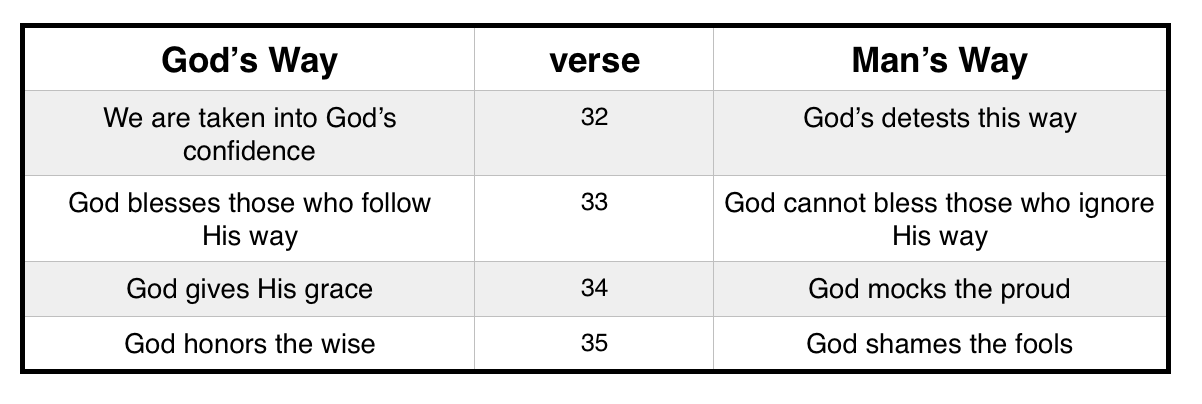
Notice the contrasts (see the conjunction “but”) in these wise words from King Solomon—

For the Lord detests a perverse man but takes the upright into His confidence.

The Lord’s curse is on the house of the wicked, but He blesses the home of the righteous.

He mocks proud mockers but gives grace to the humble.

The wise inherit honor, but fools He holds up to shame. (Proverbs 3:32-35)

Solomon is inviting us to compare God’s way with our way.

God's way or man's way

Looking at this, it’s not too hard to figure out which way is the better way to live! 

Charles Bridges commented on these verses, “The value of our inheritance is beyond all price; its happiness unspeakable; its security unchangeable; its duration eternity. The wise shall inherit glory. ‘They that be wise shall shine as the brightness of the firmament for ever and ever’ (Daniel 12:3; Matthew 13:43).”

(To download a PDF version of the chart above, click here → God’s way or man’s way)

The Quotable Billy Graham (book review)

BillyGrahamOne man … 452 topics … 1000 quotes. All of this coming from a man who has lived his message with integrity through nine decades. The Quotable Billy Graham is a delight to read!

The thing that most amazed me was the wisdom of this godly man. This book of quotes was compiled nearly 50 years ago, and yet the insight with which Dr. Graham spoke and wrote has stood the test of time. All of these quotes are just as relevant today as they were a half-century ago.

What a remarkable book!

(Obviously I will be sharing several of these quotes with you over the next few weeks.)

You Are God’s Lavish Gift To Others

GratefulI have noticed a couple of things about thank-full people (people who are full of thanks). In a single word the difference is ABUNDANCE.

  • Thank-full people have an abundance mentality—they believe there’s plenty for everyone; that God’s grace overflows and is boundless.
  • Thank-full people want others to find this abundant life too. As Charles Spurgeon prayed, “I would then that the quickening Spirit would come down upon me, and upon you, upon every one of us in abundance, to create men valiant for truth and mighty for the Lord.”

This abundance mentality is what Paul is referring to when he writes, “Let the word of Christ dwell in you richly” (Colossians 3:16). Both words dwell and richly convey someone who is so saturated in the abundance of God, that they cannot help wanting to share it with everyone!

So how do Christians lavish their thank-fullness and peace-fullness on others? The rest of that verse in Colossians tells us:

  1. We teach.
  2. We admonish with all wisdom.
  3. We sing.

Teaching others is always rooted in love, and is for the benefit of the other person (Ephesians 4:15, 25, 29).

Wisdom is the Greek word sophia. It means heavenly insight that is extremely practical. That’s what we need when we admonish those we love. This word means to warn people if they are on a wrong path. We love them enough to speak a loving word of warning (Proverbs 27:5-6).

And we sing out of our abundant overflow. The word of Christ dwells in us so richly that it literally bursts out of us in song! Have you ever been around someone so full of God’s presence that their words almost seem to be a song?

But don’t miss out on this. The lavish gift God wants to pour out on people is YOU! Notice how many times the pronoun you is used in Colossians 3:15-17. YOU are God’s gift to your family, your friends, your co-workers, your community!

Don’t rob others of this amazing gift by becoming ungrateful.

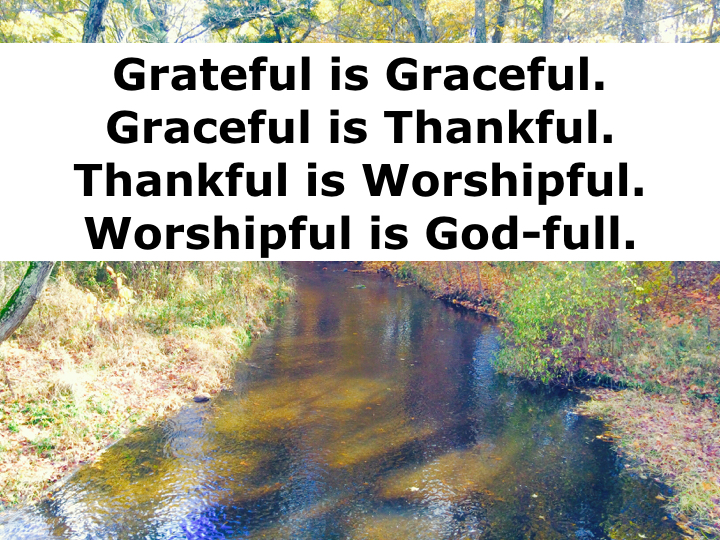
Grateful is graceful. 
Graceful is thankful. 
Thankful is worshipful.
Worshipful is God-full.

“The essence of Christianity is that we give the Son of God a chance to live and move and have His being in us, and the meaning of all spiritual growth is that He has an increasing opportunity to manifest Himself in our mortal flesh.” —Oswald Chambers

What will you do to remain thank-full, and remain God’s lavish gift to others?

Part three of our 3-part series on gratitude is coming up this Sunday. If you don’t have a home church in the Cedar Springs area, I would be so thank-full to have you come join us!

Links & Quotes

link quote

“The time for speaking seldom arrives, the time for being never departs.” —George MacDonald

David Wilkerson has some encouraging words for those in a dark place: “When we’re in the midst of a trial, we must get our eyes off our troubles. In just such times, we need to encourage ourselves, saying, ‘My God can do anything—and He hasn’t forgotten me. He has His eyes on me right now….’” Read more of his post on trusting God here.

And Max Lucado remind us, “We need to know that God is near. We are never alone. In our darkest hour, in our deepest questions, the Lord never leaves us!” Read the rest of his post He Is In Charge.

J. Warner Wallace shares yet another way the existence of consciousness demonstrates the existence of God.

Alan Shlemon tackles a heavy question with some sage advice: Should same-sex attracted Christian men be in a platonic relationship?

Tim Elmore writes, “Our society today unwittingly encourages our kids to simply ‘blend in’—to do what’s asked of you, but only what’s asked of you. In fact, we condition them to do the bare minimum requirement to get by, to look for loopholes and shortcuts. As a result, too many of our gifted young athletes, academicians, and other performers carry this ‘good enough’ mindset with them. They are fine with being ‘average.’” Read the rest of Tim’s post here, and check out a poem I shared earlier about being average.

[VIDEO] Ken Davis always cracks me up—

Links & Quotes

link quote

“‘God works for those who wait for Him’ (Isaiah 64:4). The proper connotation of saying God works for me is that I am bankrupt and need a bailout. I am weak and need someone strong. I am endangered and need a protector. I am foolish and need someone wise. I am lost and need a Rescuer. ‘God works for me’ means I can’t do the work.” —John Piper

“Pure holy simplicity confounds all the wisdom of this world and the wisdom of the flesh.” —Francis of Assisi

The Cedar Springs Post has a nice article about our residents which are featured in the Heart of West Michigan’s ArtPrize. Glad our town is so well represented!

This is pretty amazing: why the information in our DNA points to a Creator.

Eric Metaxas explains how the heroin epidemic in our country is a great opportunity for the church.

5 lies that lead to burnout.

[VIDEO] Cecile Richards admits under oath that Planned Parenthood has lied about providing mammograms—

And here is a list of how beyond lying to the public, Planned Parenthood continues to break the law!