Listen to the podcast of this post by clicking on the player below, and you can also subscribe on Apple, Spotify, or Audible.
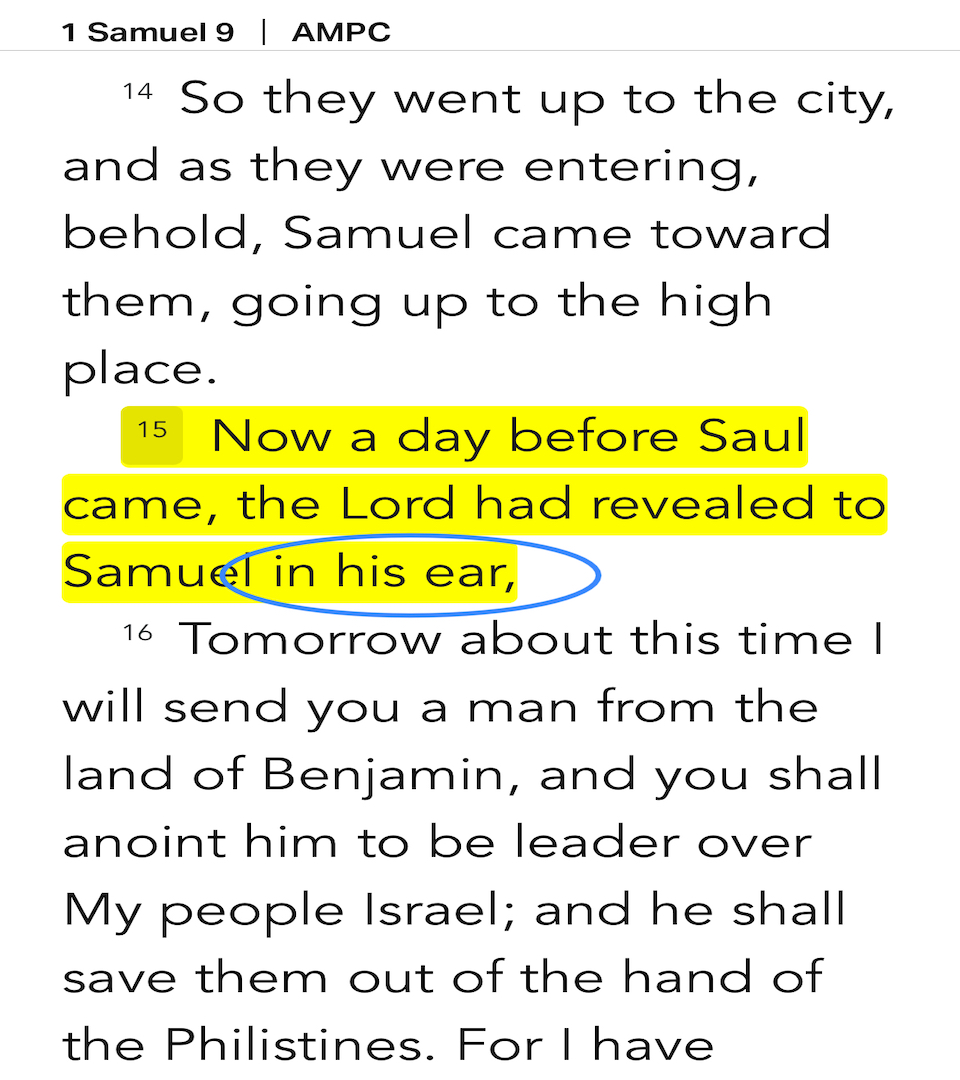
Last week we talked about the Voice of the Holy Spirit. I love the phrase from 1 Samuel 9:15 where God “told Samuelin his ear” about Saul’s arrival and what he should say to Saul. Then the Holy Spirit’s Voice for all of us is foretold in Isaiah 30:21.
It’s great hearing the Spirit’s Voice, but He also empowers us to know the Mind of God.
This is not something that automatically comes to every Christian at the moment they invite Jesus to be their Lord and Savior, as we see mention of immature Christians throughout the New Testament.
Even after Jesus is resurrected from the dead, we see His followers as unsure, troubled men. We meet their…
This is all post-resurrection but pre-conversion, but look at what happens next. After Jesus breathes on them (John 20:22), they are peaceful (vv. 19, 21, 26) and they can now understand the Scriptures (Luke 24:45-48).
As we’ve said, we shouldn’t stop at salvation. Certainly, Jesus wanted more for His followers than merely salvation. He wants His disciples empowered for witnessing and disciple-making (Luke 24:48; Acts 1:4-5, 8).
Check out these examples of the Holy Spirit sharing with us the mind of God:
Joseph—Genesis 41:16, 38-40
Daniel—Daniel 2:19-23, 27-28, 47
Peter—Acts 2:14f; 3:17-26; 4:8-12
Stephen—Acts 7
Philip—Acts 8:30-35
And just in case you think this is just for “super spiritual” people, look how the Holy Spirit helps the whole Church share the Gospel—
After they prayed, the place where they were meeting was shaken. And they were all filled with the Holy Spirit and spoke the Word of God boldly. … Those who had been scattered preached the word wherever they went. (Acts 4:31, 8:4).
This was always God’s plan! Paul harkens back to prophecies like Isaiah 55:8-9, Isaiah 40:13, and Jeremiah 31:33 when he writes about Christians having “the mind of God” in 1 Corinthians 2:6-16.
He says, “These are the things revealed to usby His Spirit” (v. 10).
What things? “Things God has prepared for those who love Him”—things which human eyes haven’t seen, human ears haven’t heard, human minds haven’t conceived (v. 9). These are the the very thoughts of God Himself!
Just as my spirit is the only one that knows what’s really in my mind, the Holy Spirit is the only One Who knows the mind of the Father and Son (v. 11). We have been given the Holy Spirit “so that we may understand what God has freely given us” (v. 12). Contrast this with the dull, unfruitful minds of both unbelievers (2 Corinthians 4:4) and carnal Christians (Philippians 3:18-19).
This mind of God is given to us for our edification so that we can be empowered witnesses and disciple-makers. So don’t stop at salvation, but be baptized in the Holy Spirit, and then keep on being filled with the Spirit.
The apostle Paul demonstrates how a confident leader empowers his teammates to soar—he believed the best in them! Check out the full conversation Greg and I had on The Craig and Greg Show about leaders as gardeners.
In the spirit of C.S. Lewis’ Screwtape Letters, in this post Grimgod talks to his nephew Globdrop about the battle over the definition of masculinity. “If total amnesia of man and woman was not our aim, what was? Stripping those definitions of unwanted details. Man reclaimed that he is, not what he is. They reclaimed the temple, yes, but what remains? The gold, carried away. The glory, departed. They raise their flag above ruins. Is this their triumph—that a man is what his body tells him? Is this all? What is a man? A male adult human. What is the difference? Chromosomes. Bone density. Muscle mass. Voice depth. This is the meager strip of land they repossessed, and we smile at it.”
A recent discovery of a mosasaur fossil in Mississippi has evolutionists buzzing about macro evolution. But the facts say otherwise: “The fossil record shows mosasaurs have always been mosasaurs. These and other terrestrial and marine creatures were buried in a series of violent events one could easily attribute to a massive flood. Proteins, pigment, and other biomolecules uncovered in mosasaur bone provide compelling evidence that these reptiles existed recently—as in thousands of years ago.”
A missionary who thought his years of ministry had accomplished nothing and his daughter who had been estranged from her father both discovered just how much God had done through their ministry.
I love this perspective from Detroit Tigers player Brewer Hicklen, “Almost 1100 days… This journey has molded me and I’ve smiled through most of it, but boy have there been some days where I never thought I’d get there. To anyone that feels defeated—don’t ever give up. God has you in that journey for a reason. Failure is a beautiful thing.”
“Four considerations seem to hold especially in the case of friendship: love, affection, security, and delight. Friendship involves love when there is a show of favor that proceeds from benevolence. It involves affection when a certain inner pleasure comes from friendship. It involves security when it leads to a revelation of all one’s secrets and purposes without fear or suspicion. It involves delight when there is a certain meeting of the minds—an agreement that is pleasant and benevolent—concerning all matters….” —Aelred of Rievaulx
“Psychologist Henry H. Goddard studied tired children and found that they had a burst of energy when he said something encouraging to them. But when he said something negative, they became even more tired.” With that in mind, here’s a 30-second rule to help you better engage others in conversation.
Listen to the podcast of this post by clicking on the player below, and you can also subscribe on Apple, Spotify, or Audible.
I was honored to be invited to offer the commencement address for some amazing students graduating from the Parent Teacher Co-op program.
I think we rush too quickly through our celebrations. It seems that at each milestone, we pause only briefly to move on toward the next milestone. But if we don’t celebrate well, we are actually setting ourselves up for a disappointing future.
It’s very telling that after the perfection of Creation, God took time to celebrate His own handiwork. And then He called us to do the same. That’s what a sabbath really is: A time to celebrate what God has done for us, and what He has empowered us to do for His glory. I think the reason many older people become more contemplative and nostalgic is because they rushed through their life without taking time for sabbath celebrations.
If you look at the history of the Israelites, you will see majestic mountain peaks followed by depressing valleys. What sent them sliding into their valley was one thing: forgetfulness. Time and time again, God sends His prophet to chastise the Israelites for failing to take a sabbath rest. They forgot to honor God and celebrate Him, but instead they rushed along to the next thing. What brought them out of their valley and back to the mountain was also one thing: remembering. Celebrating God for who He is.
So I challenged these graduates—and you—with this. At each milestone in your life…
Thank God for His blessings
Celebrate your own hard work.
Recognize the help you’ve received from others.
Determine which lessons to keep, which to enhance, and which to leave behind.
Find someone to share the journey with you.
Don’t forget to remember!
I would suggest at a minimum celebrating the sabbath each week as God gave us that example, but you may find that you have a moment to celebrate even a small win in the middle of the day in the middle of your week. If you do that, I think your appreciation for God’s blessings will keep you even more dependent on His abiding presence.
You may also be interested in a couple of related blog posts and videos:
Listen to the podcast of this post by clicking on the player below, and you can also subscribe on Apple, Spotify, or Audible.
I would like you to think about a wise, loving friend. One who has years of godly wisdom, empathy, loads of patience, and loving boldness. When you talk with them, you know that you will always get good counsel—even if you may not like exactly what they have shared with you, deep down you know it is still sound wisdom. This is what the Holy Spirit—as our Counselor—does for us.
The Holy Spirit is not merely a force, but He is a Person. Jesus Himself give the Spirit the pronouns “He / Him / His.”
I especially want to key in on those last two attributes where the Holy Spirit is speaking to us.
Samuel grew up during the time of the judges, where everyone did whatever they thought best. This is a time that is described like this, “In those days the word of the Lord was rare; there were not many visions” (1 Samuel 3:1). Visions in the Hebrew language is two words: open communication. In other words, people just weren’t listening for God’s voice.
Samuel had to learn to hear God’s voice as well (see this passage and all of the other biblical references in this post by clicking here).
God doesn’t reveal His heart to those who are unwilling to obey. His persistent call is for obedience to His Word and reliance on His provision. So the word of the Lord had to be revealed to Samuel (v. 7). When Samuel said he was listening (v. 10), that was a posture of readiness to obey.
God wants to reveal His heart to His obedient people. I love how God does this later for Samuel, “Now the Lord had told Samuel in his earthe day before Saul came…” (1 Samuel 9:15).
This is how Jesus described the Holy Spirit in John 7:37-39, as streams that flow continuously out of our being. And Jesus also calls Him Counselor (John 14:16).
Isaiah described our Counselor like this, “Whether you turn to the right or to the left, your ears will hear a Voice behind you, saying, ‘This is the way; walk in it’” (Isaiah 30:21).
Let’s call this GPS = God’s Personal Spirit in us!
Those who are baptized in the Holy Spirit—utterly yielded to His wisdom—will experience:
More insight into God’s Word—Psalm 119:18
More timely application of God’s Word—2 Timothy 3:16-17
More boldness in prayer—2 Samuel 7:27 (same word for in his ear as Samuel experienced)
All Christians have a deposit of the Holy Spirit in their lives at the moment of salvation. The baptism in the Holy Spirit is a completed yielding to the Counselor’s influence. So don’t stop at salvation, but ask Jesus to send you what the Father has promised (Luke 24:49; Acts 2:33).
Check out all of the messages in our series leading up to Pentecost Sunday by clicking here.
If someone is gossiping to you about others, you can be sure that they are gossiping to others about you—shut it down! Check out this full message about gossips.
I hope you celebrated your Mom on Mother’s Day weekend. This is a great perspective from the Axis newsletter: “Some in our culture say motherhood is a prison, or a trap set by the patriarchy. Pop singer Chappell Roan, for example, recently said she didn’t know any people who have kids and are happy. Others say it’s a paradise—with ‘momfluencers’ online making it look like having kids is a nonstop joyride where the lighting is always perfect and nobody ever cries. When ‘prison’ and ‘perfection’ are presented as the only two options, it’s no wonder U.S. birth rates are declining. One way to honor mothers this year is to admit that motherhood is work—albeit spirit-forming, richly rewarding work—and that we can’t expect to see all the fruit of that labor within our lifetime. Hales writes, ‘Christian parenting is about continually pointing to Jesus as the Author and Perfecter of our faith, clinging to the reminder that He who began a good work in us and our children will complete it.’”
In his study Bible, Dr. Henry Halley offered this comment on 1 Corinthians 6:11. “The greatest proof of the new birth is a changed life. Children of God now suddenly love the following:
They love Jesus. Before conversion the sinner might hold Christ in high esteem, but after conversion they love the Savior (1 John 5:1-2).
They love the Bible. We should love God’s Word as the psalmist did in Psalm 119. There he expresses his great love for God’s Word 17 times.
They love other Christians. ‘We know that we have passed from death to life, because we love each other. Anyone who does not love remains in death’ (1 John 3:14).
They love their enemies (Matthew 5:43-45).
They love the souls of all people. Like Paul, they too can cry out for the conversion of loved ones. ‘Brothers and sisters, my heart’s desire and prayer to God for the Israelites is that they may be saved’ (Romans 10:1).
They love the pure life. John says that if anyone loves the world, the love of the Father is not in them (1 John 2:15-17).
They love to talk to God. ‘Speaking to one another with psalms, hymns, and songs from the Spirit. Sing and make music from your heart to the Lord’ (Ephesians 5:19).”
T.M. Moore and I share the same passion for pastors to operate as shepherds. Moore wrote, “Shepherds equip the saints who take up the works of the ministry that build the church. The work of shepherding is hard. It’s not a program that you run from time to time, hoping to enlist new folks in the training. It is the ongoing, body-building means whereby the Lord’s flocks are nourished and become equipped to use their Spirit-given gifts (1 Corinthians 12:7-11) and power (Acts 1:8) to grow their church in unity and maturity in the Lord.” Moore also wrote an endorsement for my book Shepherd Leadership.
John Piper has a thoughtful and biblical response to a question about Christians losing their rewards in Heaven. In part, he says, “All the good deeds that God approves and rewards are works of faith and the fruit of the Spirit. So, let’s get the idea of merit for these good deeds totally out of our minds.” He goes on to show the Scriptures that secure our promised rewards from God.
Paleontologists have discovered an amazing dinosaur graveyard off the coast of southern Chile. The fossilized remains here gave ample evidence to the global Flood described in the Bible.
T.M. Moore has a challenging word for those who are called to preach the Gospel. He writes, “Jesus, like Ezekiel set His face like flint to fulfill His appointed mission. And so must we, for whom the Word is both sweet and bitter (cf. Revelation 10:8-11). We must live and proclaim its sweet and bitter message to an impudent and hard-hearted age, beginning in our churches. It is time for judgment to begin from the house of God (1 Peter 4:17). We must speak to our brethren in the Lord, the household of faith, to teach, warn, direct, and to summon them to revival, renewal, and awakening, for a greater knowledge of the Lord and His love, and a fuller realization of His Kingdom presence, promise, and power.”
“An essential aspect of creativity is not being afraid to fail.” —Edwin H. Land
I have written before how significant it is that the New Testament uses the phrase “one another” so many times. T.M. Moore writes about this as well, noting, “The more we love Jesus, the more loving our neighbors will come (super)naturally to us as the Spirit of God works in us to will and do of His good pleasure. So, as in everything we do to take up Jesus’ work of building His Church, loving one another begins with loving Jesus.”
After listing a truckload of verses describing Who the Holy Spirit is, Sinclair Ferguson concludes, “Think about all of that! This Spirit—this one and the same Spirit, and no other—‘dwells within thee.’ He is the very Spirit who dwelled in the Lord Jesus. … There are not multiple Holy Spirits—One in Whose grace and power the Lord Jesus lived, One Who indwells you, One Who indwells me, and a multiplicity of other Holy Spirits indwelling an innumerable company of believers. No! There is only One Holy Spirit; and He who thus indwells me as the Spirit of Christ also indwells every believer I shall ever meet.”
Listen to the podcast of this post by clicking on the player below, and you can also subscribe on Apple, Spotify, or Audible.
Here in West Michigan, the city of Holland has a yearly festival that has just begun called Tulip Time where attendees will see millions of the most beautiful flowers growing everywhere. It is a stunning display, but perhaps even more impressive is the hard work and care that goes into the cultivation of these flowers. In today’s episode, Greg and I want to encourage you to bring the mindset of a gardener to your leadership. With hard work, patience, and just the right amount of careful pruning, your team will grow from small seeds in the ground to a dazzling beauty that rivals any horticultural display.
[0:40] I’m not sure I’m qualified to talk about today’s topic…
[1:32] A seed has almost everything it needs to grow, and so do our teammates.
[3:13] What do people need most from a gardener-leader?
[5:25] Leaders will need to exhibit confidence in a teammate’s competency.
[8:04] We need to be careful of not rushing the process.
[10:16] I share how the apostle Paul demonstrated belief in his people.
[12:04] How do we make sure our teammates know we have genuine belief in them?
[14:33] I reference a great passage from Greg’s forthcoming book about how leaders stand up for their team.
[19:13] A healthy habit for gardener-leaders.
[21:36] Gardening isn’t an assembly line—the growth plan for every person must be individualized.
[23:44] Greg shares an insightful quote about obstacles.
[25:11] Coaching can help you help your teammates grow.
Check out this episode and subscribe on YouTube so you can watch all of the upcoming episodes. You can also listen to our podcast on Spotify and Apple.
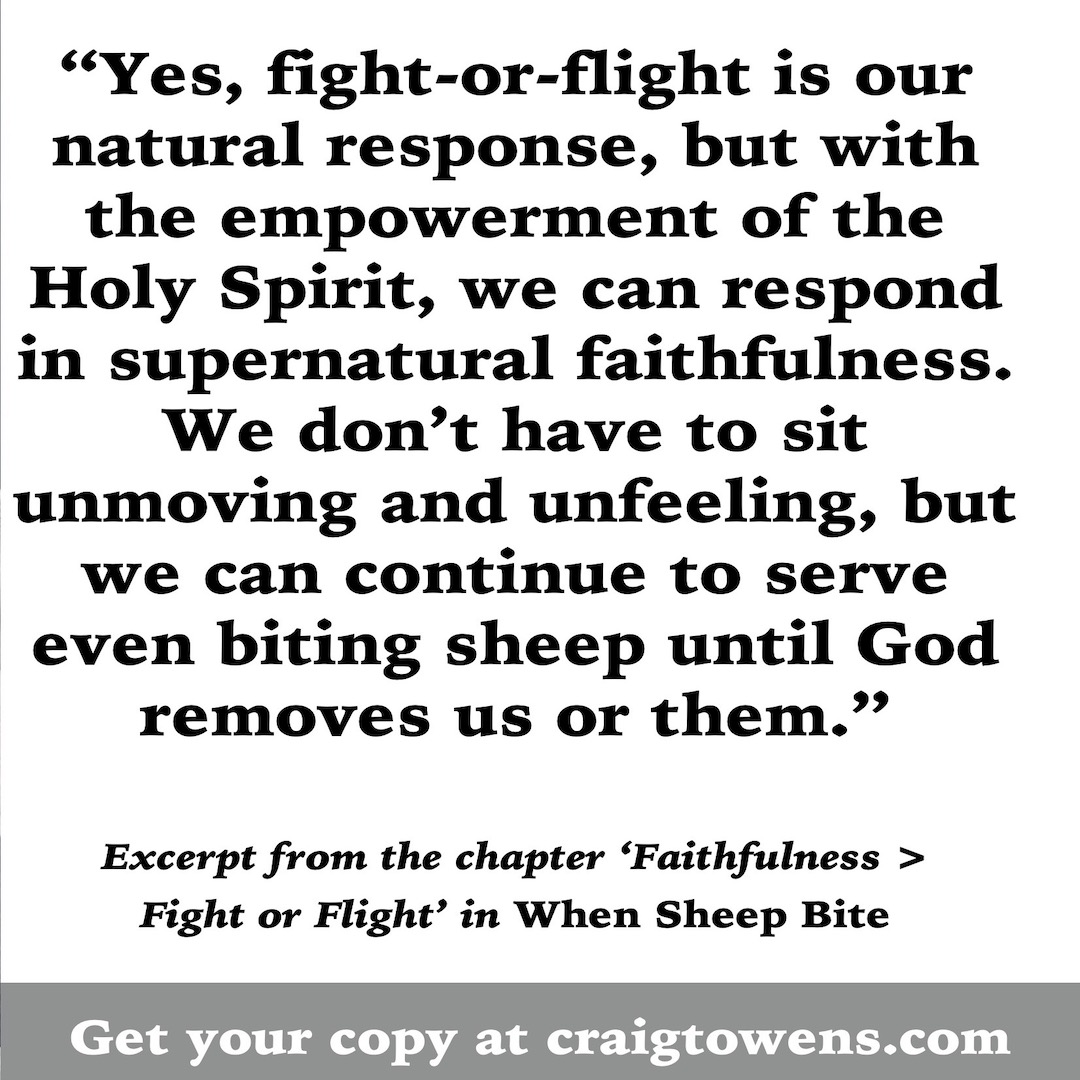
The closing chapter of my book When Sheep Bite is entitled ‘Faithfulness > Fight or Flight.’ In that chapter I wrote—
Remember that we are all striving to not succumb to the natural fight-or-flight response, but to attain the supernatural response of faithfulness. In this, we have a perfect example in our Good Shepherd.
In the Book of Revelation, Jesus is called the One who is “Faithful” (Revelation 19:11), and Paul says that the Faithful One who has called us will empower us to remain steadfast: “He who calls you is faithful, who also will do it” (1 Thessalonians 5:24 NKJV).…
Yes, fight-or-flight is our natural response, but with the empowerment of the Holy Spirit, we can respond in supernatural faithfulness. We don’t have to sit unmoving and unfeeling, but we can continue to serve even biting sheep until God removes us or them.
We glorify God by faithfully serving the sheep He has placed under our care, giving our very best, even if our words and actions are unappreciated or ignored by those we are serving.
If you are in a difficult place in your leadership assignment, I encourage you to check out When Sheep Bite.
Listen to the podcast of this post by clicking on the player below, and you can also subscribe on Apple, Spotify, or Audible.
After God created Adam, He said, “It’s not good for you to be alone.” That’s just as true today: God didn’t intend for us to journey on our own, but He gives us companions along the way.
Last week we saw that God has to sometimes cause us grief to get our attention when we are straying from His path. He sometimes puts people in our lives to do the same thing.
There’s a reason God puts the people in our lives that He does. We are called to speak the truth in love (Ephesians 4:15). But that sometimes means people will get upset with us (Galatians 4:16). “Real friends hurt each other. … Truth is the primary way faithful friends should wound each other—it is the help that hurts.” —Dick Brogden
The Corinthians thought they were super-spiritual, but Paul had to call them out on their foolishness (1 Corinthians 3:3; 5:1-2). Before Pauls’ letter, the Corinthians seemed happy. His letter caused them grief, but it was good grief that led to repentance and true joy (2 Corinthians 7:8-10).
To keep silent when a brother or sister is straying is not God-honoring. We are not to be the sin police, but we are to address sinful issues (James 5:19-20).
As King David flirted with the idea of how he could get something that he thought would make him happy, an anonymous attendant tried to get his attention. David ignored this and then tried to sweep it under the rug. In fact, he thought he got away with his sin (2 Samuel 11:1–12:7).
But God sent Nathan to speak a hard word to David. We don’t know when Psalm 141 was written, but we know that David did write it. Perhaps it was penned at the time of Nathan’s loving confrontation. He said, “Let a righteous man strike me—that is a kindness; let him rebuke me—that is oil on my head” (Psalm 141:5).
We do know that David wrote Psalm 51 after Nathan’s loving hard word, and in this prayer we see David’s confession, repentance, and a request for God’s joy to replace David’s grief.
So how do New Testament-era Christians use good grief to help fellow saints?
Examine yourself first (Matthew 7:1-5). Make sure you aren’t plagued by the same sin you have noticed in a brother or sister.
Cry before you confront, just as the prophet Samuel did before he had to deliver a hard word to King Saul (1 Samuel 15:10-11).
Confront in love with the goal of restoration, but make sure you are confronting someone who know you love them and who will receive your loving word(Proverbs 27:5; 9:8).
Pray that their grief will be turned to joy (Luke 22:31-32; Galatians 6:1; Psalm 51:12).
Friendships with fellow saints are precious and they are vital. We need iron to sharpen iron (Proverbs 27:17) so that we will all stand before the throne together for eternity.



 And some other blog posts you could read to go deeper on this topic:








 Craig T. Owens