If God said to you, “Ask for whatever you want,” what would you ask for?
God did ask Solomon that very question in 1 Kings 3:5. Here’s how Solomon replied—
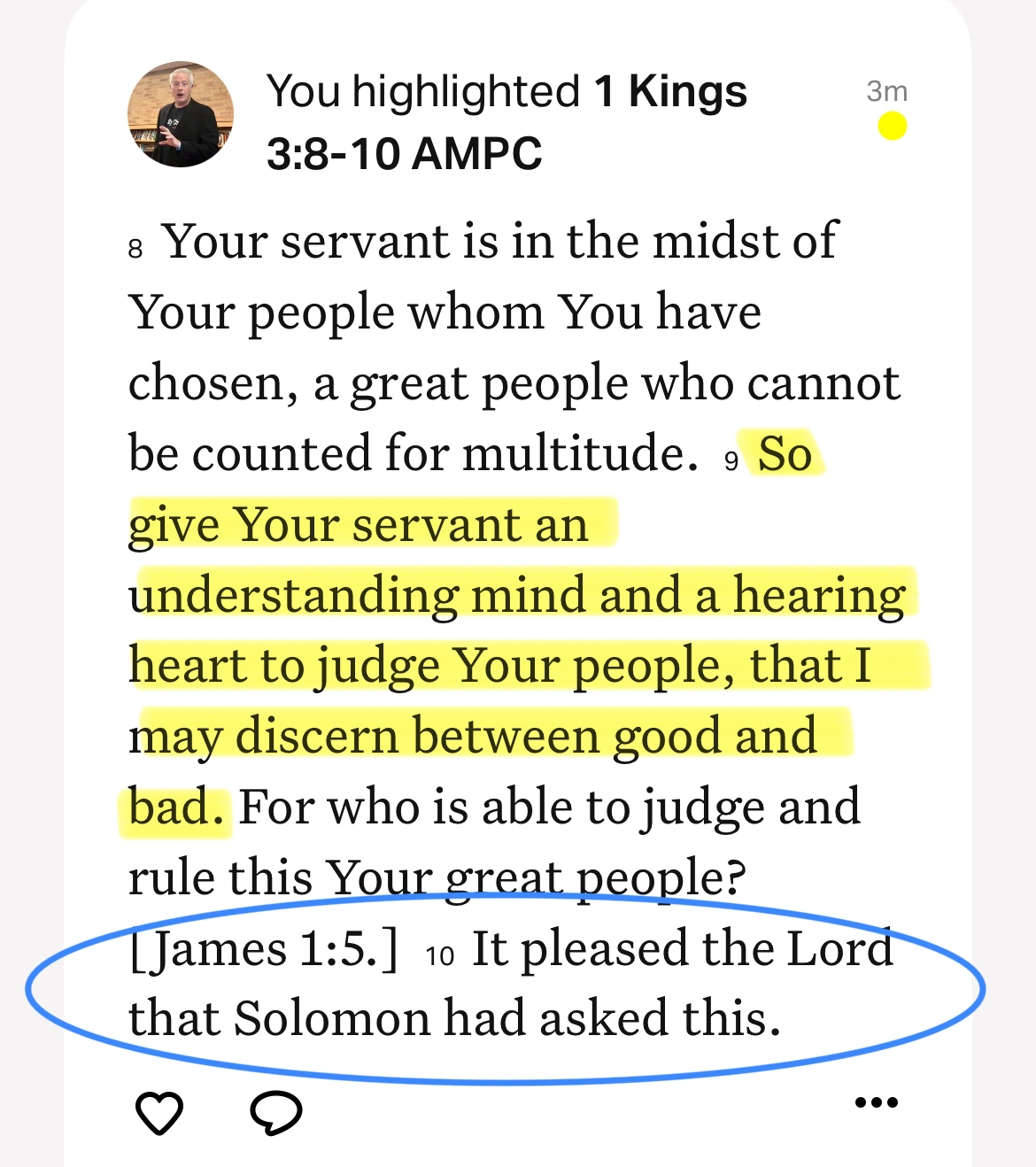
“Your servant is in the midst of Your people whom You have chosen, a great people who cannot be counted for multitude. So give Your servant an understanding mind and a hearing heart to judge Your people, that I may discern between good and bad. For who is able to judge and rule this Your great people?” (1 Kings 3:8-9 AMPC)
And how did God respond to this request? “It pleased the Lord that Solomon had asked this” (v. 10).
Solomon didn’t ask for things but for a greater intimacy with God—he wanted to know God’s mind. Sadly, we tend to reverse this, saying, “Because I have things, I bless God for them.”
Instead, our prayer should echo what Solomon prayed here in 1 Kings 3 and what Jesus taught us in His Sermon on the Mount: My desire is solely for Your glory and Your Kingdom (see Matthew 6:9-10, 33). When you pray this way, it will please that Lord that you had asked that!
Listen to the podcast of this post by clicking on the player below, and you can also subscribe on Apple, Spotify, or Audible.
When I say a rebuke can be loving, let me start off with this reminder: People need to know you truly love them before they will pay attention to a rebuke. If they don’t know you love them and want the best for them, your rebuke will simply make them angry and may create an uncrossable chasm between you.
Nathan was the prophet who confronted David with his sin, saying, “You are the man!” (2 Samuel 12:1-7). Nathan not only took his life into his hands by speaking so boldly against King David, but he risked the lives of his family as well.
Thankfully, David acknowledged his sin, repented, and asked forgiveness (2 Samuel 12:13; Psalm 51:3-12). Instead of being banished, Nathan was honored. In fact, we see Nathan faithfully serving in King David’s inner circle even after the king is dead and King Solomon ascends to the throne.
And then during the reign of King Solomon, two of Nathan’s sons are honored with prestigious positions in Solomon’s court. “Azariah son of Nathan was over the officers; Zabud son of Nathan was priest and the king’s friend and private advisor” (1 Kings 4:5).
Solomon wrote, “He who rebukes a man shall afterward find more favor than he who flatters with the tongue” (Proverbs 28:23).
We must speak the truth in love. Not so that we are rewarded here (because that may or may not happen), but because God has called us to this. And He keeps perfect records so that we will be rewarded in Heaven.
Listen to the podcast of this post by clicking on the player below, and you can also subscribe on Apple, Spotify, or Audible.
There’s an interesting verb used with both Enoch and Noah that denotes intimate fellowship—the word is “walked.”
Enoch walked with God; and he was not, for God took him. (Genesis 5:24)
These are the records of the generations of Noah. Noah was a righteous man, blameless in his generation. Noah walked with God. (Genesis 6:9)
David uses this same verb when he prays, “Vindicate me, Lord, for I have walked in my integrity, and I have trusted in the Lord without wavering. Examine me, Lord, and put me to the test; refine my mind and my heart. For Your goodness is before my eyes, and I have walked in Your truth” (Psalm 26:1-3).
And Solomon uses the same verb to say that anyone who walks in righteous integrity leaves a legacy of righteousness for his family: “A righteous person who walks in his integrity—how blessed are his sons after him” (Proverbs 20:7).
There is something important that is implied in this walking. God tells us what it is in this question: How can two walk together unless they agree to do so? (Amos 3:3).
But make no mistake, God doesn’t agree with whatever path I choose to walk, but I must agree to walk God’s path.
I must agree that God’s path is best, despite what everyone else is doing—“Then the Lord saw that the wickedness of mankind was great on the earth, and that every intent of the thoughts of their hearts was only evil continually” (Genesis 6:5). Yet Noah didn’t walk with the wicked, but he was commended because he walked with God.
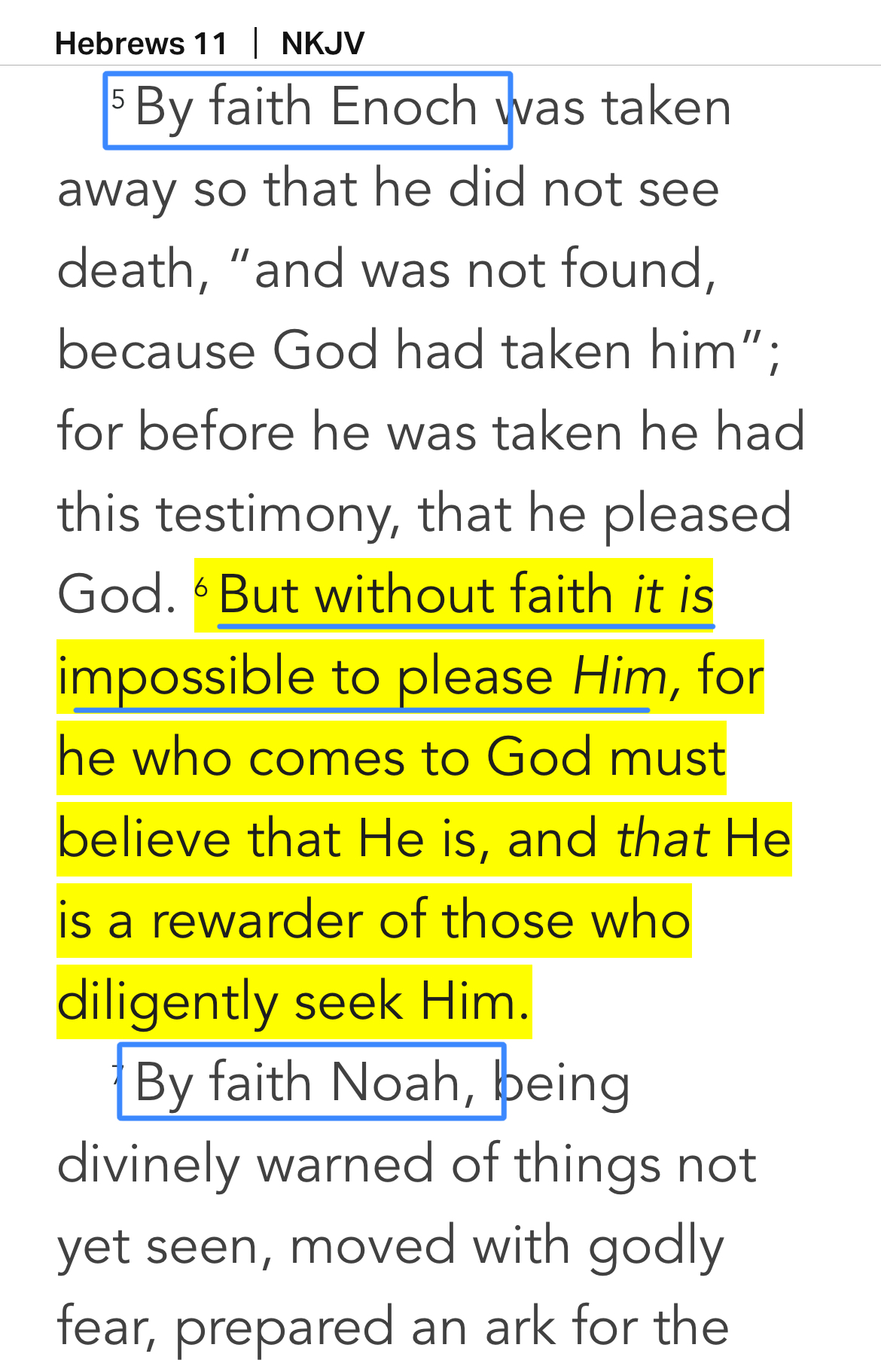
In the New Testament, Enoch and Noah are listed as back-to-back examples of faith (Hebrews 11:5, 7). The verse that connects these two men speaks of the faith-filled integrity that kept them walking with God—
And without faith it is impossible to please Him, for the one who comes to God must believe that He exists, and that He proves to be One who rewards those who seek Him. (Hebrews 11:6)
That word “seek” means to diligently crave. Enoch and Noah and David show us examples of men who diligently craved walking with God above all else. Their faithful, diligent walking made them stand out from all those around them.
What about us? Hebrews 11:6 says we can follow their example. We can choose to walk with God by faith. We can diligently crave Him above all else. When we walk righteously with God, He “rewards those” who do—for ever and ever!
Listen to the podcast of this post by clicking on the player below, and you can also subscribe on Apple, Spotify, or Audible.
Bruce Barton said, “When you’re through changing, you’re through!” I think the same thing could be said about a leader’s learning—when you think you’ve learned it all, your leadership is beginning to crumble.
I never want to get to the place where I think I have “arrived” as a leader, but I want to be humble enough to admit that there are so many things I have yet to learn. Jesus reminded us, “Every student of the Scriptures who becomes a disciple in the kingdom of heaven is like someone who brings out new and old treasures from the storeroom” (Matthew 13:52 CEV).
“New and old treasures” tells me that there’s some good stuff we need to protect, and also some good stuff we haven’t yet learned.
A mark of a godly leader is his commitment to being a lifelong learner.
Here are three new things the Holy Spirit has recently taught me:
Acts 6:3 says, “Choose seven men from among you who are known to be full of the Spirit and wisdom. We will turn this responsibility over to them.”
My lesson: The résumé for those that are to be placed in ministry leadership positions should include servant-heartedness, Christlike character, wise experience for the task, and reliance on the Holy Spirit.
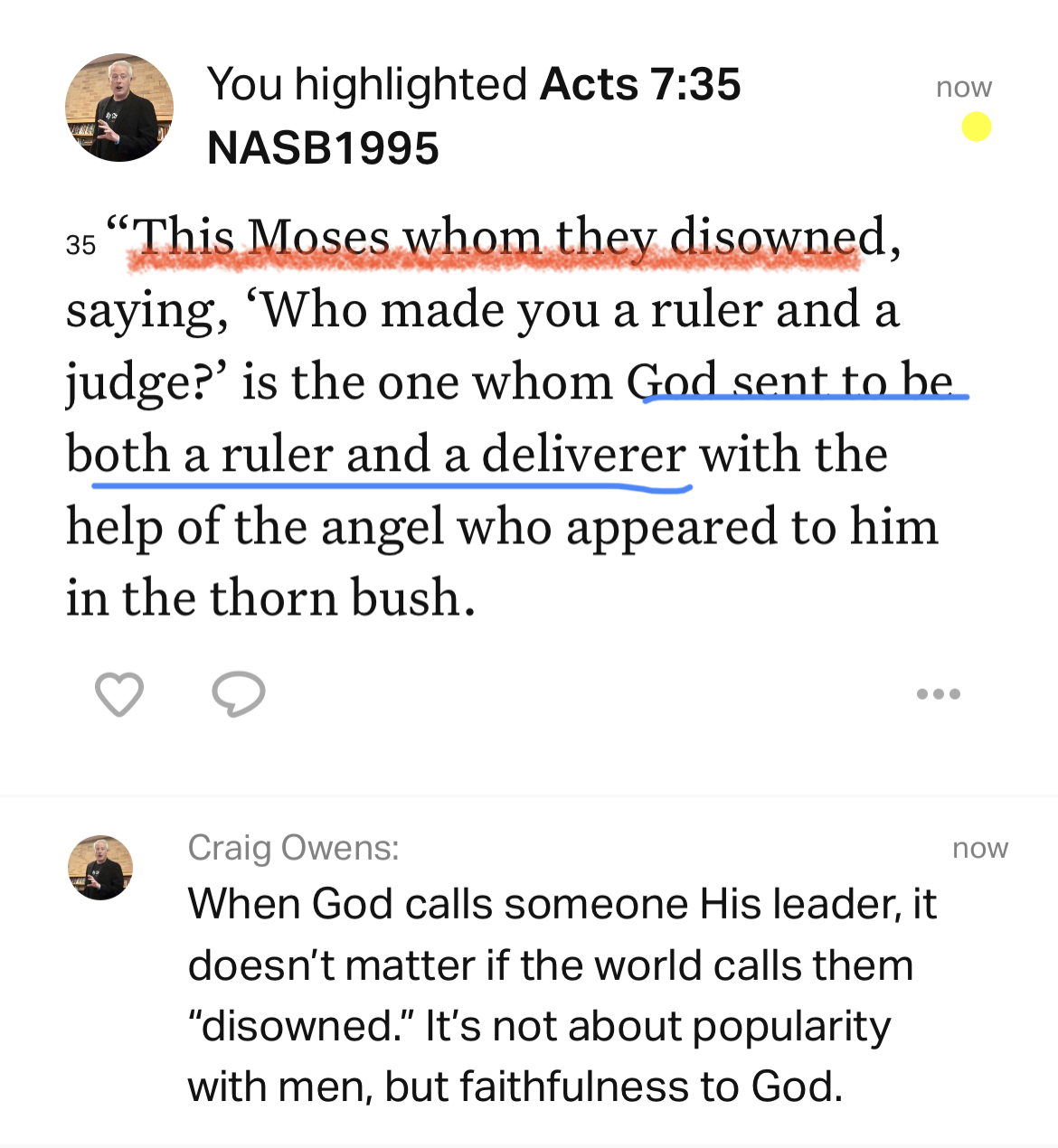
“This Moses whom they disowned…is the one God sent to be both a ruler and a deliverer” (Acts 7:35).
My lesson: When God calls someone His leader, it doesn’t matter if the world calls them disowned. It’s not about popularity with men, but faithfulness to God.
When we first meet Boaz, he is described as “a man of standing.” Some Bible translations say “a man of wealth,” which is an acceptable definition. In fact, the word can mean strength, wealth, valor, or prominence, but the root word means something brought forth out of travail and pain. That tells us that Boaz wasn’t born a man of standing, he became a man of standing by going through difficult times, not giving in to the downward slide of culture, and remaining true to God.
Boaz had a steel-forged integrity!
Believe me, it would have been easy for Boaz to compromise! This was a dark time of selfishness in Israel’s history. A time where just doing the bare minimum was acceptable because most of the Israelites were selfishly doing whatever would benefit them (Judges 21:25).
The other description we read about Boaz is that he is a “kinsman-redeemer.” This same word is used in this verse: “Plead my cause and redeem me; revive me and give me life according to Your word” (Psalm 119:154). A redeemer is one who is close by to help, has the strength or resources to help, and is willing to help. Of course, the perfect example of a Kinsman-Redeemer is Jesus, who became our human kinsman so that He could rescue us (see Hebrews 2:14; Philippians 2:7-8).
Boaz was given the opportunity to do this for Naomi and Ruth, and he seized the opportunity with gusto. Far from being a “bare minimum” man, Boaz always went the second mile to bless Ruth and Naomi:
he practiced the “hospitality clause” plus he protected Ruth and gave her more than was required
he provided food for his workers plus he provided food for Ruth and Naomi
he blessed his workers plus he blessed Ruth in the name of the Lord
Ultimately, Boaz did indeed become the kinsman-redeemer for Naomi (by paying off all the debts of her deceased husband) and for Ruth (by marrying this non-Israelite woman and bringing her into the family line of Jesus).
Boaz was King Solomon’s great-great-grandfather. When Solomon was completing the temple in Jerusalem, he erected two pillars at the entrance: one was named Boaz, and the other was Jakim (with means “God will establish”). Taken together these pillars proclaim the message: By His integrity and faithfulness, God establishes and makes firm.
Boaz exhibited integrity at every opportunity, which is what forged his character and made him “a man of standing.” Boaz demonstrated that integrity is really faith in God plus faith-filled, second-mile, others-focused actions.
“Faith without works is just wishful dreaming.
Works without faith is just religious posturing.
Works with faith is God-glorifying!” —Craig T. Owens
Men of God, please remember this:
Every Word of God that you read or hear is a test—will you obey Him or will you compromise?
Every setback you go through is a test—will you learn and grow or will you sulk and shrink back?
Every success you experience is a test—will you bless others or will you hoard your blessings?
Every decision you make in a dark culture is a test—will you just have faith, just have bare-minimum works, or will you exhibit the steel-forged integrity that comes from putting your faith to work?
God’s blessing on your life of integrity will show others a picture of Jesus. God’s blessing on your life of going the second mile will show others that it is God who establishes and makes firm.
Don’t rob your family, don’t rob us, don’t rob future generations of the outpouring of God’s blessing because you are selfish or compromising. Stand strong, trust God, go the second mile, be the kinsman-redeemer for those in need, and then watch for God’s blessings!
David said, “…I had it in my heart to build a house as the place of rest for the ark of the covenant of the Lord. … But God said to me, ‘You are not to build a house for My name…’” (1 Chronicles 28:2-3).
David’s son Solomon would later write about how we make plans in our hearts, but God directs all our steps (Proverbs 16:9, 19:21).
David not only had the desire to build this temple for God but he said the Holy Spirit gave him the plans (1 Chronicles 28:12, 19). As a result of this, David began amassing resources and organizing personnel. All of this David could then hand over to Solomon, the man who would build the house for the ark of the covenant of the Lord.
I am sure David felt a twinge of disappointment when God said “no.” Still, David continued to work the plan the Spirit had given him. Who knows how Solomon would have begun his reign as king if David hadn’t done all of this for him. Many of the plans God gives me will not be forme but for the following generations who will benefit from my diligence in those plans.
A mark of a godly leader is one who knows that obedience to God IS success.
In one of David’s psalms, he prays for success and for his heart’s desire to be fulfilled, but he also acknowledges God’s sovereignty over these things (Psalm 20). May I always keep in mind that obedience IS success. Success isn’t limited only to what I can see and measure during my lifetime.
This is part 53 in my series on godly leadership. You can check out all of my posts in this series by clicking here.
When I look up “prosper” in the dictionary, the first entry says, “to be successful or fortunate, especially in financial respects.” This isn’t even close to the Old Testament Hebrew word for prosper!
God makes prosper a dependence on Him. Mammon makes prosper a dependence on self.
The Hebrew word tsalach means:
to overcome obstacles (like crossing a river)
to be empowered by the Spirit of God to overcome an enemy (like Samson did)
to flourish like a plant growing to full harvest
to have favor with man so that good can be done for others (Nehemiah 1:11)
to be poured out; to be a conduit of God’s blessings to others
Prosperity God’s way is being blessed to bea blessing to others.
Prosperity is never for me, only from God through me.
Prosperity from God helps me overcome obstacles for others, defeat enemies for others, bring in a good harvest for others, have earthly favor that will benefit others, finish well for the sake of others.
I’ll say it again: True prosperity ISN’T for me, it’s only from God through me!
Hezekiah showed how God’s prosperity came through him to benefit others:
he did “what was good and right and faithful before the Lord”
he lived “in obedience to the law and the commands”
“he sought his God and worked wholeheartedly”
In light of this definition, I have no problem praying, “God, make me prosperous. As I seek You and work wholeheartedly, flow through me to bless others!”
“For as he thinketh in his heart, so is he,” said the wise King Solomon nearly 3000 years ago. James Allen picked up on this phrase and noticed how true it still was in his day, prompting him to pen some astute observations in his book As A Man Thinketh.
This is not an academic book, nor is it a self-help book. Mr. Allen states his rationale for writing on the opening pages: “This little volume (the result of meditation and experience) is not intended as an exhaustive treatise on the much-written-upon subject of the power of thought. It is suggestive rather than explanatory, its object being to stimulate men and women to the discovery and perception of the truth that—‘They themselves are makers of themselves.’”
Just as the biblical book of Proverbs contains short observations that are intended to cause the reader to contemplate the outcome of particular life choices and thought patterns, Mr. Allen does the same thing for a contemporary audience. Although you could breeze through this short book quite quickly, I strongly urge you to take your time to ponder just how powerfully your patterns of thought contribute to your everyday actions.
Metacognition is a psychological term meaning to think about what you think about. As A Man Thinketh will definitely stimulate some productive metacognition of your own.



 If God said to you, “Ask for whatever you want,” what would you ask for?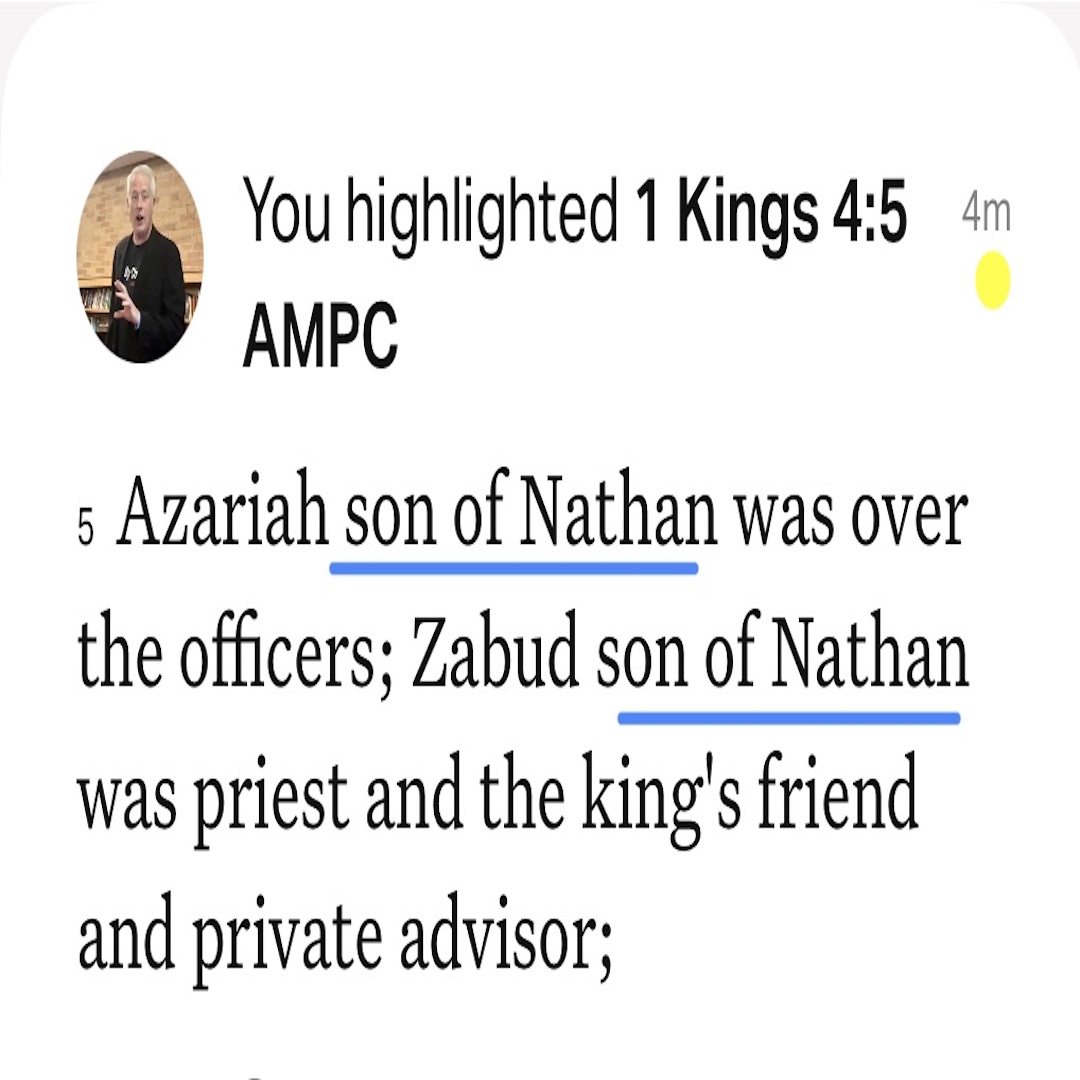







 Craig T. Owens