
A Perspective On Problems

False ideas on problemsWe were blessed to have a special guest speaker yesterday morning: Jeff Hlavin. Wow, what a great word he shared with us! He continued in our series called Aliens and Strangers, on how Christians are to live in this world as citizens of Heaven. Below are a few notes I jotted down.

Dear friends, do not be surprised at the fiery ordeal that has come on you to test you, as though something strange were happening to you. (1 Peter 4:12)

Using this verse as his introduction, Pastor Jeff shared four false ideas about problems:

  1. Problems are bad and are an interruption to our lives.
  2. All problems can be avoided by hard work, careful planning and clear thinking.
  3. Good Christians don’t have problems.
  4. My problems are a result of sin or are a sign of a lack of faith/maturity.

Instead I should see from a biblical perspective that…

“The Holy Spirit is the greatest Change Agent in a Christian’s life. I can only resolve this tension by obedience. … The devil tries to invoke turmoil in my life, but I can overcome this turmoil by submitting to God (James 4:7).” —Jeff Hlavin

“Trials develop spiritual/emotional/mental muscles that we need to have to soar into the place God has for us.” —Jeff Hlavin

If you would like to download a copy of the outline Pastor Jeff handed out to us, click here → Perspective on Problems Outline ←

We will be continuing in our Aliens and Strangers series this Sunday, and I’d love to have you join us. If you’ve missed any messages in this series, you may find the complete list by clicking here.

One Word

RedemptionWhen it comes right down to it, there is really just one word that makes Christians peculiar. Just one word changes our citizenship from Earth to Heaven. One word took us from a path where our sins had us headed toward an eternity in Hell.

Jesus stepped in where He didn’t have to go. Jesus became our sin to pay-off our sin debt. Jesus took us back from satan’s possession, and made us a part of His Father’s family.

Jesus redeemed us! 

I wonder if we truly understand that word redemption?

Peter is speaking to us as “strangers here in reverent fear” on Earth, and he calls us to live up to God’s call—Be holy, because I am holy (1 Peter 1:16; Leviticus 11:44-45). He asks us to obediently follow God’s Word (1:22), to get rid of Earth-bound things (2:1), and instead taste that the Lord is good (2:3).

Why? Because we’ve been “redeemed from the empty way of life…by the precious blood of Christ” (1:18-19) We don’t live holy lives to try to earn redemption, but because we have been redeemed we are now capable of living holy lives!

To help illustrate his point, Peter quotes a couple of verses from Isaiah 40. In this chapter, we are invited to weigh the greatness and love and knowledge and power of God against the things we can provide for ourselves on Earth. Please check out the video below, where I go through this 40th chapter of Isaiah.

If you’ve missed any messages in this series, you may find the complete list by clicking here.

A Whole New Revelation

The Word and the SpiritHow would you like to have better insight than prophets like David, Isaiah, Jeremiah, Ezekiel or Daniel? How would you like to have a greater revelation of who Jesus is than even in the angels in Heaven? You can!

Peter tells us aliens and strangers how we should live on Earth as citizens of Heaven (1 Peter 1:13-16):

  • Our minds prepared for action
  • Self-controlled (another translation says sober)
  • Fully hopeful of God’s promises
  • Obedient children
  • Not conformed to the world’s standards
  • As holy as God is

If that sounds like a challenging list, it’s because it is a challenging list! But notice an important word that starts verse 13: Therefore. This tells us we must look at what came before the therefore to know how to respond to what comes after the therefore.

In the verses preceding (vv. 10-12) we read about Old Testament prophets and New Testament preachers. But notice the similarities between these two—They both spoke about grace and salvation, and they both spoke with the Holy Spirit’s guidance. The Word of God was inspired by the Holy Spirit, and it is the same Holy Spirit that wants to give you a full revelation of what is in the Word.

The prophets searched carefully, but they never got to see Jesus come to Earth and fulfill the prophesies. The angels in Heaven have seen the story played out, but they don’t know what it is to have received a complete pardon for their sins that would have damned their souls to Hell.

That’s why Spirit-filled Christians who regularly study the Word of God have better insight than the prophets, and greater revelation than the angels!

What about you?

  1. Have you invited Jesus into your heart?
  2. If you have, are you regularly reading your Bible?
  3. If you are, have you allowed God to baptize you in His Holy Spirit?

This combination not only makes you peculiar to Earthlings, it makes you peculiar to prophets and angels too!

If you’ve missed any messages in this series, you may find the complete list by clicking here.

The Joy Of Trials

Drawing othersA quick show of hands: How many of you would consider your difficult situations a blessing from God?

Probably not a lot of hands went up, but it’s true.

Peter lists six blessings of God for which we can bless Him (see 1 Peter 1:3-3-9):

  1. God’s great mercy
  2. New birth
  3. Living hope
  4. An inheritance that can never perish
  5. God’s shielding power
  6. Trials

Trials?! Yep!

Peter is quick to tell us that trials only last for a little while, but they are sent our way to prove that our faith is genuine. He says that trials result in praise, glory and honor from God to us, and that successfully going through our trials lead to “an inexpressible and glorious joy.”

In trials you probably don’t feel like praising God, but our God-breathed soul is made up of more than just emotions. We also have been given a mind and a will. So here’s what I would suggest—in your trials, use your mind to reflect on the blessings of God. Then use your will to open your mouth. When you you do this, you will experience the emotion of an inexpressible and glorious joy.

In other words: you are more likely to act yourself into feeling than you are you feel yourself into action!

Look at how David did this in Psalm 34. In a huge trial…

  • …he used his mind and will: I will extol the Lord at all times.
  • …then his emotions kicked in: My soul will boast in the Lord.
  • …his worship helped others: let the afflicted hear and rejoice.
  • …and this pointed everyone to God: Glorify the Lord with me; let us exalt His name together.

Seeing your trials as a way to bless God not only benefits you, but it draws others to God’s sustaining power as well.

If you’ve missed any messages in this series, you may find the complete list by clicking here.

Preach Like John

John the BaptistThis is a post for my fellow preachers (but the rest of you are free to listen in as well).

When Jesus says someone is the greatest preacher in history, it gets my full attention. Think about what John didn’t have…

  • No church building
  • No platform or pulpit
  • No worship team
  • No sound system
  • No Logos software
  • No library or study
  • No commentaries
  • No PowerPoint or handouts

He only had the Word of God and the Holy Spirit.

His sermons were thoroughly grounded in Scripture (Luke 3:4-6).

His sermons were anointed by the Holy Spirit (Luke 1:66).

His message was simple: “Repent from your sins, and produce fruit in keeping with repentance” (Luke 3:3, 8).

His messages prompted people to ask, “What should we do?” and he gave them Spirit-anointed answers (Luke 3:10-14).

His messages “exhorted the people” and brought “the good news to them” (Luke 3:18).

His sermons unashamedly called out sin (Luke 3:19).

And he will go on before the Lord, in the spirit and power of Elijah, to turn the hearts of the fathers to their children and the disobedient to the wisdom of the righteous—to make ready a people prepared for the Lord. (Luke 1:17)

Fellow preachers, may we be of the same spirit in our preaching!

Making Hearts Burn

Living WordThere is an interesting line the angels speak to the ladies who came to anoint Christ’s dead body in the tomb: “Why are you looking for the living among the dead?” (Luke 24:5).

That phrase sums up much of our culture. People are looking for life, but they are looking for it among dead things. Wise King Solomon wrote that God has placed a God-shaped void in the heart of every human being (Ecclesiastes 3:11). But Solomon went on to say that anything “under the sun” that we try to use to fill that God-void will be utterly meaningless.

Peter wrote to aliens and strangers about living such good lives that will point people to God. This means Christians need to help people who are looking for the living among the dead see that real life is in Christ. To do this, we need to be immersed in the Living Word of God.

In the conversations after Christ’s resurrection, look at the references to God’s Living Word:

  • Remember how He told you … Then they remembered His words (Luke 24:6-8)
  • what was said in all the Scripture concerning Himself… (Luke 24:27)
  • …written about Me in the Law of Moses, the Prophets and the Psalms … so they could understand the Scriptures ( Luke 24:44-45)

There is life in God’s Word! When the two disciples of Jesus remembered His Living Word, they said their hearts burned inside them (Luke 24:32).

If you want to help those searching for life to find it, let them hear God’s Living Word coming from your lips. This will make their hearts burn, and lead them to a personal relationship with Jesus Christ.

If you’ve missed any messages in this series, you may find the complete list by clicking here.
Laughing At Christ?

These words of Charles Spurgeon are gripping. Especially the questions at the end…

But when we continue in our sin, when we laugh at what God disallows, we do indeed laugh at Jesus hanging on that Cross.

Christ on the Cross“See Him; like a cart pressed down with sheaves He goes through the streets of Jerusalem. Well may you weep, daughters of Jerusalem, though He bids you dry your tears; they hoot Him as He walks along bowed beneath the load of His own Cross which was the emblem of your sin and mine. They have brought Him to Golgotha. They throw Him on his back, they stretch out His hands and His feet. The accursed iron penetrates the tenderest part of His body, where most the nerves do congregate. They lift up the Cross. O bleeding Savior, Thy time of woe has come! They dash it into the socket with rough hands; the nails are tearing through His hands and feet. He hangs in extremity, for God has forsaken Him; His enemies persecute and take Him, for there is none to deliver Him. They mock His nakedness; they point at His agonies. They look and stare upon Him with ribald jests; they insult His griefs, and make puns upon His prayers. He is now indeed a worm and no man, crushed till you can think scarcely that there is divinity within. The fever gets hold upon Him. His tongue is dried up like a potsherd, and He cries, ‘I thirst!’ Vinegar is all they yield Him; the sun refuses to shine, and the thick midnight darkness of that awful mid-day is a fitting emblem of the tenfold midnight of His soul. Out of that thick horror He cries ‘My God, My God, why hast Thou forsaken Me?’ Then, indeed, was He pressed down! O there was never sorrow like unto His sorrow. All human griefs found a reservoir in His heart, and all the punishment of human guilt spent itself upon His body and His soul. O shall sin ever be a trifle to us? Shall I ever laugh at that which made Him groan?” —Charles Spurgeon

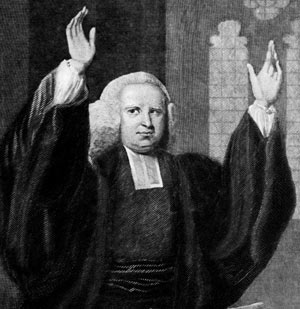
11 Quotes From “A Sketch Of The Life And Labors Of George Whitefield”

A Sketch of the Life and Labors of George WhitefieldYesterday I tweeted…

And that’s definitely true in the book J.C. Ryle wrote: A Sketch Of The Life And Labors Of George Whitefield. You can read my full book review by clicking here. Below are some of the quotes I highlighted in this interesting biography.

“Informing your opinion of the comparative merits of Christian men, never forget the old rule: ‘distinguish between times.’ Place yourself in each man’s position. Do not judge what was a right course of action in other times, by what seems a right course of action in your own.”

“In the thirty-four years of his ministry, it is reckoned that [Whitefield] preached publicly eighteen thousand times. … No preacher has ever retained his hold on his hearers so entirely as he did for thirty-four years.”

“He seemed to live for only two objects—the glory of God, and the salvation of immortal souls. He raised no party of followers who took his name. He established no system, like Wesley, of which his own writings should be cardinal elements. A frequent expression of his is most characteristic of the man: ‘Let the name of George Whitefield perish, so long as Christ only is exalted.’” 

“He was a man of extraordinary catholicity and liberality in his religion. He knew nothing of that narrow-minded policy which prompts a man to fancy that every thing must be barren outside his own camp, and that his party has got a monopoly of truth on heaven. He loved all who loved the Lord Jesus Christ in sincerity. He measured all by the measure which the angels of God use —‘Did they possess repentance towards God, faith towards the Lord Jesus Christ, holiness of conversation?’ If they did, they were as his brethren. His soul was with such men, by whatever name they were called.”

“Whitefield preached a singularly pure gospel. Few men ever gave their hearers so much wheat and so little chaff. … This, you may be sure, is the corner-stone of all preaching that God honors. It must be predominantly a manifestation of truth.”

“To make easy things seem hard is easy, but to make hard things easy is the office of a great preacher.” —Archbishop Usher

“He is the best orator who can turn men’s ears into eyes.” —Arabian Proverb

“It was no uncommon thing with him to weep profusely in the pulpit. Cornelius Winter goes so far as to say that he hardly ever knew him to get through a sermon without tears.”

“Once become satisfied that a man loves you, and you will listen gladly to anything he has got to say. And this was just one grand secret of Whitefield’s success.”

“He founded no denomination among whom his name was embalmed, and his every act recorded, as did John Wesley. He headed know mighty movement against a Church which openly professed false doctrines, as Luther did against Rome. He wrote no books which were to be the religious classics of the millions, like John Bunyan. He was a simple, guileless man, who lived for one thing only, and that was to preach Christ. If he succeeded in doing that effectually, he cared for nothing else. He did nothing to preserve the memory of his usefulness. He left his work with the Lord.”

“The truth, I believe, is, that the direct good Whitefield did to immortal souls was enormous. I will go farther. I believe it is incalculable.” 

Are You Irritated? Good!

Pearl oysterPastor Tom Kaastra shared a whole new way of looking at the irritations we sometimes have, by pointing us to an example in nature. God reveals Himself to us in the Bible and through nature. That’s why Francis DeSales said, “God has signed all created things. We can trace His footsteps through the natural world.”

So take a look at the oyster. God designed it with a heart, a mouth, a digestive system, a reproductive system, a nervous system, and all other things that allow it to survive. But He also gave it a way to thrive.

The oyster can be irritated by a foreign invasion. But… God has put within the oyster the power to turn an irritation into a valuable pearl!

It is the same for Christians. The same power that raised Christ from the dead dwells in us (see Romans 8:11). That power allows us to see that all things are working together for the good of those who love God (see Romans 8:28-29). As Pastor Tom said it, “God wants to Jesus-size us.”

Carl Jung said, “Everything that irritates us about others can lead us to an understanding of ourselves.” So God designs irritations on purpose to develop a valuable pearl in our lives that will bring Him glory.

Look at Joseph. His brothers sold him into slavery in Egypt (which ranks in my book as a major irritation!). But look how Joseph saw the pearl God developed—

And now, do not be distressed and do not be angry with yourselves for selling me here, because it was to save lives that God sent me ahead of you. For two years now there has been famine in the land, and for the next five years there will not to be plowing and reaping. But God sent me ahead of you to preserve for you a remnant on earth and to save your lives by a great deliverance. So then, it was not you who sent me here, but God. (Genesis 45:4-8, emphasis added)

So the next time you’re irritated, remind yourself, “Great! God is making a valuable pearl in my life!”

You can watch the video of Pastor Tom’s message below, and be sure to check out his website for other valuable lessons like this one.

What Does God Think About You?

Pastor Josh SchramJosh Schram, our youth pastor, brought an amazing message to us Sunday morning. I have included the link to his full message below, but here are a few of my take-aways from his message.

Often we think about God’s thoughts of us the way we think about ourselves. That means sometimes I think He really loves me, and sometimes I think His love for me has cooled off a bit.

TRUTH: God’s love for me is not conditional on my circumstances or on my status. His love is unconditionalHe couldn’t love me anymore than He already does!

In Luke 15, we see that the religious leaders didn’t like Jesus hanging around “sinners.” Why? Because those “sinners” should be getting the punishment they deserved, not getting Christ’s undivided attention (vv. 1-2).

When Jesus told His first two parables, it seems as if the Pharisees were more concerned about a lost coin or a lost sheep than they were about a lost person (vv. 3-10)! Do I feel that God is more concerned about a lost “thing” than He is about me?

To make the point perfectly clear, Jesus told the story of the lost son (vv. 11-32). The son deserved punishment. He came home covered in pig poop. But the son was STILL the father’s son and he loved his son no less than the day he left home!

The wrong way of thinking—God loves me less because I mess up.

The right way of thinking—God loves me unconditionally just as I am.

Check out this amazing message…