4 Reasons To Study Your Bible

Commitment to readYou probably hear Christians say quite frequently, “You should read your Bible.” But one thing you may not hear as often is why you should read your Bible. There are probably many more reasons, but here are four reasons why I believe reading your Bible should be a daily part of your life.

(1) To help spot errors.

When the devil tempted Jesus, it is noteworthy that Jesus didn’t try to use logic, or persuasion, or even willpower. Every temptation was blocked by Jesus saying, “It is written” as He quoted Scripture.

In the second temptation, the devil tried the same tactic. He, too, quoted a couple of verses from the Psalms, but he took them out of their context. So notice Christ’s reply, “It is also written” (Matthew 4:7). The best way to spot error is to know the full counsel of God’s Word. This tactic the devil tried with Jesus wasn’t something new, but it was something he used on the very first humans: “Did God really say…” (Genesis 3:1), and he will try it again on you!

(2) To clarify your emotions.

Most of us allow our emotions to control our actions. Or sometimes we wrestle with, “My heart says one thing, but my head says something else!” In this tug-of-war, we allow our emotions to determine our beliefs, and then our beliefs determine our actions. This is not only dangerous, but it is contrary to what the Bible teaches.

The healthy way to respond is by fully knowing what we believe, and then acting according to our beliefs. Our proper emotional response will then follow those actions.

Look at the example of Jesus in John 2:13-16. He was ticked off at how people were misusing His Father’s house, and He did some serious house cleaning! Just reading those four verses, you may get the idea that Christ’s emotions carried Him away. But check out verse 17, in which we see He was acting in accordance to His beliefs, which were fully grounded in Scripture.

(3) To know prophesy.

All of the Scriptures point to Jesus, so all of the Scriptures are illuminated by Christ (Luke 24:27, 45). If you want to know what is happening in our world, turn to the pages of Scripture and see how Jesus is revealed. This will help you put even current events into perspective.

(4) To give sound answers.

When people need help, I want to be able to give them real answers. Not my opinion, but truth that they can apply. The Apostle Peter told us to always be prepared to give people an answer that is based on our knowledge of Jesus (1 Peter 3:15).

“Beware of saying, ‘I haven’t time to read the Bible, or to pray’; say rather, ‘I haven’t disciplined myself to do these things.’” —Oswald Chambers

Can I challenge you to do something I challenged my whole church to do … Make a commitment to read the Bible every day for the next seven days. See what happens as God meets with you, and reveals Himself and His wisdom to you, every day.

We’ll be learning some Bible study strategies next Sunday, and I invite you to join us.

Asyougo

Listen to the podcast of this post by clicking on the player below, and you can also subscribe on AppleSpotify, or Audible.

A little habit started for me as a kid. I’d put things on the bottom steps of the stairway, so I’d be sure to see them and grab them as I went upstairs to my bedroom. After a while, everyone in our family had his or her own “step.” I called these asyougos: as you go upstairs, please take these with you. The principle was pretty simple, as I would naturally see these things going about my regular route.

Jesus had a similar idea for His followers: Go into all the world and preach the Good News to all creation (Mark 16:15). The verb tense and definition of the word go literally means that Jesus said, “Asyougo into all the world, preach the Good News.

In fact, this is exactly how Jesus lived His life. As He went about His normal life, His life intersected with people who needed Good News (check out Mark 10:17, 46; Luke 8:4, 42; 17:11; and John 9:1 as examples).

Peter summed up all of Christ’s life like this: God anointed Jesus of Nazareth with the Holy Spirit and power, and how He went around doing good and healing all who were under the power of the devil, because God was with Him (Acts 10:38).

Jesus lived an asyougo lifestyle, He called us to do the same, and He empowered us to live our asyougo lifestyle with the same power He had (Matthew 28:18-19; Acts 1:8).

Here’s the big idea—We don’t need to go anywhere special to find people who need Good News…

  • asyougo to school, you will attend class with them
  • asyougo to work, you will work alongside them
  • asyougo to the grocery store, you will interact with them
  • asyougo to do yard work, you will talk over the backyard fence with them
  • asyougo out to eat, you will sit next to them

People who need the life-changing, disease-healing, sin-forgiving power of Jesus are all around you. ASYOUGO share the Good News of Jesus Christ with them!

►► Would you please prayerfully consider supporting this ministry? My Patreon supporters get behind-the-scenes access to exclusive materials. ◀︎◀︎

4 Thoughts To Help Prayer Become A Daily Habit

ImportunityI have shared several strategies about prayer throughout this series (you can read them here, here, here, and here). One danger in putting these steps into practice in our life is what I would call one-and-done. We do it once and think we’ve done all we need to do.

Scientists tell us at a minimum it takes 21 days in a row to make a habit. Jesus went even farther than that in talking about prayer in Matthew 7:7. When we look at the three aspects of the verbs ask, seek, and knock in this verse, it would be better stated like this—

You need to keep on asking, and keep on seeking, and keep on knocking. This is not good advice or a helpful suggestion, but it is vital for your spiritual life. So after you have asked, sought, and knocked, then do it again, and again, and AGAIN.

Matthew Henry said it this way: “Here is a precept in three words to the same purport, Ask, Seek, Knock; that is, in one word, ‘Pray; pray often; pray with sincerity and seriousness; pray, and pray again; make conscience of prayer, and be constant in it; make a business of prayer, and be earnest in it.’”

In the English language the dictionary has a word for this: importunity. This means being urgent and persistent, sometimes annoyingly so!

I believe importunity requires these four characteristics:

  1. Trust. Remember Jesus taught us to begin our prayer with, “Our Father.” We have to come to Him again and again and again trusting that He loves us, that He alone is the Source of our help, and that He wants to help us. We also have to trust that our Father wants to give us the very best (Matthew 6:8, 7:7-11).
  2. Perseverance. I love the story of the persistent widow in Luke 18:1-5. This determined lady kept coming back again and again. Henry Ward Beecher said, “The difference between perseverance and obstinacy is, that one often comes from a strong will, and the other from a strong won’t.”
  3. Creativity. One of my favorite New Testament stories is about a mother who is not only as persistent as the widow in Luke 18, but she is creative in her prayer as well (Mark 7:24-30). This lady bantered with Jesus in a way that I believe caused Christ to throw back His head and laugh! This is not bargaining with God, as Oswald Chambers wrote, “Repetition in intercessory importunity is not bargaining, but the joyous insistence of prayer.”
  4. Action. Paul was looking for an open door to preach the Gospel, but he didn’t sit still while he waited for God to say “yes” (Acts 16:6-10).

Keep these in mind as you make importunity a key part of your prayer life. And check out the full video of my message on importunity in prayer.

The Power Of Confession

God restoresGod wants to meet with us. He loves hearing our voice and talking to us. We can come into His presence at anytime, with anything and everything that’s on our heart, and know for sure that He is waiting to hear from us.

But there is one thing that can short-circuit this intimate relationship. And if we don’t deal with this one thing quickly, it could lead to disastrous results.

This one thing is unconfessed sin.

Adam and Eve sinned, and started a downward slide that we continue in today. First, they tried to cover up their sin (Genesis 3:7). Think about this for a moment. They made clothes out of fig leaves. What happens to leaves when are detached from their vine? Yep, they die and shrivel up!

Next, they tried to hide from God (Genesis 3:8-10). Really? You can hide from God?! That’s sort of like a toddler covering her eyes and thinking since she can’t see daddy, he can’t see her either.

Then they made excuses for their sin (Genesis 3:11-13). Of course, they said, we would have never sinned on our own. She made me do it! The devil made me do it!

None of this worked. Instead it kept them in fear of God’s presence!! 

A beautiful prayer of confession of his sin is David’s prayer in Psalm 51. Notice this:

  • He was assured of God’s unfailing love and His great compassion (v. 1).
  • He confessed his sin without excuse. Five times in verses 1-3 he says my transgression, my sin, my iniquity.
  • He let God restore him (vv. 7-12)

It works so much better when God does the restoring! Instead of the fig leaves which were dying, God Himself made clothes for Adam and Eve (Genesis 3:21). This was a foreshadowing of the of way God will clothe all men and women who confess their sin, and place their faith in Christ’s work on Calvary (Ephesians 5:26-27).

Don’t let unconfessed sin keep you from God’s presence! Quickly confess your sin, and let God clothe you in the righteousness of Jesus.

We’ll be continuing our look at Practical Prayer this Sunday, and I hope you can join me. If you cannot join us in person, check out our live broadcast on Periscope.

Expectation Or Superstition?

Safe placeWhat good is it to pray if we don’t expect to receive anything from God? Isn’t that just making “prayer” a superstition? Instead, the Bible tells us that we can have “a remarkable degree of confidence” that when we take something to God in prayer, we can expect something great (1 John 5:14-15)!

Our prayer closet should be the safest place for us to express ourselves. You might have a close friend with whom you can “be yourself.” You can pour everything out to your friend, knowing that they will still love you. And yet, even with that really close, true-blue friend there are still times you hold back.

God doesn’t want that from us.

Check out David’s prayer closet. He had no problems telling God how he felt about the bad guys who were after him (Psalm 56:5-7; 57:3; 58:6-8; 59:13). Here’s the important thing to note: David poured out these words only in God’s presence. We don’t read anywhere in the Bible where David yelled these words at his enemies, or even shared these thoughts with his close friends.

Instead David said, “Trust in Him at all times, O people; pour out your hearts to Him, for God is our refuge” (Psalm 62:8). Pouring out your heart to anyone else can sound like gossiping, picking a fight, or whining!

When David got it all out in God’s presence, he experienced two really cool things:

  1. His swirling, angry thoughts were quietedfor God alone my soul waits in silence.
  2. He came away with an expectation of God’s helpmy soul, wait thou only upon God; for my expectation is from Him.

What about you? Are you being honest in prayer? Are you pouring out all of your hurts and doubts and frustrations to your Heavenly Father? Do you expect Him to answer you?

Here’s how you can tell if you aren’t praying with total honesty … you will walk out of your prayer closet still in turmoil. When you truly unload your heart in God’s presence, He will give you a peace that is so beyond anything you could have worked up yourself (Philippians 4:6-7).

Check this out…

Join me next Sunday as we continue our look at Practical Prayer.

4 Practical Prayer Tips From Jesus

Listen to the podcast of this post by clicking on the player below, and you can also subscribe on AppleSpotify, or Audible.

One of the best ways to learn how to pray is not to read about prayer. It’s not even to listen to other people pray. The best way to learn how to pray is … to pray! 

Can you imagine a baby thinking to herself, “I’m not going to start talking until I’ve got the English language nearly mastered. I need to brush up on my vocabulary and have a few tongue-twisters handy, and then I’ll start talking”? Of course not!

Babies learn to talk by talking! Well, perhaps they learn by babbling first. But ask any parent, and they will tell you that those first da-da, ma-ma, ba-ba sounds are like music in their ears!

It’s the same way with our Heavenly Father. He’s not waiting for you to be a prayer expert (whatever that is!) before you start talking with Him. Even if your attempt at praying sounds like a baby’s babbling to you, those attempts are sweet sounds to our loving Heavenly Father.

One verse about Jesus gives us four practical prayer tips to help us practice praying—

Very early in the morning, while it was still dark, Jesus got up, left the house and went off to a solitary place, where He prayed. (Mark 1:35)

Check out these four prayer tips:

1. early in the morning. This speaks to me of priority. I want to talk with God before I talk with anyone else—before I make my plans for the day, or even before I have any major decisions to make.

Practical application: I need to go to bed on time.

2. Jesus got up. This was a physical change of position to make sure He was alert.

Practical application: Don’t try to pray laying in bed, but find a posture where I am most alert; maybe even go for a walk while I pray.

3. left the house [and] went to a solitary place. He left the familiar and left any distractions behind. Some translations of Matthew 6:6 say we should go into our prayer closet.

Practical application: Find a place that’s just for prayer, then eliminate the distractions (like turning off my phone).

4. He prayed. This Greek word is used 87 times in the New Testament and it means … PRAY. There’s nothing wrong with reading the Bible, or listening to worship music, but I shouldn’t allow these activities to substitute for prayer.

Practical application: My mind can wander when I’m praying unless I’m intentional about staying focused. So I keep a list of things I want to pray about, and I keep a blank piece of paper ready for things that come to my mind. Both of these things keep my mind from wandering away from prayer.

How about you: Can you make prayer a priority? Can you find a place and posture that will help you pray? What can you do to stay focused while you’re praying?

Remember: the best way to learn how to pray is to pray. Get started today! Your Father is waiting to hear your sweet voice!

You may also be interested in my post Continually learning to pray.

I’ll be continuing our series on Practical Prayer this Sunday. If you don’t have a home church in Cedar Springs, I’d love to have you join us. Otherwise, you can tune in to our live broadcast via Periscope.

►► Would you please prayerfully consider supporting this ministry? My Patreon supporters get behind-the-scenes access to exclusive materials. ◀︎◀︎

Practical Prayer

Practical PrayerI remember when I was searching for my first job, and I kept getting turned down because I didn’t have any “experience.” And I kept thinking, “How am I supposed to get any experience if you won’t hire me?!” It’s frustrating being in a place where the only way you can get the job is to have experience, which you can’t get because you don’t have the job!

Sadly, I think this is how many people—even many Christians—feel about prayer.

Mature Christians say, “You need to pray.” But newer Christians keep thinking, “I don’t have the experience to allow me to come into God’s presence, because I haven’t been praying before. Does God even want to hear from me now?” It can be frustrating being in a place where you feel the only way you can get to God is to have advanced prayer experience, which you can’t get because you don’t know how to pray that way!

This Sunday I am beginning a new nuts-and-bolts series on how anyone can learn what prayer really is. We will be looking at some of the most basic things that anyone can do to get the prayer experience they need. The series will be called Practical Prayer, and I believe everyone is going to find it highly practical.

I hope you can join me at 10:30am this Sunday. If you cannot join us in person, be sure to check out our live broadcast on Periscope every week (search for @craigtowens).

Year-End Review (2015 edition)

Theme for 2016The last Sunday of each year I take some time with our church family to look back to review what we’ve learned. Then we look forward to a theme God is impressing on us for the new year. Check it out here—

Is “Christian” Just A Label?

Josh SchramOur youth pastor, Josh Schram, shared a message yesterday which really convicted me. Here are my notes just as I took them Sunday morning.

Some stereotypes of Christians aren’t very flattering. If we ask someone to think of a farmer or a plumber, we probably all get the same sorts of images in our minds. But when we say “Christian,” there are a lot of images that come to mind. And many of them aren’t very flattering.

The word Christian only appears three times in New Testament (in the NIV)—Acts 11:26; Acts 26:28; 1 Peter 4:16.

The followers of Jesus preferred to call themselves disciples (see Acts 26:11). That signals a lifestyle, not just a label.

Does my lifestyle reflect the fact that I’m a follower of Jesus, or am I just happy with the title “Christian”? Am I trying to justify not doing the discipleship work that Jesus commanded me to do, namely loving God and loving others (Luke 10:25-37)? Notice especially this verse: But he wanted to justify himself, so he asked Jesus, “And who is my neighbor?” (Luke 10:29).

Why don’t Christians want to put their love into action? They say they’re busy, or don’t have enough resources, or don’t want to get involved, or they think helping may be a trap. But the priest and Levite who didn’t stop to help may have saved the injured man’s life! How much so the Christian of today!

Does my faith in Jesus change the way I live, or is “Christian” just a title I’m happy to live with?

As kids, when we play “follower the leader” we follow all the actions of the leader. But Christians seem to change the rules: “I just need to believe what He says, but I don’t have to do what He says.”

To truly be called a “Christian”—a disciple of Jesus—my LOVE should be in action, just like Jesus (Luke 10:27-28; c.f. Acts 10:38).

If you’re ready to be challenged, check out Josh’s message for yourself—

Misbehaving Government

Misbehaving governmentChristians are to have an “alien” response to earthly governments. Simply stated: the Bible says we should not rail against governing authorities the way Earthlings do. Christians should respond with proper submission (check this out).

But what if those earthly governors are misbehaving? What then?

We can still be in God-honoring submission to them in the way we call out their misbehavior. 

Look at some examples—

  • Daniel asked permission to go against the king’s wishes (Daniel 1:8), proposed an alternative plan (v. 12), but ultimately agreed to submit to the authority’s decision (v. 13).
  • Shadrach, Meshach and Abednego didn’t argue with King Nebuchadnezzar (Daniel 3:16-18), but respectfully took their stance for God (notice the use of the phrase “O king” as a title of respect).
  • Peter and John simply stated, “We must obey God rather than human authority” (Acts 5:29).

This is exactly what Jesus told us to do when He said, “Give to Caesar what is Caesar’s, and to God what is God’s” (Luke 20:25). Jesus said something very similar to Pilate, when that governor said, “Don’t you realize I have the power to set You free?” Jesus said, “You would have no authority over Me if it were not given to you from above” (John 19:10-11).

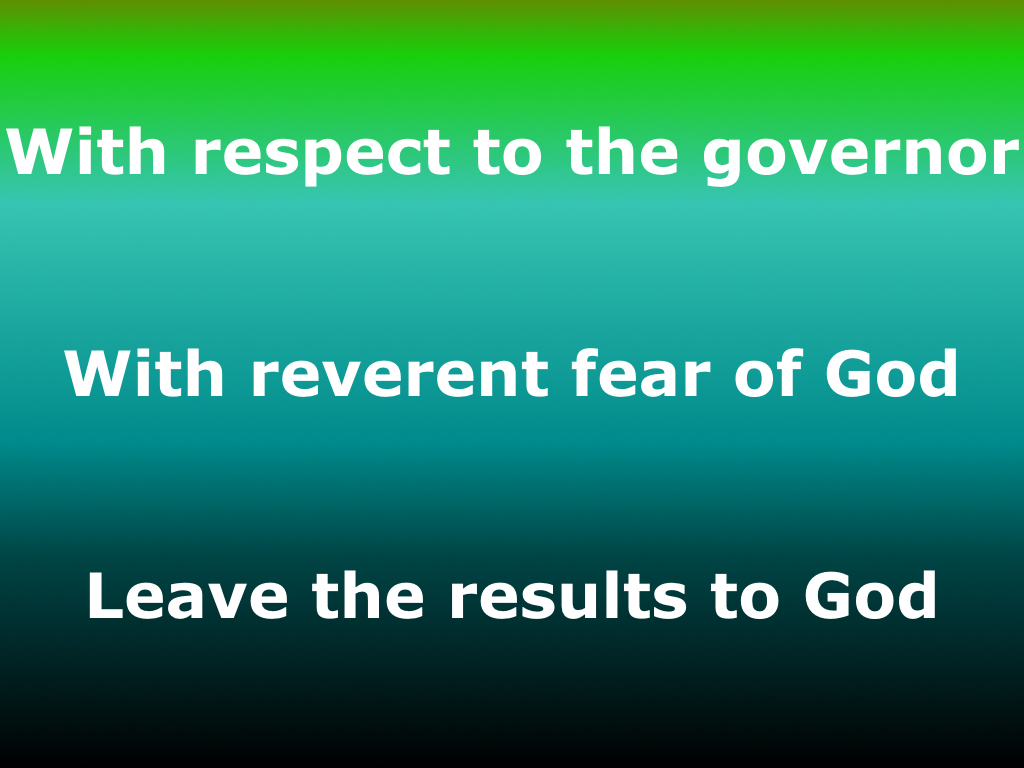
So how do we respond to misbehaving governors?

[1] With respect to their office.

[2] With reverent fear of God (see 1 Peter 2:17). “Because we reverence God as the Lord of history, we see beyond the fear and intimidation of the moment.” —James W. Thompson

[3] Leaving the results to GodDaniel 3:26-29, 6:16-27; Acts 5:40-42.

[4] With lots of prayer1 Timothy 2:1-4.

Throughout history, Christians have always had the opportunity to confront ungodly governors. HOW they did it is what set them apart from the Earthling response, and what brought glory to God.

Here’s the video of my full message on this topic—

Next Sunday, November 8, is a day of prayer for those facing persecution for their Christian faith around the world. Join us in a time of prayer for them. If you’ve missed any messages in this series, you may find the complete list by clicking here.