Don’t rejoice when your enemies fall; don’t be happy when they stumble. Don’t fret because of evildoers; don’t envy the wicked. (Proverbs 24:17, 19 NLT)
We don’t rejoice when evildoers stumble, nor do we fret when evildoers succeed. Why? Because our attention should be captivated by our Savior.
God’s peace shall be yours—that tranquil state of a soul assured of its salvation through Christ, and so fearing nothing from God and being content with its earthly lot of whatever sort that is—that peace which transcends all understanding shall garrison and mount guard over your hearts and minds in Christ Jesus. (Philippians 4:7 AMPC)
God’s transcendent peace comes into our heart like an elite special forces team to guard our heart from enemies. We are the ones who welcome in this special force by being content with all God is for us in Jesus. That means we can dismiss this special force by being discontent.
Listen to the podcast of this post by clicking on the player below, and you can also subscribe on Apple, Spotify, or Audible.
Gratitude is a great attitude. It sets you apart from the crowd of complainers, and it causes people to ask, “What do you know that we don’t know?”
Wouldn’t you just love to silence the complainers in your life? Maybe you can relate to this poem by Shel Silverstein called Complainin’ Jack—
This morning my old jack-in-the-box
Popped out—and wouldn’t get back-in-the-box.
He cried, “Hey, there’s a tack-in-the-box,
And it’s cutting me through and through.
“There also is a crack-in-the-box,
And I never find a snack-in-the-box,
And sometimes I hear a quack-in-the-box,
‘Cause a duck lives in here too.”
Complain, complain is all he did—
I finally had to close the lid.
Since, as Christians, we can’t really “close the lid” on the complaining people around us, maybe there’s something else we can do. I can think of three possibilities.
We could entirely avoid complaining people. But to do this wouldn’t allow us to live our lives as the salt and light Jesus called us to (Matthew 5:13-16). After all, in order for salt to season or light to drive away darkness, the salt and light have to be in close proximity to those they are helping.
We could simply ignore the negativity. Be around it, but do nothing about it. But both Paul and Jesus call us to engage with people in a way that points them to the Good News of the Gospel (Philippians 2:14-16; Matthew 28:19).
If we cannot avoid complainers nor remain apathetic about them, we must find a way to engage them but protect our hearts in the process.
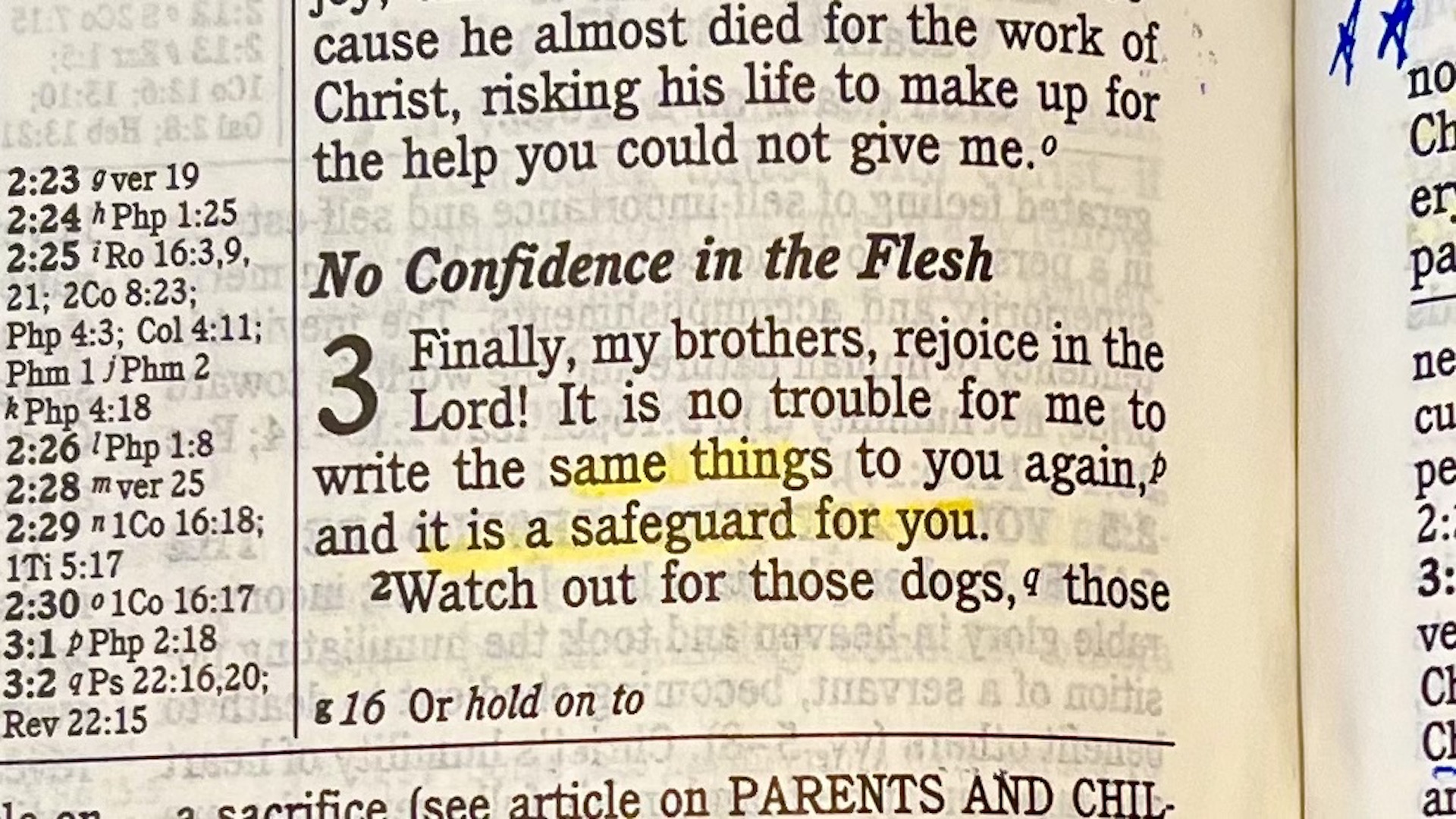
We learn from the apostle Paul’s letter to Philippi that gratitude is our shield against anything that would seek to steal our joy! “Further, my brothers and sisters, rejoice in the Lord! It is no trouble for me to write the same things to you again, and it is a safeguard for you” (Philippians 3:1).
In the Greek, the root word for “safeguard” means “fail.” But when we add the prefix it becomes cannot fail! So rejoicing makes us secure, firm, reliable.
Quite simply that means that gratitude is our attitude protector because gratitude is our shield against anything that would seek to steal our joy!
Jesus used the same word for rejoicing even when we are facing insults, exclusion, and persecution—
Blessed are you when people hate you, when they exclude you and insult you and reject your name as evil, because of the Son of Man. Rejoice in that day and leap for joy, because great is your reward in heaven. For that is how their ancestors treated the prophets. (Luke 6:22-23)
Both Jesus in this passage and Paul in Philippians 3:1 remind us that our rejoicing is IN the Lord. We are not expected to rejoice in our circumstances, but in who God is for us. Matthew Henry noted, “The more we rejoice in Christ the more willing we shall be to do and to suffer for Him, and the less danger we shall be in of being drawn away from Him.”
I also like both the proactive and reactive use of rejoicing that John Henry Jowett identifies when he says, “Gratitude is a vaccine, an antitoxin, and an antiseptic.” Rejoicing is never supposed to be a one-and-done action, but it is an ongoing lifestyle. As Paul wrote to the Christians in Philippi just a few verses later, “Rejoice in the Lord always. I will say it again: Rejoice!” (Philippians 4:4).
Gratitude is a shield—a vaccine, an antitoxin, and an antiseptic—but it doesn’t protect us unless we use it!
In order to use this shield whenever it’s needed, we have to be constantly reminded to be grateful. This is where we can leverage the power of our brain’s reticular activating system. I shared a short video about how to do this on The Podcast last week—check it out here.
Gratitude is a great attitude, and grateful people are a winsome testimony of God’s love and provision to those “complainin’ Jacks” we all encounter. Try it and see what a difference it will make with those you are around this week.
Listen to the podcast of this post by clicking on the player below, and you can also subscribe on Apple, Spotify, or Audible.
When Mary visits Elizabeth, she discovers that Elizabeth is pregnant, just as the angel Gabriel told her. This confirms for Mary that everything Gabriel told her about her own pregnancy would be fulfilled too.
Mary’s rejoicing was prompted by her deeper realization of who her Savior is. The more she knows her Lord, the more she can praise Him; the more she praises Him, the more He is glorified; the more He is glorified, the more she knows Him.
So could we say it this way? As my spirit rejoices in God my Savior my soul glorifies Him. Yes, indeed we can! There seems to be an interconnectedness: As I focus on God to rejoice in Him, that rejoicing cannot help but glorify Him.
So we could also say it this way: God is glorified in my rejoicing of Him.
Or: As I express my delight in my Savior, His glory is seen more clearly.
However we put it, when I rejoice in who God is, He is glorified. As He is glorified, my joy in rejoicing in Him is increased. As my joy in Him increases, I cannot help but rejoice in Him even more.
This, I believe, is a picture of Heaven. Just as the angels encircle the throne and call out to one another, “Holy! Holy! Holy!” as they perpetually rejoice in a new realization of God’s glory, so will we. There are an infinite number of beauties in our Savior which will prompt us to rejoice in Him and glorify Him, so we need an infinite amount of time to fully appreciate His majestic beauty.
Let’s not wait until we arrive in Heaven to begin this loving worship. Let’s follow the example of Mary and sing out our praise at every possible moment. As we do, a desperate world cannot help but be drawn to gaze upon the beauty which is celebrated in our rejoicing.
As Moses called the Israelites to keep three main feasts each year—Passover, Weeks (or Pentecost), and Tabernacles—he said the purpose was to remember.
Closely linked to all three of these feasts was another important word: celebrate (vv. 10, 13, 15).
This remembering and rejoicing on a regular schedule was to keep God’s people aligned with God’s intimate and ongoing involvement in their lives. As a result, an attitude and an action should become just as ongoing in the lives of God’s people—
The attitude: joyful gratitude (vv. 11, 14)
The action: joyful giving (vv. 10, 15, 17)
These three set times were to be a time of reorientation. They were not supposed to be the only three times God’s people remembered what God had done, celebrated His goodness, let joy overflow their hearts, and let giving overflow to others. These reorientation times should excite us to live like this every single day!
That’s why Paul wrote, “Rejoice in the Lord always. I will say it again: Rejoice!” (Philippians 4:4).
What celebrations can you build into your life that will help you
I am standing upon the seashore. A ship at my side spreads her white sails to the morning breeze and starts for the blue ocean. She is an object of beauty and strength. I stand and watch her until at length she hangs like a speck of white cloud just where the sea and sky come to mingle with each other.
Then someone at my side says, “There, she is gone!”
“Gone where?”
Gone from my sight. That is all. She is just as large in mast and hull and spar as she was when she left my side, and she is just as able to bear her load of living freight to her destined port.
Her diminished size is in me, not in her. And just at the moment when someone at my side says, “There, she is gone,” there are other eyes watching her coming, and other voices ready to take up the glad shout, “Here she comes!” —Henry Van Dyke
Only let your conduct be worthy of the gospel of Christ… (Philippians 1:27).
The apostle Paul wanted the Philippians’ living to be their preaching. Much like Francis of Assisi said years later: “Preach always; if necessary, use words.”
The big question is—what does conduct “worthy of the gospel of Christ” look like? I believe Paul identifies at least 15 characteristics in just the next 20 or so verses…
It is not a people-pleasing lifestyle. It is a God-honoring, Spirit-lead, Christ-glorifying lifestyle.
It is steadfast, which means it perseveres even through the trials and difficulties.
It is a heart and mind unified with other Christians.
It is bold—“without being frightened in any way by those who oppose you.”
It is strengthened in Christ and it is in constant fellowship with the Holy Spirit.
It overflows with loving comfort, affection, and mercy to those around it.
It humbly serves others while confidently refreshing itself in Christ.
It strives to live as Jesus did, seeking always for God to be glorified.
It is obedient to the conviction and direction of the Holy Spirit.
It finds pleasure in doing God’s will.
It doesn’t complain.
It is a blameless and harmless life.
It shines a light that attracts others to God’s love.
It holds fast to the Word of life for the long haul.
It is a rejoicing, contented lifestyle.
Heavenly Father, may it always be said of my life that it is one that is worthy of the gospel of Christ. May I always be sensitive to the nudges of the Holy Spirit to keep my life aligned in this way. In Jesus’ name I pray, Amen!
Notice that the title of this post says “when” not “if.” Maybe this will be a newsflash for some of you (but I highly doubt it): Christians will face trials.
Even the apostle James says, “Dear brothers and sisters, when troubles of any kind come your way, consider it an opportunity for great joy” (James 1:2). Wait, trials are “an opportunity for great joy”? How can that be?!
→ Trials teach us lessons that we can learn in no other way! ←
How much more mature, and wise, and empathetic would we become if instead of trying to get out of the trials that come our way, we would instead see what we could get out of that trial!
We can rejoice, too, when we run into problems and trials, for we know that they help us develop endurance.And endurance develops strength of character, and character strengthens our confident hope of salvation.And this hope will not lead to disappointment. For we know how dearly God loves us, because He has given us the Holy Spirit to fill our hearts with His love. (Romans 5:3-5)
“When trials come we can try to get out of them, or we can learn to get something out of them.”
—Craig T. Owens
So the next time a trial comes your way, ask the Holy Spirit to show you what lessons you can learn by going through the trial.
…And because of this I rejoice. Yes, and I will continue to rejoice (Philippians 1:18).
Paul is in prison, yet he tells his friends that he is choosing to rejoice. Wow!
Not only that, but this same imprisoned man also reminds his friends to…
… let their joy in Jesus overflow
… conduct themselves in a manner worthy of the gospel of Christ
… continue to have a servant’s attitude like Jesus
… don’t give in to complaining or arguing
… look out for the interests of other people
… rejoice in the Lord
… don’t rest on their laurels
… forget the past and press on toward the future
John Maxwell has noted that most people have uphill dreams but downhill habits. That is definitely not a winning combination!
Paul is making his friends aware of the possible downhill habits that may hold them back from their uphill dreams, and using himself as an example. This first step—awareness—is vital if we are going to break free of the things that are pulling us away from our God-given dreams.
Solomon wrote, “The path of life leads UPWARD for the prudent to keep them from GOING DOWN to the realm of the dead” (Proverbs 15:24).
Being prudent is saying, “I’m always on the lookout for what’s best.”
None of us can go UP by ignoring our downhill habits, or even trying to coast through life. The only way to achieve our uphill dreams is to ask the Holy Spirit to reveal our downhill habits so that we can make a plan to turn those around.
Making my own way Getting a mentor / partner (4:9)
Being discontent Being content (4:11-12)
Trying to be self-made Striving to be Christ-reliant (4:13)
A good prayer for all of us who have uphill dreams that we want to achieve—Holy Spirit, reveal to me my downhill habits. I acknowledge that I need Your help to see and break these habits. Then help me to replace them with Christ-honoring uphill habits that will allow me to achieve the purpose God has for my life.
I am going to a city where the streets with gold are laid
Where the tree of life is blooming and the roses never fade.
Here they bloom but for a season—soon their beauty is decayed
But I am going to a city where the roses never fade.
In this world we have our troubles, satan’s snares we must evade
We’ll be free from all temptation where the roses never fade.
Here they bloom but for a season—soon their beauty is decayed
But I am going to a city where the roses never fade.
Loved one gone to be with Jesus in their robes of white arrayed
Now are waiting for my coming where the roses never fade.
Here they bloom but for a season—soon their beauty is decayed
But I am going to a city where the roses never fade. —variously attributed to Elsie Osborn, Jack Osborn, or Jim Miller (the handwritten copy is from Russell Coffield, my wife’s grandfather, and was read at his funeral)















 Craig T. Owens