When the Holy Spirit shines His light on a biblical promise, and you turn that into a prayer, write it down! You may need to go back to this again and again. When God answers your prayer, write it down again! This can become a testimony journal that you and others can use to recall God’s provision.
“The pathway to maturity and to solid biblical food is not first becoming an intelligent person, but becoming an obedient person.” —John Piper
“Somehow or other an extraordinary idea has arisen that the disbelievers in miracles consider them coldly and fairly, while believers in miracles accept them only in connection with some dogma. The fact is quite the other way. The believers in miracles accept them (rightly or wrongly) because they have evidence for them. The disbelievers in miracles deny them (rightly or wrongly) because they have a doctrine against them.” —G.K. Chesterton
“At every moment, we always have a choice, even if it feels as if we don’t. Sometimes that choice may simply be to think a more positive thought.” —Tina Turner
Every day should be a day of thanksgiving!
“We are strangers on Earth; our homeland is in Heaven. Our walk is here; our hearts are there.” —Dr. Henry Halley
I have already shared the first two posts in the latest archeological research on the biblical city of Jericho. Here is part three.
“Success is no accident. It is hard work, perseverance, learning, studying, sacrifice, and most of all, love of what you are doing or learning to do.” —Pelé
“The greatest leader is not necessarily the one who does the greatest things. He is the one who gets people to do the greatest things.” —Ronald Reagan
If I want to present my best ideas, I need to be open to the helpful, sharpening critique that people close to me have to offer. My first idea sounds great, until others come along to make it better.
“In so far as I am Man I am the chief of creatures. In so far as I am a man I am the chief of sinners.” —G.K. Chesterton
Cold case detective J. Warner Wallace applies the same scrutiny to examining the evidence of the New Testament as he does with a suspect. “There are four critical questions that must drive our examination of any eyewitness, ancient or modern: Were they actually present to see what they claim? Can their account be corroborated in some fashion, even indirectly? Have the key elements of their story shifted over time? And finally, do they possess ulterior motives or bias that would tempt them to lie or embellish? This is not a uniquely religious or anti-religious method; it is simply good investigative practice.”
“Few men, if any, step into responsible positions without preparation. Sometimes in our shortsightedness we seem to get the idea in regard to Bible characters that they come on the scene ready-made, fully prepared; here they are, God’s gift to the world! They take up the work, and that’s all there is to it. But if you will read more carefully, you will find that usually—I think we could even say always—there is a period of preparation behind them. God lays His plans well in advance.” —William Sanford LaSor
The writer of the Book of Hebrews challenges Christians to learn how to better encourage others and spur them on to their very best. This means we have to go deeper in our relationships with people. Here’s one way not to do this.
T.M. Moore cautions us against having a “too small God” mindset. He writes, “We are short-changing the people of God unless our preaching and teaching fits them to seek the Kingdom of God and the restoration of the world in all our life and work. We do not expect to recreate the original conditions that existed before the fall, but to remember them, to recall them, to recover a measure of them for the life of the world and, by so doing, to point ahead to the new and better and fully remade world that is to come.”
More archeological evidence from the city of Jericho helps scholars date the exodus from Egypt more precisely as well. All of this reinforces the absolute historicity of the biblical accounts.
“The Pentecostal movement emerged at the turn of the 20th century, resulting from a series of overlapping revivals that occurred around the world.” One of those revivals was in Wales.
“Although [traditional scientists] feel certain that dinosaurs went extinct 66 million years ago, unremitting soft tissue discoveries from dinosaur fossils openly challenge such age options and validate the creation model.” Check out how the Raman spectroscopy tests are aligning paleontological discoveries with the biblical timeline of Creation.
When you are waiting for God to fulfill His promise, keep watching with a smile. Let your childlike trust become your testimony as you entrust yourself to your heavenly Father.
“The case for the reliability of the New Testament Gospel eyewitness accounts is dependent on the trustworthiness of its authors. In cold-case criminal trials, eyewitness accounts are typically evaluated through the lens four critical questions.” J. Warner Wallace then gives a succinct overview of each of these four questions and the evidence supporting them.
“One can sometimes do good by being the right person in the wrong place.” —G.K. Chesterton
“A great leader never sets himself above his followers except in carrying responsibility.” —Jules Ormont
“There is a great difference between worry and concern. A worried person sees a problem, and a concerned person solves a problem.” —Harold Stephens
We have a culture where respect for others is eroding quickly. The Bible makes it clear that reverence for God results in respect for people, and respect for people helps us reverence the God who created them.
“The real great man is the man who makes every man feel great.” —G.K. Chesterton
Dr. Louis A. Markos has an insightful article on the works of C.S. Lewis that help us learn how to stay human. “Christians today who are committed to restoring a proper view of man have an ally in the greatest apologist of the twentieth century, C.S. Lewis (1898–1963). Though Lewis offers much help in his best-known apologetics books (Mere Christianity, The Problem of Pain, The Screwtape Letters, The Great Divorce) and his beloved Chronicles of Narnia, we would do well to expand our reading of Lewis to include his searing critique of modern educational philosophy (The Abolition of Man) and his anthropologically incisive science fiction novels, The Ransom (or Cosmic) Trilogy: Out of the Silent Planet, Perelandra, That Hideous Strength.”
The ICR has an article about a fascinating new dinosaur that was unearthed. “Even now in the twenty-first century, paleontologists are still at a loss as to the origin of the dinosaurs. As recently as 2024, five evolutionists stated, ‘Today, inspired by clues from fossils and footprints from a lost world, scientists continue to piece together the puzzle of how various dinosaur groups arose, behaved, and diversified.’ In contrast, the creation model argues that all dinosaur kinds were created during the same period—specifically on Day 6 of the creation week—several thousand years ago. From this perspective, the lack of definitive transitional forms or ancestral precursors in the fossil record aligns with the expectation that dinosaur kinds appeared fully formed and distinct, as observed in the fossil record.”
Axis’ Culture Translator discusses an article posted in Harper’s: “Many have written about how porn warps the expectations users have for relationships; this article demonstrates that, for young men in particular, pornography is often willingly embraced as a complete replacement for human connection. … Woven throughout this subculture is also conscious self-degradation; as the Harper’s article points out, ‘ruin your mind,’ ‘go deeper,’ and ‘give up on life’ are embraced as the movement’s rallying cries. Many young men and women are trapped in this spiritual prison, convinced there is nothing better to live for. Who will show them the way out?” Two helpful resources are Fight The New Drug and Pure Desire.
Leaders need to learn that disagreement on your team is normal and can be healthy. Disagreement doesn’t mean people distrust their leader, but it may mean that they want the bring out the best in their leader. Check out the full conversation Greg and I had on this subject.
As I was studying the Book of Jude, I came across this phrase, “Though you already know all this, I want to remind you.” This prompted these three quick thoughts that I want to share with my fellow pastors.
Using the words from Isaiah 40:10-11, Sarah Young has Jesus speaking these words to us: “Adverse circumstances become growth opportunities when you affirm your trust in Me no matter what.”
Ken Blanchard has long used a challenge for leaders to catch their teammates doing something right. That phrase has now become the title of a biography about Ken. He says, “Great leaders who want to encourage and motivate their people set up a positive cycle:
A great leader catches someone doing something right and praises them.
The leader’s praise helps the person feel good about themselves.
People who feel good about themselves produce good results.
A great leader notices when people produce good results.
See #1.”
This is a very encouraging read for men! Scott Hubbard writes, “You may not have ability for preaching and teaching, as Timothy did. But the Holy Spirit does not leave any Christian giftless. … You may have a small vision for your life; God does not.”
An amazing series from T.M. Moore on the law in a Kingdom economy. T.M. writes, “Christians don’t keep the Law to be saved; we keep it because we are saved, because it is the path that Jesus walked (1 John 2:1-6); and we recognize its value for helping us realize more of the life of holy, righteous, and good works for which we have been redeemed (Romans 7:12; Ephesians 2:8-10).”
Geologists have discovered what Creationists already proposed about plate tectonics related to the Flood described in the Bible. “Flood geologists have predicted that plate motion slowed at the end of the Flood year, and now conventional scientists are finding it to be true.”
The Assemblies of God has always responded to popular religious trends with solid biblical exegesis. The “latter day rain” movement in the 1940s is a good example.
“Mature leaders swallow their egos and recognize God as their power source. They walk confidently in His authority, but never assume credit for it. Faith enables them to stretch, while humility enables them to stoop.” —John Maxwell
Listen to the podcast of this post by clicking on the player below, and you can also subscribe on Apple, Spotify, or Audible.
As we continue our look at the Book of Jude, let me remind you that Jude calls Christians to contend for the faith with a servant’s attitude and with an all-in attitude that will not give in even when the going gets tough.
What exactly are we contending for? Jude calls it “…the faith once for all entrusted to the saints” (Jude 3).
It might be helpful to look at this phrase in the AMPC: “…to contend for the faith which was once for all handed down to the saints—the faith which is that sum of Christian belief which was delivered verbally to the holy people of God.”
During the Reformation there was a phrase that became prominent: “Sola Scriptura” which means the Bible is our authoritative guide for everything in our lives. Jesus addressed the religious leaders who added to the Scripture (Mark 7:8-9, 13), and here Jude is now addressing those who took away from Scripture (Jude 4).
We have to be so careful here. Contending doesn’t meet fighting for our traditions, nor does it mean compromising with the whims of culture. Jesus told us to preach the Gospel, not to argue nor give in to avoid problems. Jude says this Gospel message have been entrusted to us.
Ronald Reagan was talking about the freedoms in the United States of America, but his warning sounds like it originated with Jude: “Freedom is never more than one generation away from extinction. We didn’t pass it to our children in the bloodstream. It must be fought for, protected, and handed on for them to do the same, or one day we will spend our sunset years telling our children and our children’s children what it was once like in the United States where men were free.”
We don’t want to spend our sunset years telling our children and grandchildren how it used to be when we contended for the faith that was entrusted to us, but we want to tell them how we are still winsomely and consistently contending for this faith still to this day!
So how do we contend for this faith the right way?
(1) Study God’s Word and then study it some more. I like what Charles Spurgeon said of John Bunyan,“Why, this man is a living Bible! Prick him anywhere—his blood is Bibline, the very essence of the Bible flows from him. He cannot speak without quoting a text, for his very soul is full of the Word of God. I commend his example to you, beloved.” May that be said of us!
James encourages Christians to receive God’s Word in their hearts. The Amplified Bible says it this way: “the Word which [is] implanted and rooted in your hearts.” But I really love the KJV rendering that calls it “the engrafted word.” We study God’s Word to us so that it can become a living, breathing part of who we are—the very fabric of our thoughts and attitudes.
(2) Wrestle with the whole counsel of Scripture. This is hard work, but it is the most rewarding work of all! Don’t stick with only passages of the Bible that are enjoyable to read, but consider the whole counsel of God’s Word. Ask yourself things like: What did it mean then? What does it mean now? What does it mean for me? Where can I cross-reference this with another place in Scripture?
(3) Make your “No” merciful, peaceful, and loving. This is how Jude calls us to live in v. 2, and the apostle Peter said something very similar in 1 Peter 4:1-5.
(4) Make your “Yes” compelling and attractive. Remember that we want to be known more for what we’re for, not for what we’re against. Again, Peter sounds this same note in 1 Peter 3:13-16.
As saints entrusted with the faith, we have to learn to contend for this faith without becoming contentious and without compromising the truth.
If you’ve missed any of the other messages in this series Earnestly Contend, you can find them all here.
Christian saints have the joyful privilege of being able to step up for fellow saints. It’s hard work at times, but if we remember who those saints really are, it’s never heavy work!
“A people that values its privileges above its principles soon loses both.” —Dwight D. Eisenhower
“[Jesus] draws us to Himself daily, to seek His beauty in Scripture, dwell before the beauty of His glorious face, bask in the beauty of His heavenly throne room, and become, increasingly, His beauty in and to the world. No matter how long we’ve known Him or how careful and earnest our study of Him has been, His fresh beauty remains fresher still.” —T.M. Moore
“Christianity is always out of fashion because it is always sane; and all fashions are mild insanities.” —G.K. Chesterton
Replace the “sandwich method” of feedback with this: (1) Tell the person why you are giving them feedback, (2) Give them the feedback, and (3) End with a belief statement.
G.K. Chesterton penned these words over a century ago. If they were true then, imagine how much more so they are now: “These are the days when the Christian is expected to praise every creed except his own.”
“The only way to do great work is to love what you do. If you haven’t found it yet, keep looking. Don’t settle.” —Steve Jobs
Epaphras literally put his life on the line to tell others about Jesus (Colossians 1:7; Philemon 23) and then tenaciously wrestled in prayer for the saints he led to the Lord (Colossians 4:12). That is a life worth emulating!
Sarah Young uses passages of Scripture and writes in the first-person voice as though Jesus Himself was speaking to us. “When you bring Me prayer requests, lay out your concerns before Me. Speak to Me candidly; pour out your heart. Then thank Me for the answers that I have set into motion long before you can discern results. When your requests come to mind again, continue to thank Me for the answers that are on the way. If you keep on stating your concerns to Me, you will live in a state of tension. When you thank Me for how I am answering your prayers, your mind-set becomes much more positive. Thankful prayers keep your focus on My Presence and My promises.”
Have you felt under attack spiritually lately? Especially when things are going well, we need to stay on guard because the enemy of our soul is always looking for an opening. Don’t give him any opening at all—stay vigilant!
“All men are ordinary men; the extraordinary men are those who know it.” —G.K. Chesterton
I thoroughly enjoy reading the words of Oswald Chambers (check out my lengthy Thursdays with Oswald feature). Dr. Steve Nichols shared a mini-biography about this extraordinary pastor on his 5 Minutes In Church History podcast.
Over a week before the assassination of Charlie Kirk, Abdu Murray had a chilling prediction in his commentary From Cancel Culture to Assassination Culture.
“Practice, which some regard as a chore, should be approached as just about the most pleasant recreation ever devised.” —Babe Didrikson Zaharias
Using a question about the recreational uses of marijuana, John Piper notes something deeper: “The church for a long time has leaned too heavily on the overlap between the state and the church for the strength of our conviction concerning what is right and wrong.” This post is a call for Christians to dig into the Scriptures for what we believe, and not just follow what society says.
“The man who thinks he can live without others is mistaken; the one who thinks others can’t live without him is even more deluded.” —Hasidic Proverb
This 12-minute video from Daniel Pink has some solid insights on higher productivity.




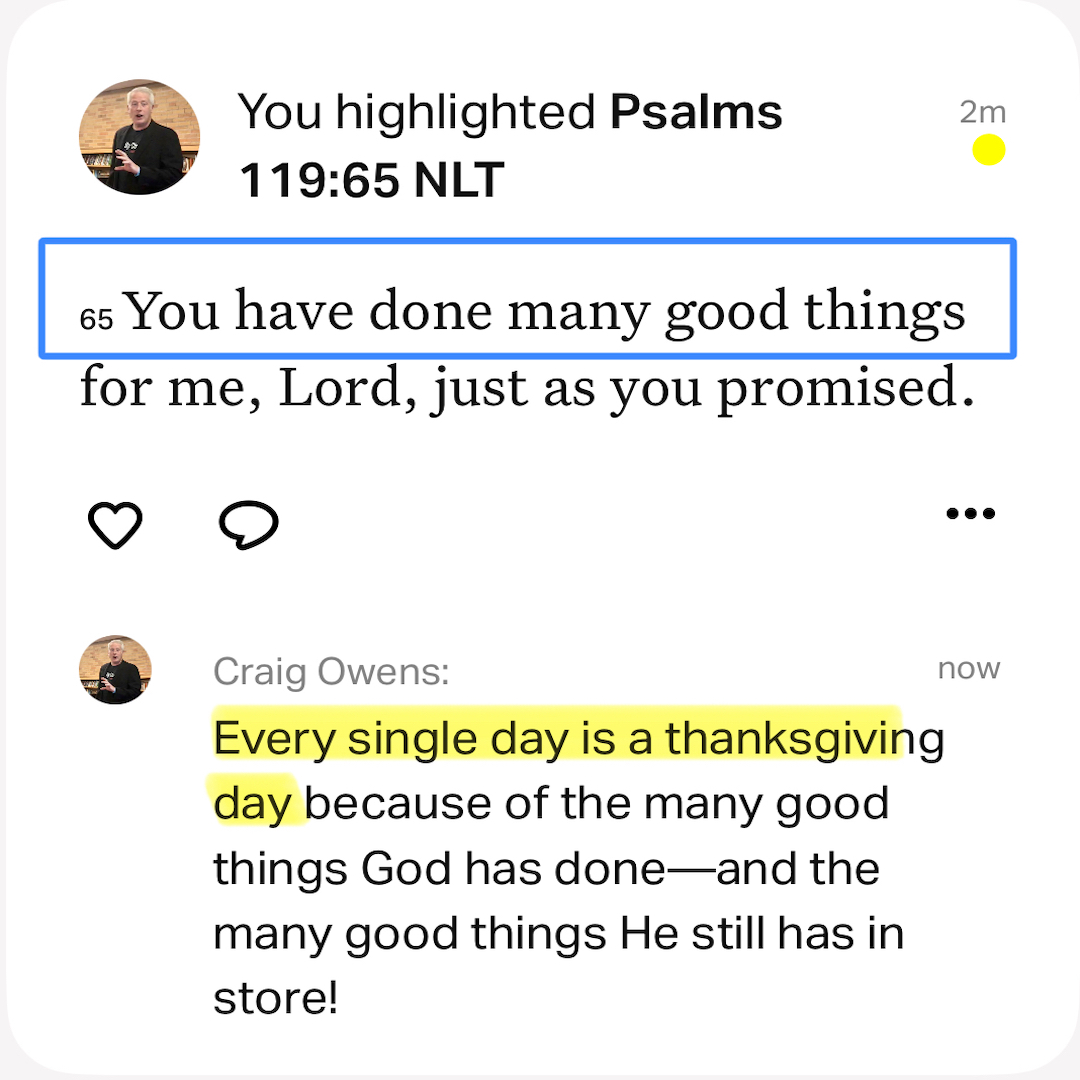 Every day should be a day of thanksgiving!


 Craig T. Owens