Saturday In The Psalms—A Sabbath Psalm

A psalm. A song for the Sabbath day (preface to Psalm 92).

The Sabbath is—

  • a day of reflection
  • a day of rejoicing
  • a day of reconnecting
  • a day of meditating on past blessings
  • a day of strengthening for the upcoming week
  • a day of acknowledging the Creator
  • a day of appreciating creation
  • a day of assessing the investment of my God-given talents
  • a holy day—different from all other days

So … “It is good to give thanks to the Lord, and to sing praises to Your name, O Most High; to declare Your lovingkindness in the morning, and Your faithfulness every night” (vv. 1, 2).

Sabbath is not just a noun, but a verb—sabbathing—something that can be done every day, but something which also takes on special significance for the one day each week that we set aside as our holy day or worship and reflection. 

The Creator’s works and wisdom should be pondered and praised as we sabbath (vv. 4-6), something “a fool” doesn’t take time to do.

As we sabbath, we should confess to God—and then turn over to Him—those things which have overly preoccupied our minds (vv. 7-9).

We should recommit that the place of growth and blessing is in God’s presence (v. 13) as we endeavor to keep our hearts there. And then we can be energized and joy-filled as we contemplate His blessing which never diminishes nor grows old (vv. 14, 15).

Truly sabbathing is a good thing!

Do you have a Sabbath day? Do you find time to regularly sabbath in God’s presence? 

UPDATE: I dive deep into this idea of sabbathing in my book Shepherd Leadership: The Metrics That Really Matter

What Does It Mean To Be “Worldly”?

A lot of Christians struggle with what is considered “worldly,” trying hard to avoid such things. In our last Q Series, this was a question that was asked by a couple of people: what exactly makes something “worldly”? Check out this short video clip…

In the video I reference the following Scriptures:

You can check out some other topics that we addressed in the Q Series like an apologetic for the Bible, parables, end times events, and prayer.

Saturday In The Psalms—God’s Voice Of Peace

Lord, You have been favorable … You have forgiven … You have covered all their sin. Selah (Psalm 85:1-2).

God’s favor, forgiveness, and covering of sin. Justice would say that God doesn’t have to do any of these things. The people sinned—they violated the holy law—and thus deserve death. But pause and consider this [that’s what Selah means]: God instead shows His favor, deliverance, and forgiveness. All His anger has been turned away!

How do we respond to this? The psalmist asks for restoration and revival. Revival comes when we turn back to God and turn away from our sin, and here we see God initiating revival … making revival possible.

Listen to God’s voice: He speaks peace, which allows us to experience revival. Jesus didn’t say, “Go and sin no more; I do not condemn you.” No! He said, “Neither do I condemn you, now go and sin no more” (John 8:11).

The removal of the wrath of condemnation makes the revival of the soul possible!

Once we hear God’s voice of peace, we can then know His…

  • … mercy
  • … truth
  • … righteousness
  • … goodness
  • … pathway
  • … freedom

God, You are so good! So loving, kind, merciful! Showing Your favor to all who will listen to Your words of peace!

A Leader’s Confidence

Give ear to my words, O Lord, consider my meditation. Give heed to the voice of my cry, my King and my God, for to You I will pray (Psalm 5:1-2).

When David prays, he prays with confidence—he is confident that God will hear him.

Where does his confidence come from? From these two truths about the nature of God:

  1. You are a God who takes no pleasure in wickedness (v. 4), so David must confess his sin quickly.
  2. In fear of You I worship (v. 7), so David doesn’t have to cower before God wondering if God will forgive his sin.

David didn’t take the condition of his soul for granted (v. 5), but he came quickly into God’s presence because he knew of God’s mercy to forgive.

Not only was David confident that God would hear his prayer, but he also eagerly anticipated receiving…

  • …God’s answer to his prayer
  • …God’s joy
  • …God’s blessing
  • …God’s protection

A mark of a godly leader is one who prays confidently and then eagerly expects God to answer.

If you want confidence in your earthly leadership, do what David modeled: Enter God’s presence quickly and confidently, and then eagerly anticipate what God is going to do!

This is Part 16 in my series on godly leadership. You can check out all of my posts on this topic by clicking here.

Saturday In The Psalms—Generations

I will utter dark sayings of old, which we have heard and known, and our fathers have told us. We will not hide them from their children, telling to the generation to come the praises of the Lord… (Psalm 78:3-4).

If George Santayana* was right about the dangers of unlearned history lessons for the general population, he identified something even more vital for those who follow God.

Asaph recounts a history of God’s people where God blessed them, the people became complacent in His blessing, until they turned from God and became subject to His wrath. The cycle, sadly, repeats again and again.

Asaph wants today’s generation to learn this lesson and to break this cycle. 

He calls on this generation to continually remind the next generation of God’s blessings for obedience, and God’s judgment for disobedience—

Make them known to their children (v. 5).

The children who would be born, that they may arise and declare them to their children (v. 6)

For today’s parents this means…
No complacency. 
No assumptions. 
No letting kids “figure it out on their own.” 
Constant diligence.
Constant communication.

May this generation speak words of life to the generation to come!

* George Santayana said, “Those who do not learn from history are doomed to repeat it.” And he also noted, “A child educated only in school is an uneducated child.”


Saturday In The Psalms—Like No One Else

Praise is awaiting You, O God… (Psalm 65:1).

Why is praising awaiting God? Because no one else does what He does!

  1. He hears all our prayers
  2. He turns no one away
  3. He atones for our transgressions
  4. He helps us approach Him
  5. He fills our lives with good things
  6. He longs for us to dwell with Him
  7. He satisfies our deepest longing
  8. He is All-Righteous
  9. He does awesome things!
  10. He is Salvation
  11. He is Confidence
  12. He answers our prayers
  13. He is Creator
  14. He is Wonderful
  15. He is Beauty
  16. He is All-Powerful
  17. He is Provider
  18. He is Abundance
  19. He is Good
  20. He is Joy

There is no like You, O God!

So my praise will be lifted to You—to You my vows will be fulfilled!

Saturday In The Psalms—Joy In The Desert

A psalm of David when he was in the wilderness of Judah (preface to Psalm 63).

Being in a desert place, you would expect David to say things like, “my soul thirsts,” “my flesh longs,” and “I am in a dry and thirsty land where there is no water.”

But what’s unexpected is what David found that satisfied. Not food and water, but “my soul thirsts for You,” “my flesh longs for You,” and “O God, You are my God.”

David knew that when outward conditions were at their worst, his focus needed to be at its best—and it needed to be on God. So David made the following commitments:

  • Early will I seek You
  • I have looked for You
  • I remember You on my bed
  • I meditate on You in the night watches
  • My lips shall praise You
  • My soul follows close behind You
  • I shall rejoice in God

Because of these commitments, David could reach the following conclusions:

  • Your lovingkindness is better than life
  • My soul is satisfied
  • I will rejoice in the shadow of Your wings
  • Your right hand upholds me

David found joy in the desert by changing his focal point!

I can reach the same conclusions that David reached, IF I am willing to make the same commitments David made.

In the desert places, I must deliberately and continually turn my eyes and thoughts FROM the desert TO God’s goodness.

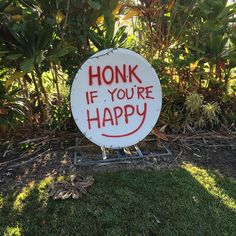
Honk! Honk! Honk!

First of all, I encourage you to watch the first few minutes of the video below for an amazing story about honking horns. Trust me on this one—it’s a memorable story that will go along way toward helping you defeat anxiety when it rears its ugly head in your life.

What kills joy and happiness and gratitude? Anxiety is the killer.

What makes people so full of joy-killing anxiety? In a word: fear. Fear of missing out … Fear of falling short … Fear of not measuring up … Fear of bad things that might happen.

If anxiety kills joy, what kills anxiety? Anxiety—the joy-killer—is itself killed when joy is expressed.

Being grateful for what you have kills the anxiety of what you don’t have.

Being thankful for what you have kills the fear of what you may be missing.

Being grateful for what you have kills the anxiety of the bad stuff that may never even happen.

If joy kills anxiety, how can we develop more of it? Most people would say, “If you’re happy, give thanks” or “If you’re happy, honk.” But really it’s the other way around: “If you want to be happy, honk!”

Don’t fret or worry. Instead of worrying, pray. Let petitions and praises shape your worries into prayers, letting God know your concerns. Before you know it, a sense of God’s wholeness, everything coming together for good, will come and settle you down. It’s wonderful what happens when Christ displaces worry at the center of your life. (Philippians 4:6-7)

Honking your thanks is not only good for you, but it’s good for everyone around you who hears your “honk! honk!” of gratitude. David experienced this in Psalm 34:1-3. Even when he was at a low point, when he started praising God other anxious people began to experience joy as well.

Can I challenge you to join me in doing two things for at least the rest of this month:

  1. Keep a gratitude journal in a notebook, on your computer, or in your phone or tablet. Regularly write down those things for which you are grateful.
  2. Don’t keep your gratitude to yourself, but share it with the world. Use hashtag #honk to let people know you are using joy to kill anxiety in your heart.

Honk! Honk! Honk! It’s good for you; it’s good for others; and it brings glory to God.

Saturday In The Psalms—Don’t Be A Fool

The fool has said in his heart, “There is no God” (Psalm 53).

You can choose this paradigm if you like. But if you do, here’s what you can expect—

Corruption … you will reap from others the corruption you sow

No one seems trustworthy … you will live your life untrusting and not being trusted

Limited understanding … “without God we’re just a lucky convergence of matter and energy, and after death there’s a vast nothing,” says the fool. But anyone who’s ever fallen in love knows there is something more than just matter and energy.

Everyone seeks his own self-interest … no one does good just to do good (we’re back to the untrusting lifestyle again!)

Fear and terror of the unknown … these lurk constantly in the back of your mind

Missing out on eternal blessings … what if you’re wrong? what if there really is a God who wants to be in relationship with you? If that’s true, you are squandering your life. You are living for the moment, and about to miss out on an eternity of pleasure in God’s presence.

A fool sticks his fingers in his ears, closes his eyes, and refuses to even consider an alternative—“There. Is. No. God!”

Don’t be a fool!

Will you at least be willing to consider the possibility that this Universe was created on purpose? Will you at least be willing to consider that the Creator made you to have a relationship with Him?

The fool tries to make all of life fit into his tiny box. The wise person knows there’s so much more.

Don’t be a fool!

Praying Against Spiritual Strongholds

“This week we pray that God will demolish the Antichrist’s strongholds

“We are surrounded by systems and strongholds that oppose Christ the Lord and King. There are social, political, economic, and legal structures and schemes that try to disparage God.

“We are not for or against a particular political system. We are Bible-believers, Christ-worshippers; and we come from all walks of life and backgrounds. We seek the glory of God and His alone. We align ourselves with His Word.

“We should not harbor enmity or hatred toward anyone. Even if they oppose us, deride our faith, doubt our God, and insult our Savior and King, they are not our enemies. The real enemy is satan who manipulates them. Our war is against satan and his strongholds.

“Such people are poor humans who need love and compassion from us, and mercy and forgiveness from God. We do not depend on human methods or material weapons, because this is spiritual warfare against satanic powers. Rather, our method is prayer, and that is all.

“Our prayer—O Lord our God, may You be praised for ever and ever! Why do the nations rage? Why do the peoples plot in vain? The kings of the earth set themselves, and the rulers take counsel together, against You and against Your Anointed One (Psalm 2:1-2).

“Help us arm ourselves with the weapons You gave us in Your Word: the belt of truth, the breastplate of righteousness, the readiness of the gospel of peace, the shield of faith, the helmet of salvation, and the sword of the Spirit (Ephesians 6:14-17).

He who sits in the heavens laughs; the Lord derides them … at the name of Jesus every knee will bow, in heaven and on earth and under the earth, and every tongue confess that Jesus Christ is Lord, to the glory of God the Father (Psalm 2:4; Philippians 2:10-11). I pray in the mighty name of Jesus. Amen.” —a prayer from Praying For Muslims