JumpStart Your Leadership (book review)

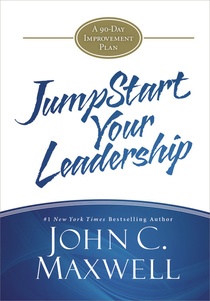
JumpStart Your LeadershipJohn Maxwell always gives his readers a treasure-trove of helpful thoughts for personal growth! I would highly recommend anyone to grab any one of his books and dive in. But a good place to start may be JumpStart Your Leadership.

This book is setup as a 90-day journey of leadership growth. Whether someone is just beginning in a leadership position, or has been in a position of leadership for quite some time, this is a tremendous resource. Each day has a quote, a short teaching point from John Maxwell, and then a page to respond to the question of the day. After three months, I am confident you will feel your leadership surging forward.

Small book, big dividends. Get this book and get growing!

I am a Center Street book reviewer.

Links & Quotes

link quote

Some good reading and watching from today…

“The worst form of ill association is ungodly marriage. I do not know anything that gives me more satisfaction than to see our brethren and sisters, who have walked in the faith of God, united in marriage—the husband and wife, both fearing and loving God. It is a delightful spectacle, and bids fair to be the means of building up the church with a generation which shall fear the Lord. But a very fruitful source of ruin to church members is that of a young man or a young woman choosing an ungodly partner in life. They never can expect God’s blessing upon it. They tell you sometimes they hope to be the means of their friend’s conversion. They have no right to hope such a thing; it so seldom occurs. The much more likely thing is that the ungodly one will drag the other down to his level, than that the godly one shall pull the other up.” —Charles Spurgeon

“If homosexuals are bullied, we need to protect them. If they’re unjustly discriminated against, we need to help them. If they’re treated with contempt, the person hurting them should be stopped. If a family member comes out as gay and then is belittled, harmed, or vilified, then the offending family needs to be corrected. If Christians ridicule people who identify as gay or lesbian, they need to admonished. If a church doesn’t welcome seekers of all stripes (including people who identify as gay, lesbian, or bisexual), then it needs to change. But none of these circumstances are reasons to reinterpret Scripture to affirm homosexuality.” This is from a fascinating article: Bad Reasons To Adopt Pro-Gay Theology.


“Prudence means practical common sense, taking the trouble to think out what you are doing and what is likely to come of it.” —C.S. Lewis

“Resentment simply cannot dwell in a loving heart. Before resentfulness can enter, love must take its flight and bitterness take over.” —A.W. Tozer

“No nation ancient or modern has ever lost the liberty of freely speaking, writing or publishing their sentiments, but forthwith lost their liberty in general and became slaves.” —John Peter Zenger (in 1735 after winning his case that established the precedent for our freedom of the press)

“Never leave growing till the life to come!” —Robert Browning

“Why should you turn from God when you turn to your books, or feel that you must turn from your books in order to turn to God? If learning and devotion are as antagonistic as that, then the intellectual life is in itself accursed and there can be no question of a religious life for a student, even of theology.” —B.B. Warfield

[VIDEO] John Maxwell has some great advice on conflict.

Did you know there is a right way to procrastinate? Yep! Check this out.

Links & Quotes

link quote

Some good reading & watching from this weekend…

[VIDEO] John Maxwell has some good insight on dealing with skeptics, even if the skeptic is you!

The begging in ministries today is a result of men doing good things without being sent by God’s voice. Their own desires are being mistaken for God’s bidding.” David Wilkerson shred 4 ways to know you are correctly hearing the voice of God.

“The heart knows so much more than the mind.” —Henri Nouwen

“Lord, grant we may always keep between the two extremes of distrusting or tempting Thee.” —George Whitefield

“The principle virtue of music is a means of communication with God.” —Igor Stravinsky

“Where would you have been but for grace? To repeat the old saying of John Bradford, when he saw a cartful of men going off to Tyburn to be hanged, ‘There goes John Bradford but for the grace of God.’ When you see the swearer in the street, or the drunkard rolling home at night, there are you, there am I, but for the grace of God. Who am I? What should I have been if the Lord, in mercy, had not stopped me in my mad career?” —Charles Spurgeon

“There can be no such thing as chance from God’s point of view. Since He is omniscient His acts have no consequences which He has not foreseen and taken into account and intended.” —C.S. Lewis

[VIDEO] This short film is based on a true story from the front lines of a World War I battlefield on Christmas Eve 1914…

15 Quotes From “Finding The Love Of Your Life”

Finding The Love Of Your LifeFinding The Love Of Your Life by Dr. Neil Clark Warren is a wonderful resource for anyone contemplating marriage, or for parents to help prepare their children for marriage. You can rad my full book review by clicking here. Below are some of the quotes I found especially interesting in this book.

“The person you can become is far more important than the person you are today. … When you start with who you are today and commit yourself to moving steadily toward goals, the progress you experience will not only make you feel genuinely proud, but it will also make you significantly more attractive to members of the opposite sex. … This kind of emotional growth is best achieved when you start with a deep understanding that you are totally lovable just the way you are. If your pursuit of excellence grows out of an appreciation for the way you have been created, you’ll grow by leaps and bounds.”

“The crucial thing is not to seek after someone whose personality is like your father’s or mother’s, but to search for that person whose personality would make you genuinely happy through the years.”

“Research has consistently shown that religious commitment and marital success are highly related.” 

“Research findings are highly consistent: the most stable marriages are those involving two people with many similarities. … For couples, similarities are like money in the bank, and differences are like debts they owe. Suppose you received two bank statements in the mail today, one showing the amount of money in your savings account, the other showing the amount you owe on your credit card. If you have a large savings account and little debt, you’re in a position of strength and you can weather economic storms. If a financial crisis arises, you have the means to handle it. You can make decisions and purchases without scrambling to figure out how you’ll manage. But the reverse is also true. With big debts and little savings, you’re on shaky financial ground. You have to work a lot harder to cover the bills, and you worry about job security and making ends meet. … If you want to make a marriage work with someone who is very different from you, you had better have a large number of similarities as permanent equity in your account. If you don’t, your relationship could be bankrupt at a frighteningly early stage. Why is this the case? Because every difference you have requires negotiation and adaptation. One of you has to give a lot, or both of you have to give some, and in either case there is the need for plenty of change.”

“If the qualities that attracted you to someone are different from your own, be cautious.” 

“A great marriage requires two healthy people, and the time to get healthy is before you get married. … What I am particularly concerned about here is the emotional and mental health of the two people considering a lifelong partnership.”

“When we marry, it will be ideal if in relation to our parents (1) we are essentially free from them—emotionally independent individuals—so we do not have to make decisions and live our lives to please them; (2) we are clear about what is particularly true of our relationship with our mother and father, and what is true in relation to our spouse. When we confuse these relationships, we leave our spouse feeling violated and helpless; and (3) we have established a relationship with our parents in which they will not intrude in our marriage, will not dictate to us in any authoritative ways, and yet we can still maintain a closeness and connectedness to them.”

“The desire to touch, hold hands and hug is critical for long-term satisfaction. I agree. Building a great marriage is virtually impossible without the attraction and excitement that comes with passionate love. … I am deeply convinced that any two people who choose to marry need to maintain clear minds until the moment they say ‘I do.’ Because of this, I believe in sexual abstinence prior to marriage. Sexual intercourse before marriage is a clear act of commitment! Once you have become sexually involved with a potential mate, your ability to think clearly and objectively becomes impossible. … In one impulsive moment, two people cut short the process of ‘choosing’ one another, and they rob themselves of their own wisdom. Once they are sexually involved, they forfeit their combined ability to make a wise, unhindered decision.”

“(1) Passionate love between two people is a crucial ingredient if they are to have a long and satisfying relationship. (2) Passionate love always involves strong physical attraction. (3) Physical involvement must be managed with extreme care. (4) Every progression of physical activity establishes a new plateau—and it is extremely difficult to retreat once it has been reached. (5) When sexual expression is not kept in check, the emotional, cognitive and spiritual aspects of the relationship become slaves to the physical desires.”

“Too many failed marriages involve fantasy triumphing over fact.”

“When you are intimate with the person you love, you create unlimited possibilities for the growth of your relationship. Intimacy has the potential for lifting the two of you out of the lonely world of separateness and into the stratosphere of emotional oneness. Conversely, the number one enemy of any marriage is the lack of intimacy. If two people do not know each other deeply, they can never become what the Bible calls ‘one flesh.’” 

“You have to know yourself if you’re going to be intimate with someone else.”

“When two people discover that they have a spiritual hunger or spiritual awareness in common, they are strongly drawn to one another. In fact, I have found that a lack of mutually held spiritual beliefs often signals an intimacy deficit that leaves couples dangerously unconnected. In fact, one research study showed that spirituality ranked among the six most common characteristics of strong families. The strongest families in this study reported experiencing ‘a sense of power and a purpose’ greater than themselves—a spiritual orientation.”

“The fatal flaw of our society is that the principles of business have increasingly infiltrated our intimate relationships. That’s why society has found it necessary to trivialize wedding vows, to pretend they are no longer binding or relevant. Marriage makes very little sense when viewed from a business perspective. Let me explain: Two fundamental principles in business are: (1) What you pay for something is based on what you get in return; (2) When a business arrangement is no longer a ‘good deal,’ you either alter the arrangement or terminate it. But marriage is radically different! It depends on unconditional commitment. When you get married, you pledge to love, honor and cherish another person for a lifetime. If your mate changes over time, you are not released from your pledge. … Relationships that are conditional allow almost no room for trust and intimacy.”

“There is only one time to think about commitment-—before you make it!

Links & Quotes

link quote

Some good reading (and watching) from this weekend…

This was a bit convicting: 7 Signs You’re Spending Too Much Time Looking At Your Phone (I am trying to improve on this!).

This post from Chilly Chilton was also a bit convicting: My Take On President Obama.

“Jesus builds His Church, not by programs, facilities, budgets, and good ‘branding,’ but by living His life in and through each of the members of His Body, beginning with their shepherds.” —T.M. Moore

[VIDEO] John Maxwell says being growth oriented is better than being goal oriented.

“The popular notion that the first obligation of the church is to spread the gospel to the uttermost parts of the earth is false. Her first obligation is to be spiritually worthy to spread it. Our Lord said ‘Go ye,’ but He also said, ‘Tarry ye,’ and the tarrying had to come before the going.” —A.W. Tozer

“I believe that our Lord wants us to learn more of Him in worship before we become busy for Him. He wants us to have a gift of the Spirit, an inner experience of the heart, as our first service, and out of that will grow the profound and deep and divine activities which are necessary.” —A.W. Tozer

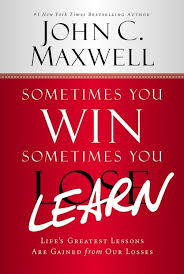
21 Quotes From “Sometimes You Win, Sometimes You Learn”

Sometimes You WinAs I mentioned in my book review (which you can read by clicking here), John Maxwell always expands my horizons with his writings. I appreciate his ability to use his own life experiences as well as historical and contemporary examples and writings. So some of my favorite quotes from Sometimes You Win, Sometimes You Learn are from Dr. Maxwell, and some are from others that he quotes. Enjoy!

“I sometimes react to making a mistake as if I have betrayed myself. My fear of making a mistake seems to be based on the hidden assumption that I am potentially perfect and that if I can just be very careful, I will not fall from heaven. But a mistake is a declaration of the way I am, a jolt to the way I intend, a reminder that I am not dealing with facts. When I have listened to my mistakes, I have grown.” —Hugh Prather

“Those who profit from adversity possess a spirit of humility and are therefore inclined to make the necessary changes needed to learn from their mistakes, failures, and losses. … When we are focused too much on ourselves, we lose perspective. Humility allows us to regain perspective and see the big picture. … Humility allows us to let go of perfection and keep trying.” —John Maxwell

“Most people spend their entire lives in a fantasy Island called ‘Someday I’ll.’” —Denis Waitley 

“An idealist believes the short-run doesn’t count. A cynic believes the long run doesn’t matter. A realist believes that what is done or left undone in the short-run determines the long run.” —Sydney J. Harris

“Those things that hurt, instruct.” —Benjamin Franklin

“You can’t grow and learn if your focus is on finding someone else to blame instead of looking at your own shortcomings.” —John Maxwell

“The highest reward for our toil is not what we get for it but what we become by it. … Mistakes are not failures. They are proof that we are making an effort. When we understand that, we can more easily move out of our comfort zone, try something new, and improve. … Improvement demands a commitment to grow long after the mood in which it was made has passed.” —John Maxwell 

“Success in most things comes not from some gigantic stroke of fate, but from simple, incremental progress.” —Andrew Wood

“The main trouble with despair is that it is self-fulfilling. People who fear the worst tend to invite it. Heads that are down can’t scan the horizon for new openings. Bursts of energy do not spring from a spirit of defeat. Ultimately, helplessness leads to hopelessness.” —Norman Cousins

“Positive thinking must be followed by positive doing.” —John Maxwell

“When you are influential and highly respected, people tend to tell you what you want to hear, not what you need to hear. They are seeking your approval, or they flatter you. Unfortunately, this creates a gap between what you hear and reality. If you find yourself in that situation, you will need to work extra hard to get the people close to you to speak honestly into your life. And you will have to become highly intentional in observing and listening.” —John Maxwell 

“Wisdom is the reward you get for a lifetime of listening when you would have preferred to talk.” —Doug Larson

“Circumstances are the rulers of the weak; but they are the instruments of the wise.” —Samuel Lover 

“Mistakes are painful when they happen, but years later a collection of mistakes is what is called experience.” —Denis Waitley

“Ninety percent of those who fail are not actually defeated; they simply quit. … As you face bad experiences, it’s important for you to remember that you can rarely see the benefits while you’re in the midst of them. You usually gain perspective on the other side of it.” —John Maxwell 

“Most people would rather change their circumstances to improve their lives when instead they need to change themselves to improve their circumstances. They put in just enough effort to distance themselves from their problems without ever trying to go after the root, which can often be found in themselves. Because they don’t try to change the source of their problems, their problems keep coming back at them.” —John Maxwell

“To grow, you must be willing to let your present and future be totally unlike your past. Your history is not your destiny.” —Alan Cohen

“If I had my life to live over again, I’d make the same mistakes, only sooner.” —Tallulah Bankhead

“Maturity is doing what you are supposed to be doing, when you’re supposed to be doing it, no matter how you feel.” —Dom Capers 

“Have you not succeeded? Continue! Have you succeeded? Continue!” —Fridtjof Nansen, Nobel Peace Prize winner

“How we think when we lose determines how long it will be until we win.” —G.K. Chesterton

Thursdays With Oswald—The Word & The Words

This is a weekly series with things I’m reading and pondering from Oswald Chambers. You can read the original seed thought here, or type “Thursdays With Oswald” in the search box to read more entries.

Oswald Chambers

The Word & The Words

     The Bible is the Word of God only to those who are born from above and who walk in the light. Our Lord Jesus Christ, the Word of God, and the Bible, the words of God, stand or fall together, they can never be separated without fatal results. A man’s attitude to our Lord determines his attitude to the Bible. 

     The “sayings” of God to a man not born from above are of no moment; to him the Bible is simply a remarkable compilation of literature—“that it is, and nothing more.” All the confusion arises from not recognizing this. 

     But to the soul born from above, the Bible is the universe of God’s revealed will. The Word of God to me is ever according to my spiritual character; it makes clear my responsibility to God as well as my individuality apart from Him. 

From Christian Disciplines (emphasis mine)

Do you agree with Chambers on this viewpoint?

In light of this, how will you view Scripture differently?

The Dictatorship Of The Routine

Wow, I am really challenged by this word from A.W. Tozer! I pray that my personal life, and my life as a pastor, never falls under the dictatorship of the routine.

Tozer“The treacherous enemy facing the church of Jesus Christ today is the dictatorship of the routine, when the routine becomes ‘lord’ in the life of the church. Programs are organized and the prevailing conditions are accepted as normal. Anyone can predict next Sunday’s service and what will happen. This seems to be the most deadly threat in the church today. When we come to the place where everything can be predicted and nobody expects anything unusual from God, we are in a rut. The routine dictates, and we can tell not only what will happen next Sunday, but what will occur next month and, if things do not improve, what will take place next year. Then we have reached the place where what has been determines what is, and what is determines what will be. That would be perfectly all right and proper for a cemetery. Nobody expects a cemetery to do anything but conform…. Everyone and everything in a cemetery has accepted the routine. Nobody expects anything out of those buried in the cemetery. But the church is not a cemetery and we should expect much from it, because what has been should not be lord to tell us what is, and what is should not be ruler to tell us what will be. God’s people are supposed to grow.” —A.W. Tozer (emphasis added)

What do you think about this?

Growing Pains

Listen to the podcast of this post by clicking on the player below, and you can also subscribe on AppleSpotify, or Audible. 

I remember when I was a teenager having such an ache in my legs at night. I’d be laying on my bed trying to sleep, but I couldn’t get comfortable because of that dull, unrelenting ache in my legs. I’d go ask my Mom what was going on, and her reply was simple: “Those are growing pains.”

In order to grow in any area of our lives—physically, emotionally, mentally, relationally—we have to go through a certain amount of pain.

No pain, no gain.

The process is not always a lot of fun, but that’s why we have to keep our eyes on the goal. The process may not be something we like, but the end results will make the pain worth it.

For instance, you may not like dieting but you like the weight loss or lower cholesterol numbers, so you stick with it. You may not like saying, “I’m sorry, I was wrong, please forgive me” but you like the healed relationship, so you say it.

Throughout the New Testament the phrase one another is frequently used to address how members of the Body of Christ should relate to each other. God desires that all of us operate interdependently with one another. In order to get there, we must get ready for some growing pains!

In Ephesians 4:2, Paul tells us what is required to get to a place of unity and maturity in the Church:

  • Be completely humble (the King James Version says lowliness). This Greek word means not letting our thoughts rise far from the ground. In other words, we are thinking of ourselves as God thinks of us, not independently as a self-made man or woman, but viewing all of my success as God-appointed. This process toward interdependence starts in our thoughts—in our attitudes about ourselves and about others.
  • Gentle means strength under control. Gentleness says, “I could do this, but for your sake I won’t.”
  • Patient interaction (KJV: longsuffering) with others is allowing them the freedom to grow just as others allowed me the freedom to grow.
  • Bearing with one another in love. Think of a load-bearing wall in a building that is holding up the weight of the roof and walls. When we bear with one another we are helping to share the burdens.

Being humble with ourselves and gentle and patient with others is the way we go through the growing pains of bearing with one another in love. The process may not be a lot of fun, but the end result is something that glorifies God, that’s why we must stick with one another through all our growing pains.

Check out all of the other messages in our series Live Together by clicking here.

►► Would you please prayerfully consider supporting this ministry? My Patreon supporters get behind-the-scenes access to exclusive materials. ◀︎◀︎

Thursdays With Oswald—Stair-step Growth

Listen to the podcast of this post by clicking on the player below, and you can also subscribe on AppleSpotify, or Audible. 

This is a weekly series with things I’m reading and pondering from Oswald Chambers. You can read the original seed thought here, or type “Thursdays With Oswald” in the search box to read more entries.

Stair-step Growth

     There are stages in spiritual development when God allows us to be dull, times when we cannot realize or feel anything. It is one of the greatest mercies that we have those blank spaces, for this reason, that if we go on with spiritual perception too quickly we have no time to work it out; and if we have no time to work it out, it will react in stagnation and degeneration. 

From Bringing Sons Unto Glory

Many people mistakenly think that their growth in spiritual maturity should be a steady, unbroken climb. They think that the line on the “spiritual growth graph” should always move upward and to the right. This is not only an inaccurate view, but an unhealthy view as well. It simply isn’t possible.

In reality, our growth looks more like a staircase. There are times of growth, times of relapse, and times of plateau. Growth and relapse we usually understand, but many of us have a hard time with the “blank spaces” when we don’t feel anything going on one way or the other. But God purposely gives us these flat times.

I’ve learned that these God-given plateaus are for two things:

  1. Assimilating what we have learned <or>
  2. Preparing for the next upward climb

So don’t get frustrated by the plateaus, for they are, as Chambers say, one of the greatest mercies God gives us.

►► Would you please prayerfully consider supporting this ministry? My Patreon supporters get behind-the-scenes access to exclusive materials. ◀︎◀︎