Thursdays With Oswald—Why Wait For A Tragedy To Get Your Attention?

This is a weekly series with things I’m reading and pondering from Oswald Chambers. You can read the original seed thought here, or type “Thursdays With Oswald” in the search box to read more entries.

Oswald Chambers

Why Wait For A Tragedy To Get Your Attention?

     God is not a supernatural interferer; God is the everlasting portion of His people. When a man “born from above” begins his new life he meets God at every turn, hears Him in every sound, sleeps at His feet, and wakes to find Him there. He is a new creature in a new creation, and tribulation but develops his power of knowing God….

From Christian Disciplines

Tribulation has an amazing power to get people’s attention. After every calamity (whether it’s the attack on Pearl Harbor or the World Trade Centers, a shooting in a school, or a young family killed by a drunk driver) our churches are filled. People are searching for something to help them make sense of that tragedy. Yet after a couple of weeks, life returns to “normal” and the churches empty out.

What we discovered in that moment of tragedy is what we should be discovering every day: God is there.

Do you hear God in all the sounds? Do you see Him at every turn? Do you sleep peacefully in Him each night? Do you go through your day without anxiety because You know He is by your side?

You can because He is there. Don’t wait for a tribulation to remind you of that fact. Open your eyes and ears and heart to His presence surrounding you even now.

Thursdays With Oswald—Contemptible Unbelief

This is a weekly series with things I’m reading and pondering from Oswald Chambers. You can read the original seed thought here, or type “Thursdays With Oswald” in the search box to read more entries.

Oswald Chambers

Contemptible Unbelief 

     “All power is given unto Me in heaven and in earth” (Matthew 28:18). All power is given—unto whom? To the Being who lived a humble, obscure life in Nazareth; the One who says, “Come unto Me, all ye that labor and are heavy laden, and I will give you rest.” If all power is given to Jesus Christ, what right have I to insult Him by worrying? If we will let these words of Jesus come into our heart, we shall soon see how contemptible our unbelief is. 

     … Will I say skeptically, “What does Jesus Christ know about my circumstances? Is His power and understanding sufficient to manage things for me?” To talk like that is the way to realize the size of our unbelief, and to see why Jesus Christ was so stern in condemning it.

From Bringing Sons Unto Glory 

I love the phrase from the old hymn—

Oh, what peace we often forfeit
Oh, what needless pain we bear
All because we do not carry
Everything to God in prayer! 

When I think how All-powerful and All-loving He is, I begin to see how utterly contemptible is my unbelief and my unwillingness to take everything to Him. If all power is given to Jesus Christ, what right have I to insult Him by worrying?

Embracing Conflict

Listen to the podcast of this post by clicking on the player below, and you can also subscribe on AppleSpotify, or Audible.

A quick survey: Please raise your hand if any of these pertain to you:

  • Have you ever had a disagreement with someone?
  • Have you had a disagreement with someone you love?
  • Have you had a disagreement with someone you love, who also called themself a Christian?

If you raised your hand, you joined 100% of my congregation who answered “yes” to all three.

When we are in close proximity to anyone, there will be conflict. In fact, close proximity usually leads to more conflict because closeness increases friction. For a Christian the issue is not if we will have conflict with others in the Church, but how will we navigate and resolve these conflicts.

The apostle Paul wrote a thank you letter to the church at Philippi, in which he speaks in some of the most glowingly loving terms of any of his letters. Clearly, this was a group of people close to his heart. So when he heard about a conflict between two ladies in this congregation, he took time to address it publicly in his letter—

I plead with Euodia and I plead with Syntyche to be of the same mind in the Lord. (Philippians 4:2)

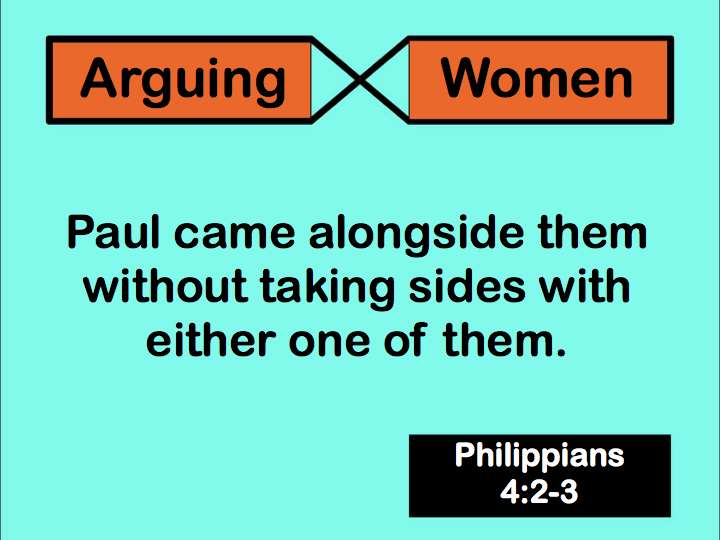
We don’t know why these ladies were arguing but notice that Paul doesn’t take sides. He simply says, “I please with Euodia AND I plead with Syntyche.” The word for plead means someone who comes alongside to help. In using this terminology, Paul gives us an important principle:

We can come alongside those in conflict without taking sides with either one of those in conflict.

In the next verse, Paul implores the rest of the church to join him in this alongsided-ness

And I exhort you too, my genuine yokefellow, help these two women to keep on cooperating…. (v. 3 in the Amplified Bible)

In other words, Paul wants the rest of the church to embrace these at-odds sisters, also without taking sides. He addresses the members of the church as yokefellow. It’s not a word we use too often today (although it is still in the dictionary), but it paints a crystal clear picture of our role. Here’s what we CAN’T do as yokefellow:

  • Look away
  • Mind our own business
  • Hope the situation will work itself out
  • Try to navigate around the problem

Instead, we embrace the conflict by embracing those in the conflict. We help them to cooperate and to work in harmony in the Lord (v. 2 in the Amplified Bible). It’s our responsibility to help maintain the bonds of peace so that the Body of Christ can grow in a way that is healthy and God-honoring.

Do you know someone in conflict right now? Are you in the conflict yourself? Ask God to show you how you can come alongside—not take sides—with those in this conflict so that you can help bring about peace.

If you have missed any messages in this series called Life Together, you can find them all by clicking here.

►► Would you please prayerfully consider supporting this ministry? My Patreon supporters get behind-the-scenes access to exclusive materials, like a map and an app I just shared to help with your personal Bible study time. ◀︎◀︎

Prayer For Israel

In addition to praying for the elections in the United States, the Bible also encourages us to pray for the peace of Israel—

Pray for peace in Jerusalem. May all who love this city prosper. O Jerusalem, may there be peace within your walls and prosperity in your palaces. For the sake of my family and friends, I will say, “May you have peace.” For the sake of the house of the Lord our God, I will seek what is best for you, O Jerusalem. (Psalm 122:6-9 NLT)

Sunday, October 7, has been designated as a day of prayer for Israel. We will be praying at Calvary Assembly of God, and I hope you and your church will join us in praying this very God-honoring prayer.

You can get more information and sign a prayer resolution by clicking here.

10 Quotes From “Grace”

Max Lucado’s newest book Grace is a wonderful reminder of how extravagant God is toward us (you can read my full review by clicking here). Here are 10 of my favorite quotes from Grace

“God’s guilt brings enough regret to change us. satan’s guilt, on the other hand, brings enough to enslave us. … It boils down to this choice: Do you trust your Advocate or your accuser?”

“Sin is not a regrettable lapse or an occasional stumble. Sin stages a coup against God’s regime. Sin storms the castle, lays claim to God’s throne, and defies His authority. Sin shouts, ‘I want to run my own life, thank you very much!’ Sin tells God to get out, get lost, and not come back. Sin is insurrection of the highest order, and you are an insurrectionist. So am I. So is every single person who has taken a breath. … God didn’t overlook your sins, lest He endorse them. He didn’t punish you, lest He destroy you. He instead found a way to punish the sin and preserve the sinner. Jesus took your punishment, and God gave you the credit for Jesus’ perfection.”

“Grace-a-lots believe in grace, a lot. Jesus almost finished the work of salvation, they argue. In a rowboat named Heaven Bound, Jesus paddles most of the time. But every so often He needs our help. So we give it. We accumulate good works the way Boy Scouts accumulate merit badges on a sash. … We find it easier to trust the miracle of resurrection than the miracle of grace. We so fear failure that we create the image of perfection, lest Heaven be even more disappointed in us than we are. The result? The weariest people on earth. Attempts at self-salvation guarantee nothing but exhaustion. We scamper and scurry, trying to please God, collecting merit badges and brownie points, and scowling at anyone who questions our accomplishments. Call us the church of hound-dog faces and slumped shoulders. Stop it! Once and for all, enough of this frenzy. ‘Your hearts should be strengthened by God’s grace, not by obeying rules’ (Hebrews 13:9 NCV). Jesus does not say, ‘Come to Me, all you who are perfect and sinless.’ Just the opposite. ‘Come to Me, all who are weary and heavy-laden, and I will give you rest’ (Matthew 11:28 NASB).”

“Give the grace you’ve been given. You don’t endorse the deeds of your offender when you do. Jesus didn’t endorse your sins by forgiving you. Grace doesn’t tell the daughter to like the father who molested her. It doesn’t tell the oppressed to wink at injustice. The grace-defined person still sends thieves to jail and expects and ex to pay child support. Grace is not blind. It sees the hurt full well. But grace chooses to see God’s forgiveness even more. It refuses to let hurts poison the heart. ‘See to it that no one misses the grace of God and that no bitter root grows up to cause trouble and defile many’ (Hebrews 12:15 NIV). Where grace is lacking, bitterness abounds. Where grace abounds, forgiveness grows.

“Find a congregation that believes in confession. Avoid a fellowship of perfect people (you won’t fit in), but seek one where members confess their sins and show humility, where the price of admission is simply the admission of guilt. Healing happens in a church like this.”

“Plunge a sponge into Lake Erie. Did you absorb every drop? Take a deep breath. Did you suck the oxygen out of the atmosphere? Pluck a needle from a tree in Yosemite. Did you deplete the forest of foliage? Watch an ocean wave crash against the beach. Will there never be another one? Of course there will. No sooner will one wave crash into the sand than another appears. Then another, then another. This is a picture of God’s sufficient grace. Grace is simply another word for God’s tumbling, rumbling reservoir of strength and protection. It comes at us not occasionally or miserly but constantly and aggressively, wave upon wave. We’ve barely regained our balance from one breaker, and then, bam, here comes another. ‘Grace upon grace’ (John 1:16 NASB). We dare to hang our hat and stake our hope on the gladdest news of all: if God permits the challenge, He will provide the grace to meet it. We never exhaust His supply. ‘Stop asking so much! My grace reservoir is running dry.’ Heaven knows no such words. God has enough grace to solve every dilemma you face, wipe every tear you cry, and answer every question you ask.”

“How long has it been since your generosity stunned someone? Since someone objected, ‘No, really, this is too generous’? If it has been awhile, reconsider God’s extravagant grace. ‘Forget not all His benefits, who forgives all your iniquity’ (Psalm 103:2-3 RSV).”

“Your identity is not in your possessions, talents, tattoos, kudos, or accomplishments. Nor are you defined by your divorce, deficiencies, debt, or dumb choices. You are God’s child. You get to call Him ‘Papa.’ You ‘may approach God with freedom and confidence’ (Ephesians 3:12 NIV). You receive the blessings of His special love (1 John 4:9-11) and provision (Luke 11:11-13). And you will inherit the riches of Christ and reign with Him forever (Romans 8:17).”

“To live as God’s child is to know, at this very instant, that you are loved by your Maker not because you try to please Him and succeed, or fail to please Him and apologize, but because He wants to be your Father. Nothing more. All your efforts to win His affections are unnecessary. All your fears of losing His affection are needless. You can no more make Him want you than you can convince Him to abandon you. The adoption is irreversible. You have a place at His table.”

“Where there is no assurance of salvation, there is no peace. No peace means no joy. No joy results in fear-based lives. Is this the life God creates? No. Grace creates a confident soul who declares, ‘I know Whom I have believed, and am convinced that He is able to guard what I have entrusted to Him for that day’ (2 Timothy 1:12 NIV). … Trust God’s hold on you more than your hold on God. His faithfulness does not depend on Yours. His performance is not predicated on yours. His love is not contingent on your own.”

Give All Your Concerns To God

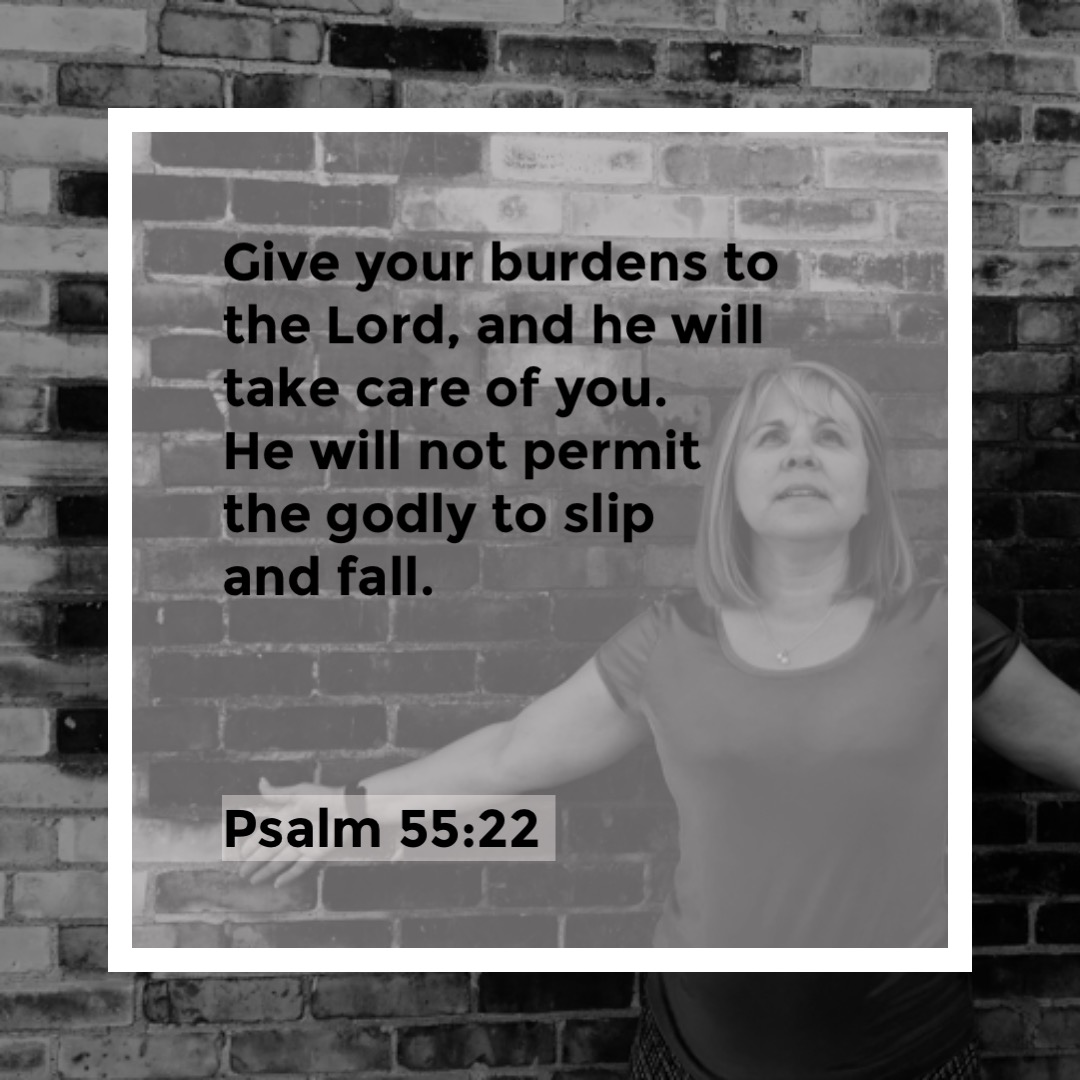
Cast your cares on the Lord and He will sustain you; He will never let the righteous fall. (Psalm 55:22)

“Care, even though exercised upon legitimate objects, if carried to excess, has in it the nature of sin. The precept to avoid anxious care is earnestly inculcated by our Savior, again and again; it is reiterated by the apostles; and it is one which cannot be neglected without involving transgression: for the very essence of anxious care is the imagining that we are wiser than God, and the thrusting ourselves into His place to do for Him that which He has undertaken to do for us. We attempt to think of that which we fancy He will forget; we labor to take upon ourselves our weary burden, as if He were unable or unwilling to take it for us. Now this disobedience to His plain precept, this unbelief in His Word, this presumption in intruding upon His province, is all sinful. Yet more than this, anxious care often leads to acts of sin. He who cannot calmly leave his affairs in God’s hand, but will carry his own burden, is very likely to be tempted to use wrong means to help himself. This sin leads to a forsaking of God as our Counselor, and resorting instead to human wisdom. This is going to the broken cistern instead of to the fountain; a sin which was laid against Israel of old. Anxiety makes us doubt God’s lovingkindness, and thus our love to Him grows cold; we feel mistrust, and thus grieve the Spirit of God, so that our prayers become hindered, our consistent example marred, and our life one of self-seeking. Thus want of confidence in God leads us to wander far from Him; but if through simple faith in His promise, we cast each burden as it comes upon Him, and are careful for nothing because He undertakes to care for us, it will keep us close to Him, and strengthen us against much temptation.” —Charles Spurgeon 

Here Comes Trouble!

Do you see it on the horizon? Storm clouds building, blowing in fast; wind picking up; something ominous in the air. Here comes trouble!

Jesus certainly did as He talked with His followers just before His arrest and crucifixion. Just before the storm hit, here’s what He said…

I have told you these things, so that in Me you may have peace. In this world you will have trouble. But take heart! I have overcome the world. (John 16:33)

I find something reassuring about Jesus telling me that I will have trouble. Not that trouble is enjoyable (at all!). But what is enjoyable is knowing that He knows. Nothing takes Jesus by surprise!

Jesus said that I would find my peace when I remain IN Him. When I see trouble coming, my natural tendency is to start doing things for myself. I start making plans, giving orders, gathering resources, hunkering down in my foxhole. In reality, all this does nothing but increase my level of anxiety!

Jesus has overcome. So when I stay IN Him, I overcome too.

Here’s what I’ve learned about how to stay IN Him…

  • Stay in the Word every day, but especially when I see trouble coming.
  • Stay in prayer; in fact, I should increase my prayer times.
  • Stay in worship because I don’t want to focus on the storm, but on the Overcomer.
  • Stay in contact with my friends and ask them to join me in prayer.

Check out this prayer David penned when he saw trouble coming. It’s still a great prayer for you and me today:

Keep me safe, O God, for IN You I take refuge. I said to the Lord, “You are my Lord; apart from You I have no good thing.” Therefore my heart is glad and my tongue rejoices; my body also will rest secure. You have made known to me the path of life; You will fill me with joy IN your presence, with eternal pleasures at Your right hand. (Psalm 16:1, 2, 9, 11)

The Blessing Of Fullness

Thanksgiving Day 2011 is over, but the days for giving thanks should never be over. Although that sounds humorous, for many of us it is an important reminder. We need to remind ourselves because it is so easy for us to go from overflowing with thankfulness, to feeling depleted and empty.

This is exactly what Paul reminded the Colossians in part 3 of our Overflowing With Thanks series—

Devote yourselves to prayer, being watchful and thankful. (Colossians 4:2)

Here’s how the cycle works:

  • When we are thank-full to God for His blessings, we enthrone Christ in our hearts.
  • When we are Christ-full, He brings with Him all of the peace we will need.
  • When we are peace-full, the peace of God, which transcends all understanding, will guard your hearts and minds in Christ Jesus (Philippians 4:7).
  • When our hearts and minds are clear, we can better see the blessings for which we can thank God.
  • And when we are thank-full to God for His blessings, we start the cycle all over again.

We don’t have to run dry, or become depleted, or lose our joy, or be robbed of our peace. If we will remain watch-full to be thank-full, we will remain Christ-full, which will keep us peace-full.

May we never lose the blessing of fullness!

Exhaustion Relief

I was reading and meditating on Matthew 11:28-30. These are the notes just as a jotted them down in my journal. I pray they will be as helpful for you as they were for me.

Come—without delay

to Me—Jesus is my only Source

all—no one is ever excluded from Christ’s call

you who are weary—I feel like I have been working hard, but gaining little ground

and burdened—and my conscience is bugging me because I feel I’m falling short of what God requires

and I will—only Jesus can do this

give you resta quiet, calm, patient expectation of a better future

Take—I need to apply what Jesus says to my life right now

My yoke upon you—Christ’s power to fulfill God’s requirements

and learn from Me—I must get in the habit of doing things His way

for I am gentle—strong enough to help me, but in a way that doesn’t overwhelm me

and humble in heart—He has the perfect attitude toward our Heavenly Father, and He can show me how to live this way too

and you will find rest—an intermission from my struggles

for your souls—the real me

For My yoke is easy—virtuous and pleasant

and my burden is light—relieving my conscience from worry and guilt

Why do I wait until I am wearied and burdened before I come to Christ? Why don’t I just take His yoke upon me daily? It’s my self-imposed burdens, from trying to do things my own way, that wear me out and beat me up! O stubborn pride! that keeps me toiling away, trying to do life my way. Submit and be free, O my soul!

Disagreeing Agreeably

Listen to the podcast of this post by clicking on the player below, and you can also subscribe on Apple or Spotify.

Why do disagreements have to become so, well, disagreeable?

Is it possible to disagree agreeably?

It’s not easy, but I think it’s possible.

When I was younger I couldn’t stand the idea of “losing” an argument: I always had to be right. I think I’ve matured a bit (at least, I hope I have), and I no longer feel the same way. So here are a few lessons I’ve learned:

(1) Remember the person I’m disagreeing with is my brother or sister. God has created both of us, so that makes us siblings.

(2) Always go for win-win. Don’t look out only for your own interests, but take an interest in others, too (Philippians 2:4).

(3) Choose your battles wisely. You can’t make everything an issue worth dying over. Thomas Jefferson wisely said, “In matters of principle, stand like a rock; in matters of taste, swim with the current.”

(4) Redefine the “win.” What does it mean to win? Is it to put someone else in their place? That doesn’t seem very healthy. Perhaps a “win” is when values or principles are agreed to, although the way they are applied may be very different from person to person.

(5) Leave the baggage behind. Don’t bring previous hurts into a new situation. Don’t assume this new person will act like someone else from your past.

We’re all different people, so we’re going to have disagreements. The key: let’s find a way to disagree agreeably.

If you have other thoughts about how to disagree agreeably, I would love it if you would share them in the comments.

►► Would you please prayerfully consider supporting this ministry? ◀︎◀︎