
Pray For Them?!

Listen to the podcast of this post by clicking on the player below, and you can also subscribe on AppleSpotify, or Audible. 

How exactly should we pray for those who have so badly mistreated us? There’s a natural response, and then there’s a supernatural response that Jesus calls us to.

Check out this episode of The Podcast.

In chapter 14 of When Sheep Bite I wrote—

      In the New Testament, the Greek word for “bless” is eulogeo. The prefix eu- means “good” and the root logos is “word.” So, in the New Testament context in which we now live, to bless someone literally means to say good words both to them and about them. So when Jesus tells us, “Bless those who curse you and pray for those who mistreat you,” He is telling us to say good words to them, and to say good words about them in prayer to our Heavenly Father. …

      Commenting on Psalm 109:4, my friend Kevin Berry said, “While they accuse me like satan, I will pray for them like Jesus.” This is the highest level of Christian maturity: To pray like Jesus did for those who insulted Him, slandered Him, and crucified Him, “Father, forgive them for they don’t understand what they are doing” (Luke 23:34).

The Scriptures that I reference on this episode of The Podcast are Matthew 5:44; Psalm 109:4; Revelation 12:10; John 10:10; Luke 23:34; Psalm 139:23-24; Romans 12:18-21.

And the blog posts I mention are: Unexpected Response and Choice Four-Letter Words.

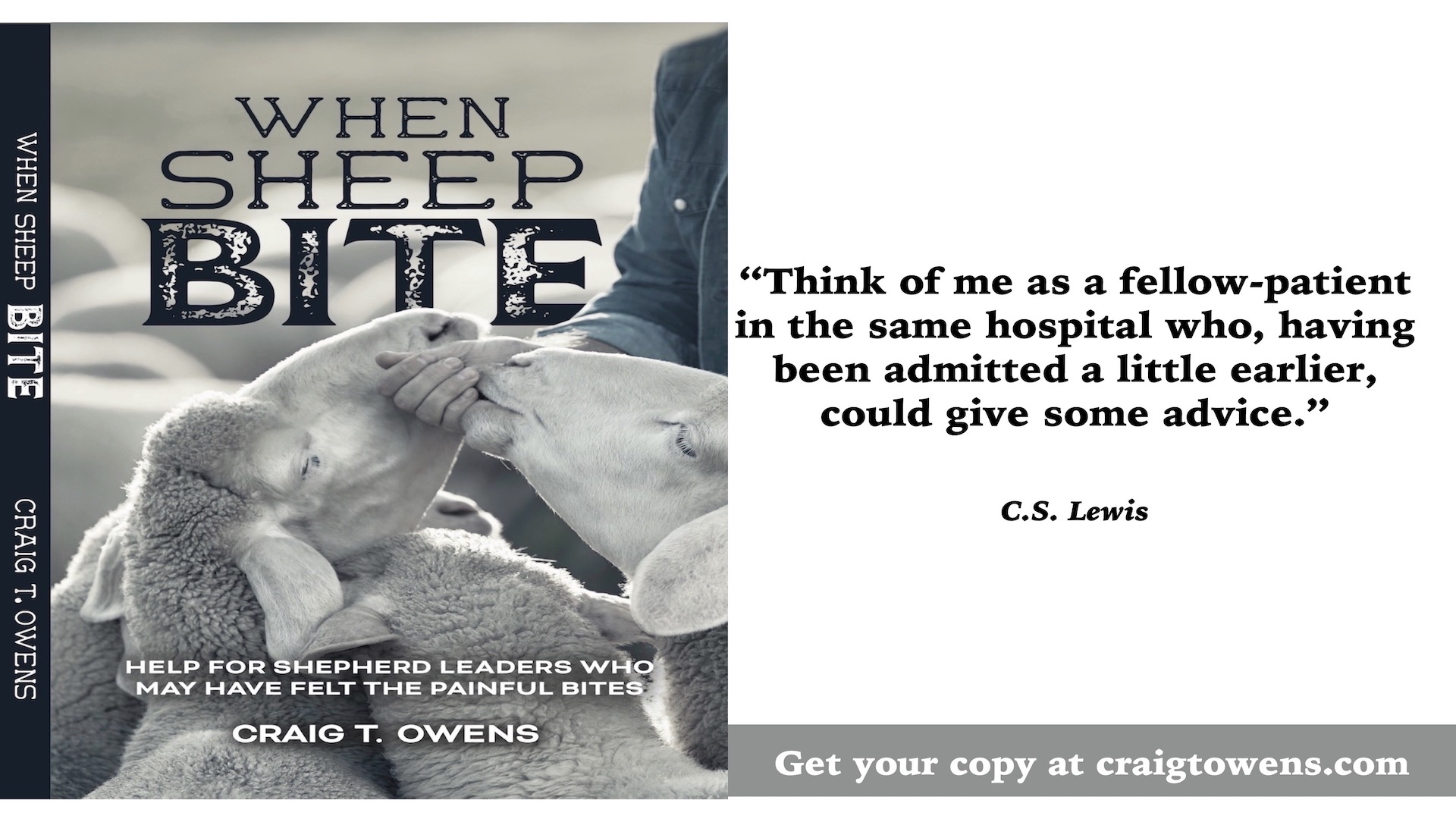
I truly believe that When Sheep Bite will be a healing resource for shepherd leaders who are still feeling the pain of their latest sheep bite. Please pick up a copy today! 

►► Would you please prayerfully consider supporting this ministry? My Patreon supporters get behind-the-scenes access to exclusive materials. ◀︎◀︎

Where This Book Originated

Listen to the podcast of this post by clicking on the player below, and you can also subscribe on AppleSpotify, or Audible. 

I would like to take you behind the scenes to the origin of my second book. In this video, you will hear how I first came up with the idea for When Sheep Bite, and how the Holy Spirit redirected my original book design.

Check out this episode of The Podcast.

I wrote this in the Introduction to Section One of When Sheep Bite

      I know that when you are in distress you are looking for immediate relief. You may be tempted to jump right to Section 2 of this book where I outline specific thoughts and strategies for handling the ways your sheep are biting and kicking, but I invite you to hold off. … It may appear from your perspective that the fault lies entirely with the attacking sheep—and that you feel that you haven’t done anything to provoke them. But these attacks can open our eyes to things we haven’t noticed before and teach us invaluable lessons, if we are willing to quiet ourselves before the Holy Spirit’s counsel. …

     If we don’t have the heart of a shepherd leader, we will not only treat every bite and kick as if it is completely their fault, but we will never be looking for ways to bring healthy correction and restoration to that wayward sheep. Let me remind you that all of us were those wayward sheep—biting God’s hand, running away from Him—when Jesus put His very life on the line to bring us into the sheepfold (Romans 5:6-8). This kind of shepherding doesn’t come just because we outwardly try to do the right thing, but because we have a right heart attitude (Philippians 2:5).

I truly believe that When Sheep Bite will be a healing resource for shepherd leaders who are still feeling the pain of their latest sheep bite. If you are a pastor—or if you love your pastor—please pick up a copy today! 

►► Would you please prayerfully consider supporting this ministry? My Patreon supporters get behind-the-scenes access to exclusive materials. ◀︎◀︎
Empathizing Is Never One-Upping

Listen to the podcast of this post by clicking on the player below, and you can also subscribe on AppleSpotify, or Audible. 

When we are going through something difficult or painful, we want to get counsel from someone who has some understanding of what we’re facing. In a word, we want someone empathetic. 

Webster’s Dictionary defines empathy as the action of understanding, being aware of, and being sensitive to the feelings, thoughts, and experience of another. If you were telling me about your painful situation, to let you know that I “get you”—that I empathize with you—I might say something like, “I’ve been there, done that, and have the scars to prove it.” 

But as I tell you my story, I need to really guard against one-upmanship. Webster’s defines that as the art or practice of outdoing or keeping one jump ahead of a friend or competitor. Saying something like, “Oh, feel your pain, but let me tell you how I had it so much worse” is one-upping and unhelpful! 

In my book When Sheep Bite, I wrote this in the Introduction—

     When you share a tale of real pain with a trusted friend, you don’t want them to try to one-up your story. Instead, you would want them to comfort you in your pain, to give you some helpful insight, or to even just cry along with you. On the other hand, you probably aren’t going to share your story of pain with someone who has no understanding of your situation. We want someone who “gets us,” someone who can relate, someone who can truly empathize with what we are feeling. … 

     I want to give you what I wanted when this happened to me: empathy, insight, a helpful perspective, and a manual of help that God has provided in the Bible. I don’t want to try to one-up your story of pain, because I’m confident that no one could truly know how deeply you’ve been hurt. But I do want to give you some assurance that I know what I’m talking about. 

As I was discussing some of the ideas in my book with a group of pastors, I reminded them of the value of an iron-sharpening-iron friend (as Solomon describes in Proverbs 27:17) who is empathetic without crossing the line into one-upmanship. 

I truly believe that When Sheep Bite will be a healing resource for shepherd leaders who have been there, done that, and have the sheep bite marks to prove it. If you are a pastor—or if you love your pastor—please pick up a copy today! 

►► Would you please prayerfully consider supporting this ministry? My Patreon supporters get behind-the-scenes access to exclusive materials. ◀︎◀︎

Please Don’t Misunderstand Me

Listen to the podcast of this post by clicking on the player below, and you can also subscribe on AppleSpotify, or Audible. 

I want to make sure there are no misunderstandings on this, so please stay with me! I realize that the title of my newest book—When Sheep Bite—may bring a picture to your mind that I never intended.

Check out this episode of The Podcast.

Here are some helpful resources from this episode:

If you would like to watch the full interview I did on the Converge Coaching podcast, check that out here.

Order your copy of When Sheep Bite here!

Here are a bunch of ways to get in touch with me and follow along with other projects on which I am involved.

►► Would you please prayerfully consider supporting this ministry? My Patreon supporters get behind-the-scenes access to exclusive materials. ◀︎◀︎

I Wish I Didn’t Have To Write This Book

Listen to the podcast of this post by clicking on the player below, and you can also subscribe on AppleSpotify, or Audible. 

This is a book that I wish I didn’t have to write. But it needed to be written, so let me tell you what it’s all about.

Check out this episode of The Podcast.

Here are some helpful resources from this episode:

If you would like to watch the full interview I did on the Converge Coaching podcast, check that out here.

Order your copy of When Sheep Bite here!

Here are a bunch of ways to get in touch with me and follow along with other projects on which I am involved

►► Would you please prayerfully consider supporting this ministry? My Patreon supporters get behind-the-scenes access to exclusive materials. ◀︎◀︎
How God Uses Pain

Listen to the podcast of this post by clicking on the player below, and you can also subscribe on AppleSpotify, or Audible. 

Romans 8:28 assures us that God uses everything for His glory. Even our pain. Here is when I learned this painful but precious truth.

On the Leading From Alignment podcast, John Opalewski asked me about lessons I have learned from painful experiences.

►► Would you please prayerfully consider supporting this ministry? My Patreon supporters get behind-the-scenes access to exclusive materials. Like this recent post where I shared a map and an app to help with your Bible study time. ◀︎◀︎

Links & Quotes

This is just one example of the power of a leader’s storytelling. Check the full conversation Greg and I had on The Craig And Greg Show. I have lots of new content every week, which you can check out on my YouTube channel.

“We are all born ignorant, but one must work hard to remain stupid.” —Benjamin Franklin

George Jeffreys was born with a limiting speech impediment, but with the empowering of the Holy Spirit, George and his brother Stephen led incredible Pentecostal revivals in England and Wales. They were said to be the greatest evangelists since George Whitefield and John Wesley. Someone asked Jeffreys how long a revival should last, and he responded, “Thank God, a revival started in my heart 30 years ago, and it has never stopped; it will never end.” He continued by saying, “As long as Jesus is kept in the front, and made the center of fellowship and blessing and unity, the revival will never end.” Check out this mini biography about his life.

John Stonestreet uses the example of C.S. Lewis’ Aslan to talk about how God can speak to us through our pain. John writes, “Pain is never the point of God’s plans, any more than it is the purpose of physical exercise. Never pushing ourselves to the point that it hurts means never improving our health. On the other hand, seeking pain is more likely to do harm than to aid our wellbeing. In and of itself, pain is not good, but it is meaningful. Pain indicates that something is wrong and needs to be addressed.”

“The best way to make a dream come true is to wake up.” —Dame Anna Wintour

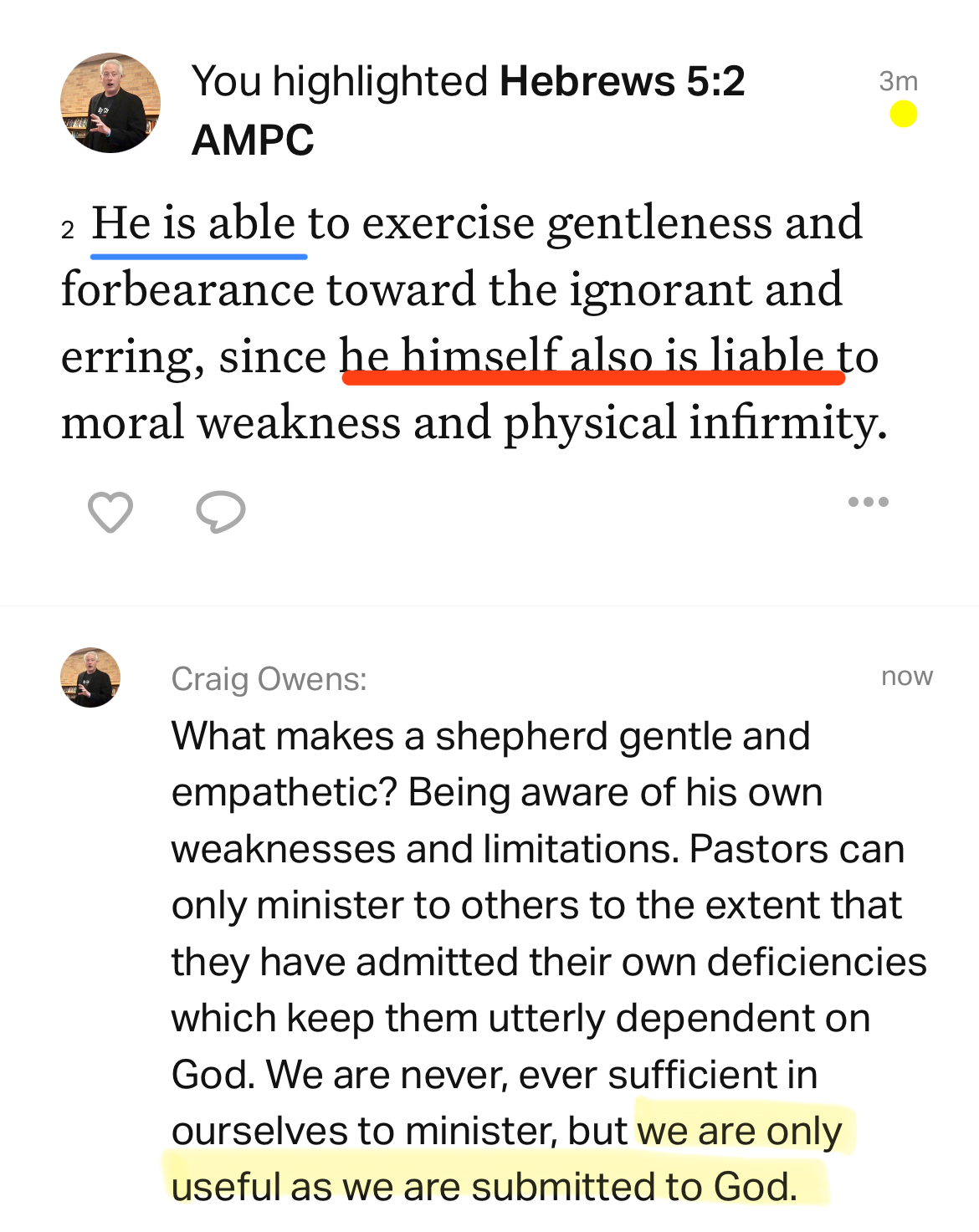
Because of the extensive prayer, research, and work I put into my book Shepherd Leadership, I am frequently drawn to passages of Scripture that reinforce the idea of pastors as shepherds. I was meditating on Hebrews 5:2 the other day, and I shared some of my thoughts with some of my pastor friends.

A Hard Word For A Good Reason

Listen to the podcast of this post by clicking on the player below, and you can also subscribe on AppleSpotify, or Audible. 

Is it okay for a friend to hurt another friend’s feelings? Let’s talk about it.

Check out this episode of The Podcast.

Resources mentioned in this video:

►► Would you please prayerfully consider supporting this ministry? My Patreon supporters get behind-the-scenes access to exclusive materials, like a 10-minute video I just shared on study tips for the poetic books of the Bible. ◀︎◀︎

Links & Quotes

Unhealthy leaders don’t admit their need for help, and as a result they put a lid on their leadership potential. Check out more of this message hereAnd be sure to check out all of my videos on my YouTube channel.

A prominent Chinese scholar, Dr. Wang Yun Wu (1888-1979), abandoned atheism in 1924 after he witnessed the miraculous healing of his sister’s eyesight. Dr. Wang later became Vice Premier of the Republic of China (Taiwan). Check out this miraculous story in the Pentecostal Evangel.

The Culture Translator weekly email from Axis had some helpful information for Mental Health Awareness Month.

What it is: May is mental health awareness month, making mental health and suicide prevention bigger topics than ever. #mentalhealthmatters has around 42 billion views on TikTok, and #mentalhealthawareness has racked up 20 billion.

Why the conversation is changing: The CDC’s Youth Risk Behavior survey showed that suicidal ideation, especially for teenage girls, is continuing on a concerning trajectory. In 2021, 30% of girls said that they had seriously considered suicide in the past year, and 24% said they had an actual plan to end their life. According to data published by Mental Health America, 16.4% of youth reported experiencing a major depressive episode within the last 12 months. This news comes at a time when adults are feeling so lonely that the US surgeon general has declared loneliness a public health emergency. Stigma around mental health topics appears to be eroding, but that isn’t necessarily leading to better mental health outcomes for teens and for the population at large.

Conversation Starter: What do you think are the biggest contributors to mental health issues for your generation? (Check out our new video series on Mental Health for more help having this conversation!)

One of the things contributing to the unhealthy mental state of many people (not just teens) is the negative impact of pornography. Fight The New Drug reports how watching porn hurts self-esteem.

“A pessimist is one who makes difficulties of his opportunities and an optimist is one who makes opportunities of his difficulties.” —Harry Truman

Is pain good or bad? Dr. Matthew Loftus makes the case that avoiding suffering undermines the role of medicine and also stunts our ability to feel and express compassion. Check out this full article and the thoughts John Stonestreet shared about them.

“What a sweetness lies in the little word ‘our’; how much is God’s glory endeared to us when we consider our interest in Him as ‘our Lord’ [Psalm 8:1].” —Charles Spurgeon, in Spurgeon and the Psalms

The Craig And Greg Show: Toughen Up, Buttercup

Listen to the audio-only version of this podcast by clicking on the player below, or scroll down to watch the video.

Recently Greg got a call from an educational institute asking him for advice on how to help their athletes “toughen up.” Unfortunately, they’re not alone, it seems like resilience is in increasingly shorter supply across the board these days. As a leader, it is your job to help instill grit into your team. Not tearing them down, but showing them that you view them with more potential.

  • [0:15] It’s time to toughen up, Buttercup! 
  • [2:54] We learn the best leadership lessons from the toughest times.
  • [4:17] Greg shares an example from coaching t-ball that applies to all our leadership roles.
  • [7:28] The temporary pain can protect us against the pain that would have derailed our leadership.
  • [8:35] A college contacted Greg about why their athletes are lacking resilience.
  • [10:12] Greg shares an insightful quote about struggling through a problem to achieve success.
  • [12:07] We define the leadership culture that will serve us and our teams best.
  • [13:34] We discuss an example from Greg’s NFL experience.
  • [14:56] Resilience can be hard to teach, but we still need to keep trying.
  • [17:54] Data from the Mayo Clinic that encourages us to develop grit.
  • [19:34] What happens to reach that have teammates who don’t show stick-to-it-iveness?
  • [21:04] A leadership separator is action over feelings.
  • [24:00] The wrong and right ways to handle disappointments.
  • [25:53] We can help coach you to bring out the resilience in yourself and your team.

Check out this episode and subscribe on YouTube so you can watch all of the upcoming episodes. You can also listen to our podcast on Spotify and Apple.