Listen to the podcast of this post by clicking on the player below, and you can also subscribe on Apple, Spotify, or Audible.
We had our final service of the summer joining with Hillcrest Community Church in Morley Park. Pastor Caleb Claybaugh shared a message that challenged me.
He started out with a simple question: Why do we do ministry? “Because the Bible says so” is a good start but it’s not enough. It’s not just doing but having the right attitude.
God is more interested in the attitude of our hearts than He is the actions of our hands.
First, we have to love others as Jesus loved: So now I am giving you a new commandment: Love each other. Just as I have loved you, you should love each other. Your love for one another will prove to the world that you are My disciples (John 13:34-35 NLT).
When people hurt, Jesus hurts. When Jesus saw her weeping and saw the other people wailing with her, a deep anger welled up within Him, and He was deeply troubled. … Then Jesus wept (John 11:33, 35 NLT). So, too, when we see people hurting, we should hurt with them, and our pain should move us to action—When [Jesus] saw the crowds, He had compassion on them because they were confused and helpless, like sheep without a shepherd (Matthew 9:36 NLT).
Christ’s compassion prompted Him to preach the Good News and to heal the sick (v. 35). And then Jesus prayed that more of us would be involved in this type of compassion-driven ministry (vv. 37-38).
Although this was a word Peter spoke to pastors, it’s a good challenge for all of us about checking out attitude: Care for the flock that God has entrusted to you. Watch over it willingly, not grudgingly—not for what you will get out of it, but because you are eager to serve God (1 Peter 5:2 NLT).
May our prayer be for God to give us both the heart of compassion that Jesus has, and also the hands of compassion that meet the needs of hurting people.
Don’t judge your creative efforts by the world’s likes (or even by its silence). If you did your best with the talents that God gave you, the applause from nail-scarred hands is all that really matters.
“It will be vain for me to stock my library, or organize societies, or project schemes, if I neglect the culture of myself; for books, and agencies, and systems, are only remotely instruments of my holy calling; my own spirit, soul, and body, are my nearest machinery for sacred service; my spiritual faculties, and my inner life, are my battle axe and weapons of war.” —Charles Spurgeon
“A man who has faith must be prepared not only to be a martyr, but to be a fool.” —G.K. Chesterton
The paleontological evidence of dinosaur fossils is most easily explained by the Flood described in the Bible. ICR reports, “Virtually every dinosaur fossil ever found is ensconced in sedimentary or (rarely) volcanic sediments, indicating a sudden and catastrophic deposition. … So why would paleontologists entertain bizarre extinction explanations such as slipped discs, sunspots, or magnetic reversals? Because if a scientist dismisses the global Flood out of hand, then anything goes when trying to explain the dinosaur demise.”
Listen to the podcast of this post by clicking on the player below, and you can also subscribe on Apple, Spotify, or Audible.
I couldn’t say it any better than the apostle Paul said it—
We live in such a way that no one will stumble because of us, and no one will find fault with our ministry. In everything we do, we show that we are true ministers of God. We patiently endure troubles and hardships and calamities of every kind. We have been beaten, been put in prison, faced angry mobs, worked to exhaustion, endured sleepless nights, and gone without food. We prove ourselves by our purity, our understanding, our patience, our kindness, by the Holy Spirit within us, and by our sincere love. We faithfully preach the truth. God’s power is working in us. We use the weapons of righteousness in the right hand for attack and the left hand for defense.
We serve God whether people honor us or despise us, whether they slander us or praise us.
We are honest, but they call us impostors. We are ignored, even though we are well known. We live close to death, but we are still alive. We have been beaten, but we have not been killed. Our hearts ache, but we always have joy. We are poor, but we give spiritual riches to others. We own nothing, and yet we have everything. (2 Corinthians 6:3-10 NLT)
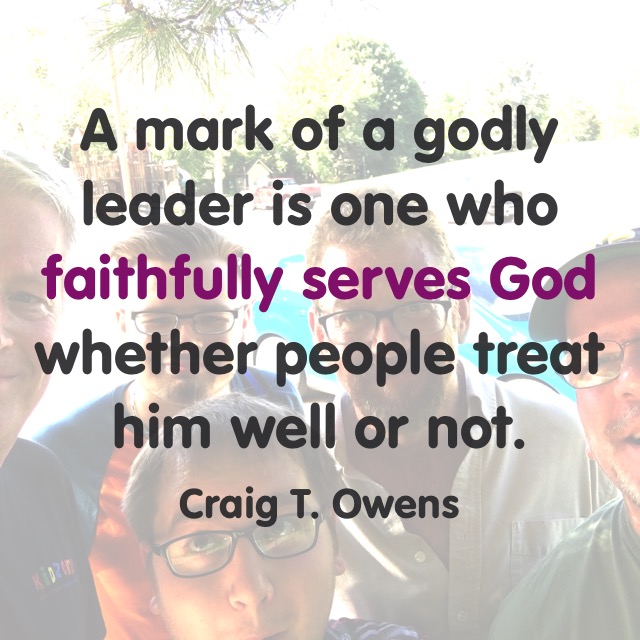
A mark of a godly leader is one who faithfully serves God whether people treat him well or not.
We don’t minister faithfully so we can receive human applause, because cheers can quickly turn to jeers. Just ask Jesus who heard everyone speaking well of Him in one moment, and then in the next moment saw that same group ready to throw Him off a cliff.
Instead, we minister faithfully so that we can hear applause from nail-scarred Hands, and hear His voice saying, “Well done, good and faithful servant.”
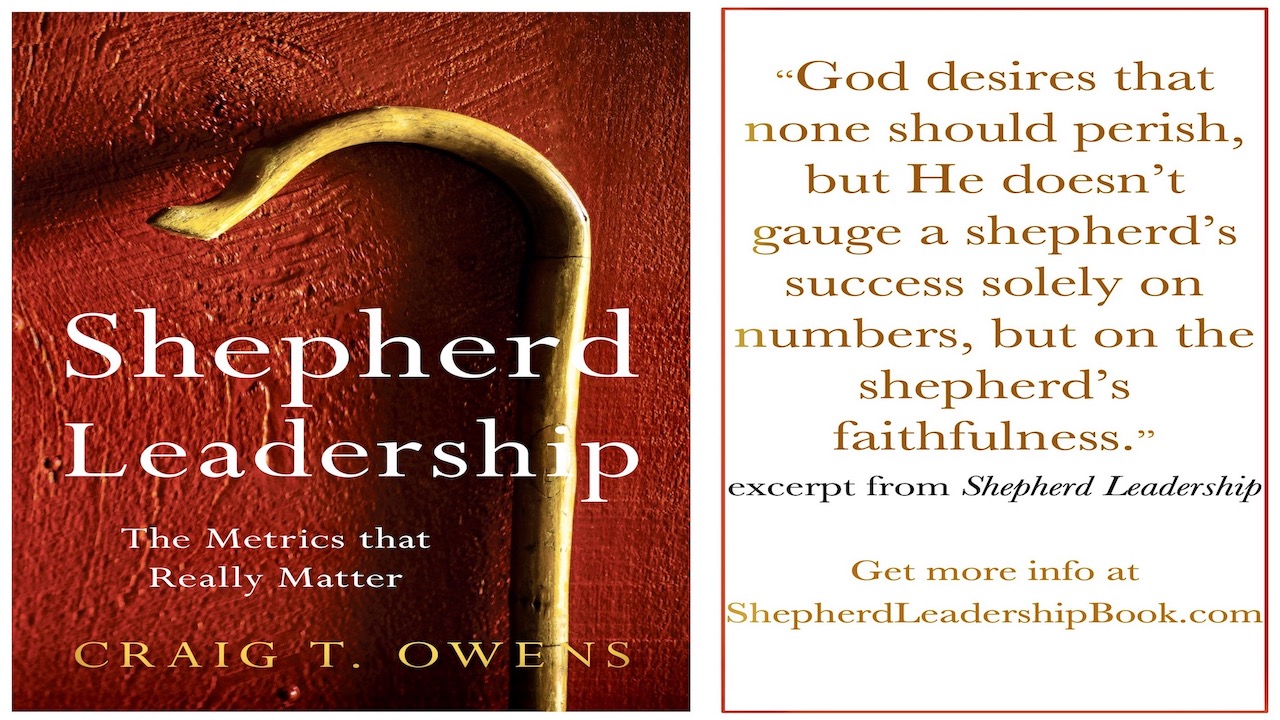
In my book Shepherd Leadership, I talk about these metrics of success. And in my book When Sheep Bite, I talk about how we can respond to the slanders and slings that come our way.
This is part 80 in my series on godly leadership. You can check out all of my posts in this series by clicking here.
I shared this video last week with my Patreon supporters. When we’re unclear about all that God has asked us to do, the first step is to obey the part that is clear to us. Check out my blog post Clearing up the Confusion for more insight on how Peter handled this.
I have lots of new content every week, which you can check out on my YouTube channel.
T.M. Moore calls on Christians to recognize the God-given authority our leaders have. Not just recognize, but submit to that authority: “We show that we believe the Lord and trust in His Word, and we demonstrate the evidence of that faith when we submit to our church leaders as unto the Lord (Colossians 3:23-24). Submitting to proper authorities is an integral component of full faith. If we want to gain the benefit God intends for us from those appointed to lead, we’re going to have to learn to submit.”
“Talent is never enough. With few exceptions the best players are the hardest workers.” —Earvin Magic Johnson
“Take your job seriously, but don’t take yourself too seriously.” —Alex Trebek
The American Bible Society reports that Gen Z is engaged with Scripture less than any other generation. But here is a sad outcome: “Scripture Engagement is associated with significantly lower anxiety levels among all Americans, but especially among Generation Z. The anxiety score for Bible Engaged Gen Z respondents (3.4) is less than half that of the anxiety score for Bible Disengaged Gen Z respondents (7.1).”
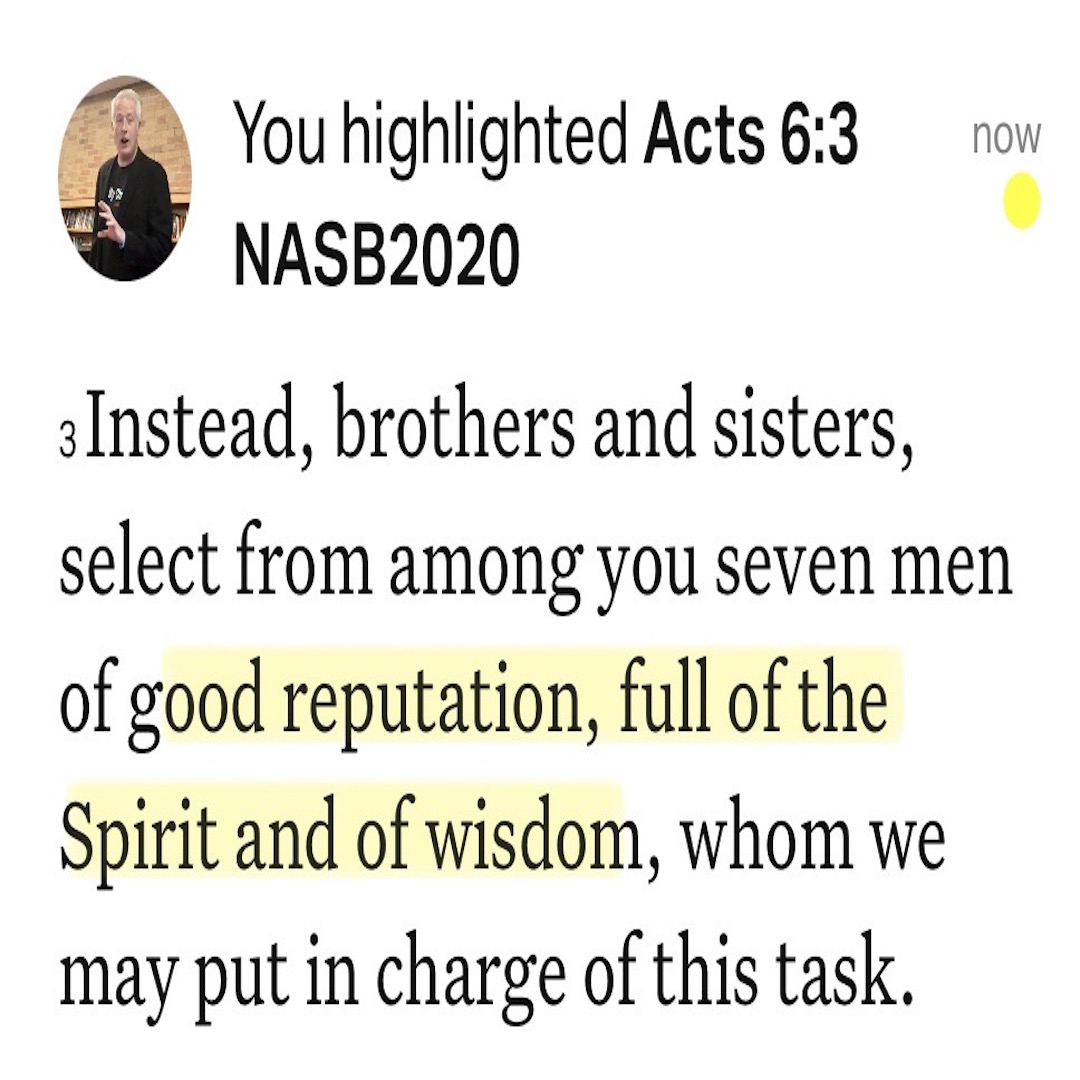
What if the qualifications in Acts 6:3 were the only qualifications we used for selecting folks for ministry assignments: (a) good reputation, (b) full of the Holy Spirit, and (c) full of wisdom?
Listen to the podcast of this post by clicking on the player below, and you can also subscribe on Apple, Spotify, or Audible.
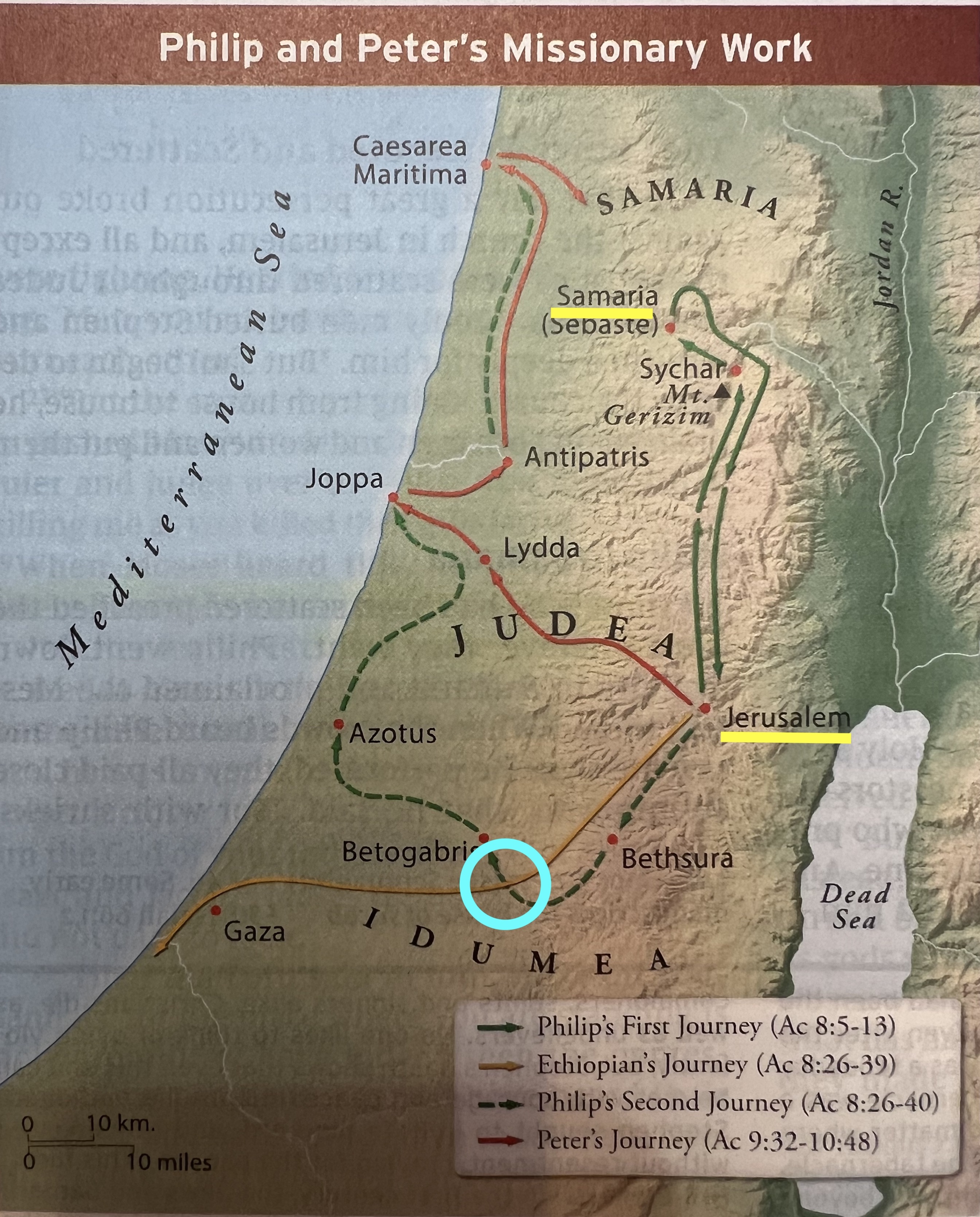
Ministry was booming in Samaria, and Philip was at the center of the activity. People were getting saved, healed, and set free from demonic possession.
And then an angel tells Philip it is time to move on. We don’t see Philip debating or negotiating, but we just see his immediate obedience. As Philip is traveling the route the angel gave him, he sees a chariot approaching. The Holy Spirit then speaks to Philip and says, “Get close to that chariot and stay near it.” It was then that Philip hears the man in the chariot reading aloud from the Book of Isaiah, so he asks him if he understands what he is reading. This high-ranking official from Ethiopia then invites Philip into his chariot to explain the meaning to him.
Philip had to leave Samaria in time to cross paths with the Ethiopian official who was heading home from Jerusalem—they met in the middle of a desert. An angel got Philip started. The Holy Spirit refined where Philip needed to be. And then Philip took it from there.
If Philip had been trying to “grow” a successful ministry, he may have downplayed or even ignore the messages he received. But Philip wasn’t concerned about bigger numbers, just quicker obedience.
Philip’s quick obedience placed him precisely where God needed him to be, precisely when he needed to be there! (See Acts 8:4-40.)
In my book Shepherd Leadership, I have a chapter entitled “Don’t Try to Grow Your Ministry.” A portion of what I wrote comes from Philip’s quick obedience—
Don’t try to grow your ministry. First, because it’s not yours, it’s His; and second, because your measure of success is probably more slanted toward quantitative measurements than qualitative. Jesus wasn’t concerned about bigger numbers: “What do you think?” He asked, “If a man has a hundred sheep, and one of them goes astray, does he not leave the ninety-nine and go to the mountains to seek the one that is straying?” (Matthew 18:12).
Philip went to Samaria to tell people about Jesus. He didn’t go there because it fit his plan, but because Jesus said, “You will be My witnesses in Jerusalem, and in all Judea and Samaria, and to the ends of the earth” (Acts 1:8). Philip’s obedience brought God’s success: hundreds turned to Jesus as their Savior, demon-possessed people were delivered, the sick were healed, and the new Christians were baptized in the Holy Spirit. Yet God called Philip to leave these “ninety-nine” and go to the desert to cross paths with just one confused and wondering sheep (Acts 8). After that, Philip virtually disappears from Luke’s historical record.
What’s the value of one government official’s life? God says that his value is incalculable. Apparently, God knew that Philip was the perfect shepherd to lead this Ethiopian to the pasture where he would accept Jesus as his Savior. Philip was obedient, a sheep was saved, and God was pleased. But I wonder how many people today might think Philip’s ministry was unsuccessful because he left a bigger ministry in Samaria to go to a smaller ministry in the desert? Bishop William C. Abney said, “I’m still waiting for a leader to say, ‘God called me to a smaller ministry.’ We usually only say, ‘God called me’ when it’s something bigger. God’s math doesn’t work our way.”
The Chief Shepherd made this commitment to His sheep: “And I will give you shepherds according to My heart, who will feed you with knowledge and understanding” (Jeremiah 3:15). My prayer is that we would much rather feed a few sheep where God has directed us and given us His heart than for us to try to manufacture success that is measured by how many nickels and noses we can count.
Philip demonstrates for us that it’s not about bigger numbers, it’s about obedience to God’s voice in the moment, and then hearing our Chief Shepherd’s voice at the end of our life saying, “Well done, good and faithful servant.”
Jim’s book centers on the intersection of three circles. This is the “sweet spot” where people are doing what God created them to do. In order to find your sweet spot (or help others find theirs), Jim gives us three questions. Here are those questions with a couple of supporting quotes.
Question #1—What is your passion?
“The easiest question is the first one I always ask and sounds something like this: What are you passionate about? What thrills you when you get to do it? What makes your heart come alive when you see it? What do you love to do when you’re done doing what you have to do? If all jobs paid the same and you couldn’t fail, what would you do starting tomorrow?”
“Paul said he was ‘compelled’ to preach the gospel and that it was a ‘pleasure’ to do so. His passion for the God of the lost and the lost themselves caused him to travel the world. Everywhere he went, he saw revival or a riot, or at times, both in the same day. Then he’d be mistaken for a Greek god, stoned and left for dead or at times beaten, imprisoned, and slated for execution. And then the next day, he got up and did it all over again. That’s not fear of failure! That’s a God-given passion to tell people the good news of Jesus Christ!”
Question #2—What is your pain?
“What bothers you? What is it you see in the world that you would change? What breaks your heart? What do you find yourself praying about more than any other thing? What subjects do people no longer want to talk to you about because you’re always talking about those things?”
“The way I figure it, if it was bothering me the way it was, I was probably the one God wanted to do something about it. You see, I’ve learned that if I do something about what bothers me, and you do something about what bothers you, and the folks around here all do something about what bothers them, well, eventually there may come a day when there won’t be anything left to bother anyone.”
Question #3—What is your proficiency?
“What are you good at? What comes naturally to you? What did you pick up quickly and easily compared to others around you? What do you do with little effort that takes others much effort?”
Listen to the podcast of this post by clicking on the player below, and you can also subscribe on Apple, Spotify, or Audible.
I want to make sure there are no misunderstandings on this, so please stay with me! I realize that the title of my newest book—When Sheep Bite—may bring a picture to your mind that I never intended.
Check out this episode of The Podcast.
Here are some helpful resources from this episode:
If you would like to watch the full interview I did on the Converge Coaching podcast, check that out here.



 We had our final service of the summer joining with Hillcrest Community Church in Morley Park. Pastor Caleb Claybaugh shared a message that challenged me.




 Craig T. Owens