Listen to the podcast of this post by clicking on the player below, and you can also subscribe on Apple, Spotify, or Audible.
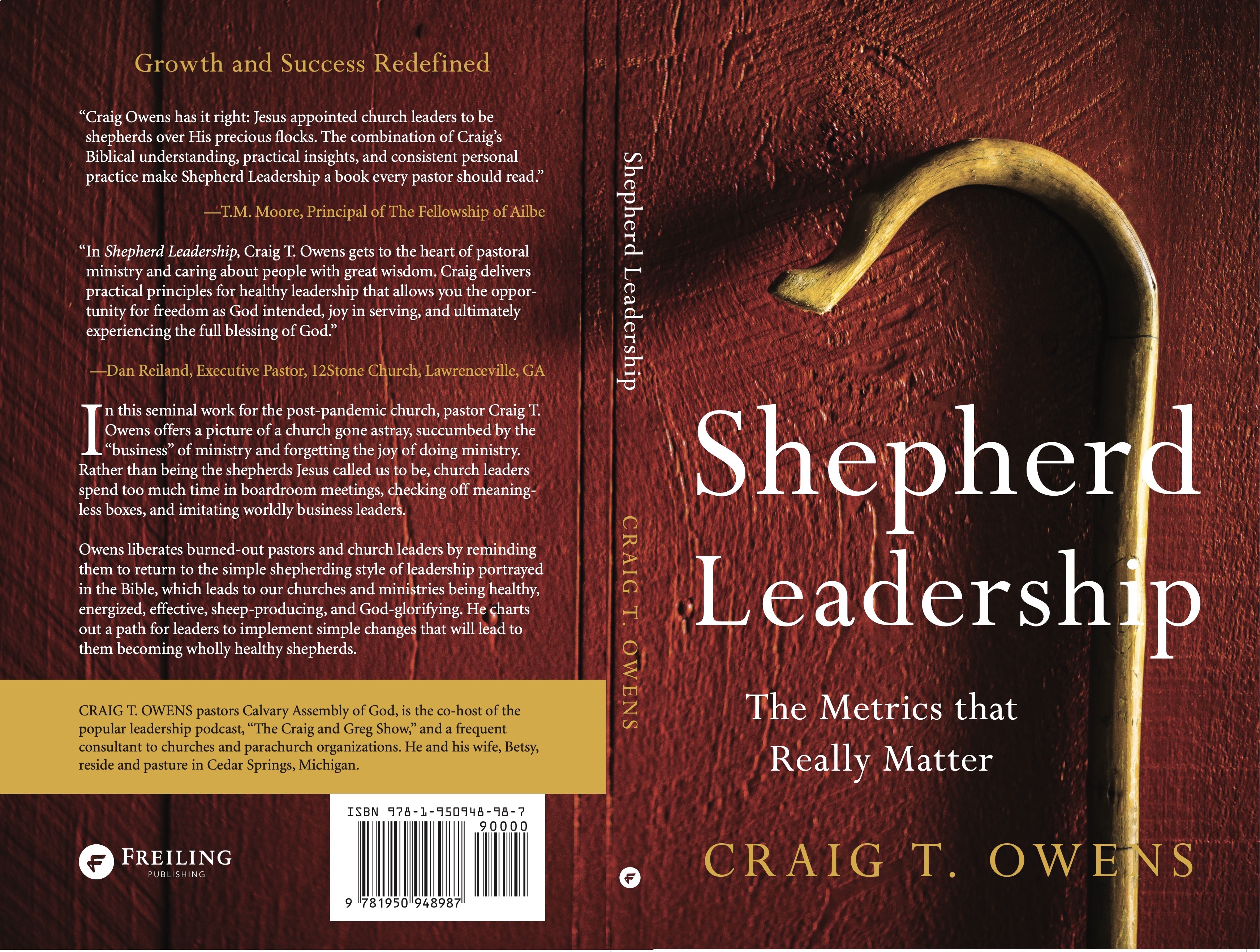
Thank you to my many friends who helped make Shepherd Leadership a reality! My first book would not have been published, and been such a blessing to so many Christian leaders, if it hadn’t been for such amazing people who helped me fund this project!
Shepherd Leadership opened the door for me to talk with so many pastors. In my conversations with them, I discovered how beat up so many of them were feeling. This began to stir in me the desire to write another book to help them out, which prompted the thought for yet another book.
The first book has the working title When Sheep Bite: How shepherds should respond to attacks and abandonment. This book will be presented in three sections:
Cultivating a shepherd’s heart toward the sheep
Handling the various bites and kicks that come from the sheep
Staying faithful to God’s call to shepherd His flock under your care
The second book has a working title of Amen Indeed! This is a book of prayers for the variety of situations that pastors face. The first part of this book lists the different scenarios that call for prayer and then presents a prayer that is rooted in biblical texts. The second part of the book is a prayer for pastors for each Sunday of the year.
But in order to help these ministry leaders, I once again need some help from you. One of the lessons I learned from my first publishing experience is that a lot of money was spent on a publisher that could have gone toward getting the book out to more people. So this time I will be self-publishing these books.
Would you consider being a sponsor of these books?
For a donation of $35, you will get an advanced, pre-release copy of the ebook. You will be reading this book before anyone has it![UPDATE: 1 sponsor at this level]
For a donation of $75, you will not only get the pre-release copy of the ebook but also an autographed copy of the pre-released print version of the book.[UPDATE: 2 sponsors at this level]
For a donation of $200 or more, you will get all of the above, AND you will have access to the opening paragraphs of each chapter as they are written, as well as some behind-the-scenes videos throughout this journey.[UPDATE: 3 sponsors at this level]
All of my supporters will receive immediate access to the audio version of the introduction to When Sheep Bite.
Every Monday I share a 1-minute thought to get your week started. It’s my weekly Monday Motivation series of videos. Check out this week’s video that I posted the day after Christmas, and please subscribe on YouTube.
T.M. Moore wrote one of the endorsements for my book Shepherd Leadership. In an interview I then did on his Fellowship of Ailbe podcast, I shared my dismay over unbiblical ideas and practices that have crept into the church. Both T.M. and I share a passion to see our church leadership return to our secure biblical foundation.
In a recent blog post, T.M wrote, “From the days of the apostles onward, a tendency has existed among church leaders to drift from the plain teaching of the Word of God into forms of Christian life and ministry that derive from sources other than Scripture. Or that stretch the meaning of Scripture to fit the shape of certain cultural forms.” Please check out T.M.’s post “Do not go beyond.”
In a fascinating post from Rabbi Benjamin Blech, I read these thoughts about the power of a name: “The Hebrew word for soul is neshamah. Central to that word, the middle two letters, shin and mem, make the word shem, Hebrew for ‘name.’ Your name is the key to your soul. … When the Torah says, ‘God created,’ it doesn’t suggest that He worked with what He fashioned by labor, but merely that He spoke—and the very words describing the object came into being. God said, ‘Let there be light and there was light.’ The Almighty merely gave it a name, and the very letters defined its atomic structure.” Check out the full post here.
“Success” doesn’t always mean bigger numbers. King David got into trouble with God when he wanted to measure his success by how many fighting men he had under his command. Consistently throughout the Bible God’s measure of success is our trust in Him. This thought was a key part of the sub-title of my book Shepherd Leadership: The Metrics That Really Matter.
God will give you everything you need to minister to others. But there’s one thing you have to do first…
“He who thinks half-heartedly will not believe in God; but he who really thinks has to believe in God.” —Isaac Newton
Back in 1929, Donald Gee shared three temptations that Pentecostals needed to be cautious of avoiding: (1) selfish satisfaction, (2) fanaticism, and (3) the temptation to forsake the pure worship of God in exchange for popularity. Check out the full article here.
I really appreciate the leadership insights from Dan Reiland. That’s why I was so honored to have him write such a nice endorsement of my book Shepherd Leadership! Here is an important post Dan wrote for leaders, warning us of 5 ways we can misuse our spiritual authority.
[11:02] Greg’s first business venture was only an entry point to his career
[13:37] Another decision further refined Greg’s niche in business
[15:03] The unforeseen changes that brought me to West Michigan where I met Greg
[15:59] One of the first ministries that we worked on together
[20:00] A leadership lesson we tried to teach to the students at an urban youth center
[20:40] The dream list for us going forward
[22:40] What do we do as consultants?
[24:02] Greg has some cool keynote addresses that he presents
[25:53] How we can help you grow your leadership capacity
Check out this episode and subscribe on YouTube so you can watch all of the upcoming episodes. You can also listen to our podcast on Spotify and Apple.
Listen to the podcast of this post by clicking on the player below, and you can also subscribe on Apple, Spotify, or Audible.
During a Bible study I was recently leading, I was asked how a pastor finds a day to set aside as a Sabbath day. This is tricky for pastors because Sunday is usually considered a “workday” for us. And even if we can take a “day off” there are still people who need to speak with us.
Being able to Sabbath is vital for all leaders, but especially for pastors. I spend five chapters in my book Shepherd Leadership talking about the mental, physical, spiritual, and relational health of pastors. If you are a pastor, I encourage you to pick up a copy of my book. If you love your pastor, please get a copy for him or her.
I came across a passage from a blog post I wrote 10 years ago, but it is still so timely for today: “Pastors, we can become so focused on the next sermon, the next appointment, the next Board meeting, the next outreach that we are actually worshiping the ministry instead of worshiping God through our ministry. When we are more focused on the work than on God, we can easily begin to feel over-worked and under-appreciated.”
“Stay with your Lord, however long the night, for only in Him have you hope of the morning!” —Charles Spurgeon
“I shall not demean my own uniqueness by envy of others. I shall stop boring into myself to discover what psychological or social categories I might belong to. Mostly I shall simply forget about myself and do my work.” —Clyde Kilby
Jonathan Edwards wrote words that resonate with my message about pastors following the example of the Great Shepherd Jesus. “The ministers of Christ should be persons of the same spirit that their Lord was of: the same spirit of humility and lowliness of heart; for the servant is not greater than his Lord. They should be of the same spirit of heavenly-mindedness and contempt of the glory, wealth, and pleasures of this world: they should be of the same spirit of devotion and fervent love to God: they should follow the example of His prayerfulness; of whom we read from time to time of His retiring from the world, away from the noise and applauses of the multitudes, into mountains and solitary places, for secret prayer, and holy converse with his Father….” —Jonathan Edwards
“Wonderful things are told in this book [Daniel]. To those who find it difficult to believe these things, we say: let us remember that for one thousand years God had been nurturing the Hebrew nation for the purpose of establishing, through that nation, in a world of idol-worshiping nations, the idea that God is God. Now God’s nation had been destroyed by a nation that worshiped idols. That was plain evidence to all the world that the gods of Babylon were more powerful than the God of the Jews. It was a crisis in God’s struggle with idolatry. If ever there was a time when God needed to do something to show who He is, it was during the Babylonian exile. Strange indeed it would have been if nothing unusual had happened. Hard as it may be to believe these miracles, it would be harder to believe the rest of the story without them.
“At least the Jews, who from the very beginning had always been falling into idolatry, were now at last, in the Babylonian exile, convinced that their own God was the true God. These miracles also had a powerful influence on both Nebuchadnezzar and Darius (3:29; 6:26).” —Halley’s Study Bible
Listen to the podcast of this post by clicking on the player below, and you can also subscribe on Apple, Spotify, or Audible.
Former Assembly of God General Superintendent W.T. Gaston wrote an article of warning in 1953 that pastors and ministry leaders would do well to heed again today. This part especially caught my attention—
Gaston suggested, “If we are to have a future that is better or even comparable and worthy of our past, we will need to learn over again some of the lessons of yesterday.” One of the important lessons to rediscover, he wrote, was the importance of promoting “pure, undefiled” religion.
He recalled that many early 20th-century Pentecostal pioneers were bivocational ministers, that often met in homes or rented buildings, and that most were not very impressive by the standards of the surrounding culture. However, they did not need worldly goods and accolades in order for the Holy Spirit to accomplish great things through their lives and ministries.
Gaston wrote that he witnessed an “utter disregard for poverty or wealth or station in life” in the early Pentecostal movement. Yet “those rugged pioneers,” he noted, “had something that made them attractive and convincing.” The contrast between the attitudes of the world and the early Pentecostals was striking. According to Gaston, early believers were “completely satisfied without the world’s glittering tinsel, and content to be the objects of its scornful hatred.”
My larger concern is that churches, parachurch organizations, and nonprofit ministries that are largely founded to fulfill a biblical mandate are straying from the simple, freeing truths found in the Bible. Or maybe I should say that they are adding things to their ministries that aren’t in the pages of Scripture. Whichever way you want to say it, the result is the same: We are using the wrong metrics to define “success” for our ministries. I fear that in our focus on unbiblical practices, we are missing the joy of really doing ministry.
All of these titles, flowcharts, and non-essential things that we are discussing, revamping, implementing, and measuring aren’t doing anything to liberate us, but they are keeping us focused on checking off meaningless boxes. We’re spending far too much valuable time and resources on keeping the machinery running, but we’re not correctly evaluating the outputs. We need to recalibrate our understanding of leadership: God’s leaders are servants. …
I believe that leaders of churches and nonprofit ministries will find the greatest freedom and enjoyment—and ultimately experience the full blessing of God—when they learn to view themselves as shepherd leaders. Jesus is our ultimate example: Our Good Shepherd showed us how to live out the lifestyle that pleases Him and glorifies our Heavenly Father.
I hope you will buy a copy of this book. And I invite you to also check out this video where I explain a little more what I hope this book will accomplish in all of our ministries.
This is a weekly series with things I’m reading and pondering from Charles Spurgeon. You can read the original seed thought here, or type “Thursdays With Spurgeon” in the search box to read more entries.
Listen to the podcast of this post by clicking on the player below, and you can also subscribe on iTunes or Spotify.
Useful To The Master
In a large house there are articles not only of gold and silver, but also of wood and clay; some are for special purposes and some for common use. Those who cleanse themselves from the latter will be instruments for special purposes, made holy, useful to the Master and prepared to do any good work. (2 Timothy 2:20-21)
On the vessels of honor, you can see the hallmark. What is the hallmark that denotes the purity of the Lord’s golden vessels? Well, He has only one stamp for everything. When He laid the foundation, what was the seal He put upon it? ‘The Lord knows those who are His, and, everyone who confesses the name of the Lord must turn away from wickedness’ (2 Timothy 2:19). That was God’s seal! That was the impress of the great King upon the foundation stone. Do we find it here? Yes, we do. ‘Those who cleanse themselves from the latter will be instruments for special purposes, made holy, useful to the Master and prepared to do any good work’ (2 Timothy 2:21). Do you see, then, that the man who is the golden or silver vessel departs from all iniquity, and that is the token of his genuine character. …
Brethren, I count it an honor to be useful to the meanest child of God, but I confess that the honor lies mainly in the fact that I am thereby serving the Master Himself. Oh, to be used by God! This is to answer the end of our being. If you can feel that God has used you, then you may rejoice indeed!
There are some Christians whom the Lord cannot much use because, first of all, they are not cleansed from selfishness. They have an eye to their own honor or aggrandizement. The Lord will not be in complicity with selfish aims! Some men are self-confident—there is too much of the ‘I’ about them, and our Master will not use them. He will have our weakness but not our strength!
From The Great House And The Vessels In It
The Church of Jesus Christ is made up of many members. The Bible uses pictures of a body, a building, and a bride to describe how all of the parts work together to bring strength and vitality to the whole. But Jesus is always the central object: He is the Head of the body, the Chief Cornerstone of the building, the beloved Bridegroom to the bride.
Don’t let either the extremes of selfishness of self-abasement limit the good work you were created to do in making the body of Christ, the building of Christ, and the bride of Christ something radiantly God-glorifying!