Poetry Saturday—The Lovetobutcants

Listen to this post as a podcast by clicking here:

I have a disease called
The “lovetobutcants”—
I think it’s time I told it.
I’d love to help with that garbage can
But my fingers just can’t hold it.
Hand me a bag of groceries and
My wrists just turned to jelly.
Cuttin’ grass and hedges
Gives me flutters of the belly.
The smell of paint will make me faint,
Sweat makes my eyes start itchin’.
Dishwater on my little hands
Will start ‘em shaky-twitchin’.
Pickin’ clothes up off the floor
Would paralyze my shoulder.
I must not try to close the door,
At least not till I’m older.
So though I’d love to join the work—
Till this disease is done,
I’ll have to lie here in the shade
While you have all the fun. —Shel Silverstein

Do I Have Standing?

Listen to this post as a podcast by clicking here:

If it is true that I have gone astray, my error remains my concern alone (Job 19:4).

Why do we find it necessary to stick our noses in where they are not wanted? Why do we feel like the other person needs to hear our opinion? 

The law dictionary defines “standing” as the right to file a lawsuit or file a petition under the circumstances. In legal terms, Job’s three friends had no standing to bring charges against him. Job himself even said he didn’t want to hear their opinions. Instead, all Job asked for was, “Have pity on me, my friends, have pity.” He goes on to ask, “Why do you pursue me as God does? Will you never get enough of my flesh?” 

And then Job gives this warning: “If you say, ‘How we will hound him, since the root of trouble lies in him,’ you should fear the sword yourselves.” Despite this warning, Zophar still begins his argument by stating, “I hear a rebuke that dishonors me so I have to speak up.” 

There are indeed times when our friends may be going astray and the loving thing we can do for them is speak a word of truth, but that is something entirely different than feeling compelled to share an opinion or sticking our noses in where they don’t belong. A good question to ask ourselves before speaking: Do I have standing here?

Far better for us to apply the Golden Rule this way: Treat others in their condition the way I would want to be treated in the same condition. And if I do feel as though I have standing, and need to speak a loving word, I need to examine myself first.

Job tells his friends, “You are miserable comforters, all of you!” (16:2). One of the best things they did for him was to simply sit silently in mourning alongside him. It was when they felt compelled to argue that they not only disappointed Job, but they dishonored God too. 

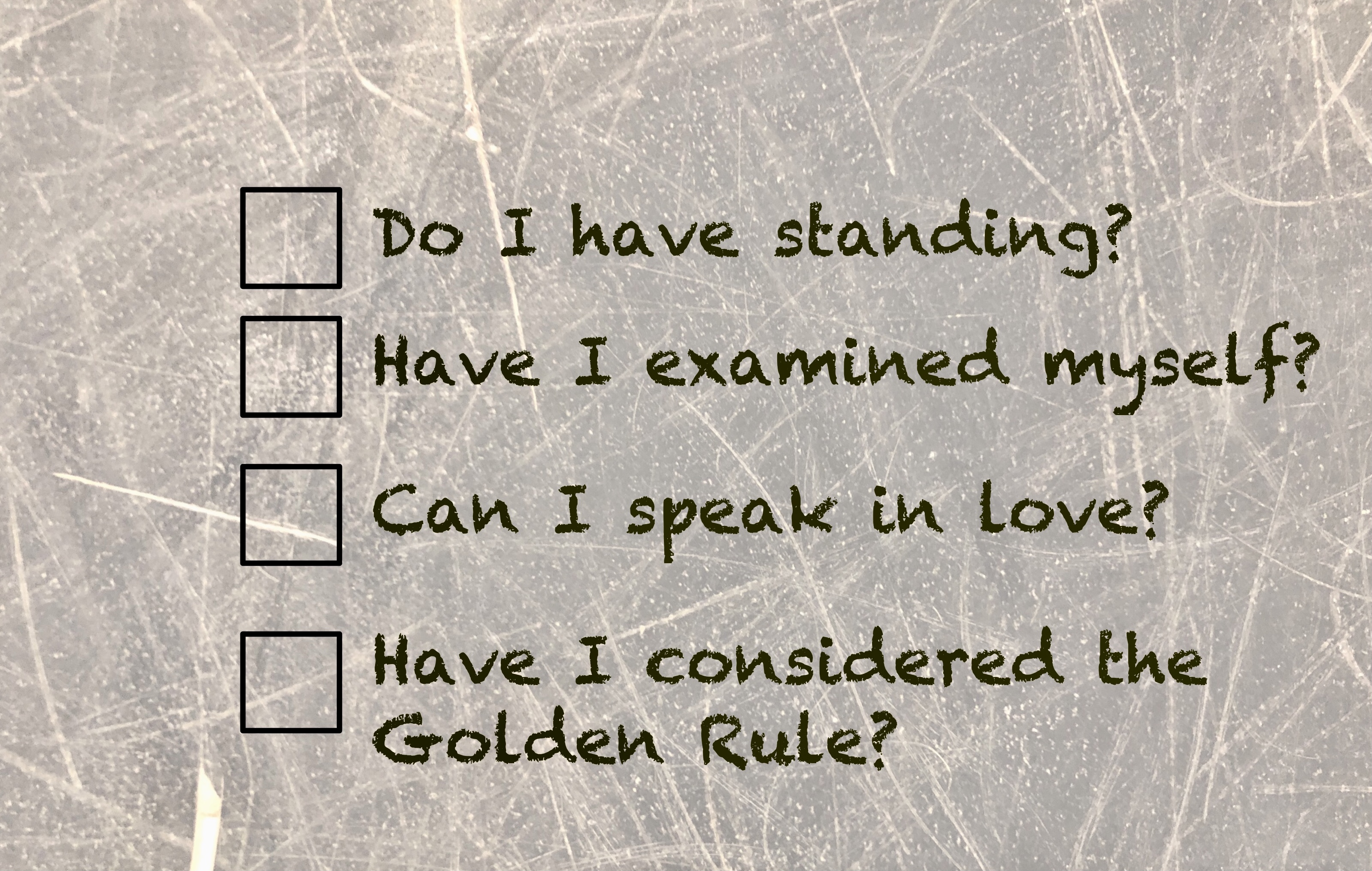
My checklist before speaking:

  1. Do I have standing? 
  2. Have I examined myself? 
  3. Can I speak truth in love (and not just air my opinion)? 
  4. Have I considered the Golden Rule? 

If I can answer “Yes” to all four questions, then speak; otherwise, it’s far more loving to remain silent. 

9 Quotes From “To The Work!”

D.L. Moody passionately and persuasively dismantles all of the hesitations Christians have to being active and outspoken about their relationship with Jesus. Check out my full book review by clicking here. 

“I have often said that if I had to convict men of sin I would have given up the work long ago. That is the work of the Holy Ghost. What we have to do is to scatter the good seed of the Word, and expect that God will bless it to the saving of men’s souls.” 

“One of the great obstacles in the way of God’s work today is this want of love among those who are the disciples of the Lord Jesus Christ. … To address men well they must be loved much.” 

“Those who have been greatly used of God in all ages have been men of courage. If we are full of faith we shall not be full of fear, distrusting God all the while. That is the trouble with the Church of Christ today—there are so many who are fearful, because they do not believe that God is going to use them. What we need is to have the courage that will compel us to move forward.” 

“If you cannot engage in any active work yourselves you can do a good deal by cheering on others.” 

“Let us not be discouraged, but let us use all these wonderful opportunities, and honor God by expecting great things. If we do we will not be disappointed. God is ready and willing to work, if we are ready and willing to let Him, and to be used by Him.” 

“A good many people are afraid of the word enthusiasm. Do you know what the word means? It means ‘In God.’ … People say that if we go on in that way many mistakes will be made. Probably there will. You never saw any boy learning a trade who did not make a good many mistakes. If you do not go to work because you are afraid of making mistakes, you will probably make one great mistake—the greatest mistake of your life—that of doing nothing. If we all do what we can, then a good deal will be accomplished.” 

“When God wanted to bring the children of Israel out of bondage, He did not send an army; He sent one solitary man. So in all ages God has used the weak things of the world to accomplish His purposes.” 

“If this world is going to be reached, I am convinced it must be done by men and women of average talent. After all there are comparatively few people in the world who have great talents. … I do not believe, either, that all God’s work is going to be done by ministers, and other officers in the Churches. This lost world will never be reached and brought back to loyalty to God, until the children of God wake up to the fact that they have a mission in the world.” 

“Philip was called away from a great work in Samaria to go and speak to one man in the desert. Christ’s great sermon on Regeneration was addressed to one man; and that wonderful discourse by our Lord on the Water of Life was spoken to one poor sinful woman. I pity those Christians who are not willing to speak to one soul; they are not fit for God’s service. We shall not accomplish much for God in the world, if we are not willing to speak to the ones and twos. … The Lord expects us to do what we can. We can all do something.”

Poetry Saturday—I Can Do Something

I may not do much with all my care,

But I surely may bless a few;
The loving Jesus will give to me
Some work of love to do;
I may wipe the tears from some weeping eyes,
I may bring the smile again
To a face that is weary and worn with care,
To a heart that is full of pain.

I may speak His name to the sorrowful,
As I journey by their side;
To the sinful and despairing ones
I may preach of the Crucified.
I may drop some little gentle word
In the midst of some scene of strife;
I may comfort the sick and the dying
With a thought of eternal life. —Marianne Farningham

Think On This…

Here’s the seed thought for this episode of Think On This

My t-shirt from To Write Love On Her Arms that says, “You make today better.”

Think on this: Am I being intentional about making other people’s today better? Am I expressing my gratitude to those who are making my today better?

Poetry Saturday—A Lost Opportunity

It came and went so quickly,
   My sluggish soul saw not
The Master stand and beckoning
   Toward one of humble lot.

And I rose not up to follow,
   So slow was I to see,
Till the help I might have given
   Forever fled from me.

And often I am grieving,
   And longing all in vain,
For a blessed opportunity
   That will not come again.

Dear Lord, give Thine anointing,
   And make mine eyes to see;
And make me swift in doing
   The work Thou givest to me. —L. Adda Nichols

10 Quotes From C.S. Lewis

Any day is a good day for some C.S. Lewis quotes! 

“To be ignorant and simple now—not to be able to meet enemies on their own ground—would be to throw down our weapons, and to betray our uneducated brethren who have, under God, no defense but us against the intellectual attacks of the heathen.” —C.S. Lewis 

“Good philosophy must exist, if for no other reason, because bad philosophy needs to be answered.” —C.S. Lewis 

“Do not waste time bothering whether you ‘love’ your neighbor; act as if you did.” —C.S. Lewis 

“If you do him a good turn, not to please God and obey the law of charity, but to show him what a fine forgiving chap you are, and to put him in your debt, and then sit down to wait for his ‘gratitude,’ you will probably be disappointed.” —C.S. Lewis 

“Good and evil both increase at compound interest. That is why the little decisions you and I make every day are of such infinite importance. The smallest good act today is the capture of a strategic point from which, a few months later, you may be able to go on to victories you never dreamed of. An apparently trivial indulgence in lust or anger today is the loss of a ridge or railway line or bridgehead from which the enemy may launch an attack otherwise impossible.” —C.S. Lewis 

“For many of us the great obstacle to charity lies not in our luxurious living or desire for more money, but in our fear—fear of insecurity.” —C.S. Lewis 

“The battle is between faith and reason on one side and emotion and imagination on the other.” —C.S. Lewis 

“Faith, is the art of holding on to things your reason has once accepted, in spite of your changing moods.” —C.S. Lewis 

“And as a matter of fact, if you examined a hundred people who had lost their faith in Christianity, I wonder how many of them would turn out to have been reasoned out of it by honest argument? Do not most people simply drift away?” —C.S. Lewis 

“A man who gives in to temptation after five minutes simply does not know what it would have been like an hour later. That is why bad people, in one sense, know very little about badness. They have lived a sheltered life by always giving in. We never find out the strength of the evil impulse inside us until we try to fight it: and Christ, because He was the only man who never yielded to temptation, is also the only man who knows to the full what temptation means—the only complete realist.” —C.S. Lewis

Love Securely

Jesus is journeying toward the Cross. On Thursday, it’s His last opportunity to impart His most important thoughts to His disciples. He is about to be arrested, and everything is about to go sideways for the disciples—“this isn’t the way this is supposed to happen!”—and Jesus needs to prepare them with the truth they will need to sustain them through this. 

“I have eagerly desired to eat this Passover with you before I suffer,” Jesus says (Luke 22:15).  

So Peter and John are sent to make arrangements for the Passover meal, but one of the arrangements that they overlooked was the host duties—washing the feet of each guest, anointing them with perfume, and giving them a welcoming kiss. 

As they are eating dinner, Jesus makes four important statements:

  1. “One of you will betray Me”
  2. “All of you will abandon Me”
  3. “I will rise again and restore you”
  4. “I have prayed for you”

These statements get the disciples arguing about who’s going to betray Jesus—“It’s not me, is it?!”—and over how faithful they are—“I would never abandon Him!” Ultimately they begin to argue over who is the greatest disciple among them. 

Jesus not only explains to them how the servant is greater than the master in God’s sight (Luke 22:24-27), but He then becomes the living example of that when He washes their feet (John 13:1-5, 12-17). 

Here’s an important principle—Only secure people can lovingly serve others. 

Insecure people don’t like to serve others because they feel they are being misused, or taken advantage of, or that others will look down on them. 

Jesus “knew” (John 13:1, 3) how much power His Father had given Him, making Him secure enough to serve. Security really means, “I am loved by God, and I know who I am in Him.”

Jesus served out of love: the profound love that He knew His Father had for Him. He gave His disciples the same mandate: Serve others out of love for Me and show the world that you are My disciples (see John 13:34-35).

When Jesus ate this last supper with His disciples, He instituted a remembrance celebration that we now call Communion. The root word is “commune” which the dictionary defines as a “conversation with profound intensity and intimacy.” 

This is the type of intimate relationship Jesus had with His Father, and this is the type of relationship He calls us to with Him. The broken bread of Communion reminds us that Jesus can make whole any broken area that would keep us from communing with Him. The cup of Communion reminds us that Jesus can instantly and fully forgive any sin that would keep us from communing with Him. 

Jesus set the example—we are to commune with our Heavenly Father through the way He made by His broken body and His shed blood. It’s out of this communion that we are empowered by His love, and then feel secure enough to serve others in love too. 

Am I Interruptible?

Time after time, Jesus was on His way someplace when someone “interrupted” Him. But was it really an interruption? Do we ever hear Jesus saying, “Not now, I’m busy with someone else”? No! 

Jesus said that every step He took during the day was directed by His Father, so Jesus is our example for dealing gracefully with any “interruptions” by those who need help.

If I pray as Jesus taught—“Your kingdom come, Your will be done on earth as it is in heaven”—then the people He sends my way are never interruptions. Instead, they are people who also need to experience God’s kingdom for themselves, and since God has allowed them to cross my path, that means that God entrusts me with the privilege of showing them God’s kingdom love.

If I am God’s servant, that means I must be interruptible by my Master. 

A servant doesn’t get up in the morning and sit around waiting for the master to tell him every single task to be done that day. The servant gets up and gets busy with what needs to be done. 

But neither does the servant put off the master’s request because he’s busy with a task. The servant doesn’t respond, “I’ll get to that request after I finish what I’m doing,” but instead the servant responds immediately to the master. The master’s requests have priority. 

So too with me. I get up and get busy, but my heart is listening for my Master to “interrupt” me (although it’s not truly an interruption!) with someone who is in need. 

May my heart always be ready to say an immediate “yes!” to anyone my Master sends across my path today. 

Unmistakable

…I tell you before it comes… (John 13:19)

Jesus made His passion, crucifixion, and resurrection unmistakable. 

He told us the Scriptures that He would fulfill (13:18). 

He told us the details of His crucifixion and resurrection (John 3:14).

And He received the “stamp of approval” from His Father (13:31-32).

When Jesus came into Jerusalem, was arrested by the religious leaders, condemned by Pilate, crucified by Roman soldiers, and resurrected three days after His death, no one should have been surprised because Jesus made it unmistakable! 

Jesus also told us how to make our belief in all He did for us unmistakable too—“By this will all know that you are My disciples, if you have love for one another (v. 35). 

Q—How unmistakeable is my gratitude for the Gift of Jesus? 

A—It is unmistakably seen in how I love others!