If God said to you, “Ask for whatever you want,” what would you ask for?
God did ask Solomon that very question in 1 Kings 3:5. Here’s how Solomon replied—
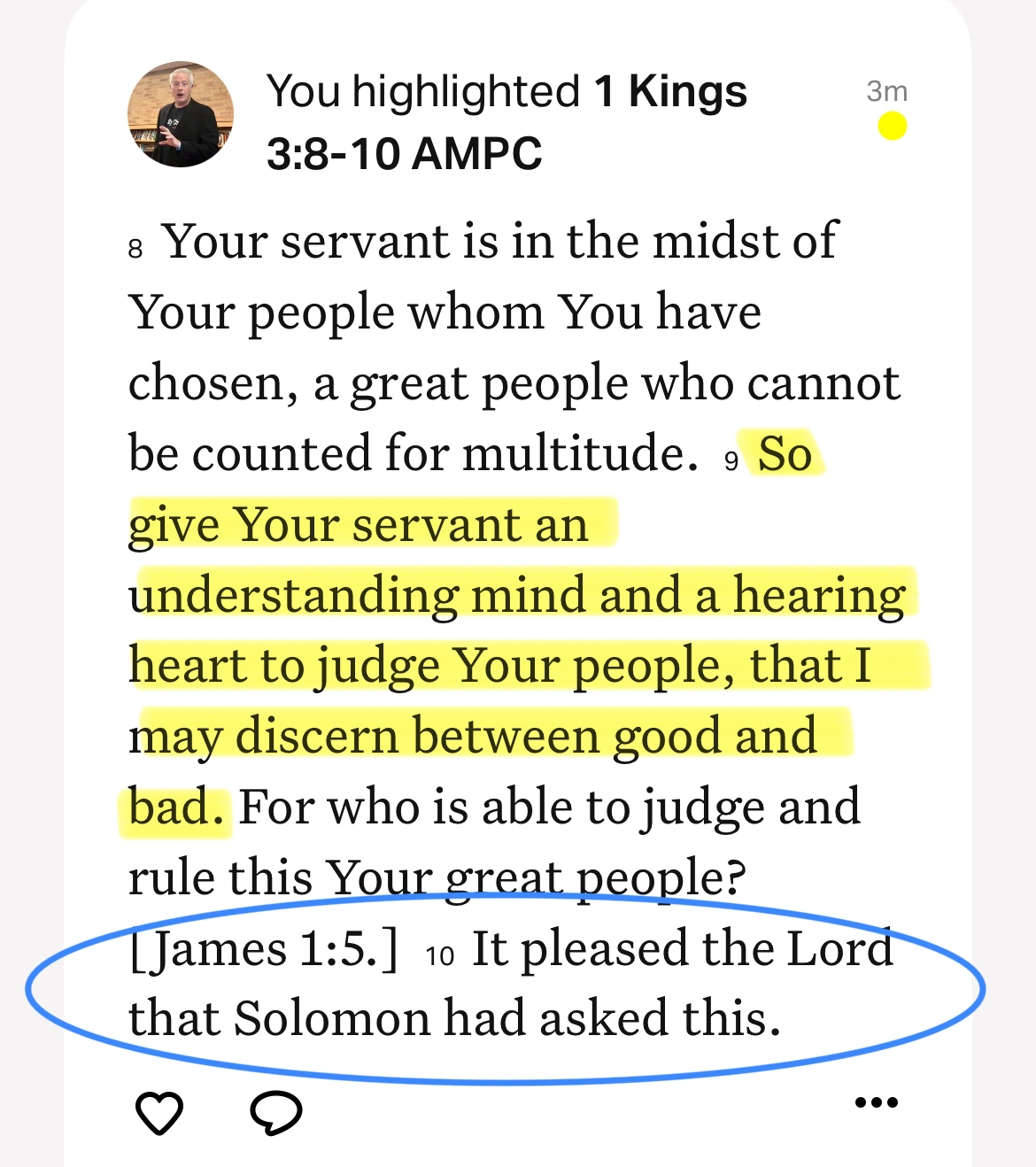
“Your servant is in the midst of Your people whom You have chosen, a great people who cannot be counted for multitude. So give Your servant an understanding mind and a hearing heart to judge Your people, that I may discern between good and bad. For who is able to judge and rule this Your great people?” (1 Kings 3:8-9 AMPC)
And how did God respond to this request? “It pleased the Lord that Solomon had asked this” (v. 10).
Solomon didn’t ask for things but for a greater intimacy with God—he wanted to know God’s mind. Sadly, we tend to reverse this, saying, “Because I have things, I bless God for them.”
Instead, our prayer should echo what Solomon prayed here in 1 Kings 3 and what Jesus taught us in His Sermon on the Mount: My desire is solely for Your glory and Your Kingdom (see Matthew 6:9-10, 33). When you pray this way, it will please that Lord that you had asked that!
Listen to the podcast of this post by clicking on the player below, and you can also subscribe on Apple, Spotify, or Audible.
We tend to be pretty self-centered creatures, filtering everything through our lens. This becomes especially true when we are going though a difficult time.
When I walked through a dark valley, I battled both physical and spiritual forces. People attacked me, but so did my own thoughts. “Why me?” and “I didn’t do anything to deserve this!” led to prayers like, “God, why didn’t You protect me from this? Why won’t you get me out of this?”
Do you hear a common theme? I didn’t while I was in the midst of the battle, but perhaps you hear it—“Why me? I didn’t do anything to deserve this! God, why didn’t You protect me from this? Why won’t You get me out of this?”
In his book Winning With People, John Maxwell shared ‘The Big Picture Principle’: “The entire population of the world, with one minor exception, is composed of others.”
On the other side of my dark valley I learned something about my time in the dark valley—I had grown:
I could help others diagnose depression
I could empathize with others
I could share helpful strategies to those who were struggling
I could intercede for them in prayer
My definition for intercede is to pray for people in a meaningful way because they are too beat up to pray for themselves.
In order to pray for them, I have to know what and how to pray. I can’t know what and how to pray unless I have firsthand experience. So perhaps my dark valley wasn’t for me, but for someone else (see Romans 8:28; 2 Corinthians 1:3-11).
I have talked and blogged so many times about the phrases “one another” and “each other” throughout Scripture. That means that Christian faith is best seen when we are with each other, supporting one another.
Jesus taught us to pray, “Our Father” (Matthew 6:9). The “our” signifies we are praying…
…with Jesus—John 14:13-14
…with other saints—Matthew 18:18-20
Even more than praying with us, Jesus intercedes for us (Hebrews 4:15-16). And Jesus gives us the Holy Spirit (John 14:26) who also intercedes for us and with us (Romans 8:26-27).
We join with our High Priest, helped by our Advocate, as we pray to our Heavenly Father on behalf of our brothers and sisters.
Listen to the interceding and expectation of a joyful answer that David writes in Psalm 20, and also notice how the saints are together—
May the LORD answer you when you are in distress; may the name of the God of Jacob protect you.May He send you help from the sanctuary and grant you support from Zion.May He remember all your sacrifices and accept your burnt offerings.May He give you the desire of your heart and make all your plans succeed.May we shout for joy over your victory and lift up our banners in the name of our God. May the LORD grant all your requests.Now this I know: The LORD gives victory to His anointed. He answers him from His heavenly sanctuary with the victorious power of His right hand.Some trust in chariots and some in horses, but we trust in the name of the LORD our God.They are brought to their knees and fall, but we rise up and stand firm.LORD, give victory to the king! Answer us when we call!
My cousin Dick Brogden wrote, “Jesus never intended us to suffer alone. We may not physically be able to cross oceans or deserts and sit in lonely cells with colleagues—but we are intended to traverse that distance spiritually and to bear the burdens of our brothers in prayer. Followers of Jesus under duress are empowered to bear unimaginable suffering when they know that they do not agonize alone.”
In your prayer time, I encourage you to ask the Spirit to show you lessons you have learned in your dark valleys, and then begin to intercede for your fellow brothers and sisters with the help you have already received.
Listen to the podcast of this post by clicking on the player below, and you can also subscribe on Apple, Spotify, or Audible.
Last week I asked you to recall a time that your children were asking you for something they really, really wanted. How many times did they ask? If you said, “No” to their first request, did they immediately stop asking? Probably not. And that’s good, because Jesus tells us to keep PUSHing (Luke 11:9-10).
Let’s recall the story Jesus told to illustrate the kind of importunity that God responds to. Jesus used the example of a friend going to his neighbor’s house with a request for bread. No matter how many times the neighbor said, “No,” the man continued to ask and knock (vv. 5-8). Jesus concluded by saying that the neighbor would eventually get us and give his friend “as much as he needs.”
That is the key word: needs vs. wants.
Jesus told us “your Father knows what you need, but He wants to give us so much more than what we are asking for—He wants to give us His Kingdom (Luke 12:30-32). A need is a necessity (Psalm 34:10 AMPC; Matthew 6:8), but wants are merely selfish desires (James 4:3).
Loving parents know the difference between needs and wants and therefore they know how to respond to the requests from their children. Jesus pointed out that if we “evil” parents know this, how much more does our all-wise, all-loving, all-knowing Heavenly Father know this (Luke 11:11-13)!
When my kids ask me for something—when they are asking, seeking, knocking—I want to give them the best. But sometimes the best thing means I have to say, “No.” I don’t give them candy for breakfast. I don’t let them drive a car when they’re 7 years old. I don’t give them responsibilities which they are unprepared to manage. They may want all of these things, and they may even enjoy these things for a fleeting moment. But they don’t need them and the end result could be dangerous or even disastrous!
Jesus says that we human parents even in our very limited wisdom know that giving our children their immediate wants may prevent them from receiving what they really need. My “No” may really mean a better “Yes,” if they will trust me.
Do you know a surefire way to determine if what you are PUSHing for is a want or a need? A temper tantrum! When we start throwing a fit, it probably means we are looking for a want to be supplied, not a need. Psalm 25:9 tells us that God loves to supply the needs of the humble who say, “Father, You know best.”
What if I changed “suffering” with “God’s loving ‘no’” in this passage—
Not only so, but we also glory in God’s loving “No,” because we know that God’s loving “No” produces perseverance4 perseverance, character; and character, hope. And hope does not put us to shame, because God’s love has been poured out into our hearts through the Holy Spirit, who has been given to us. (Romans 5:3-5)
Our hope in our heavenly Father’s best “Yes” is vital for our ongoing prayer live (Isaiah 30:18)!
Our all-wise, all-loving Father KNOWS what is best for us. But still, Jesus directs us to continue asking, seeking, and knocking. Keep PUSHing until His best “Yes” is given, found, and opened.
God’s loving “No” is only so that He can give you His best “Yes”!
Listen to the podcast of this post by clicking on the player below, and you can also subscribe on Apple, Spotify, or Audible.
Parents, I want you to think back to your children asking you for something they really wanted. How many times did they ask? How many different ways did they ask? What sort of strategies did they use? Did you ever sense any hesitation in them coming to you to make their request?
Do you have this firmly in mind? Good, because this is how Jesus explains prayer.
Jesus called God His Father, and when His disciples asked Him how to pray, Jesus instructed them to address God as “Father” (Luke 11:1-2).
Hindus don’t call God “father” but they flip it around by saying, “Father is like God” to teach children to respect their earthly fathers.
Buddhists don’t believe in a God that anyone can worship or even have a relationship.
Islam gives Allah 99 names, but not one of the names is “Father.”
Jewish rabbis don’t see how anyone other than Jewish people can even think of God as their Father, but even they don’t presume to address Him that way in their prayers.
And yet Jesus tells us to come to prayer to the Almighty Creator and Sustainer of the universe with, “Father.” There is intimacy in that title. There is an understanding of knowingness and trustworthiness in that title. There is an implied belief of perfect provision in that title.
We looked at Luke 11:9-10 previously, and we saw especially how the Amplified Bible brings out the idea of asking again and again and again. But is this what Jesus really meant for us to do? Don’t you feel a bit like a pest asking this way?
The disciples asked Jesus to teach them to pray (Luke 11:1-4), but then Jesus gave them an un-asked-for illustration to make His point (vv. 5-8).
The Greek word for “boldness” in v. 8 is translated “shameless persistence” or “sheer persistence” or “shameless audacity” in various biblical translations. In the Greek, it’s a unique word (anaideia) which means without shame.
The sleeping friend—although he was tired and the request for bread came at an inconvenient time—still wanted to honor his friend. Or more precisely, he wanted to preserve the honor of his friend.
There’s another Greek word (hypomone) that I would define as stick-to-it-iveness. Two great examples are Bartimaeus (Mark 10:46-52) and the Syrophoenician mother (Matthew 15:21-28).
In light the the story of the Good Samaritan in the previous chapter of Luke, I think this friend was practicing the Golden Rule: he wouldn’t want to lose standing in the community or be embarrassed by being an ill-equipped host, so he helped supply his neighbor.
“Give us each day our daily bread” (Luke 11:3) hallows God as our Father. Our Father is the Bread Supplier and He never wants His children forsaken or embarrassed—
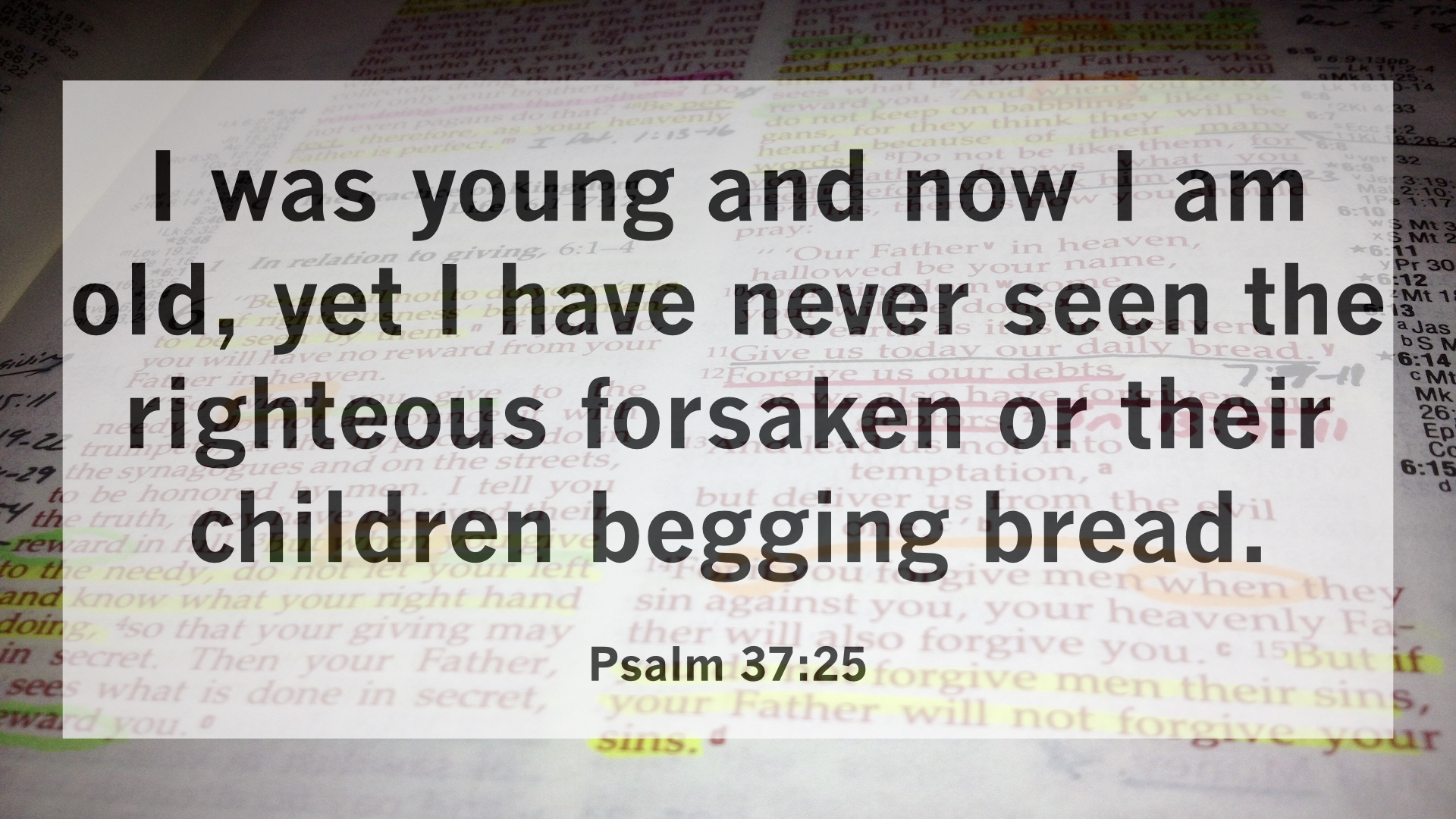
I was young and now I am old, yet I have never seen the righteous forsaken or their children begging bread. (Psalm 37:25)
The conclusion to the instructions Jesus gives us about prayer are continual asking, persistent seeking, and audacious knocking! P.U.S.H. = pray until something happens!
“Our giving depends much on the state of our minds at the moment. When depressed, we have no pleasure in giving; we either refuse, or we give merely to get quit of the applicant. Darkness of mind shrivels us up, makes us selfish, neglectful of others. When full of joy, giving seems our element—our joy overflows in this way; we cannot help giving; we delight in applications; we seek opportunities of giving. So with the blessed God. Being altogether happy, His delight is to give; His perfect blessedness flows out in giving. We can never come wrongly to such an infinitely happy Being.” —Horatius Bonar
Our importunate requests are opportunities for God to show His unequaled supply to others—to exalt His name. For that request, God will “get up and give you as much as you need” (Luke 11:8).
We are to keep on PUSHing for our Father’s “yes.”
Check out all of the other messages in this prayer series by clicking here.
When we pray the closing words of the prayer Jesus gave us—“For Yours is the kingdom, and the power, and the glory forever. Amen!”—we are both acknowledging God’s awesomeness and we are asking for our lives to display this reality.
“He who loves iniquity does not love his fellow man, for ‘he who loves iniquity does not love, but rather hates his own soul.’ And certainly he who does not love his own soul will in no way be capable of loving the soul of another.” —Aelred of Rievaulx (1109-1167)
Steven Lee shows us the biblical principles that God forms us through failure. One passage especially stood out to me because it is a central thought to both of my books. Lee writes, “God measures success according to faithfulness: ‘One who is faithful in a very little is also faithful in much’ (Luke 16:10). Do we strive for success as defined by God? Are we seeking to be faithful with all that he has entrusted to us—time, talents, and treasure? Or have we adopted the lying weights and measures of our world? Will our labors result in hearing the words ‘Well done, good and faithful servant’ (Matthew 25:23)? Put aside striving for the world’s facade of perfection.”
“The measure of who we are is what we do with what we have.” —Vince Lombardi
T.M. Moore teases us with this: “The most important question we can ask guides us in answering many other questions besides, questions such as, ‘Whom should I marry?’ and ‘How can I stop wasting time?’ and ‘What’s the best way to use my wealth?’’ Any question that helps us answer those and a myriad other questions that might arise during the day must be pretty important. Indeed, it must be the most important question any of us could ask.” What is that most important question? Check out his thought-provoking answer.
“Life is not a spectator sport. If you’re going to spend your whole life in the grandstand just watching what goes on, you’re wasting your life.” —Jackie Robinson
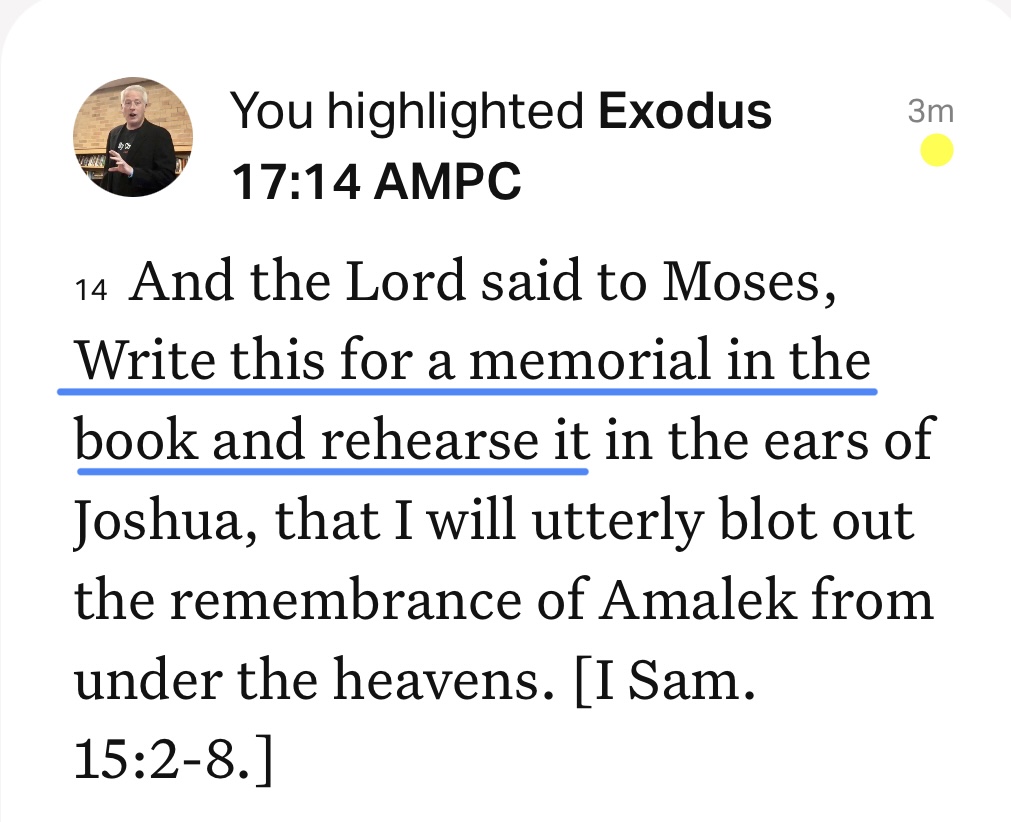
When God gives you a victory, write it down (see Exodus 17:14). When God gives you a promise, write it down. Then read it regularly so you don’t forget it. This will keep you grateful, it will keep you expectant, and it will keep you dependent on the victory-giving, promise-keeping God.
Listen to the podcast of this post by clicking on the player below, and you can also subscribe on Apple, Spotify, or Audible.
I take some time at the end of each calendar year for a quick recap of everything we have learned during this year at Calvary Assembly of God. I do this because I want to make sure we are all on the same page with each other before we move into a new year. And I also think it’s very important that we are continually reminded and reassured of what God has done for us. In our series on gratitude we talked about the dangers of forgetting to remember and re-tell the blessings of God. We see in the letters from the apostles both a re-telling of their own words, and reusing and amplifying the words of Jesus and other apostles.
You can click on the sermon series title to find a list of all of the sermons in that series. Clicking on those individual sermons will give you a short written recap of that message, and it will also give you the link to watch the video of the full sermon.
Kingdom Praying. Jesus made it clear time and time again that He came to reveal the Kingdom of God to us. He described what the Kingdom was like and told us that He came to be the means by which we could enter God’s Kingdom. He also told us how God’s children could access the power and privileges of our Heavenly Father through the means of prayer. He assured us with words like, “Do not be afraid, little flock, for your Father has been pleased to give you the Kingdom” (Luke 12:32). Jesus said quite simply that we had access to our Father through prayer. And then to make sure we didn’t miss out on this awesome privilege, He instructed us, “This, then, is how you should pray” (Matthew 6:8).
Jots and Tittles. As we get closer to the death and resurrection of Jesus, there are an increasing number of prophecies that are fulfilled in these events. Jesus appears to have been very attentive to making sure that each and every one of these prophecies were fulfilled to the smallest detail. Near the beginning of His public ministry, Jesus noted that not one iota—or “one jot or tittle” in the Old English vocabulary—of any of God’s promises would be left unfulfilled (Matthew 5:18). It’s amazing that Jesus so carefully attended to all of these, but it’s also important to ask ourselves what these fulfilled prophecies mean to us today.
Takin’ Him to the Streets. Just before Jesus ascended to Heaven, He told His followers that they would have the joyful responsibility of taking the good news of forgiveness and eternal life to all the highways and byways of every nation. Later on, Paul would get more specific about all of the groups to which he was taking the message of Jesus (see Luke 24:46-47; 1 Corinthians 9:20-22). That commission is still in effect for Christians today: We are to share the gospel with everyone—from easy street to skid row, from Wall Street to Main Street, and every street in between. The streets on which you live and work are different from the streets where I travel. In fact, all of us live on different streets, but everyone we meet on every street needs to hear about Jesus. In this new series of messages, we are going to learn how the Holy Spirit can help us be ready to take Jesus to those on each street where God sends us.
Ascending. Every year, Jews from around the world made four pilgrimages up to Jerusalem for various feasts and sacrifices. These journeys reminded them of God’s goodness as they went to the Temple to worship, and they helped refocus on God’s ways as they returned to their regular routines. Jerusalem is over 2500 feet above sea level, so the pilgrimage there was a physical workout as well as a spiritual workout. These workouts were beneficial for God’s people, preparing them to minister in their cities in the following months. The Book of Psalms contains 15 songs that these pilgrims would sing to and with each other as they traveled up to Jerusalem. These Psalms of Ascent are still instructive for Christians today.
Living in your Gift Zone. God created each and every human being uniquely. We all come in different shapes and sizes, but we all share one thing in common: He created each of us with a unique personality and a unique gift package. By unique, I truly mean that we are all one-of-a-kind creations that have never existed in all of history! Here’s another thing we all have in common: We usually live in a comfort zone that is far smaller than our gift zone. Living this way keeps us from soaring through life in the way that God intended. He wants each of us to know our gifts, and to use our gifts in a way that benefits our world and brings Him glory. It starts with believing that we are indeed gifted by our Creator. Then we must have the courage to step out of our comfort zone into the much larger gift zone God has given us.
Is that in the Bible? A meme that makes me chuckle every time I see it is a “quote” attributed to Abraham Lincoln in which he says, “The problem with quotes found on the internet is that they are often not true.” (Not to spoil the joke for you, but unless Lincoln knew how to time travel to the future, I don’t think he knew about the modern internet!). I love this meme because it captures something that so many people fall into: a quick acceptance of a statement without verifying its source or thinking through the implications of the statement’s truthfulness. In this series I think you may be surprised to discover just how many phrases we call biblical aren’t, and how many phrases there are that we never realized are actually in the Bible.
Be Thankful. It’s so easy to spot the negative things. It’s so easy to gripe about the bad stuff with others. It’s so easy to complain about what’s wrong with the world. But the Bible repeatedly calls the saints of God to rise above this downward pull of negativity. In fact, for those who have a relationship with their Heavenly Father, who call Jesus their Savior, and who call the Holy Spirit their Counselor, there is really only one way to live: Grateful!
Christ’s Advents. The word Advent means the appearing—something that bursts onto the scene. At this time of year we are actually thinking about TWO Advents. We look backward in gratitude to celebrate the first Advent of Jesus when He was born in a manger in Bethlehem. And then we look forward in joyful expectation to the second Advent of Jesus when He will return to earth again as King of kings. As Christians live in this time between the two Advents, our celebration and expectation should bring four noticeable attributes from our lives: hope, peace, joy, and love.
This next year promises to be another amazing time of learning and growing. If you live in northern Kent County and don’t have a home church, I would love for you to visit us!
“The world cares very little what you or I know, but it does care a great deal about what you or I do.” —Booker T. Washington
T.M. Moore is in the midst of sharing an eye-opening series of posts on what eternal life truly is. Here is a short snippet: “In Ephesians 1:15-23 Paul provides insight to how we may engage heavenly realities throughout our earthly and temporal sojourn. As he prayed for the Ephesians, so, we can believe, he would have prayed for us as well. But what did he pray? First, that God would give us His Spirit for ‘wisdom and revelation in the knowledge of Him’ (v. 17). The Spirit, we know, works with the revelation of God in Scripture to make us more like our Lord Jesus Christ (2 Corinthians 3:12-18). He uses the entire Bible to help us increase in our experience of eternal life. This is true for knowing more of our great salvation as well as for glimpsing more of our eternal life.”
“Comparison sabotages two relationships at the same time: your relationship with God, and your relationship with other people. You can’t fully love others when you’re jealous of them or trying to outperform them. And you can’t love God when you think maybe God has given you a bad deal.” —Practicing Gratitude reading plan on YouVersion
Recent studies have shown a connection between rising boredom rates and increasing digital media usage. The Axis Culture Translator reported, “Most of us (including our teens) reach for a digital device when we feel boredom creeping in. We might logically assume that the near-constant stimulation we receive from our devices would reduce our experience of boredom—but the truth might be the opposite. Analysis and discussion based on ten years’ worth of data suggests that while boredom might drive us towards digital media, it isn’t actually satisfied by it. Many users find themselves in a loop where the perceived solution to restlessness and boredom actually amplifies those uncomfortable feelings. In other words, the ‘thirst’ of boredom leads us to the ‘water’ of digital media, but the water is salty.”
Listen to the podcast of this post by clicking on the player below, and you can also subscribe on Apple, Spotify, or Audible.
God wants us to progress to the next level in our Christian walk, but we need to know what we’re ready for that. Just as a teacher in school prepares us for a test, administers the test, and then gives us the result of the test in order to promote us to the next level, so does our loving Heavenly Father.
Listen to the podcast of this post by clicking on the player below, and you can also subscribe on Apple, Spotify, or Audible.
Can we trust our Bibles? There are some things that skeptics point to that we need to be able to defend—even in this model prayer that we have been studying. We come to the last verse of this prayer, which many of you probably learned or heard as, “For Yours is the kingdom and the power and the glory forever. Amen.” Yet some Bibles have a footnote here that notes that this doxology is not seen in all biblical manuscripts.
We don’t have the autographs (original writings) but we have manuscripts (copied by a trained scribe from the autograph, and then copied from by yet another reliable scribe, and so forth). The oldest calfskin manuscript we have goes back to 1500 BC, and the oldest papyrus manuscript goes back to 2400 BC.
The scribes were incredibly talented and disciplined men. They became a recognized group called the Sopherim (scribes) in about 500 BC. By AD 100, the Talmudic scribes eclipsed them, and then the Masoretic scribes—the most stringent scribes of all—dominated from AD 500-900.
Let’s turn our attention first to the manuscripts that compromise what we call the Old Testament. What did Jesus—and others that lived in His time—call those 39 books of the Old Testament? They were called Scripture. Those books were not in doubt even before Jesus was on earth.
Dr. Peter Flint notes, “The biblical Dead Sea Scrolls are up to 1,250 years older than the traditional Hebrew Bible, the Masoretic text. We have been using a one-thousand-year-old manuscript to make our Bibles. We’ve now got scrolls going back to 250 BC. … Our conclusion is simply this—the scrolls confirm the accuracy of the biblical text by 99 percent.”
In the New Testament era, the disciples of Jesus went out in pairs. Their oral transmission of the news of Jesus and the quoting of Scripture was verified by their traveling partners. Even for those who happened to be by themselves (e.g. Philip in Samaria), there was always follow up by other church leaders.
So the New Testament epistles were written to verify the spoken words—James was the earliest (probably AD 45). The number of manuscripts we have of these New Testament words are simply astounding!
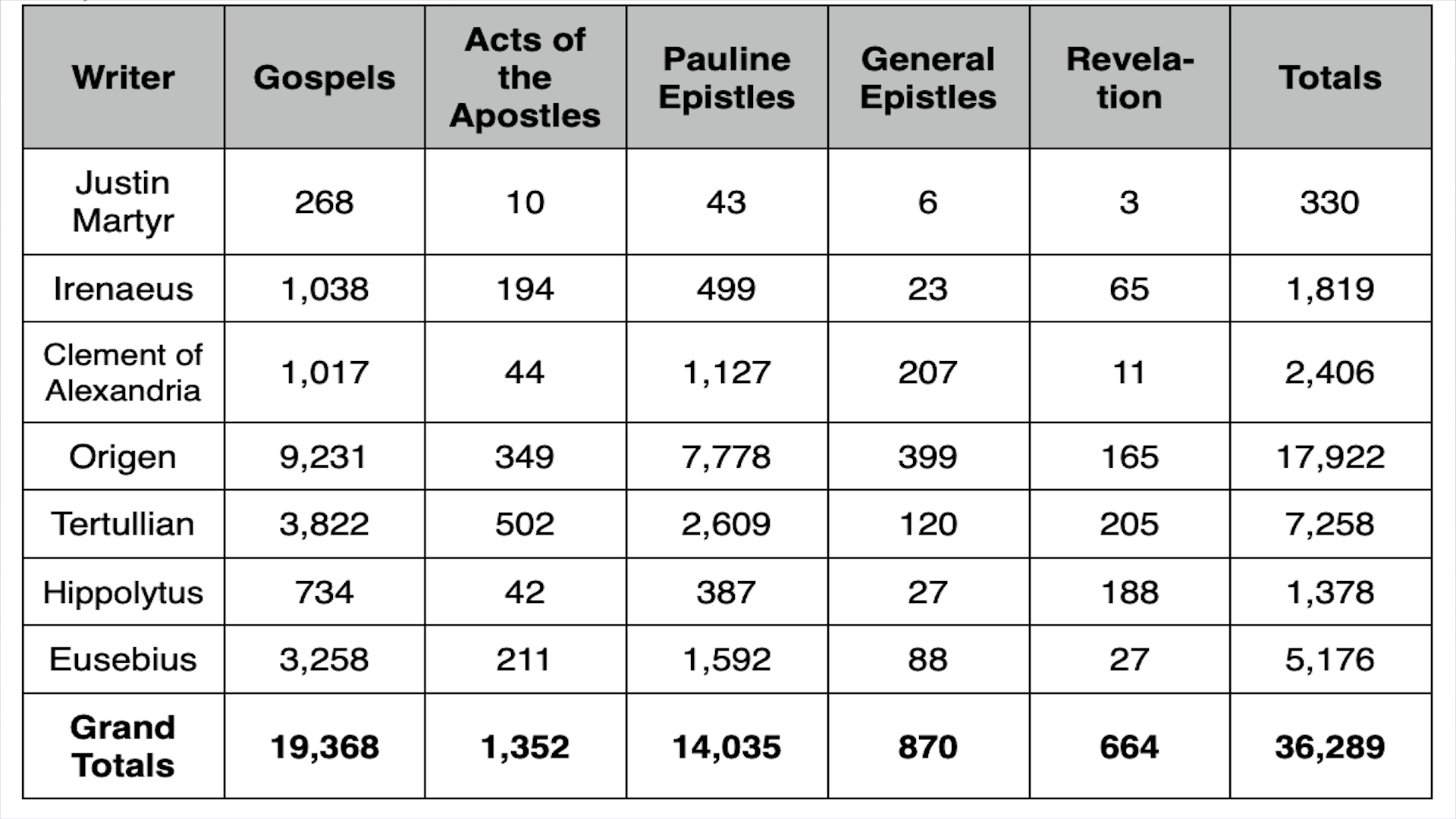
After the canon of the New Testament was completed, the church fathers quoted so much of the New Testament in their letters and books that we could completely reconstruct those 27 books just from their writings.
With this many manuscripts in existence, is it likely that there would variations in manuscripts? Yes. But none of the variations ever discovered have been fundamental enough to change anything in the meaning. Josh McDowell states, “Compared with other ancient writings, the Bible has more manuscript evidence to support it than the top ten pieces of classical literature combined.”
So how do we handle these places where scholarly footnotes tell us of a discrepancy in the existing manuscripts?
Get the context—does this fit with what is happening around it?
Is there corroboration—can we cross-reference it from elsewhere in the Bible?
In the conclusion of the powerful model prayer Jesus has given us, the closing words appear to be a doxology. But I think we can trust this because for three main reasons:
This doxology seems to come full circle with how the prayer begins in: Our Father in heaven, hallowed be Your name, Your kingdom come, Your will be done, on earth as it is in heaven (vv. 9-10).
These words are found almost verbatim in the words of David: Yours, Lord, is the greatness and the power and the glory and the majesty and the splendor, for everything in heaven and earth is Yours. Yours, Lord, is the kingdom; You are exalted as head over all (1 Chronicles 29:11).
As we have noted throughout this prayer series, the focus of this prayer is two-fold: It is both an acknowledgement of the awesome, praiseworthy glory of our God, and it is a petition for our lives to be empowered to help others see our glorious God and Savior for themselves.
For these reasons, this doxology, I believe, is an indispensable part of this majestic prayer.
Many of the examples Jesus used to tell us about the Kingdom of God seem like such small things. But those small beginnings have irresistible growth potential!Check out more thoughts in my series of posts called Kingdom Praying. I have lots of new content every week, which you can check out on my YouTube channel.
My wife is a school teacher and I also work quite a bit in our local schools. I think T.M. Moore is spot-on in his analysis of the breakdown in our current educational system: “This commitment to the Law and Word of God as foundational to the education of the young was everywhere practiced throughout the pre-revolutionary period in colonial America. It was unthinkable in the colonies that young people should be submitted to any instruction for any length of time without being taught the commandments and statutes of God, including the Gospel of Jesus Christ. Parents insisted on it, colonial and local statutes required it, and local school boards dutifully saw to it in all their schools.Since the middle of the previous century, assailed by specious invocations of ‘the separation of Church and State,’ educational policy in America has increasingly denied a place to God, His commandments, and His Word in the public-school curriculum. Generations of American children have grown up in a ‘disenchanted’ world (Charles Taylor), a world in which God, spiritual things, and the Law of God are deemed to be irrelevant if not oppressive, or at least a nuisance. The present crisis of morality, culture, and social upheaval is only the most visible consequence of that policy.”
David Mathis shared some thoughts about the healthy pace of ministry Jesus demonstrates for us. He said, “Let’s sit together at the feet of Jesus, and consider the pace and patterns of His life and ministry. He was not idle. Nor was He frenzied. From all we can tell from the Gospels, Jesus’s days were full. I think it would be fair to say He was busy, but He was not frantic. He lived to the full, and yet He did not seem to be in a hurry. In Jesus, we observe a human life with holy habits and patterns: rhythms of retreating from society and then reentering to do the work of ministry. Even as God Himself in human flesh, Jesus prioritized time away with His Father. He chose again and again, in His perfect wisdom and love, to give His first and best moments to seeking His Father’s face.“ These words resonate with me, because they are thoughts that I considered quite extensively for my book Shepherd Leadership.
I love reading stories like these that show how a relationship with Jesus utterly transforms a person’s life! “Opal W. Eubanks joined the Mississippi Highway Patrol during the race riots of 1964. A large, broad-shouldered white man, he relished the opportunity to strike fear in the hearts of African-Americans who were in trouble with the law. By his own admission, he was a foul-mouthed sinner who liked ‘rough stuff.’ A radical conversion to Christ in the early 1970s altered the course of Eubanks’ life, and his hardened heart became tender toward African-Americans in his rural community. He and his wife, Thelma, ultimately pioneered an Assemblies of God congregation consisting mostly of African-Americans, which they pastored for 21 years.”
The Greek word for “teaching” in Mark 9:31 means an ongoing dialogue. It’s an imperfect verb here because it is an activity that is never fully completed. Jesus wants us to abide with Him—to dialogue with Him—to continually learn from Him. The New Living Translation says it this way, ”For He wanted to spend more time with His disciples and teach them.” This is just as true for us today!
J. Warner Wallace addresses the claims that the Old Testament prophets actually foretold that Jesus would be the Messiah. I love considering the apologetics for the death and resurrection of Jesus Christ, and this video will become an added resource for me in the future.



 If God said to you, “Ask for whatever you want,” what would you ask for?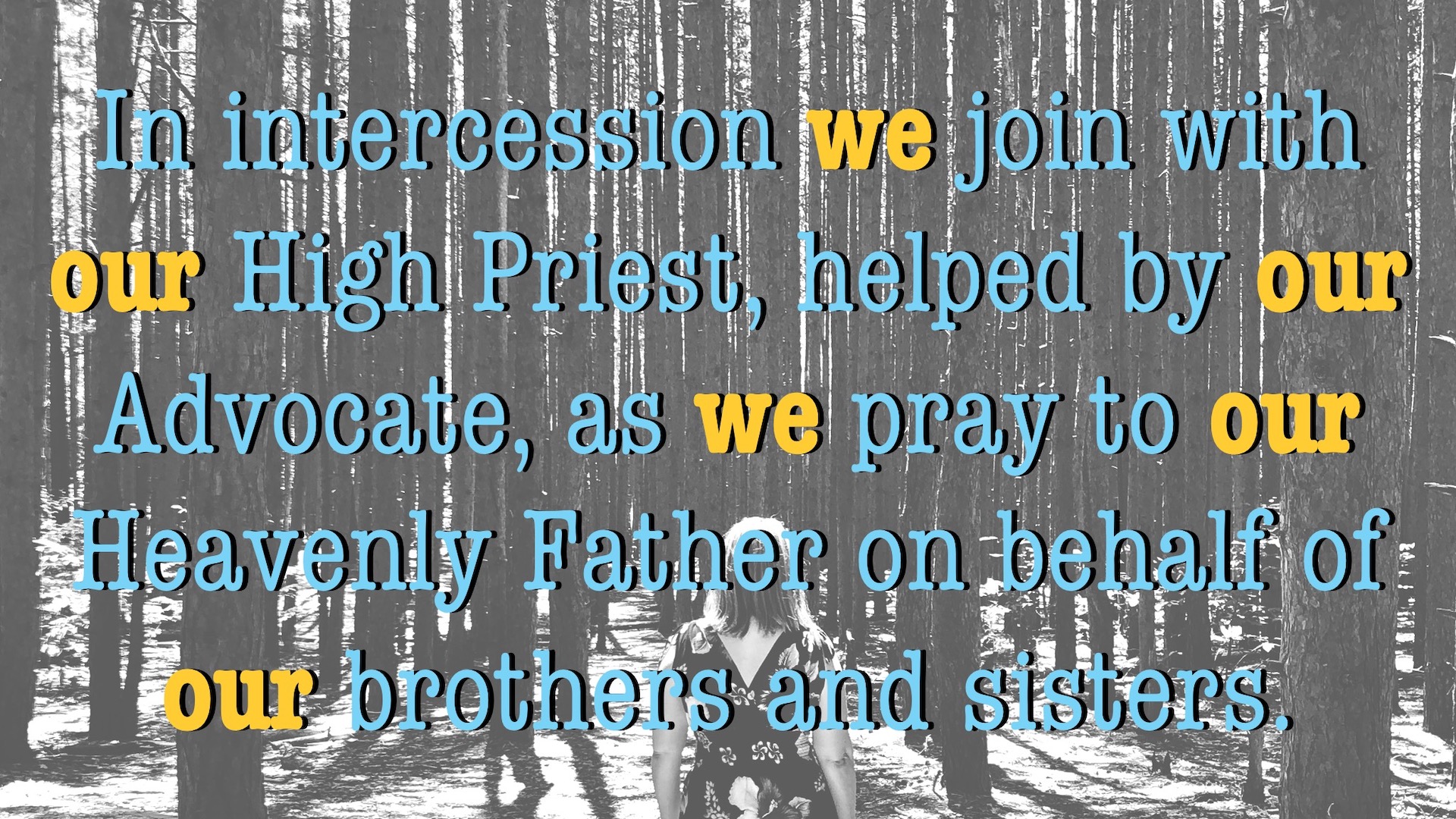






 Craig T. Owens