Learning From Mistakes

Listen to the podcast of this post by clicking on the player below, and you can also subscribe on AppleSpotify, or Audible. 

Have you made any mistakes lately? Let’s talk about what we do next on this episode of The Podcast. 

The Scriptures I referenced in this video are Psalm 25:4, 8, 10; James 1:5; Jeremiah 33:3. 

I also referenced my blog posts Self-Talk During Fearful Times and Refined By Fire. 

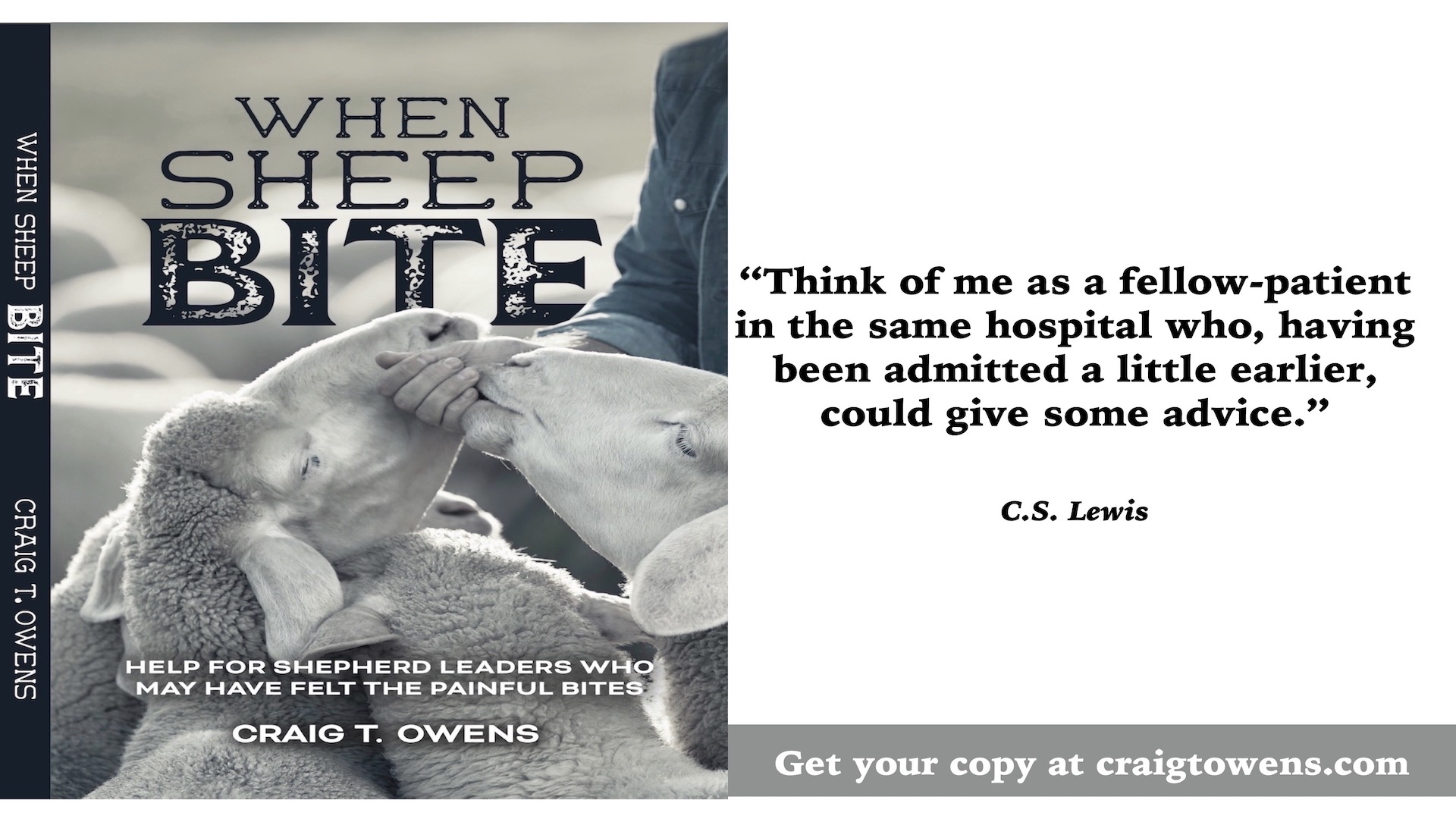
My book When Sheep Bite is all about recovering after difficulties—whether they were created by your mistakes or someone else’s mistakes. In the Introduction to my book I wrote: 

     I want to give you what I wanted when this happened to me: empathy, insight, a helpful perspective, and a manual of help that God has provided in the Bible. I don’t want to try to one-up your story of pain, because I’m confident that no one could truly know how deeply you’ve been hurt. But I do want to give you some assurance that I know what I’m talking about. … 

     Your pain and your circumstances are unique. Your pain is real, and it is incomparable to anyone el􏰃se’s pain. But the biblical principles that God revealed to me—􏰄those things that helped me heal and the thoughts I want to share with you􏰄—are applicable for any shepherd. These tried-and-true principles can help you not just survive this pain but thrive in spite of this pain. I would say to you something that C.S. Lewis wrote, “Think of me as a fellow-patient in the same hospital who, having been admitted a little earlier, could give some ad􏰋vice.” 

Check out When Sheep Bite for yourself. 

►► Would you please prayerfully consider supporting this ministry? My Patreon supporters get behind-the-scenes access to exclusive materials. ◀︎◀︎
Links & Quotes

Don’t let fear keep you standing still. Take a swing and give yourself or your coach something to tweak. Check out this full conversation hereI have lots of new content every week, which you can check out on my YouTube channel.

“Our human minds cannot comprehend the immensity of [Christ’s] task and His sacrifice. We simply know that it was to save us, and that Jesus’ suffering is the most blessed influence the world has ever known.” —Dr. Henry Halley, Halley’s Study Bible 

The Hill, though high, I covet to ascend,
The Difficulty will not me offend;
For I perceive the Way to life lies here.
Come, pluck up Heart, let’s neither faint nor fear;
Better, though difficult, the Right Way to go,
Than wrong, though easy, where the End is Woe. —Christian in John Bunyan’s The Pilgrim’s Progress 

“Nearly half the Law of God is devoted to directing God’s people in how to worship Him. And while the specific practices of that portion of God’s Law have been replaced (Hebrews 7:11-18), the emphasis on worship and the idea that worship and life are related remains. The more faithful we are in worshiping the Lord the more we will love our neighbors with the justice His Law prescribes.” —T.M. Moore

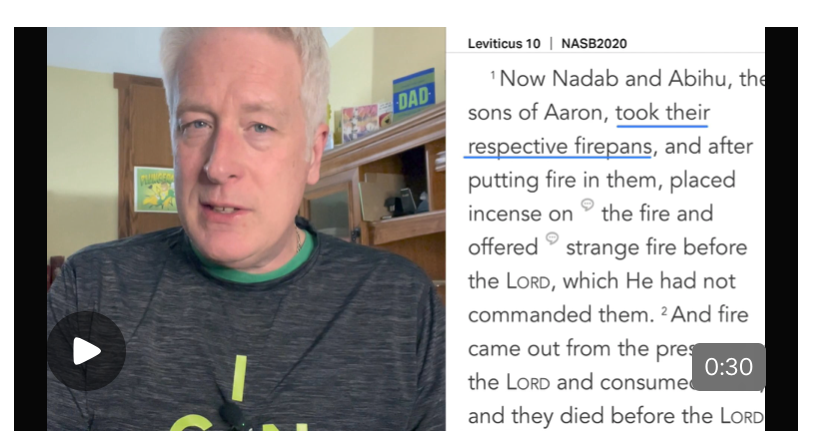
The deaths of Nadab and Abihu is a tragic story, but I think there are some important leadership insights to be gleaned from it. I shared an exclusive video with my Patreon supporters. Will you prayerfully consider joining?

How God Uses Pain

Listen to the podcast of this post by clicking on the player below, and you can also subscribe on AppleSpotify, or Audible. 

Romans 8:28 assures us that God uses everything for His glory. Even our pain. Here is when I learned this painful but precious truth.

On the Leading From Alignment podcast, John Opalewski asked me about lessons I have learned from painful experiences.

►► Would you please prayerfully consider supporting this ministry? My Patreon supporters get behind-the-scenes access to exclusive materials. Like this recent post where I shared a map and an app to help with your Bible study time. ◀︎◀︎

The Craig And Greg Show: The Leadership Lessons Of “Sage Advice”

Listen to the audio-only version of this podcast by clicking on the player below, or scroll down to watch the video.

On this episode, we are celebrating Greg! His new book Sage Advice has just been released, and everyone at Maximize Leadership is incredibly excited for you to be able to finally get your hands on the finished product. In this episode, Greg and I discuss the new book, and talk about how each chapter pairs a story from Greg’s childhood with a helpful leadership lesson.

  • [0:50] I encouraged Greg to write this book. 
  • [1:49] Each chapter combines a story from Greg’s life, a helpful leadership lesson, and an interview with a modern-day leader.
  • [3:50] How did Greg find the leadership lessons?
  • [6:00] A chapter that I especially relate to has to do with toilets! (It is another reminder of Plungerman!)
  • [9:06] What if you don’t have parents and grandparents that could give you sage advice? Where would you go to get wisdom?
  • [11:37] There are more people out there that want to invest in both emerging and seasoned leaders than most people think.
  • [13:58] We can really trust mentors who have a “limp.”
  • [15:27] Every chapter in Sage Advice is a stand-alone leadership lesson.
  • [16:08] I share my favorite chapter in this book.
  • [17:09] Greg shares a great tip for all leaders who are readers.
  • [18:02] What does a girl in a red bikini have to do with leadership?
  • [20:10] You can get an autographed copy of Sage Advice here

Check out my totally(!) unbiased book review of Sage Advice here.

Check out this episode and subscribe on YouTube so you can watch all of the upcoming episodes. You can also listen to our podcast on Spotify and Apple.

The Craig And Greg Show: Toughen Up, Buttercup

Listen to the audio-only version of this podcast by clicking on the player below, or scroll down to watch the video.

Recently Greg got a call from an educational institute asking him for advice on how to help their athletes “toughen up.” Unfortunately, they’re not alone, it seems like resilience is in increasingly shorter supply across the board these days. As a leader, it is your job to help instill grit into your team. Not tearing them down, but showing them that you view them with more potential.

  • [0:15] It’s time to toughen up, Buttercup! 
  • [2:54] We learn the best leadership lessons from the toughest times.
  • [4:17] Greg shares an example from coaching t-ball that applies to all our leadership roles.
  • [7:28] The temporary pain can protect us against the pain that would have derailed our leadership.
  • [8:35] A college contacted Greg about why their athletes are lacking resilience.
  • [10:12] Greg shares an insightful quote about struggling through a problem to achieve success.
  • [12:07] We define the leadership culture that will serve us and our teams best.
  • [13:34] We discuss an example from Greg’s NFL experience.
  • [14:56] Resilience can be hard to teach, but we still need to keep trying.
  • [17:54] Data from the Mayo Clinic that encourages us to develop grit.
  • [19:34] What happens to reach that have teammates who don’t show stick-to-it-iveness?
  • [21:04] A leadership separator is action over feelings.
  • [24:00] The wrong and right ways to handle disappointments.
  • [25:53] We can help coach you to bring out the resilience in yourself and your team.

Check out this episode and subscribe on YouTube so you can watch all of the upcoming episodes. You can also listen to our podcast on Spotify and Apple.

Don’t Dwell On The “What Ifs”

Listen to the podcast of this post by clicking on the player below, and you can also subscribe on AppleSpotify, or Audible. 

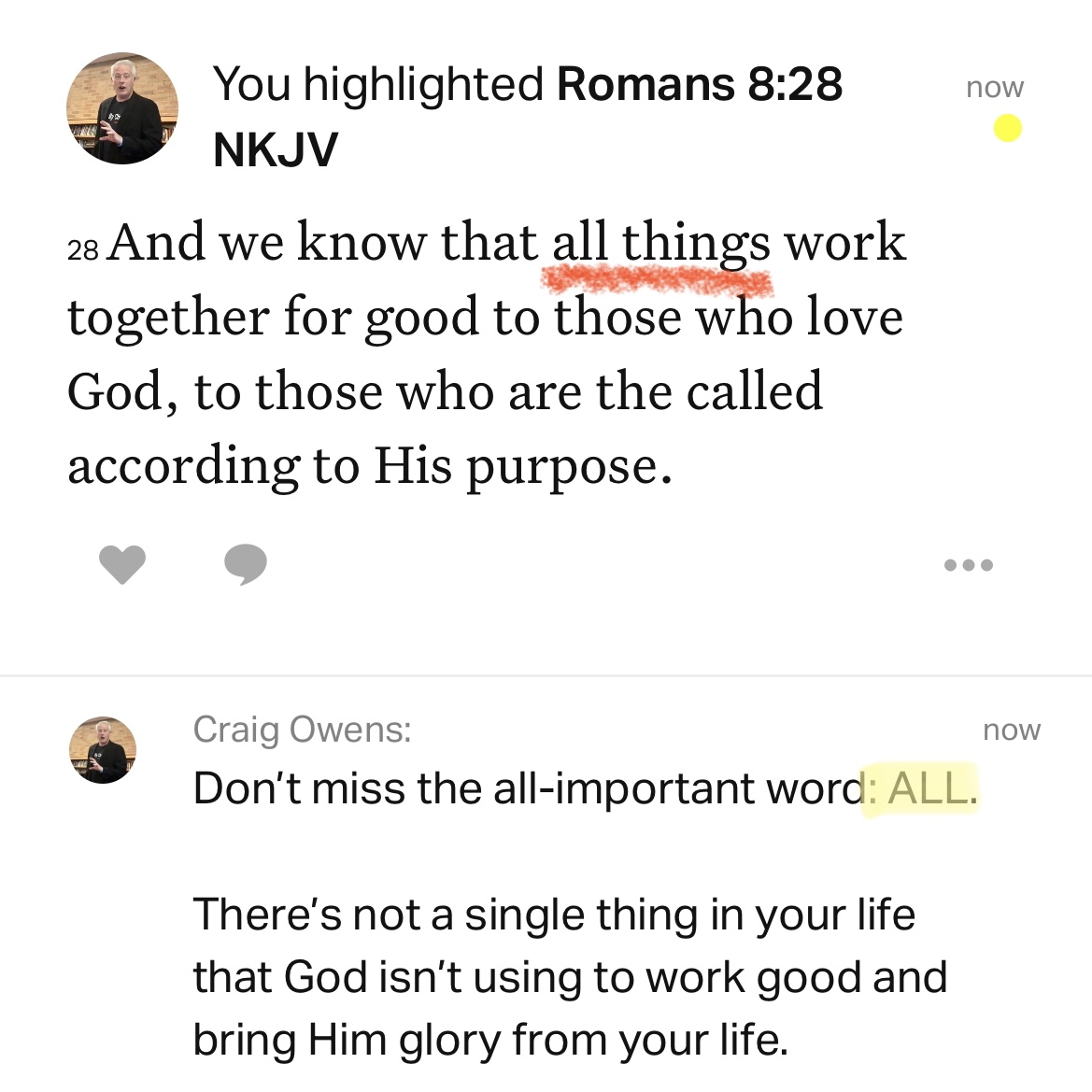
Romans 8:28 has a small but extremely powerful word in it: ALL. 

“And we know that ALL things work together for good to those who love God, to those who are called according to His purpose.” 

The verb tense here would probably be more accurate to say “are working.” God never wastes an experience, but He is using ALL those things to prepare you for the next assignment He has for you. 

Check out this brief clip from a training time I was able to share with some young ministry interns. 

Don’t dwell on the “what ifs” but let’s remind ourselves that God is sovereignly in control. Let’s learn to take God at His word—He IS WORKING ALL OF THOSE EXPERIENCES together for your good and for His glory.

►► Would you please prayerfully consider supporting this ministry? My Patreon supporters get behind-the-scenes access to exclusive materials. ◀︎◀︎

5 Truisms From Psalm 62

Listen to the podcast of this post by clicking on the player below, and you can also subscribe on Apple or Spotify.

When I see words like truly (3 times), surely (2 times), and yes (1 time) occurring so frequently in a rather short psalm, it catches my attention. Combined with the call for a Selah pause another two times in this twelve-verse psalm, and this is clearly a chapter that we should read slowly and deliberately. 

Because of these words truly and surely, I find five truisms that David makes clear to us, and I also find that they are linked together in a beautiful circular chain. 

Truism #1—God keeps me secure. He alone is my source of security (vv. 1-2). 

Truism #2—Evil people are envious of a righteous person’s secure position and will try to pull them down (vv. 3-4). When this happens I need to take a Selah pause to remember Who holds me secure. 

Truism #3—These attacks by evil people do not put my security in jeopardy, but instead it gives me a been-there-done-that testimony to share with others (vv. 5-8). Again, I need to Selah to remember that my challenges are often for the benefit of others as much as they are for my strengthening. 

Truism #4—Poor people are not excluded from God’s help, and rich people are not above God’s help (vv. 9-10). God sees every human being as infinitely valuable. 

Truism #5—God is both All-Loving and All-Powerful. He gets the final word on both judgment and reward (vv. 11-12). This fifth truism should refuel my understanding of the first truism—that God holds me securely—which continues my confident journey through this chain of beautiful truisms all over again. 

Friends, I urge you to go slowly through your personal Bible reading time. Pray for the Holy Spirit’s illumination before you begin reading, and then watch to see how He will point out to you patterns, repeated words, and other insights that will allow you to apply God’s Word to your daily life.

►► Would you please prayerfully consider supporting this ministry? ◀︎◀︎

Confessions Of A Dying Man

In our justice system, rarely will a judge allow hearsay testimony to be introduced in court. But there is one notable exception: a dying declaration. 

A dying declaration is the statement of a mortally injured person who is aware he or she is about to die. This statement is admissible testimony in court on the theory that a dying person has no reason not to tell the truth. 

Jesus was nailed to a Cross. Mortally injured, unable to escape, He had no reason to lie. In His dying moments, struggling to get enough air in His lungs to be able to speak, Jesus choked out seven statements that still have a profound impact on us today. 

Here are the confessions of Jesus we have discussed:

Discovering True Friends

Last week I shared that a mark of a maturing saint is one who when he realizes he is in a trough begins to praise God in anticipation of the blessings which are coming! I believe a keyword in this statement is realizes. Once we realize that we are in a trough, what will help us turn our mourning into praise? In a word: meditation. 

Notice Asaph’s words at the beginning of Psalm 77. Twice he says he “cried out” to God. This literally means that he called aloud, not caring who heard him. It wasn’t a whimper, but Asaph said he was “distressed.” As soon as he realized the distressed state he was in, notice the words of meditation in the next four verses: 

  • remembered (2x) 
  • mused (2x) 
  • thought 
  • inquired 

Asaph also began to ask himself questions, all of which have the obvious answer “NO”:

  • Will the Lord reject me forever? NO! 
  • Will He never show His favor again? NO!
  • Has His unfailing love vanished forever? NO!
  • Has His promise failed for all time? NO! 
  • Has God forgotten to be merciful? NO! 
  • Has He in anger withheld His compassion? NO! 

Again, Asaph meditates (notice the words thought, remember, meditate, and consider once again in the next three verses). His conclusion leads him not to self-pity, but to praising God.

Asaph taught us that when we get our eyes off ourselves we can see what God is doing in us, around us, and through us. 

One lesson I learned in a very dark night time of my life: Who my true friends are. When all my “fans” stopped cheering and started jeering, I ended up in a very dark place. But as soon as I realized the valley I was in and began to meditate on God’s presence even in this dark place, I began to see what was happening around me. One of the things I saw were two men who stood up for me against all the foes attacking me. They stepped in when all my “fans” stepped away. 

The apostle Paul had the same realization in the dark night of his Roman prison cell. He stated, “at my first defense no one came to my support.” But he also saw those who stood by his side: Luke, Timothy, and Mark.

Dark times can quickly lead us to self-pity UNLESS we will realize we are in a dark place and begin to meditate on all that God says in His Word about His faithfulness. Once we get our eyes off ourselves and onto Him, we will begin to see the lessons God is teaching and the amazing things He is accomplishing. 

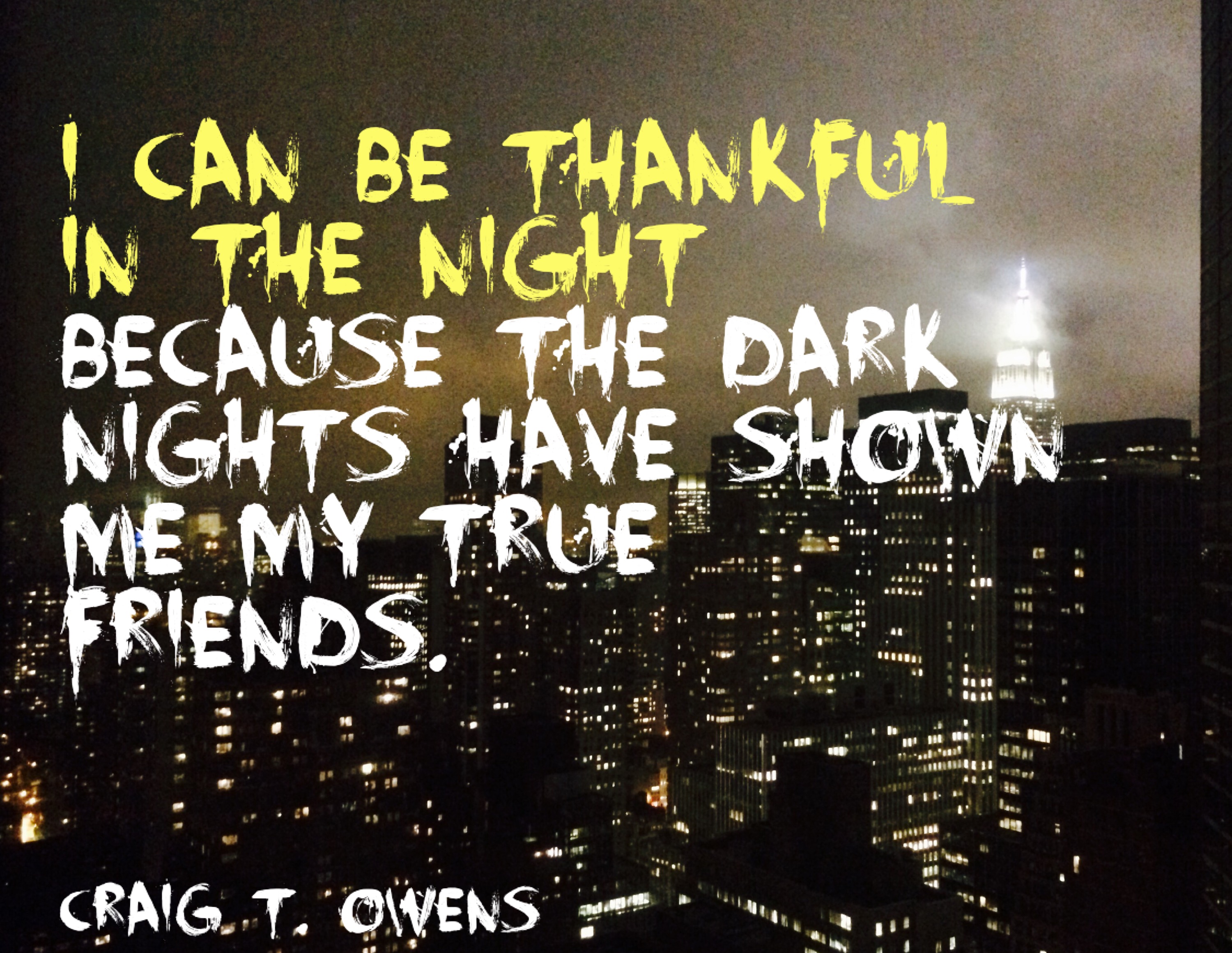
I can be thankful IN the night because the dark nights have shown me my true friends. 

If you’ve missed any of the messages in this series, you can find them all by clicking here. 

Praising God In The Troughs

Some people mistakenly think that the maturity of a Christian is a steady climb, and anything short of that is not God-honoring. They feel the graph has to always be moving up and to the right. In reality—if we zoom in—we will see lots of peaks and troughs that are in the climb. 

For instance, we read the worship leader of Psalm 42 saying, “By day the Lord directs His love, at night His song is with me—a prayer to the God of my life,” and we think, “Yeah, that’s what I expect from a saintly psalmist!” 

But let’s get the context. In the opening verses, this same worship leader talks about his profound thirst, his tears, and the taunts of his enemies. Twice in this psalm, he laments, “Why are you so downcast, O my soul? Why so disturbed within me?” 

Many people have gone through what has been called “the dark night of the soul.” I doubt anyone has ever given thanks because of those dark times, but they have learned to give thanks during those dark times.

Consider David’s beautiful words in Psalm 23. He points out that the Good Shepherd leads us into green pastures AND into dark valleys, beside quiet waters AND into the presence of enemies. 

But notice this: the Shepherd of our soul provides what we need in both daytime AND nighttime. He pours out blessings in the presence of our enemies, and as my grandfather wrote in the margin of his Bible next to verse 4, “Where there is shadow there must be light.” 

Consider the example of Paul who wrote to the Philippians, “Rejoice in the Lord always. I will say it again: Rejoice!” (4:4). He wrote this to the church that was birthed by Paul’s miraculous deliverance from prison, while Paul and Silas were doing just that: Praying and singing hymns to God! 

In The Screwtape Letters, C.S. Lewis gives us insight into how the demons view the temptation of Christians. Uncle Screwtape wrote to his nephew, “It may surprise you to learn that in God’s efforts to get permanent possession of a soul, He relies on the troughs even more than on the peaks; some of His special favorites have gone through longer and deeper troughs than anyone else. … It is during such trough periods, much more than during the peak periods, that the human is growing into the sort of creature He wants it to be. Hence the prayers offered in the state of dryness are those which please Him best.” 

A mark of a maturing saint is one who when he realizes he is in a trough begins to praise God in anticipation of the blessings which are coming! 

Don’t feel like you need to praise God FOR your troughs, but you can and should praise Him BECAUSE of His presence even in your driest, darkest trough. God is doing something in this trough time that He could accomplish in no other way. As David said, our Good Shepherd leads us in both sunlit and dark paths “for His name’s sake”—He will be glorified and you will be rewarded! 

Be sure to follow along on this series Thankful In The Night.