Thursdays With Spurgeon—Aids Of Self-Judgment

This is a weekly series with things I’m reading and pondering from Charles Spurgeon. You can read the original seed thought here, or type “Thursdays With Spurgeon” in the search box to read more entries.

Listen to the podcast of this post by clicking on the player below, and you can also subscribe on AppleSpotify, or Audible. 

Aids Of Self-Judgment

My soul is consumed with longing for Your laws at all times. (Psalm 119:20) 

     Spiritual desires are the shadows of coming blessings. What God intends to give us, He first sets us longing for. Therefore, prayer is wonderfully effective because it is the embodiment of a longing that is inspired by God because He intends to bestow the blessing prayed for! What are your longings, then, my hearer? Do you long to be holy? The Lord will make you holy! Do you long to conquer sin? You will overcome it by faith in Jesus! Are you pining after fellowship with Christ? He will come and make His abode with you! Does your soul thirst, yes, even pant after God as the hart for the water brooks? Then you will be filled with all His fulness…. 

     I say not that it is so with all human wishes, for ‘the sluggard desires and has nothing’ [Proverbs 13:4] and many a man has such evil cravings within his heart that it were contrary to the purity of God for Him to grant them. But where there are intense, heartbreaking earnings of a holy order, depend upon it, they are tokens of good things to come! 

     Where the grace of God reigns in the soul, it makes a man become a stranger among his fellows…. Worldly men care nothing for the judgments of God. No, they care nothing for God Himself! But when a man becomes born anew, a citizen of heaven, there grows up within his spirit a spiritual appetite of which he had felt nothing before—and he longs after God and His Holy Word. See to it, brothers and sisters, whether your souls cry out for God, for the living God, for again I say, by your longings you may test yourselves—by your heart’s desires you may forecast the future—and by your hungering and thirsting you may judge whether you are men of this world or citizens of the world to come. With such aids to self-judgment, no man ought to remain in doubt as to his spiritual condition and eternal prospects.

From Holy Longings

I am currently teaching a series of lessons called Craving. We are learning in these sermons that God created our souls to long intensely, to have cravings. But we go astray when what we crave are things that will merely last during this world. 

John told us, “This world is fading away, along with everything that people crave. But anyone who does what pleases God will live forever” (1 John 2:17 NLT). So by its very definition, worldly things will never satisfy our cravings because the world is temporary. Only an eternal God can give us eternal satisfaction. 

As Spurgeon teaches us here, examining our longings is the best aid of self-judgment and will help us determine our future. Craving God’s presence will bring God’s blessing and His eternal fulfillment of our cravings. Craving anything else will lead to frustration and eternal disappointment. 

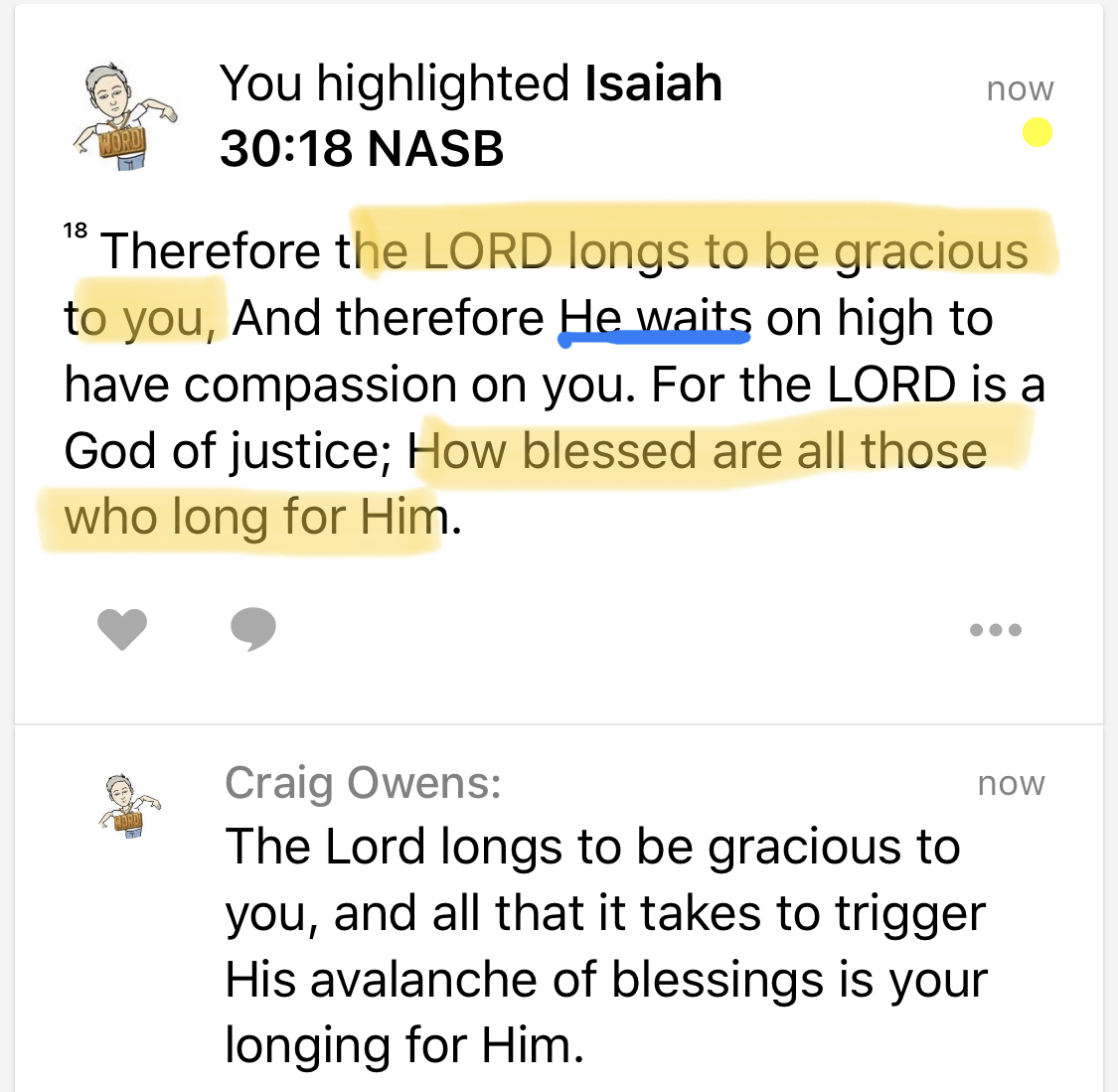
God longs to bless us (Isaiah 30:18) as long as we are craving Him!

►► Would you please prayerfully consider supporting this ministry? My Patreon supporters get behind-the-scenes access to exclusive materials. ◀︎◀︎

Created To Crave God

Listen to the podcast of this post by clicking on the player below, and you can also subscribe on AppleSpotify, or Audible. 

I was playing golf with a pastor and a missionary when the starter asked if a single player could join us to make a foursome. We happily agreed. About 4-5 holes into our game, our guest asked what we did. My pastor friend started out, “I’m a pastor, and this guy is a missionary, and—” 

Our guest interrupted and blurted out, “You guys are Christians?! I’ve never had so much fun! I always heard Christians were boring.” 

When did it come about that people thought of Christians as boring—or even worse, as sourpusses and killjoys? Sadly, too many Christians have helped cement this idea in people’s minds. I think this is largely because those Christians are misinformed and frustrated. This frustration, I believe, comes from the mistaken idea that Christians are supposed to squelch any urges or cravings that we have.  

But check out this Q&A from the Westminster Catechism—

Q: What is the chief end of man? 

A: To glorify God and to enjoy Him forever. 

Glorifying God is supposed to result in enjoyment—enjoying both God’s presence and the life He has given us. We are created to crave the fuel of His Spirit that satisfies and energizes us. 

Just as your car would at best under-perform if you attempted to run it with anything else but gasoline, so our lives will under-perform and feel like drudgery if we are trying to fuel our cravings with anything other than God. 

The dictionary defines “craving” as a great or eager desire, or a yearning. But I believe the Bible defines God-honoring craving as the longing for an intimate relationship with God that is implanted by God Himself. 

The people of Judah had gone astray from God and were trying to satisfy their urges with foreign gods and pagan idolatry. When King Asa called these backsliders back to God, here’s how he did it—

[Asa] commanded Judah to seek the Lord, the God of their fathers—to inquire of and for Him and crave Him as a vital necessity—and to obey the law and the commandment. (2 Chronicles 14:4 AMP) 

Contrast this with the temporary cravings of earth—

But those who crave to be rich fall into temptation and a snare and into many foolish, useless, godless, and hurtful desires… (1 Timothy 6:9 AMP) 

This world is fading away, along with everything that people crave. But anyone who does what pleases God will live forever (1 John 2:17 NLT). 

Nowhere are godly cravings and earthly cravings better contrasted than in James 4:1-6. 

In this passage, the Greek word for desires (v. 1) and pleasures (v. 3) is hedone. This is where we get our English word “hedonism.” There is nothing wrong with pleasure—for God Himself takes pleasure—but it’s what pleasures we are craving that can make them ungodly. James rightly points out that the wrong hedonism is a craving to fulfill “your desires,” “your pleasures,” and to desire “friendship with the world” (v. 1, 3, 4)

Jesus talked about worldly cravings—using the same word hedone—when He said, “The seed that fell among thorns stands for those who hear, but as they go on their way they are choked by life’s worries, riches and pleasures [hedone], and they do not mature” (Luke 8:14). 

Notice the same thing in Isaiah 58:2 where God declares that people “seem eager” to delight in God, but it’s only a show for them to satisfy fleshly cravings. John Piper noted, “God means they are delighting in their business and not in the beauty of their God. He does not rebuke their hedonism. He rebukes the weakness of it. They have settled for secular interests and thus honor them above the Lord.” 

Instead, notice the fulfilled cravings when we seek God: “If you keep your feet from breaking the Sabbath and from doing as you please on My holy day, if you call the Sabbath a delight and the Lord’s holy day honorable, and if you honor it by not going your own way and not doing as you please or speaking idle words, then you will find your joy in the Lord, and I will cause you to ride in triumph on the heights of the land and to feast on the inheritance of your father Jacob. For the mouth of the Lord has spoken” (Isaiah 58:13-14). 

I like that reminder that “the mouth of the Lord has spoken.” The origin of the word craving is the Old Norse word krefja, which means to lay claim on something because of a promise. God has promised, and so we can claim it. 

James assures us that the spirit God implanted in us envies intensely (James 4:5). We were made to crave God’s presence, we were made to find ultimate satisfaction in His presence, we were made to find eternal delight in knowing Him more intimately! 

The proud person says, “God, I know what I want. Give it to me.” The humble person says, “God, I know Your presence is the only thing that will satisfy me. Give it to me.” 

The craving in our spirit can be redirected from earthly yearnings to God-honoring yearnings by yielding to the Holy Spirit. I would humbly suggest that our prayer should be something like this—

“Father, grant that my cravings are for Your name to be hallowed, Your kingdom to be made visible, and Your will to be done. Let the enjoyment I have in Your presence shine out of me in a way that invites others to be dissatisfied with their earthly cravings and find their ultimate satisfaction in a personal relationship with You through Jesus Christ. Holy Spirit, continue to refine and redirect all of my cravings away from earthly things to eternal pleasures. In Jesus’ name I pray, Amen.” 

If you would like to follow along with all of the messages in this series called Craving, you can find all of the sermons by clicking here. 

►► Would you please prayerfully consider supporting this ministry? My Patreon supporters get behind-the-scenes access to exclusive materials. ◀︎◀︎

Directed Steps

Listen to the podcast of this post by clicking on the player below, and you can also subscribe on AppleSpotify, or Audible. 

Jesus was constantly cognizant of His mission. We see it at the beginning of His ministry and all the way through to the very end. At the beginning, He makes a decision where to live and base His ministry “to fulfill what was said through the prophet Isaiah” (Matthew 4:12-16). At the end, He knows “that everything had now been finished, and so that Scripture would be fulfilled” He makes a final request (John 19:28). 

So “when Jesus heard that John had been put in prison, He withdrew to Galilee…and lived in Capernaum…in the area of Zebulun and Naphtali.” This residency fulfilled Isaiah’s prophetic word. 

Jesus knew He had to go to this region. The event of John’s imprisonment prompted His move to Capernaum. 

My sovereign God makes no mistakes; nothing is random nor inconsequential. I should develop the habit of praying, “Now that this has happened, what would You have me do?” I believe this is how Jesus lived. 

My life, just like Jesus’ life, has a purpose. Just as the Holy Spirit directed the movements of Jesus, He will direct my steps as well, if I will only listen for His voice.

I think we would be wise to form a daily prayer something along these lines—

Father, in my heart I may have planned a course for today, but I trust You to direct my steps. I will not stubbornly nor thoughtlessly lean on my own understanding, but at every moment I will listen for Your wise and perfect counsel. Jesus, just as You lived dependent on the Holy Spirit, I want to live this way as well. In Jesus’ name, Amen. (see Proverbs 16:9, 3:5-6; James 4:13-15) 

►► Would you please prayerfully consider supporting this ministry? My Patreon supporters get behind-the-scenes access to exclusive materials. ◀︎◀︎
Dehydrated

Listen to the podcast of this post by clicking on the player below, and you can also subscribe on AppleSpotify, or Audible. 

I just came back from California where drought-like conditions cause residents a lot of concern—wildfires, crop failure, what happens if too much rain falls too quickly? Being dry causes people a lot of stress. 

Most people live under-hydrated, if not dehydrated. Depending upon the size of the person, the amount of water in the human body makes up 55-75%. That means that when we don’t get enough water, many complications can arise. So if you struggle with…

  • …headaches, don’t take a Tylenol, but trying drinking more water 
  • …bad breath, don’t swish mouthwash, but trying drinking more water 
  • …being tired, don’t guzzle caffeine, but trying drinking more water 
  • …gut problems, don’t pop an Alka-Seltzer or milk of magnesia, but trying drinking more water 
  • …bags under your eyes, don’t get botox, but trying drinking more water 

The introduction to Psalm 143 only says, “A psalm of David,” but nothing about his actual predicament. But we can see the things that were weighing heavy on David: 

  • he pleaded for mercy, which means not getting the punishment he deserved (vv. 1-2) 
  • enemies were pursuing him (v. 3) 
  • he felt faint in spirit and dismayed in heart (v. 4) 
  • he had a failing spirit (v. 7) 
  • he was lost, asking God to “show me the way” (v. 8) 
  • he prayed for God to “preserve my life…bring me out of trouble” (v. 11) 
  • he felt the slander of his enemies (v. 12) 

All of this must have led to David feeling emotionally and spiritually—if not even physically—dehydrated. 

We have said there are three definitions for Selah, but I think the context of this chapter clearly limits it to just one definition: a pause to reflect. David’s Selah in this psalm is actually a quadruple Selah! A dehydrated David reminds himself and us to…

  • remember or recall to mind 
  • meditate or speak to yourself (also see Psalm 42:5-6) 
  • consider—some translations use the word “muse,” a word meaning an inner conversation, including airing our complaints 
  • Selah—the call to “pause and calmly think of that,” as the Amplified Bible defines that word  

All of these things pressing in on David were getting his full attention, so he forgot to drink deeply of the Living Water of God. As a result, David was dehydrated. This is why he calls for that quadruple Selah to be refreshed. 

But what if there are so many problems around us that we cannot even think of anything that we can “drink” from God? What if there are so many troubles that we don’t know what to thank Him for? 

Let me point you to a tiny preposition: IN in vv. 8, 9 (and also in Psalm 42:5-6). David is not saying he has to get a drink, but that he has to go IN to the Source of Living Water. 

Rejoice IN the Lord (Philippians 4:4) and Trust IN the Lord (Isaiah 26:4). As a result, God will then keep us IN His peace (Isaiah 26:3; Philippians 4:7). [Check out all of these verses by clicking here.]

This is what I think David spoke to himself in his remembering, meditating, and considering—in his inner conversations. Let the morning bring me word of Your unfailing love, for I have put my trust IN You. Show me the way I should go, for to You I entrust my life (Psalm 143:8). 

When you’re dehydrated, it’s hard to think of things to be thankful for, but we can look to the unchangeable attributes of God. David did this and it helped him with his actions and attitude: 

God’s love is unfailing so we can rely on Him (v. 8a)
God’s omniscience is infinite so we can trust His leading (v. 8b)
God’s omnipotence is unmatched so we can be secure in Him (v. 9)
God’s sovereign wisdom is unrivaled so we can confidently obey and follow Him (v. 10)
God’s eternal glory is unending so we can have eternal hope (v. 11)
Again David notes that God’s love is unfailing so we can continue to fearlessly serve Him (v. 12), which takes us right back to the opening two verses of this psalm

The Selah time allowed David to make these connections, or rather, it allowed him the quiet time to drink in the Holy Spirit’s reminders of these attributes of God. David always knew who God was, but in his time of dehydration his Selah re-reminded Him of who God was to him. 

When we are feeling dehydrated, we must Selah to drink deeply of the Living Water. This Selah pause plunges us INTO God’s presence and allows us to make His attributes personal.  

If you’ve missed any of the messages in our Selah series, you can find the complete list of them by clicking here. 

►► Would you please prayerfully consider supporting this ministry? My Patreon supporters get behind-the-scenes access to exclusive materials. ◀︎◀︎

Thursdays With Spurgeon—Proof Of God’s Love

This is a weekly series with things I’m reading and pondering from Charles Spurgeon. You can read the original seed thought here, or type “Thursdays With Spurgeon” in the search box to read more entries.

Listen to the podcast of this post by clicking on the player below, and you can also subscribe on AppleSpotify, or Audible. 

Proof Of God’s Love

I have written for him the great things of My law, but they were considered a strange thing. (Hosea 8:12) 

     It is no mean proof of His goodness, that He stoops to, rebuke His erring creatures. It is a great argument of His gracious disposition, that He bows His head to notice terrestrial affairs. … He might dwell alone, far, far above this world, up in the seventh heaven, and look down with calm and silent indifference upon all the doings of His creatures. He might do as the heathens supposed their Jove did, sit in perpetual silence, sometimes nodding his awful head to make the Fates move as he pleased. But Jove never thought of the little things of earth, disposing of them as beneath his notice, engrossed within his own being, swallowed up within himself, living alone and retired. … 

     We see from our text that God looks upon man, for He says of Ephraim, ‘I have written for him the great things of My law, but they were considered a strange thing.’ But see how when He observes the sin of man He does not dash him away and spurn him with His foot? He does not shake him by the neck over the gulf of hell until his brain does reel and then drop him forever. But rather, He comes down from heaven to plead with His creatures. He argues with them, He puts Himself, as it were, upon a level with the sinner, states His grievances, and pleads His claim.

From The Bible

In my sermon this last Sunday I was leading my congregation through Psalm 89. I noted that there were two important blessings that Ethan the Ezrahite tells us of: 

  1. The blessing of God’s favor on our obedience 
  2. The blessing of God’s discipline on our disobedience

Yes, the fact that God disciplines us—that He “stoops to rebuke His erring creatures”—is positive proof of His immense, unending love for us. The opposite of love is not hate but apathy. If God didn’t love us, He wouldn’t personally involve Himself in our lives because neither our obedience or disobedience would mean a thing to Him. 

Consider this passage—

In all their affliction He was afflicted,
and the Angel of His Presence saved them;
in His love and in His pity He redeemed them;
and He bore them and carried them
all the days of old.
But they rebelled and grieved His Holy Spirit;
so He turned Himself against them as an enemy,
and He fought against them
. (Isaiah 63:9-10)

In His love, God both carries us in our adversity AND turns to confront us in our waywardness. BOTH of these actions are proof of His love. My friend, wherever you are and whatever you may be facing, be assured of God’s unquenchable love for you!

►► Would you please prayerfully consider supporting this ministry? My Patreon supporters get behind-the-scenes access to exclusive materials. ◀︎◀︎

Thursdays With Spurgeon—God Means What He Says

This is a weekly series with things I’m reading and pondering from Charles Spurgeon. You can read the original seed thought here, or type “Thursdays With Spurgeon” in the search box to read more entries.

Listen to the podcast of this post by clicking on the player below, and you can also subscribe on AppleSpotify, or Audible. 

God Means What He Says

…For the mouth of the Lord has spoken (Isaiah 1:20).

     You talk about God as being ‘love,’ and if you mean by this that He is not severe in the punishment of sin, I ask you what you make of the destruction of Jerusalem? Remember that the Jews were His chosen nation and that the city of Jerusalem was the place where His temple had been glorified with His presence. Brethren, if you roam from Edom to Zion and from Zion to Sidon and from Sidon to Moab, you will find, amid ruined cities, the tokens that God’s words of judgment are sure. Depend on it, then, when Jesus says, ‘These will go away into everlasting punishment’ (Matthew 25:46), it will be so. When He says, ‘If you do not believe that I am He, you will die in your sins’ (John 8:24), it will be so. … 

     It is of no avail to sit down and draw inferences from the nature of God and to argue, ‘God is love, and therefore He will not execute the sentence upon the impenitent.’ He knows what He will do better than you can infer. He has not left us to inferences, for He has spoken pointedly and plainly. He says, ‘He that believes not shall be damned’ (Mark 16:16), and it will be so, ‘for the mouth of the Lord has spoken.’ Infer what you like from His nature. But if you draw an inference contrary to what He has spoken, you have inferred a lie and you will find it so. …

     I know why you do not believe in the terrible threats. It is because you want to be easy in your sins. … Yet if you do not believe its loving warnings nor regard its just sentences, they are true all the same. If you dare its thunders, if you trample on its promises, and even if you burn it in your rage, the Holy Book still stands unaltered and unalterable. ‘The mouth of the Lord has spoken.’ Therefore, I pray you, treat the sacred Scriptures with respect and remember that ‘these are written that you may believe that Jesus is the Christ, the Son of God, and that believing you might have life through His name’ (John 20:31).

From The Infallibility Of Scripture

Spurgeon delivered this sermon on March 11, 1888. Nearly 2000 years earlier, Asaph delivered a similar message from God—

“Call upon Me in the day of trouble; I will deliver you, and you shall glorify Me.” But to the wicked God says: “What right have you to declare My statutes, or take My covenant in your mouth, seeing you hate instruction and cast My words behind you? When you saw a thief, you consented with him, and have been a partaker with adulterers. You give your mouth to evil, and your tongue frames deceit. You sit and speak against your brother; you slander your own mother’s son. These things you have done, and I kept silent; you thought that I was altogether like you; but I will rebuke you, and set them in order before your eyes. Now consider this, you who forget God, lest I tear you in pieces, and there be none to deliver: Whoever offers praise glorifies Me; and to him who orders his conduct aright I will show the salvation of God.” (Psalm 50:15-23) 

Commenting on this passage from Psalm 50, T.M. Moore wrote, “Surely, this is the most fundamental error of thinking humans ever make: To think of God, spiritual things, worship, human life, the world, and everything else from our vantage point rather than His. … Asaph could see what was happening. And even though the nation was safe, strong, and surfeited with wealth, he knew that, spiritually, things were going awry. The people had persuaded themselves that God was just like them, that He thought like they did, and so was agreeable to their doing things their own way, indulging all their base desires, and pursuing their schemes for success—all the while continuing an outward show of faith.”

Let us take the Bible as what it truly is: Words the mouth of God has spoken. Let us not play games with them, changing the message to words we like. But if the Word of the Lord makes us uncomfortable, let us repent and return to Him. It is those who accept God’s Word as His Word, and obey it, that will see the salvation of God.

►► Would you please prayerfully consider supporting this ministry? My Patreon supporters get behind-the-scenes access to exclusive materials. ◀︎◀︎

Links & Quotes

“…when it comes to following Jesus, life is never as good as it gets. There is always more righteousness, more peace, and more joy in the Spirit to know, and more love and truth to share, as long as we are willing to press on.” Read more of this post from T.M. Moore here.

Commenting on Haggai 1, Dr. Henry Halley reminds us, “One of the most insistent Old Testament teachings is that national adversity is due to national disobedience to God.” In a series of messages I shared from the minor prophets, I noted the precision of the fulfillment of God’s prophecies, especially in the book of Haggai. So when God promises punishment for disobedience, we should take notice. Revival will come when we repent from those sins.

J. Warner Wallace understands why the church is often confused about the role of apologetics in evangelism. In this video he does a marvelous job of explaining the value of apologetics—

Thursdays With Spurgeon—Accepting It For What It Is

This is a weekly series with things I’m reading and pondering from Charles Spurgeon. You can read the original seed thought here, or type “Thursdays With Spurgeon” in the search box to read more entries.

Listen to the podcast of this post by clicking on the player below, and you can also subscribe on AppleSpotify, or Audible. 

Accepting It For What It Is

…For the mouth of the Lord has spoken (Isaiah 1:20).

     In the Word of God the teaching has unique dignity. This Book is inspired as no other book is inspired, and it is time that all Christians avowed this conviction. …  

     Where are we if our Bibles are gone? Where are we if we are taught to distrust them? If we are left in doubt as to which part is inspired and what is not, we are as badly off as if we had no Bible at all. I hold no theory of inspiration. I accept the inspiration of the Scriptures as a fact.

From The Infallibility Of Scripture

I, too, accept the inspiration of the Scriptures as a fact. Every single word is perfectly inspired by the Holy Spirit. Even the order in which the words are spoken.

During the summer months, I like to lead my congregation through a study of the Book of Psalms. Currently, we are looking at the psalms that contain the word Selah. 

It is distressing to me to see how many “modern” translations of the Bible either relegate the word Selah to a footnote (like the NIV which says, “The Hebrew has Selah [a word of uncertain meaning] here”), or completely disregard this word (e.g. The Message, The Contemporary English Version, and The Living Bible, to name a few). 

Why? Do we think we are so much smarter now that we know which words the Holy Spirit truly inspired, and which ones we can leave out?

Once we start down this path, what is to stop us from modifying any word in the Bible? Many liberal-minded people want to tell us “what God really meant” in some passages, or to water down the inspiration so much to try to make it “culturally relevant” that they end up destroying its very meaning. This is not only a slippery slope, but it is something that God has already warned us against doing: 

I warn everyone who hears the words of the prophecy of this scroll: If anyone adds anything to them, God will add to that person the plagues described in this scroll. And if anyone takes words away from this scroll of prophecy, God will take away from that person any share in the tree of life and in the Holy City, which are described in this scroll. (Revelation 22:18-19)

Let us accept the Word of God for what it is: Words that the mouth of Almighty God has spoken, not words that we think can be modified, improved, or eliminated. 

►► Would you please prayerfully consider supporting this ministry? My Patreon supporters get behind-the-scenes access to exclusive materials. ◀︎◀︎

The Path To Revival

Listen to the podcast of this post by clicking on the player below, and you can also subscribe on AppleSpotify, or Audible. 

As we rejoin our series looking at the Selahs in the Psalms, let me remind you of the definition of Selah: (a) a pause to reflect—or “pause, and calmly think of that,” as the Amplified Bible says; (b) notice the contrasts; or (c) get ready for a crescendo. 

Psalm 85 is a longing for revival. Not only longing for it but giving us the path to revival. 

Many Christians say they want revival, but I’m not so certain they have the biblical definition in mind. When most people define revival, they use descriptions about exuberant worship, manifestations of the gifts of the Holy Spirit, the church reenergized for ministry, and non-believers flocking to see what’s happening and then accepting Jesus into their hearts as a result. 

But those are actually the results of revival, not the revival itself. 

Take a look at this overview of Psalm 85: 

  • a look back (vv. 1-3) 
  • a look around (vv. 4-6) 
  • a look ahead (vv. 8-13) 

I am aware that I skipped verse 7 in that overview. That is the middle verse of this psalm, so it is presenting us with the main idea. It’s a longing to see the path forward, the path to revival. It’s not about “getting saved” again because verses 1-3 already thank God for His salvation. 

But let’s notice the Selah. It seems to come mid-thought in the backward look. I think this is both a pause to consider deeply, and also a pause to look at the contrasts. It’s almost as if the sons of Korah, who wrote this psalm, have their breath taken away as they consider the immensity of God’s love that covers our sins! 

That word “cover” means to cover our nakedness, conceal our shame, and hide us from our forgiven sins. The alternative is to live in fear of God’s righteous judgment on our unforgiven sin. 

The sons of Korah long for this again. They long for a crescendo of righteousness, which is why in the “look around” section we see the phrases “restore us again” (v. 4) and “revive us again” (v. 6). 

This Hebrew word for “restore” always means a turning:

  • men turning back from God (apostasy) 
  • men turning away from God (backsliding) 
  • men turning away from evil (repentance) 
  • men turning back to God (revival) 

The ball is in our court. God has remained faithful; we are the ones who have sinned and turned away from Him. God hasn’t gone anywhere; we have! 

So revival begins with the recognition of our sin and profound repentance from that sin. Revival is a recognition that I have turned back from God, and now I need to turn away from evil and turn wholeheartedly back to God. 

Immediately following that middle verse notice the personal, singular pronoun “I” in verse 8. Revival starts with my recognition of my sin and then my repentance of that sin quickly follows. 

The “show us the way” prayer of verse 7 is answered in verse 13: “Righteousness will go before Him, and shall make His footsteps our pathway” (NKJV). God Himself shows us the way! His footsteps mark the path for us to walk! 

Just as Jesus told us He was the way (John 14:6). 

When we repent from following any other path, revival and restoration happen. The fruit of revival is then a life sustained, quickened, and equipped by God’s presence that will draw others to Him too! 

Let us SELAH—pause and consider the forgiving love of God, the need for my repentance, and then let us enjoy the crescendo of living in daily revival! 

If you have missed any of the other messages in our Selah series, you can find all of those messages by clicking here. 

►► Would you please prayerfully consider supporting this ministry? My Patreon supporters get behind-the-scenes access to exclusive materials. ◀︎◀︎
Spirit-Filled Dads 

Listen to the podcast of this post by clicking on the player below, and you can also subscribe on AppleSpotify, or Audible. 

Last week I mentioned that there are numerous people who only appear in the Bible once. They come on the scene—many of them nameless to us—to play their part and then we never hear about them again. 

But we still hear from them because their lives are still teaching us. 

Remember that each of you is God’s gift to the world IF you are using God’s gift in you to glorify God in the world. We meet one of those gifts in the Book of Luke that can teach us Dads some valuable lessons. 

There are several “one-timers” listed by Luke in the Advent story. Luke was a first-rate historian, researching his subject and talking to eyewitnesses to the events. Some of these one-timers have a few details Luke shared with us: 

  • Zechariah and Elizabeth—we know their family lineage (priestly), Zechariah’s role in the temple, and the fact that Elizabeth was barren 
  • Shepherds—we know where they came from (the fields surrounding Bethlehem) and their occupation. 
  • Anna—we know her tribe (Asher), her father (Phanuel), and role (prophetess), and that she had been married and is now widowed. 

But all Luke can say of Simeon is, “There was a man called Simeon…” (Luke 2:25-35). 

Although, even that short introduction is packed with meaning. 

Simeon in Greek means harkening while Simeon in Hebrew means heard. So he was both one who heard God and one who was heard by God. This speaks to me of an intimacy of relationship. Simeon didn’t view his conversation with God as a monologue but as a dialogue. I think that far too often we view our Bible reading time as God simply speaking to us, and our prayer time as us speaking to God. But both of these activities should be a two-way dialogue.

A.W. Tozer has a great definition of a godly leader that I believe accurately portrays Simeon: “A true and safe leader is likely to be one who has no desire to lead but is forced into a position of leadership by the inward pressure of the Holy Spirit and the press of the external situation.” 

I think this means that a safe, godly leader is one who sees what is happening in a Christ-less culture, who then cries out in pain to God, and then who hears the Holy Spirit telling him how to live a holy life in that Christ-less culture.

We could call this external pressure grief over unrighteousness. Simeon so stood out in his culture that Luke calls him “righteous.” This is one whose way of thinking, feeling, and acting is wholly conformed to the will of God. 

He also calls Simeon “devout.” This is a compound Greek word that only Luke uses in the New Testament which means to catch good things and make them your own. Simeon took hold of the things of God, made them his own, and then observed them carefully.

Finally, Luke tells us that Simeon was “waiting for the consolation.” He was living expectantly to see God’s Word come to its fulfillment. He could do all of this because the Holy Spirit was upon him and the Holy Spirit had revealed truth to him. 

That phrase “revealed to him by the Holy Spirit” again speaks to the intimate relationship Simeon had with God. 

Simeon knew that what God promises, He fulfills. He knew the consolation God had promised through Isaiah (Isaiah 40:1-2), and then Simeon saw its fulfillment in Jesus the Christ—

“Sovereign Lord, as You have promised, You may now dismiss Your servant in peace. For my eyes have seen Your salvation, which You have prepared in the sight of all nations: a light for revelation to the Gentiles, and the glory of Your people Israel.” (Luke 2:29-32)

In today’s darkening, Christ-less culture, godly men like Simeon are needed again. 

Dads, do you feel the external pressure of today’s culture? If so, I pray that you will also feel the inward strengthening of the Holy Spirit drawing you into a more intimate relationship with Himself.

God gives His Word to men that will wait expectantly and pray fervently for its fulfillment. God is looking for men—for Dads—that will not cave in to cultural pressure. 

Guys, let the Holy Spirit’s inward pressure strengthen you to stand strong. As you see the external downward spiral away from God, don’t collapse, don’t complain, but hear God’s Word and remain a righteous and devout man for your family and your community. 

In our series We Are: Pentecostal, we talked much more in-depth about how the Holy Spirit wants to help us. You can check out all of those messages by clicking here.

►► Would you please prayerfully consider supporting this ministry? My Patreon supporters get behind-the-scenes access to exclusive materials. ◀︎◀︎