Scriptural Surprises

Charles Spurgeon wrote:

“Scripture grows upon the student. It is full of surprises. Under the teaching of the Holy Spirit, to the searching eye it glows with splendor of revelation.”

I love this!

I cannot count how many times I read my Bible and do a double-take. I look again and think to myself, “I don’t think that was there the last time I read that passage!” That’s probably because I wasn’t ready for it earlier.

In the comments below, share something surprising you’ve read in the Bible recently.

God’s Truth, Not Your Comfort

Some time ago I was asked to speak in a church setting outside of my church. The audience was a blend of people from all different church backgrounds, and perhaps even some without any church background. I talked about the hopelessness of trying to pay-off our sin debt on our own, and the amazing love that Jesus showed when He paid our debt in full.

After the service, a couple of pastors in the audience wanted to speak with me about my message. They were moved by what they called “the impact” of the message, and especially about the way I called sin “sin.” As I spoke with them further, I discovered that they were somewhat hesitant to speak so openly and plainly about sin, because it unsettled some people in their congregations.

But here is the sober reality—

The Word of God IS unsettling because we cannot read it or hear it and remain unchanged.

Our job as pastors or preachers is to speak the Word. When we do, the Holy Spirit will bring the necessary conviction and pull hearts toward repentance. Here’s what Oswald Chambers wrote about this:

“When we preach, we are not simply proclaiming how people can be saved from Hell and be made moral and pure; we are conveying good news about God.

“In the teachings of Jesus Christ the element of judgment is always brought out—it is the sign of the love of God. Never sympathize with someone who finds it difficult to get to God; God is not to blame. It is not for us to figure out the reason for the difficulty, but only to present the truth of God so that the Spirit of God will reveal what is wrong. The greatest test of the quality of our preaching is whether or not it brings everyone to judgment. When the truth is preached, the Spirit of God brings each person face to face with God Himself.”

Pastor, just speak the truth. You’re not trying to win a popularity contest, but to share with people how to step into a deeper relationship with God Almighty!

One final thought from Chambers: “Never water down the truth of God. Let it have its way and never apologize for it.

Why Would You Go Through It?

The process we call sanctification is usually not a lot of fun. At least not in the moment the Holy Spirit is doing His work on us.

I like to remember the definition of sanctification by saying it this way: saint-ification. Literally, the Holy Spirit is making us into saints.

So why would you or I want to go through that saint-ification process?

Is it so others will admire us? Is it so we will become the example for everyone else to follow? No!

We go through it because it glorifies God when we become saints.

And notice this: the word is saintS (plural, not singular). If you search through the New Testament you will find that this word is always in the plural. There are no singular saints. The Holy Spirit saint-ifies us to bring unity to the Body of Christ.

May the God who gives endurance and encouragement give you a spirit of unity among yourselves as you follow Christ Jesus, so that with one heart and mouth you may glorify the God and Father of our Lord Jesus Christ. (Romans 15:5-6)

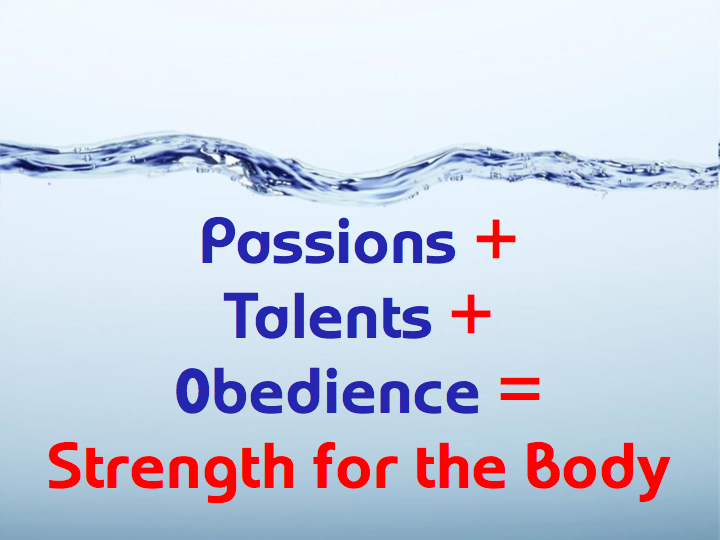
Think of your physical body. You go through the process of dieting or exercising for the benefit of the entire body. Your tastebuds may really want to savor some junk food, but for the good of the whole body, you go through the discipline of eating the healthy food. Your legs may not want to go for that jog, but for the good of the whole body, you push through your exercise routine.

It’s the same way spiritually: The Holy Spirit helps you become saint-ified for the good of the whole Body of Christ. The Holy Spirit wants you to mature as a saint so that you can help other saintS, and together the unified Body of Christ can glorify God.

So allow the Holy Spirit to take you through the saint-ification process, because other saintS need your help. And God will be glorified as you do!

If you’ve missed any of the messages in the Immersed series, you can find them all here.

Sinful Nature Versus Spiritual Nature

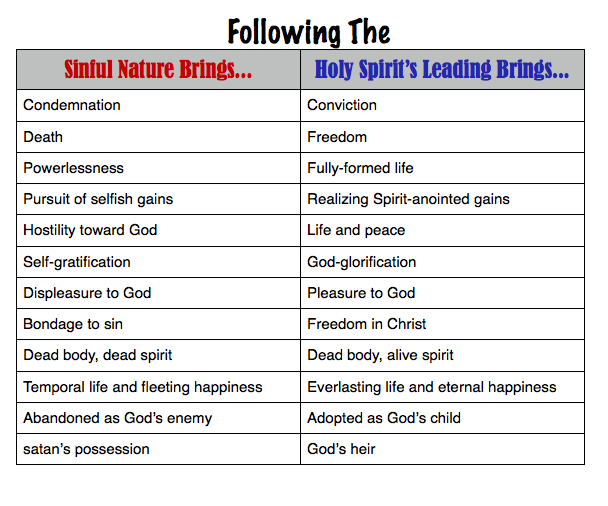
As a part of our Immersed series, I handed out a sheet contrasting the sinful nature and the Spirit-led nature, as seen in Romans 8. Several folks have asked if they could have an electronic version of this, and I’m more than happy to make this available.

Click this link to download the PDF version of this graphic → Sinful versus Spiritual ←

If you’ve missed any of the messages in the Immersed series, you can find them all here.

What Is Successful Church Ministry?

I like to keep asking myself and my leadership team this question: How do we know if our church is successful? 

The apostle Paul uses two words to help answer these questions: Quality and Faithfulness.

But each one’s work will be shown for what it is; the Day will disclose it, because it will be revealed by fire—the fire will test the quality of each one’s work. (1 Corinthians 3:13)

Now it is required that those who have been given a trust must prove faithful. (1 Corinthians 4:2)

So here are two important questions we need to ask ourselves:

  • Am I doing quality work?
  • Am I faithfully doing my work?

To help answer those questions, I like this thought from Leonard Sweet’s book I Am A Follower:

“The most important metrics we must rely on, the crucial ‘deliverables’ we can present, must focus on the newly formed lives of the disciples we are making, the followers who are following Christ into a place of serving Him by serving others. The most important measure of our faithfulness to Christ must be the extent of transformation into the living image of Christ Himself. …

The quantifiable fruit of our church is not found in the number of people we can gather on a weekly basis. What counts is what is happening in the lives of those who have gathered. …It is quite possible to have a ‘successful’ life—and a ‘successful’ church—without God. But it is absolutely impossible to have a truly fruitful one.”

Again, Paul’s advice here is invaluable:

My conscience is clear, but that does not make me innocent. It is the Lord who judges me. Therefore judge nothing before the appointed time; wait till the Lord comes…. (1 Corinthians 4:4, 5)

Pastor, you need to think about these questions about “success.” But they should be questions framed around your quality and faithfulness of work as revealed to you by the Holy Spirit, not by some “expert” or anyone else.

(By the way, if you’re interested in exploring this further, I framed this question a different way in this post.)

UPDATE: This post was one of the seed thoughts that went into fashioning my book Shepherd Leadership: The Metrics That Really Matter.

It’s Not Me; It’s You

Listen to the podcast of this post by clicking on the player below, and you can also subscribe on AppleSpotify, or Audible. 

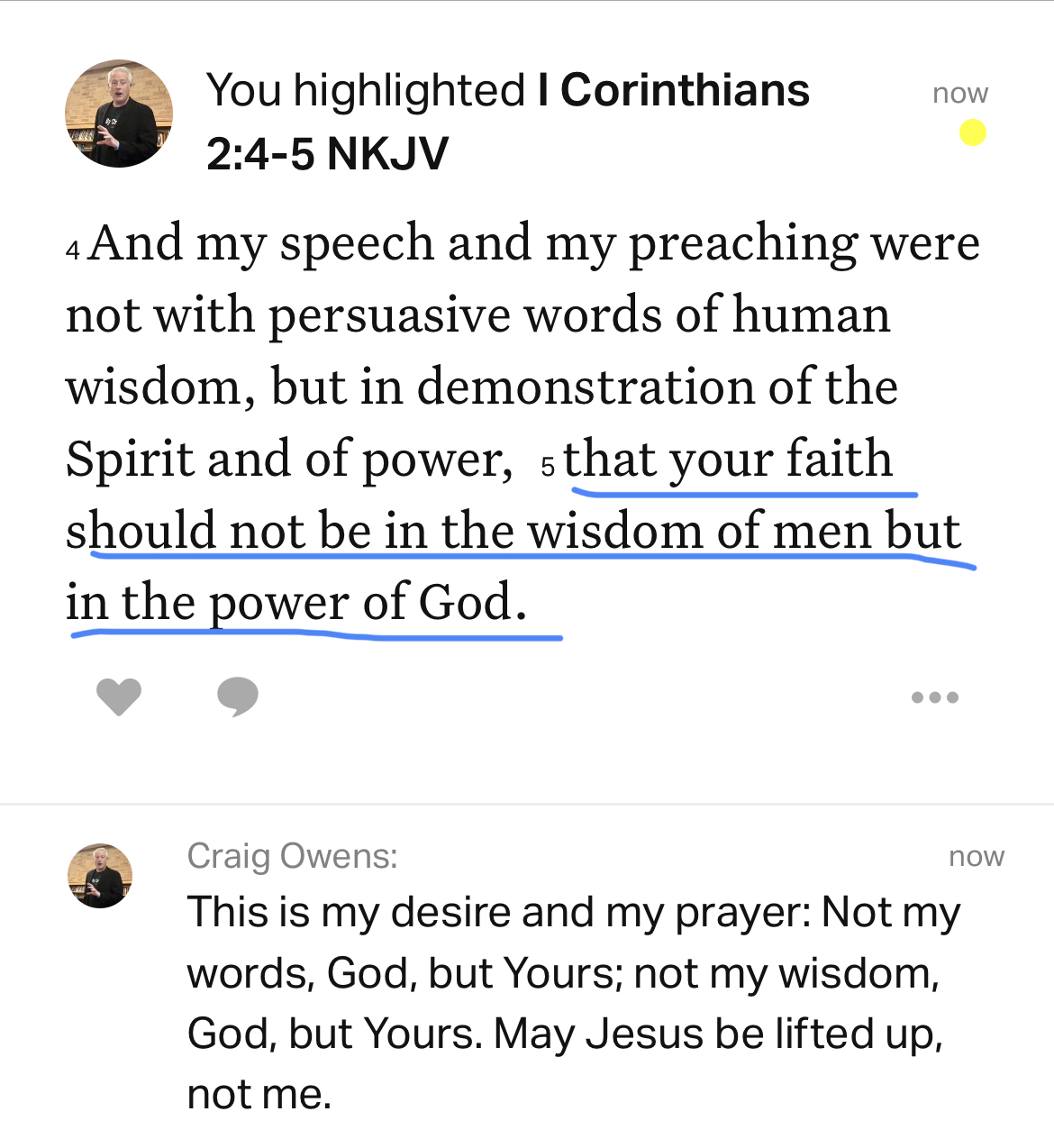
When I first came to you, dear brothers and sisters, I didn’t use lofty words and impressive wisdom to tell you God’s secret plan. For I decided that while I was with you I would forget everything except Jesus Christ, the One Who was crucified. I came to you in weakness—timid and trembling. And my message and my preaching were very plain. Rather than using clever and persuasive speeches, I relied only on the power of the Holy Spirit. I did this so you would trust not in human wisdom but in the power of God. (1 Corinthians 2:1-5)

I only want Jesus lifted up; not me.

As Your Spirit gives me words to share, may people turn to You; not me.

May anyone who hears me desire more of You; not me.

May my messages create a hunger and thirst for You; not me.

I want people to find encouragement in You; not me.

May I find my strength to minister in You; not in me.

May people only follow You; not me.

May everyone who hears me be impressed with You; not me.

It’s all about You, Jesus; not me.

►► Would you please prayerfully consider supporting this ministry? My Patreon supporters get behind-the-scenes access to exclusive materials. ◀︎◀︎

Getting Out Of The Hole

Yesterday in part two of our Immersed series, we looked at how helpless we are in trying to break free from sin’s pull on our lives. That is, we are helpless to help ourselves.

But with the Holy Spirit’s help, we go from helpless to hopeful!

In Romans 8, there are all of these contrasting statements about the sinful life versus the Spirit-led life. Our hope to move into the Spirit-led life turns on this phrase in verse 15: but by the Spirit. It is only by God’s Spirit that we can break free. To help illustrate this point, I read a rather long passage from C.S. Lewis’ Mere Christianity. Several people have asked to see this, so here it is—

“Now what was the sort of ‘hole’ man had got himself into? He had tried to set up on his own, to behave as if he belonged to himself. In other words, fallen man is not simply an imperfect creature who need improvement: he is a rebel who must lay down his arms. Laying down your arms, surrendering, saying you are sorry, realizing that you have been on the wrong track and getting ready to start life over again from the ground floor—that is the only way out of a ‘hole.’ This process of surrender—this movement full speed astern—is what Christians call repentance. Now repentance is no fun at all. It is something much harder than merely eating humble pie. It mean unlearning all the self-conceit and self-will that we have been training ourselves into for thousands of years. It means killing a part of yourself, undergoing a kind of death. In fact, it needs a good man to repent. And here comes the catch. Only a bad needs to repent: only a good man can repent perfectly. The worse you are the more you need it and the less you can do it. The only person who could do it perfectly would be a perfect person—and he would not need it.

“Remember, this repentance, this willing submission to humiliation and a kind of death, is not something God demands of you before He will take you back and which He could let you off is He chose: it is simply a description of what going back to Him is like. If you ask God to take you back without it, you are really asking Him to let you go back without going back. It cannot happen. Very well, then, we must go through with it. But the same badness which makes us need it, makes us unable to do it. Can we do it if God helps us? Yes, but what do we mean when we talk of God helping us? We mean God putting into us a bit of Himself.

When we invite Christ into our lives, He places “a bit of Himself” in us: the Holy Spirit. That enables us to be perfectly forgiven.

But then when we allow the Holy Spirit to immerse us in Himself, it’s not just “a bit of Himself” we get, but all of Him. This opens the door to deeper intimacy, greater closeness, and a more God-glorifying life!

I want to live immersed!

If you’ve missed any of the messages in the Immersed series, you can find them all here.

Thursdays With Oswald—My Spiritual Personality

This is a weekly series with things I’m reading and pondering from Oswald Chambers. You can read the original seed thought here, or type “Thursdays With Oswald” in the search box to read more entries.

Spiritual Personality

     When we receive the Holy Spirit, He so energizes our spirit that we are able to detect things that are wrong, and we are able to rectify them if we ‘mind’ the Holy Spirit. This is the Scotch use of the term ‘mind,’ and it means ‘remember to obey.’ It carries with it the meaning of another Scotch word, ‘lippen,’ that is, ‘trust.’ Mind the Holy Spirit, mind His light, mind His convictions, mind His guidance, and slowly and surely the sensual personality will be turned into a spiritual personality. 

From Biblical Psychology

It’s not too often that I think of personality in a spiritual light. But God created me as a unique person, complete with my own personality. He gave me the personality He did on purpose: to glorify Him.

Left to myself, my personality is highly self-serving. But when I “mind” the Holy Spirit, He helps me live out my God-given personality in a way that is more and more God-serving and God-glorifying.

I love Chambers’ list:

  • Mind the Holy Spirit
  • Mind His light [illumination]
  • Mind His convictions
  • Mind His guidance

I’m working on “minding” better. How about you?

If I Only Would Have Thought That Through…

These words are usually said after we have messed up something. We look back and say, “What was I thinking?!”

The truth is: you were thinking, it was just wrong thinking.

The Apostle Paul writes this:

Clothe yourselves with the Lord Jesus Christ, and do not think about how to gratify the desires of the sinful nature. (Romans 13:14)

The King James Version, instead of do not think, says, “make no provision for the flesh.” In other words, the idea here is forethought.

We have a filter at the base of our brains called the reticular activating system (or R.A.S.). This is what lets in the important things, and keeps out the unimportant things. But here is the vital issue—

YOU CAN PROGRAM YOUR R.A.S.!

You tell your RAS what’s important and what’s unimportant. Paul says that if we use our forethought to consciously decide to clothe ourselves with Christ, we are programming our RAS to spot the things that glorify Him and ignore the things that gratify our fleshly desires.

A phrase that I use often (hat tip to Dr. Richard Dobbins) is: I need to think about what I’m thinking about.

By doing this, I’m able to see how I’ve programmed my RAS. It’s either programmed to look for God-honoring things or flesh-gratifying things.

Try it for yourself. Make the conscious decision to read the Bible every day. Then in your prayer time, ask the Holy Spirit to help you think about God-honoring things. If you will do this, you will notice that you are noticing more things that please God, and that you are ignoring more things that please your sinful nature.

The Hard Word

As a pastor, you are going to have to deliver the hard word from time to time. You will have to address touchy subjects, both corporately and privately. It is very instructive to see how the apostle Paul approached the hard word.

In Romans 9, Paul is getting ready to address one of the most sensitive subjects of his day. The Jews felt they were “in” with God just because they were Jews, and the Gentiles were “out” with God just because they weren’t Jews. Paul is going to have to deliver the word that both Jews and Gentiles can be accepted by God because of what Jesus did on the Cross.

So notice how he begins:

I speak the truth in Christ—I am not lying, my conscience confirms it in the Holy Spirit—I have great sorrow and unceasing anguish in my heart.

1. I speak the truth in Christ. It wasn’t his opinion, but the word from God. I must settle this matter before delivering the hard word. Far too often we can put our preferences on par with God’s Word. I cannot do this!

2. My conscience confirms it in the Holy Spirit. Before I speak a hard word that people may not like to hear, I need to make sure my conscience is right before the Holy Spirit. He alone confirms His Word. The reaction of the audience, however, may or may not confirm what God says.

3. I have great sorrow and unceasing anguish in my heart. It should be a major red flag if I looked forward to delivering a painful/challenging/correcting word. I need to put myself in their place, not try to put someone else in their place!

My job as a pastor is not to condemn, nor even to convict; the Holy Spirit will do that. My job is to (a) hear God’s truth, (b) get my conscience right with the Spirit, and (c) empathize with people as I lovingly speak the truth to them.