8 Quotes From “Jesus In Me”

Anne Graham Lotz has given us a delightful book that feels like a living room chat with a friend as we discuss how the Holy Spirit operates in our lives. Check out my full book review of Jesus In Me by clicking here. 

“The Holy Spirit is not a thing but a Person. His personhood is emphasized in John 16, when eleven times in eight verses, He is referred to by the personal, masculine pronouns He, Him, or His.” 

“Could it be that you have missed the comfort of the Comforter because it has come indirectly through someone or something else? Like Mary Magdalene at the empty tomb, are your tears blinding you to the presence of Jesus right there beside you? Right there within you? My prayer is that He will use these words to comfort you as you experience the constant companionship of the Holy Spirit. Ask Him to open your eyes to the nearness of the One who is, in fact, Jesus in you.” 

“Whether your situation involves a misunderstanding with your neighbors, or a disagreement within your church, or tension in your home, or slander in your school, or gossip in your office, the Holy Spirit is able to defend you and plead your cause. Always. Ask Him. He’s never lost a case.” 

“Multiple times God has told me He would strengthen me through the howling winds of hardship. In Jeremiah He clearly warned me that people would fight against me but that He would make me an iron pillar. Through Isaiah He told me that people would rage against me and oppose me but that I was not to be afraid because He would strengthen me. He encouraged me from Revelation that if I would endure patiently and with humility, He would make me ‘a pillar in the temple of my God.’” 

“It’s a huge relief to know that it’s not my job to convict anyone else of sin. That’s the Holy Spirit’s job. Which leaves me free to love people just as they are. Yes, I can counsel and advise if they are open to it. Yes, I can speak the truth in love. Yes, I can point out the potential consequences of their sin. But in the end the most effective thing I can do is to pray for them with a heart full of love. Because the power to transform is His alone.” 

“As we choose to fix our eyes on Jesus, pursue righteousness, live by the truth, and fulfill God’s purpose for our lives, the Holy Spirit will guide us, sharpening our focus in the midst of life’s distractions and confusion.” 

“Maintaining the fire requires intentionally establishing some common spiritual disciplines. They are simple choices but not always easy. They include daily prayer, daily Bible reading, sharing the gospel, continuous obedience as you live out what God says in His Word, continuous trust as you relinquish your expectations and let Him have His way, deepening surrender to His authority—especially during times of pain and suffering.” 

“He uses all things without exception, not just some things, for my ultimate good. And my ultimate good is not health, wealth, prosperity, happiness, or sometimes the things we associate with ‘good.’ My ultimate good is to fulfill God’s purpose of shaping me into the image of Jesus Christ so I bring glory to Him.” 

Jesus In Me (book review)

When Jesus was about to ascend back into heaven, His disciples were understandably anxious. But Jesus spoke these reassuring words to them, “I will not leave you alone. I will ask the Father to send the Comforter to you.” And true to His word, the Holy Spirit was made available to all Christians. This is what Anne Graham Lotz explores in Jesus In Me.

In the opening pages, Anne explains that an important verse to help us understand the Holy Spirit is found in John 16:7. Anne and I both like the Amplified Bible’s rendering of this verse—However, I am telling you nothing but the truth when I say it is profitable (good, expedient, advantageous) for you that I go away. Because if I do not go away, the Comforter (Counselor, Helper, Advocate, Intercessor, Strengthener, Standby) will not come to you [into close fellowship with you]; but if I go away, I will send Him to you [to be in close fellowship with you].

Using the multiple names of the Holy Spirit captured in this verse—Helper, Advocate, Intercessor, Strengthener, Standby—Anne begins to dive deeper into what the Spirit of God does in these various roles.

This is not a heavy theological dissertation, nor does this book wade deeply into complex doctrines. Jesus In Me feels like Anne is your friend, and she is just sharing with you what the Bible has said to her about the Holy Spirit and how she has experienced Him for herself. The Scripture references are there for you to read on your own, and Anne shares her personal stories, but both of these simply invite you and me to experience more of the Holy Spirit for ourselves. I really like this book! 

I am a Multnomah book reviewer. 

P.S. There are some special pre-order offers available from Anne Graham Lotz’s website which you may want to check out.

Thursdays With Spurgeon—Study The Right Things

This is a weekly series with things I’m reading and pondering from Charles Spurgeon. You can read the original seed thought here, or type “Thursdays With Spurgeon” in the search box to read more entries.

Study The Right Things

     It is very advantageous to the Christian mind frequently to consider the deep and unsearchable attributes of God. … If we study man and make him the only object of our research, there will be a strong tendency in our minds to exaggerate his importance. We will think too much of the creature and too little of the Creator, preferring the knowledge that is to be found out by observation and reason to the divine truth that revelation alone could make known to us. … 

     The fleeting things of human life and the fickle thoughts and showy deeds of men are as movable and as changeable as the waters of the treacherous deep. But when we mount up, as it were, with eagles’ wings to Him Who sits upon the circle of the earth, before Whom all its inhabitants are as grasshoppers (Isaiah 40:22), we nestle in the Rock of Ages that from its eternal socket never starts and in its fixed immovability can never be disturbed.

From The Infallibility Of God’s Purpose

I read a lot of books. But in the hands-down, it’s-not-even-close category, I read the Bible more than anything else. It is the Book of books because it reveals the eternal Wisdom behind the earth’s wisdom. 

Zig Ziglar used to say, “Every morning I read my Bible and I read the newspaper. That way, I know what both sides are up to.” That’s pretty good!

We read the Bible not just to know the Bible, but to know the One Who authored the Bible. Or, as I like to say it—

My goal in reading the Word God is to get to know the God of the Word better and better.

Charles Spurgeon would never say—nor do I—that you shouldn’t study a variety of topics. Just make sure that your priority is God’s Word. This will give you the greatest insight into other topics and will protect you from humanistic error. 

Read Your Bible More

“Read your Bible more and more every year. Read it whether you feel like reading it or not. And pray without ceasing that the joy return and pleasures increase.

“Three reasons this is not legalism:

  1. You are confessing your lack of desire as sin, and pleading as a helpless child for the desire you long to have. Legalists don’t cry like that. They strut.
  2. You are reading out of desperation for the effects of this heavenly medicine. Bible-reading is not a cure for a bad conscience; it’s chemo for your cancer. Legalists feel better because the box is checked. Saints feel better when their blindness lifts, and they see Jesus in the Word. Let’s get real. We are desperately sick with worldliness, and only the Holy Spirit, by the Word of God, can cure this terminal disease.
  3. It is not legalism because only justified people can see the preciousness and power of the Word of God. Legalists trudge with their Bibles on the path toward justification. Saints sit down in the shade of the Cross and plead for the blood-bought pleasures.

“So let’s give heed to Mr. Ryle and never grow weary of the slow, steady, growth that comes from the daily, disciplined, increasing, love affair with reading the Bible. 

‘Do not think you are getting no good from the Bible, merely because you do not see that good day by day. The greatest effects are by no means those which make the most noise, and are most easily observed. The greatest effects are often silent, quiet, and hard to detect at the time they are being produced. Think of the influence of the moon upon the earth, and of the air upon the human lungs. Remember how silently the dew falls, and how imperceptibly the grass grows. There may be far more doing than you think in your soul by your Bible-reading’ (J.C. Ryle, in Practical Religion).” —John Piper 

A Life Worthy Of The Gospel

Only let your conduct be worthy of the gospel of Christ… (Philippians 1:27).

The apostle Paul wanted the Philippians’ living to be their preaching. Much like Francis of Assisi said years later: “Preach always; if necessary, use words.”

The big question is—what does conduct “worthy of the gospel of Christ” look like? I believe Paul identifies at least 15 characteristics in just the next 20 or so verses

  1. It is not a people-pleasing lifestyle. It is a God-honoring, Spirit-lead, Christ-glorifying lifestyle.
  2. It is steadfast, which means it perseveres even through the trials and difficulties.
  3. It is a heart and mind unified with other Christians.
  4. It is bold—“without being frightened in any way by those who oppose you.” 
  5. It is strengthened in Christ and it is in constant fellowship with the Holy Spirit. 
  6. It overflows with loving comfort, affection, and mercy to those around it.
  7. It humbly serves others while confidently refreshing itself in Christ.
  8. It strives to live as Jesus did, seeking always for God to be glorified.
  9. It is obedient to the conviction and direction of the Holy Spirit.
  10. It finds pleasure in doing God’s will.
  11. It doesn’t complain.
  12. It is a blameless and harmless life.
  13. It shines a light that attracts others to God’s love.
  14. It holds fast to the Word of life for the long haul.
  15. It is a rejoicing, contented lifestyle.

Heavenly Father, may it always be said of my life that it is one that is worthy of the gospel of Christ. May I always be sensitive to the nudges of the Holy Spirit to keep my life aligned in this way. In Jesus’ name I pray, Amen! 

When Trials Come

Notice that the title of this post says “when” not “if.” Maybe this will be a newsflash for some of you (but I highly doubt it): Christians will face trials.

Even the apostle James says, “Dear brothers and sisters, when troubles of any kind come your way, consider it an opportunity for great joy” (James 1:2). Wait, trials are “an opportunity for great joy”? How can that be?!

→ Trials teach us lessons that we can learn in no other way! ←

How much more mature, and wise, and empathetic would we become if instead of trying to get out of the trials that come our way, we would instead see what we could get out of that trial!

We can rejoice, too, when we run into problems and trials, for we know that they help us develop endurance. And endurance develops strength of character, and character strengthens our confident hope of salvation. And this hope will not lead to disappointment. For we know how dearly God loves us, because He has given us the Holy Spirit to fill our hearts with His love. (Romans 5:3-5)

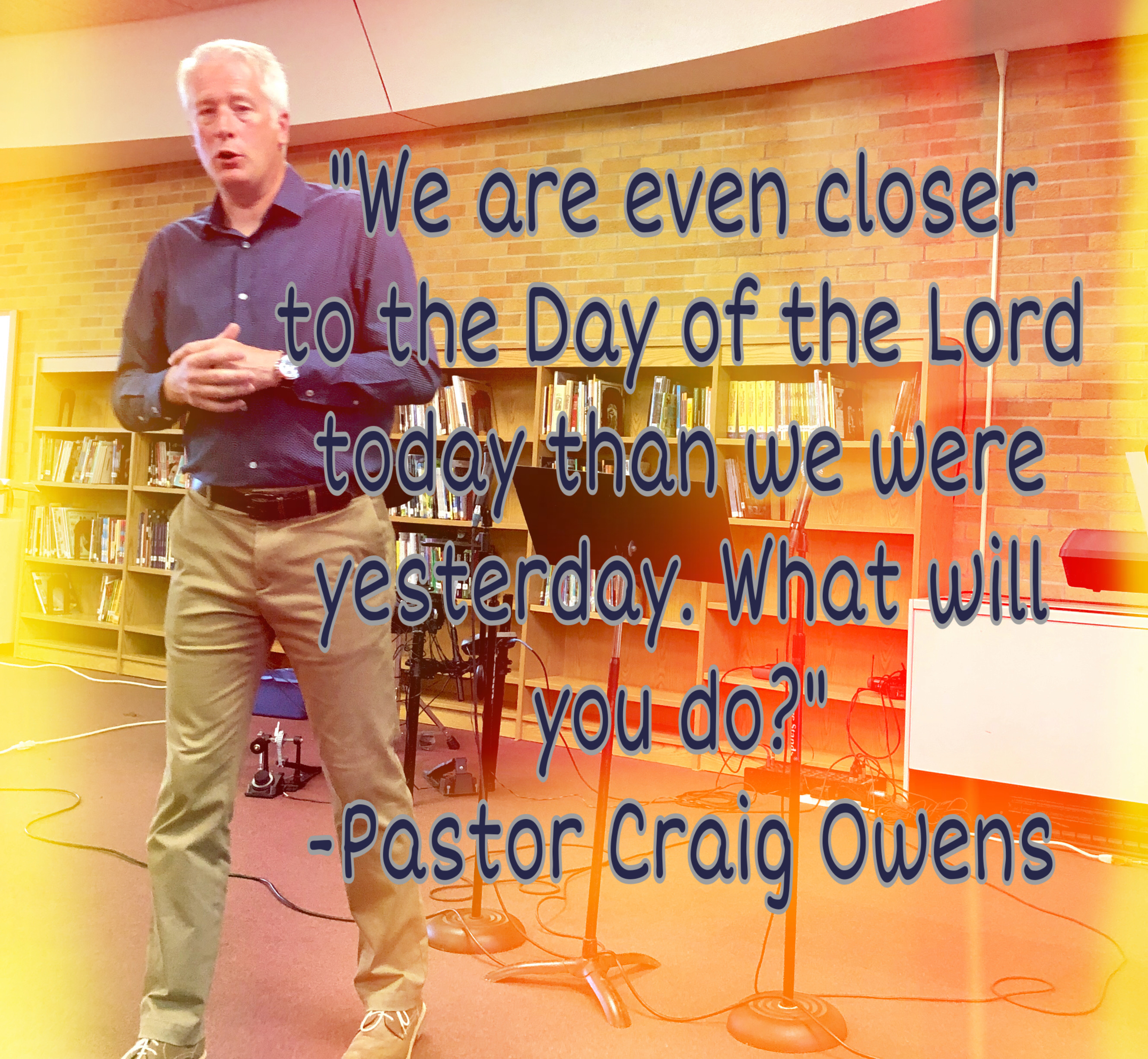
“When trials come we can try to get out of them, or we can learn to get something out of them.”

—Craig T. Owens

So the next time a trial comes your way, ask the Holy Spirit to show you what lessons you can learn by going through the trial.

Thursdays With Spurgeon—Following The Prompting

This is a weekly series with things I’m reading and pondering from Charles Spurgeon. You can read the original seed thought here, or type “Thursdays With Spurgeon” in the search box to read more entries.

Following The Prompting

     I once while preaching at New Park Street Chapel. I had passed happily through all the early parts of divine service on the Sabbath evening and was giving out the hymn before the sermon. I opened the Bible to find the text, which I had carefully studied as the topic of discourse, when, on the opposite page, another passage of Scripture sprang upon me like a lion from a thicket with vastly more power then I had felt when considering the text that I had chosen. The people were singing and I was sighing. I was in a strait between two, and my mind hung as in the balances. I was naturally desirous to run in the track that I had carefully planned, but the other text would take no refusal and seemed to tug at my skirts, crying, “No, no, you must preach from me! God would have you follow me.” I deliberated within myself as to my duty, for I would neither be fanatical nor unbelieving, and at last I thought within myself, Well, I should like to preach the sermon that I have prepared, and it is a great risk to run to strike out a new line of thought, but as this text constrains me, it may be of the Lord, and therefore I will venture upon it, come what may.

     I had brought myself into great difficulty by obeying what I thought to be a divine impulse, and I felt comparatively easy about it, believing that God would help me and knowing that I could at least close the service should there be nothing more to be said. I had no need to deliberate, for in one moment we were in total darkness. The gas had gone out…. Having no manuscript, I could speak just as well in the dark as in the light…. When the lamps were lit again, I saw before me an audience as rapt and subdued as ever a man beheld in his life. … Thus, providence befriended me. I cast myself upon God, and His arrangements quenched the light at the proper time for me. Some may ridicule, but I adore; others may even censure, but I rejoice.

From The Autobiography of Charles Spurgeon

God can speak to pastors as clearly in his or her sermon preparation time as He can in the very moments before the sermon begins. The key is our obedience to follow the prompting of the Holy Spirit. 

Spurgeon would never advocate that preachers “wing it” every time they step into the pulpit. His own life showed a man of diligent study of the Scripture. But neither would Spurgeon say that preachers have to stick to their prepared remarks no matter what. What I think he would say is: Trust God when you’re studying for a sermon, and trust God when you’re delivering a sermon. Allow the Spirit to change your course at any moment. 

Is this a bit nerve-wracking? Spurgeon would say, “Yes, only when deliberating whether to strike out on the new course.” But notice how once he obeyed that prompting, he felt completely at ease.

Spurgeon also reminds us, “I do not see why a man cannot speak extemporaneously upon a subject that he fully understands. Any tradesman, well versed in his line of business, could explain it without needing to retire for meditation, and surely I ought to be equally familiar with the first principles of our holy faith. I ought not to feel at a loss when called upon to speak upon topics that constitute the daily bread of my soul.”

Uphill Or Downhill?

…And because of this I rejoice. Yes, and I will continue to rejoice (Philippians 1:18).

Paul is in prison, yet he tells his friends that he is choosing to rejoice. Wow! 

Not only that, but this same imprisoned man also reminds his friends to…

  • … let their joy in Jesus overflow 
  • … conduct themselves in a manner worthy of the gospel of Christ
  • … continue to have a servant’s attitude like Jesus
  • … don’t give in to complaining or arguing 
  • … look out for the interests of other people 
  • … rejoice in the Lord
  • … don’t rest on their laurels
  • … forget the past and press on toward the future 

John Maxwell has noted that most people have uphill dreams but downhill habits. That is definitely not a winning combination! 

Paul is making his friends aware of the possible downhill habits that may hold them back from their uphill dreams, and using himself as an example. This first step—awareness—is vital if we are going to break free of the things that are pulling us away from our God-given dreams. 

Solomon wrote, “The path of life leads UPWARD for the prudent to keep them from GOING DOWN to the realm of the dead” (Proverbs 15:24). 

Being prudent is saying, “I’m always on the lookout for what’s best.” 

None of us can go UP by ignoring our downhill habits, or even trying to coast through life. The only way to achieve our uphill dreams is to ask the Holy Spirit to reveal our downhill habits so that we can make a plan to turn those around. 

Check out these characteristics that Paul shares—

Downhill Habit              Uphill Habit
Complaining                    Rejoicing (4:4)
Selfishness                      Gentleness (4:5)
Worrying                         Praying (4:6a)
Grumbling                       Giving thanks (4:6b)
Fixing it myself                Giving it to God (4:6c)
Idle thoughts                   Thinking about my thinking (4:8)
Making my own way         Getting a mentor / partner (4:9)
Being discontent              Being content (4:11-12)
Trying to be self-made     Striving to be Christ-reliant (4:13)

A good prayer for all of us who have uphill dreams that we want to achieve—Holy Spirit, reveal to me my downhill habits. I acknowledge that I need Your help to see and break these habits. Then help me to replace them with Christ-honoring uphill habits that will allow me to achieve the purpose God has for my life.

Thursdays With Spurgeon—What God Is Doing In Depression

This is a weekly series with things I’m reading and pondering from Charles Spurgeon. You can read the original seed thought here, or type “Thursdays With Spurgeon” in the search box to read more entries.

What God Is Doing In Depression

     This depression comes over me whenever the Lord is preparing a larger blessing for my ministry; the cloud is black before it breaks, and overshadows before it yields its deluge of mercy. Depression has now become to me as a prophet in rough clothing, a John the Baptist, heralding the nearer coming of my Lord’s richer benison. So have far better men found it. The scouring of the vessel has fitted it for the Master’s use. Immersion in suffering has preceded the baptism of the Holy Spirit. Fasting gives an appetite for the banquet. The Lord is revealed in the back side of the desert, while His servant keeps the sheep and waits in solitary awe. The wilderness is the way to Canaan. The low valley leads to the towering mountain. Defeat prepares for victory. The raven is sent forth before the dove. The darkest hour of the night precedes the day-dawn.

From The Autobiography of Charles Spurgeon

Spurgeon was known to have wrestled under the dark clouds of depression frequently throughout his life. As he noted above, “So have better men found it.” Many of us battle the dark waves of depression, myself included. 

But look at how Spurgeon came to see depression in a new light. He began to note that depression was actually the forerunner of a dawn of breakthrough. Think about how many notable people in the Scriptures went through dark valleys prior to God using them in previously unimaginable ways—men like Joseph, Moses, David, Elijah, Jeremiah, Peter, Saul (who would become Paul), and even Jesus Himself. 

The writer of Hebrews records that Jesus learned something during the dark night of His soul that He wouldn’t have learned any other way. Jesus saw God’s dawn coming, so He was able to continue to go through the darksome valley. 

Depression is a serious thing. If you are battling this darkness, there is freedom in admitting it. Spurgeon did, I have, and so have many others. Admit you need help, and then get help. Talking to your doctor or a Christian counselor may be a necessary component toward your healing. 

But in all that you do, please learn to do what these notable folks in the Bible did—and what Charles Spurgeon did: begin to see depression not as your permanent residence, but merely as a dark night that is preceding a glorious dawn! 

Interrupted But Not Discouraged

…I will…if the Lord permits… (1 Corinthians 16:5-7). 

Paul had a desire to visit certain cities to share the Gospel, so he made his plans. But he was careful to add, “if the Lord permits.” He knew from personal experience that God knows best the where and the when.

In fact, the first time Paul came to Macedonia, it was only after he had been blocked from his original plans—

They tried to go to certain regions of Asia, but they were prevented by the Holy Spirit (Acts 16:6).

They headed toward Bythinia, but again the Spirit of Jesus did not allow them to go there (Acts 16:7).

While at Troas, Paul had a vision of a man from Macedonia, so they concluded that God was calling them to preach there (Acts 16:9-10).

We must know that we know that God has green-lighted an opportunity for us. Where God opens opportunities, satan is sure to attack (1 Corinthians 16:9). We don’t want to then assume that the attack means that we are in the wrong place at the wrong time, or even in the right place at the wrong time.

Paul made his plans, but he also remained interruptible.

When God said, “Go!” Paul could endure any opposition because he was assured that God had called. And when God said, “No” Paul could rest peacefully because he was assured that God knew the best place at the best time.

The same principle is true for godly leaders today—

A mark of a godly leader is one who is interruptible without becoming discouraged.

This is part 39 in my series on godly leadership. You can check out all of my posts in this series by clicking here.