Listen to the podcast of this post by clicking on the player below, and you can also subscribe on Apple, Spotify, or Audible.
My podcast partner Greg and I just recorded an episode of our leadership podcast about Christmas traditions. I think there more traditions associated with this time of year than with any other event on our calendars. Traditions keep us connected to our roots, but they also help us feel like we can be in control of things.
There has been a tradition in countries with monarchies that whenever a king died, the people would say something like, “The king is dead. Long live the king!” They would say this because the next king ascended to the throne immediately after his predecessor died. Except when a nation had been defeated, the traditional cry of, “The king is dead” was unanswered by, “Long live the king!”
It appears at this moment that a new tradition has to be started—one where we take leadership over our own fates.
The apostle Peter noted that people awaiting the Second Coming of Jesus would question if that event was ever going to happen. And the prophet Malachi closed the Old Testament with people saying much the same thing: “There doesn’t seem to be any advantage to following God’s laws, so maybe we should just do things our own way” (2 Peter 3:3-4; Malachi 3:13-15).
But then we turn the page to the dawn of the New Testament, and Matthew writes his Gospel about the First Advent of Jesus. He wants to show us that although the line of earthly kings in Israel may have been broken, the promised King of kings had now come to earth.
I’m intrigued by the exceptions Matthew lists in his opening genealogy to illustrate this truth. First, as you might expect, the phrase “thefather of” appears 39 times. This tells us a biological fact of life. These men didn’t know if they had fathered a son or a daughter, what their child’s contribution to the world might be, or even if their child would live faithfully to God.
Matthew opens his genealogy by saying “the son of” twice. First, Matthew lists Jesus as the son of David—the king to whom God gave a very special promise of an eternal King coming from David’s family line. Then Matthew traces the genealogy back further to say “the son of Abraham”—the one through whom God said He would bless all nations (2 Samuel 7:11-16; Genesis 12:1-3).
And what about the exceptional women Matthew records in this male-dominated genealogy? We have Tamar, Judah’s daughter-in-law, who tricked him into fathering a child by her; Rahab, a Canaanite prostitute who put her faith in God; Ruth, a Moabitess who left her homeland because she trusted God; Bathsheba, an adulteress who became David’s wife; and then Mary, the mother of Jesus, who was called “highly favored” of God (Luke 1:28).
The phrase “son of” appears one more time when the angel calls Joseph by this title (Matthew 1:20). Jospeh is also called “thehusband of Mary” (Matthew 1:16).
Whereas Abraham and David were rewarded for their faithfulness to God and were told of future blessings, Joseph’s act was different. Joseph had a choice. He was told that the Child in Mary’s womb would be the Messiah. Now Jospeh had to decide: Would he choose to believe this? Would he choose to bear the shame and reproach to accept his role as father?
We have the a similar choice today: Will we choose to believe that God has announced His plan and that He is fulfilling His plan?
Here’s the simple truth. It appears as two statements, but it is really the same thought—
The Advent of Jesus has come. The Advent of Jesus will come.
The First Advent of Jesus should build our anticipation for the Second Advent. His First Advent should be proof that God keeps His promise.
Jesus told us that believing God’s promise would bring us into God’s family. Jesus said, “For My Father’s will is that everyone who looks to the Son and believes in Him shall have eternal life, and I will raise them up at the last day” (John 6:40).
The apostle Paul also assures us, “So in Christ Jesus you are all children of God through faith” (Galatians 3:26).
Let’s not blindly follow the traditions of previous generations, but let us chose for ourselves to believe in God’s promised Messiah, to trust that He alone can give us eternal life, and then let us live in both celebration of His First Advent and expectation of His Second Advent.
Listen to the podcast of this post by clicking on the player below, and you can also subscribe on Apple, Spotify, or Audible.
Although Jesus spoke these words to His followers 2000 years ago, they are especially important to all of His followers who are awaiting His imminent return—
Be dressed ready for service and keep your lamps burning, like servants waiting for their master to return from a wedding banquet, so that when he comes and knocks they can immediately open the door for him. It will be good for those servants whose master finds them watching when he comes. Truly I tell you, he will dress himself to serve, will have them recline at the table and will come and wait on them. It will be good for those servants whose master finds them ready, even if he comes in the middle of the night or toward daybreak. But understand this: If the owner of the house had known at what hour the thief was coming, he would not have let his house be broken into. You also must be ready, because the Son of Man will come at an hour when you do not expect Him. (Luke 12:35-40)
There are three words that stand out to me: ready, waiting, and watching.
Ready is an adjective describing the Christian servant. Its etymology is from the noun meaning “fitness.” So the ready servant has all that he needs at hand. He is prepared for every opportunity, ready to serve and to receive whomever his Master sends him.
Waiting is a verb that is in the present tense. That means it is something we always have to be doing. The prefix of this Greek word—like the adjective for “ready”—also means that everything that we need to serve is close by and ready to be used, and the root word is to give hospitality. So the waiting servant is waiting with a purpose: always ready to serve at a moment’s notice.
Watching is also a present tense verb. This word means that we are giving undivided attention to the task that has been given us.
Jesus was addressing His disciples, but these words are still for you and for me. At every moment we need to be fit to serve, with all that we need close at hand for every opportunity God sends our way.
I want to be occupied in my heavenly service until the very moment Jesus returns to earth or calls me Home. There are no off days. There is no time to waste on frivolous matters, but I need to be solely focused on only doing what matters for eternity.
Will you join me in serving like this? We lead others to Jesus by serving those Jesus puts in our life. And as we do that, we serve our Master as well.
Listen to the podcast of this post by clicking on the player below, and you can also subscribe on Apple, Spotify, or Audible.
Gratitude is our shield against the negativity, and gratitude is also our sword against the ambushers. But using these pieces of our armor is exhausting, which means we also need a way to recover from the attacks of negativity.
Jesus began His public ministry with a sermon that prompted Luke to record that “everyone spoke well of Him.” But in less than 60 seconds, after Jesus outlined how His ministry would unfold, Jesus is being criticized to the point where those same praising people are now ready to throw Jesus off a cliff (Luke 4:18-29)!
Elbert Hubbard wrote, “If you have something others don’t, know something others don’t, or do something others aren’t doing, then, rest assured, you will be criticized. … To avoid criticism say nothing, do nothing, and be nothing.”
Even though Hubbard is probably right, Christians don’t have the option to “say nothing, do nothing, be nothing,” because Jesus has called us to go into all the world, preach the Good News, and be salt and light. That means we will be victims of criticism. We can use our shield and sword of gratitude, but we are also going to need some medicine to help us recover too.
“Sticks and stones may break my bones but words will never hurt me” is a lie. Words do hurt.
Jesus told us these stinging words would be thrown at us like sticks and stones in Luke 6:22. When we are criticized, we have to be careful not to get embittered. How does that happen? We are naturally self-protective, so criticized people become critical and cynical unless they can be healed and have joy restored.If we hold on to our hurts, bitterness can fester in our hearts (Hebrews 12:14-15).
Look at David in Psalm 69. He acknowledged the attacks from his enemies and how it made him feel, but then he applies the healing medicine of gratitude—
But as for me, afflicted and in pain—may Your salvation, God, protect me. I will praise God’s name in song and glorify Him with thanksgiving. (Psalm 69:29-30)
Our healing is in our thanking!
Medical research has shown that gratitude improves physical health—it reduces stress and resets the heart’s healthy rhythm. This is just as true spiritually: gratitude is our medicine.
You may be thinking, “How can I bless critical people? How can I be grateful when I’m surrounded by such hostility?”
David also wrote Psalm 23 for us. This is the psalm that begins, “The Lord is my Shepherd, I shall not be in want.” But notice especially the words of verse 5: “You prepare a table before me in the presence of my enemies. You anoint my head with oil; my cup overflows.”
It is precisely in the presence of enemies that God invites us to abide with Him and to receive His medicine of anointing. But I also see that our Good Shepherd doesn’t just give us adequate blessings, but overflowing blessings—enough for me and more to share with those around me.
In the New Testament Greek, one word for “bless” is eulogeo which literally means “good words.” Jesus, Paul, and Peter all tell us that when we are victims of the sticks and stones of negative words, we are to respond by saying good words both to God and to those who are hurling evil words at us (Matthew 5:43-44; 1 Corinthians 4:12; 1 Peter 3:9).
Peter shows us exactly how Jesus did this when He was hanging on the Cross and enduring the sneers, mocking words, and insults from those surrounding Him (1 Peter 2:21-23; Luke 23:35-39). Instead of throwing evil words back at them, Jesus blessed them by saying, “Father, forgive them for they do not know what they are doing” (Luke 23:34).
Listen to the podcast of this post by clicking on the player below, and you can also subscribe on Apple, Spotify, or Audible.
It would be nice if complainers were satisfied just complaining to themselves, but they’re not. Do you know the cliché misery loves company? It’s just as true for complainers: They really want others to join them in their bellyaching!
I think a good word for what these negative people do is ambush. The dictionary says that means to lie in wait with hostile intent. Jesus told His followers that this ambushing behavior was going to happen. In Luke 6:22, He uses the word “when” not “if”—
Blessed are you when people hate you, when they exclude you and insult you and reject your name as evil, because of the Son of Man.
We see this vividly portrayed in the life of Daniel. This man had done nothing but helpful things since the moment he arrived in Babylon. He faithfully served foreign kings, never wanted any recognition for himself, saved lives, interpreted dreams, and explained confusing things. He had a great work ethic and impeccable integrity. But the complainers still wanted to ambush him (see Daniel 6:1-5).
One psalmist described these ambushers in terms of a hunting lion: His mouth is full of lies and threats; trouble and evil are under his tongue. He lies in wait near the villages; from ambush he murders the innocent. His eyes watch in secret for his victims (Psalm 10:7-8).
Doesn’t this sound like what the devil does too? Be alert and of sober mind. Your enemy the devil prowls around like a roaring lion looking for someone to devour (1 Peter 5:8).
Jerusalem was surrounded by three armies that were lying in wait to ambush the Israelites. After God told the people of Jerusalem that He would deliver them, King Jehoshaphat sent out his army with the worshippers at the front of the ranks. Then listen to how worship not only thwarted the ambushers but boomeranged their evil plans back on themselves—
As they began to sing and praise, the Lord set ambushes against the men of Ammon and Moab and Mount Seir who were invading Judah, and they were defeated. The Ammonites and Moabites rose up against the men from Mount Seir to destroy and annihilate them. After they finished slaughtering the men from Seir, they helped to destroy one another. (2 Chronicles 20:22-23)
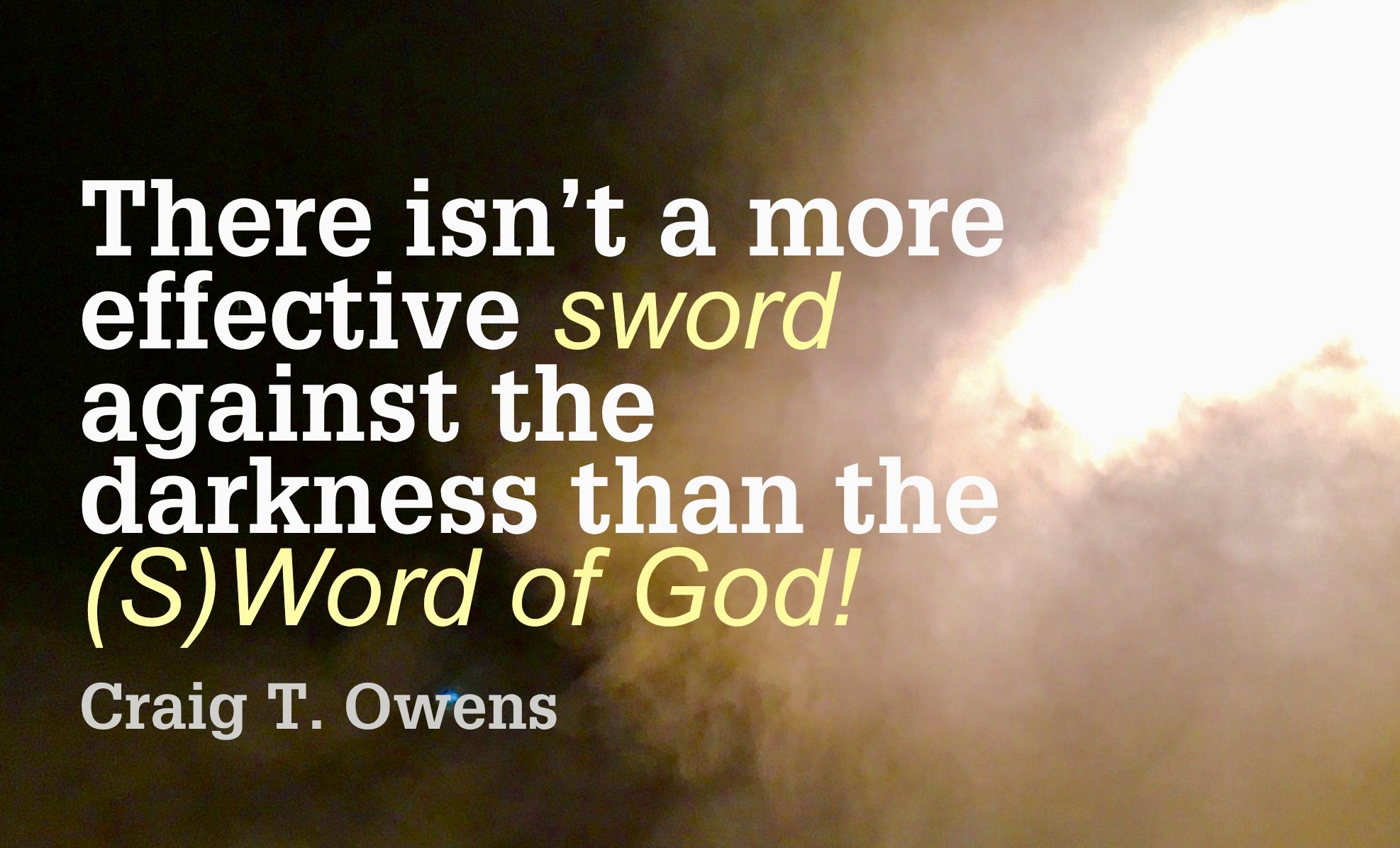
When we worship God and sing our grateful praise to Him, we put the sword of God in our mouths. And there isn’t a more effective sword against the darkness than the (S)Word of God (Hebrews 4:12; Revelation 1:16; Ephesians 6:17)!
Paul told the church at Colosse that singing our praise to God with other saints was an encouragement to all who heard those worshipful songs (Colossians 3:15-17).
So when the ambushers are surrounding you, use your thankful songs as a shield, as a sword, and as an encouragement to others!
If you’ve missed any of the other messages in our series The Great Attitude of Gratitude, you can find them all here.
Listen to the podcast of this post by clicking on the player below, and you can also subscribe on Apple, Spotify, or Audible.
An expert in Jewish law asked Jesus, “What must I do to inherit eternal life?”
Jesus, knowing this man was an expert in the law, turned the question back on him, “What do you think is written in the law about this?”
This man quoted to Jesus two passages in the mosaic law, and Jesus told him, “You have answered correctly. If you do that you will have eternal life.”
The two things he quoted were loving God with all your heart, soul, mind, and strength, and loving your neighbor as yourself. But then comes an interesting phrase. Luke writes that, “He wanted to justify himself, so he asked Jesus, ‘And who is my neighbor?’” This tells me that this expert in the law was trying to figure out the least that he could do to be approved by God.
In answer to his question, Jesus told the story that we now refer to as the parable of the good Samaritan. The Samaritan didn’t measure his love by the least he could do, and he didn’t limit himself to doing only what was comfortable or convenient. In fact, he didn’t measure his response at all—he simply did what was needed without any thought of the cost.
We often use WWJD to ask ourselves, “What would Jesus do?”
Since Jesus embodied love, maybe a more clarifying question would be WWLD—What would love do?
Maybe we could combine this with the Golden Rule. If I was in need, how would I want my neighbor to treat me? Then, as Jesus said to the expert in the law, “Go and do likewise to all your neighbors.” This is what pleases God and glorifies Jesus.
(Read this whole account for yourself in Luke 10:25-37.)
Perhaps a good prayer for us would be: Heavenly Father, I want to love the way Jesus loved. Help me to do what Love would do in all my interactions with my neighbors today. Father, be glorified in my neighborly responses today. I want to follow the example Jesus gave me, so I pray this prayer in His name. Amen.
Listen to the podcast of this post by clicking on the player below, and you can also subscribe on Apple, Spotify, or Audible.
Gratitude is a great attitude. It sets you apart from the crowd of complainers, and it causes people to ask, “What do you know that we don’t know?”
Wouldn’t you just love to silence the complainers in your life? Maybe you can relate to this poem by Shel Silverstein called Complainin’ Jack—
This morning my old jack-in-the-box
Popped out—and wouldn’t get back-in-the-box.
He cried, “Hey, there’s a tack-in-the-box,
And it’s cutting me through and through.
“There also is a crack-in-the-box,
And I never find a snack-in-the-box,
And sometimes I hear a quack-in-the-box,
‘Cause a duck lives in here too.”
Complain, complain is all he did—
I finally had to close the lid.
Since, as Christians, we can’t really “close the lid” on the complaining people around us, maybe there’s something else we can do. I can think of three possibilities.
We could entirely avoid complaining people. But to do this wouldn’t allow us to live our lives as the salt and light Jesus called us to (Matthew 5:13-16). After all, in order for salt to season or light to drive away darkness, the salt and light have to be in close proximity to those they are helping.
We could simply ignore the negativity. Be around it, but do nothing about it. But both Paul and Jesus call us to engage with people in a way that points them to the Good News of the Gospel (Philippians 2:14-16; Matthew 28:19).
If we cannot avoid complainers nor remain apathetic about them, we must find a way to engage them but protect our hearts in the process.
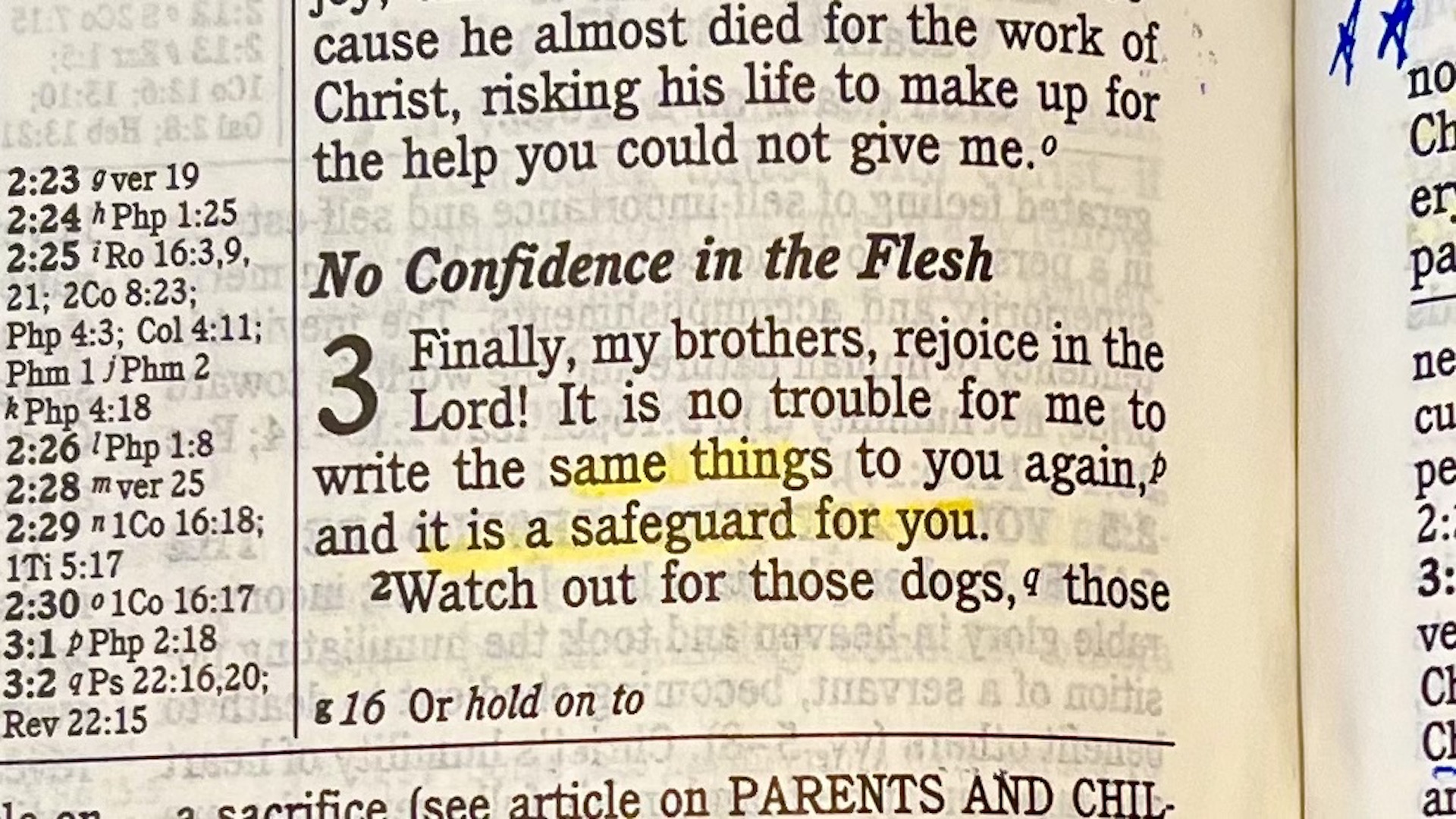
We learn from the apostle Paul’s letter to Philippi that gratitude is our shield against anything that would seek to steal our joy! “Further, my brothers and sisters, rejoice in the Lord! It is no trouble for me to write the same things to you again, and it is a safeguard for you” (Philippians 3:1).
In the Greek, the root word for “safeguard” means “fail.” But when we add the prefix it becomes cannot fail! So rejoicing makes us secure, firm, reliable.
Quite simply that means that gratitude is our attitude protector because gratitude is our shield against anything that would seek to steal our joy!
Jesus used the same word for rejoicing even when we are facing insults, exclusion, and persecution—
Blessed are you when people hate you, when they exclude you and insult you and reject your name as evil, because of the Son of Man. Rejoice in that day and leap for joy, because great is your reward in heaven. For that is how their ancestors treated the prophets. (Luke 6:22-23)
Both Jesus in this passage and Paul in Philippians 3:1 remind us that our rejoicing is IN the Lord. We are not expected to rejoice in our circumstances, but in who God is for us. Matthew Henry noted, “The more we rejoice in Christ the more willing we shall be to do and to suffer for Him, and the less danger we shall be in of being drawn away from Him.”
I also like both the proactive and reactive use of rejoicing that John Henry Jowett identifies when he says, “Gratitude is a vaccine, an antitoxin, and an antiseptic.” Rejoicing is never supposed to be a one-and-done action, but it is an ongoing lifestyle. As Paul wrote to the Christians in Philippi just a few verses later, “Rejoice in the Lord always. I will say it again: Rejoice!” (Philippians 4:4).
Gratitude is a shield—a vaccine, an antitoxin, and an antiseptic—but it doesn’t protect us unless we use it!
In order to use this shield whenever it’s needed, we have to be constantly reminded to be grateful. This is where we can leverage the power of our brain’s reticular activating system. I shared a short video about how to do this on The Podcast last week—check it out here.
Gratitude is a great attitude, and grateful people are a winsome testimony of God’s love and provision to those “complainin’ Jacks” we all encounter. Try it and see what a difference it will make with those you are around this week.
Listen to the podcast of this post by clicking on the player below, and you can also subscribe on Apple, Spotify, or Audible.
Say the word “confrontation” and many people cringe. “I try to avoid confrontations with others,” people will quickly say.
The origin of the word comes from a derivative of the word for “forehead.” The original intent of confrontation was simply putting the facts in front of someone’s face so that they could acknowledge them.
The problem for most of us (myself included) is two-fold:
I don’t like to be confronted with things I may be doing incorrectly or incompletely.
I don’t like making others defensive when I confront them with the things they may be doing incorrectly or incompletely.
As a result, we usually don’t confront others and they usually don’t confront us. Sadly, this can keep us from maturing in areas where we may be able to soar if we could only make some minor changes.
Christians should be especially open to confrontation from a brother or sister. After all, Solomon told us, “Wounds from a friend can be trusted, but an enemy only multiplies kisses” (Proverbs 27:6). And Jesus warned us, “Woe to you when all men speak well of you, for so did their fathers to the false prophets” (Luke 6:26 NKJV).
The best confrontation is self-confrontation in the presence of the Holy Spirit. After we have submitted to that loving spotlight, then we can proceed with our loving confrontation with our brothers and sisters.
Remember this:
The goals of Christian confrontation are restoration and maturity.
We want to see wandering saints return to God’s path, and we want those saints who are immature to blossom into Christ-like maturity that brings glory to God.
I have prepared a flowchart that can help you with a biblical framework for the work of confrontation. Please work through this flowchart slowly and prayerfully. Don’t rush any step, but make sure you can answer an honest “yes” to each question. When you get to the last step, keep in mind these three Ms:
Maturity—self-confrontation and confrontation of others should always be moving us toward maturity.
Mutual accountability—agree to stay involved in this process, with each of you remaining accountable to each other.
Listen to the podcast of this post by clicking on the player below, and you can also subscribe on Apple, Spotify, or Audible.
Of all the things that rob a Christian of peace and robust mental health, stress has to be near the top of the list. There are so many stressors in our lives that to not find a way to actively de-stress is to choose to remain stressed. This is sort of like fertilizing the weeds, as we learned in our second mental health strategy.
A certain amount of stress is good for us—doctors call this eustress. Our bodies have been designed by God with a hormone called cortisol that helps us respond to stressful situations, and He also designed that the unused cortisol be flushed from our bodies as we sleep and exercise. However, when we become stressed, many times sleep and exercise are squeezed out of our lives.
Men’s Health magazine reported, “You personally may dictate when you’ll die. After studying 1633 men for 30 years, Purdue scientists found that worrying takes 16 years off your life. Negative thinking triggers the release of cortisol, a stress hormone that can be dangerous when elevated for long periods of time.”
The eustress can degrade into distress if we’re not attentive to this downward slide. The excess cortisol that is allowed to remain in our bodies leads to unhealthy responses—like sleeplessness, starvation or binge eating, and little to no exercise. These unhealthy factors are further exacerbated by our diminished coping skills that come from the damage done to the hippocampus in our brain. Lingering cortisol kills the neurons in this memory center of our brains, which makes it harder for us to recall past lessons that could help us resolve stress.
Sadly, distress can become its own downward cycle as the unhealthy responses and diminished coping skills negatively impact our lives, creating even more stressors.
Stress makes us:
Self-focused
Short-sighted
Stingy with our time, possessions, and even God’s promises
But there is a word of hope for us. William James noted, “The greatest weapon against stress is our ability to choose one thought over another.”
I want to give you one thought—one word, one action—to combat stress: Bless.
Blessing others takes the focus off myself. Blessing God puts the focus on Him.
In the Gospels, we see people who had suffered the ravages of stress, encounter Jesus, find freedom, and then begin to bless others as a preventative to returning to their stress-filled lives. We can see a few examples in healed women, a man delivered from demons, and a woman who had lived a less-than-virtuous life (Luke 8:1-3, 26-39; 7:36-50).
Frequently, the Old Testament psalmists shared how blessing God and others brought them out of their stressful situations. A great example comes from David when he chose to bless God in a stressful place, and ended up being a blessing to other afflicted people around him (Psalm 34:1-6).
Instead of remaining self-focused we become others-focused
Instead of being short-sighted we get a big-picture orientation
Instead of being stingy with our possessions and God’s promises we become generous
Remember that in the distress cycle I mentioned earlier the brain cells in the hippocampus were being damaged? The excess cortisol literally kills those neurons. The good news is that the hippocampus is one of the few places in the brain that experiences neurogenesis after cortisol is flushed. When you replace stressing with blessing, and the cortisol is regularly flushed from your body, brain cells are regenerated in your hippocampus. In essence, you are developing both a new brain and a new mind.
The apostle Paul wrote, “Put off, concerning your former conduct, the old man which grows corrupt according to the deceitful lusts, and be renewed in the spirit of your mind, and that you put on the new man which was created according to God, in true righteousness and holiness” (Ephesians 4:22-24 NKJV).
Don’t let stress steal life from your years and years from your life. De-stress by blessing God and blessing those around you.















 Craig T. Owens