“When we are foolish and young, we need more rules. As we mature, we can be trusted with extended boundaries. The wiser we are, the more we appreciate those boundaries and the less they offend us. Offense at law, accountability, hedges, and boundaries is an indicator of immaturity. The wiser we are, the more unafraid and appreciative we are of those who hold us to account.” —Dick Brogden, in Proverbs: Amplified and Applied
“When public policy begins to encroach on the Christian’s freedom and duty to proclaim the Good News, or to bring the benefits of the Gospel to the community, believers must continue our mission nonetheless and be ready to bear whatever punishments those in authority may choose to inflict. Christians do not seek suffering, but we must not shun it, particularly when by our suffering we can work for public policies more in line with the centrality of the Gospel for the wellbeing of all people.” —T.M. Moore
The Golden Rule—treat others as you would want to be treated—applies to the way you treat yourself too. Stop beating yourself up when you make a mistake. You probably don’t beat up others when they stumble, so extend the same grace to yourself. Practice healthy, affirming self-talk. Check out this full conversation from episode 68 of The Craig And Greg Show.
“A thought, a sword, and a spade should never be allowed to rust.” —Irish Proverb
Dr. C. John “Jack” Collins uses some thoughts from C.S. Lewis to help us learn a little better how to read Genesis 1-11. He writes, “We should approach any biblical passage with the conviction that God inspired the Bible to be the right tool for its job. If we can get a good idea of what kind of tool our passage is, we can discern what job God intended it to perform. And that means we need to be willing to adjust what we’re looking for and be willing to find other ways of addressing some questions.”
“Failure to pray is simple unbelief. We must repent of our unbelief and take up the work of prayer with greater devotion and dedication. We shall not be able to realize progress in Christ’s Kingdom, or in returning our nation to a greater experience of justice and goodness, apart from prayer. Prayer is the starting point for public policy. Prayer must be the sustaining power of public policy. And prayer in the form of worship will be the outcome of public policies, forged in prayer, which lead to a peaceful, godly, dignified, true, and Gospel-friendly society.” —T.M. Moore
Listen to the podcast of this post by clicking on the player below, and you can also subscribe on Apple, Spotify, or Audible.
An expert in Jewish law asked Jesus, “What must I do to inherit eternal life?”
Jesus, knowing this man was an expert in the law, turned the question back on him, “What do you think is written in the law about this?”
This man quoted to Jesus two passages in the mosaic law, and Jesus told him, “You have answered correctly. If you do that you will have eternal life.”
The two things he quoted were loving God with all your heart, soul, mind, and strength, and loving your neighbor as yourself. But then comes an interesting phrase. Luke writes that, “He wanted to justify himself, so he asked Jesus, ‘And who is my neighbor?’” This tells me that this expert in the law was trying to figure out the least that he could do to be approved by God.
In answer to his question, Jesus told the story that we now refer to as the parable of the good Samaritan. The Samaritan didn’t measure his love by the least he could do, and he didn’t limit himself to doing only what was comfortable or convenient. In fact, he didn’t measure his response at all—he simply did what was needed without any thought of the cost.
We often use WWJD to ask ourselves, “What would Jesus do?”
Since Jesus embodied love, maybe a more clarifying question would be WWLD—What would love do?
Maybe we could combine this with the Golden Rule. If I was in need, how would I want my neighbor to treat me? Then, as Jesus said to the expert in the law, “Go and do likewise to all your neighbors.” This is what pleases God and glorifies Jesus.
(Read this whole account for yourself in Luke 10:25-37.)
Perhaps a good prayer for us would be: Heavenly Father, I want to love the way Jesus loved. Help me to do what Love would do in all my interactions with my neighbors today. Father, be glorified in my neighborly responses today. I want to follow the example Jesus gave me, so I pray this prayer in His name. Amen.
Listen to the podcast of this post by clicking on the player below, and you can also subscribe on Apple, Spotify, or Audible.
If we’re not careful, we can get so focused on our own appointments that we will miss out on the amazing opportunities God sends our way to show His love to others.
Check out this episode and subscribe on YouTube so you can watch all of the upcoming episodes. You can also listen to our podcast on Spotify and Apple.
Listen to this post as a podcast by clicking here:
If it is true that I have gone astray, my error remains my concern alone (Job 19:4).
Why do we find it necessary to stick our noses in where they are not wanted? Why do we feel like the other person needs to hear our opinion?
The law dictionary defines “standing” as the right to file a lawsuit or file a petition under the circumstances. In legal terms, Job’s three friends had no standing to bring charges against him. Job himself even said he didn’t want to hear their opinions. Instead, all Job asked for was, “Have pity on me, my friends, have pity.” He goes on to ask, “Why do you pursue me as God does? Will you never get enough of my flesh?”
And then Job gives this warning: “If you say, ‘How we will hound him, since the root of trouble lies in him,’ you should fear the sword yourselves.” Despite this warning, Zophar still begins his argument by stating, “I hear a rebuke that dishonors me so I have to speak up.”
There are indeed times when our friends may be going astray and the loving thing we can do for them is speak a word of truth, but that is something entirely different than feeling compelled to share an opinion or sticking our noses in where they don’t belong. A good question to ask ourselves before speaking: Do I have standing here?
Far better for us to apply the Golden Rule this way: Treat others in their condition the way I would want to be treated in the same condition. And if I do feel as though I have standing, and need to speak a loving word, I need to examine myself first.
Job tells his friends, “You are miserable comforters, all of you!” (16:2). One of the best things they did for him was to simply sit silently in mourning alongside him. It was when they felt compelled to argue that they not only disappointed Job, but they dishonored God too.
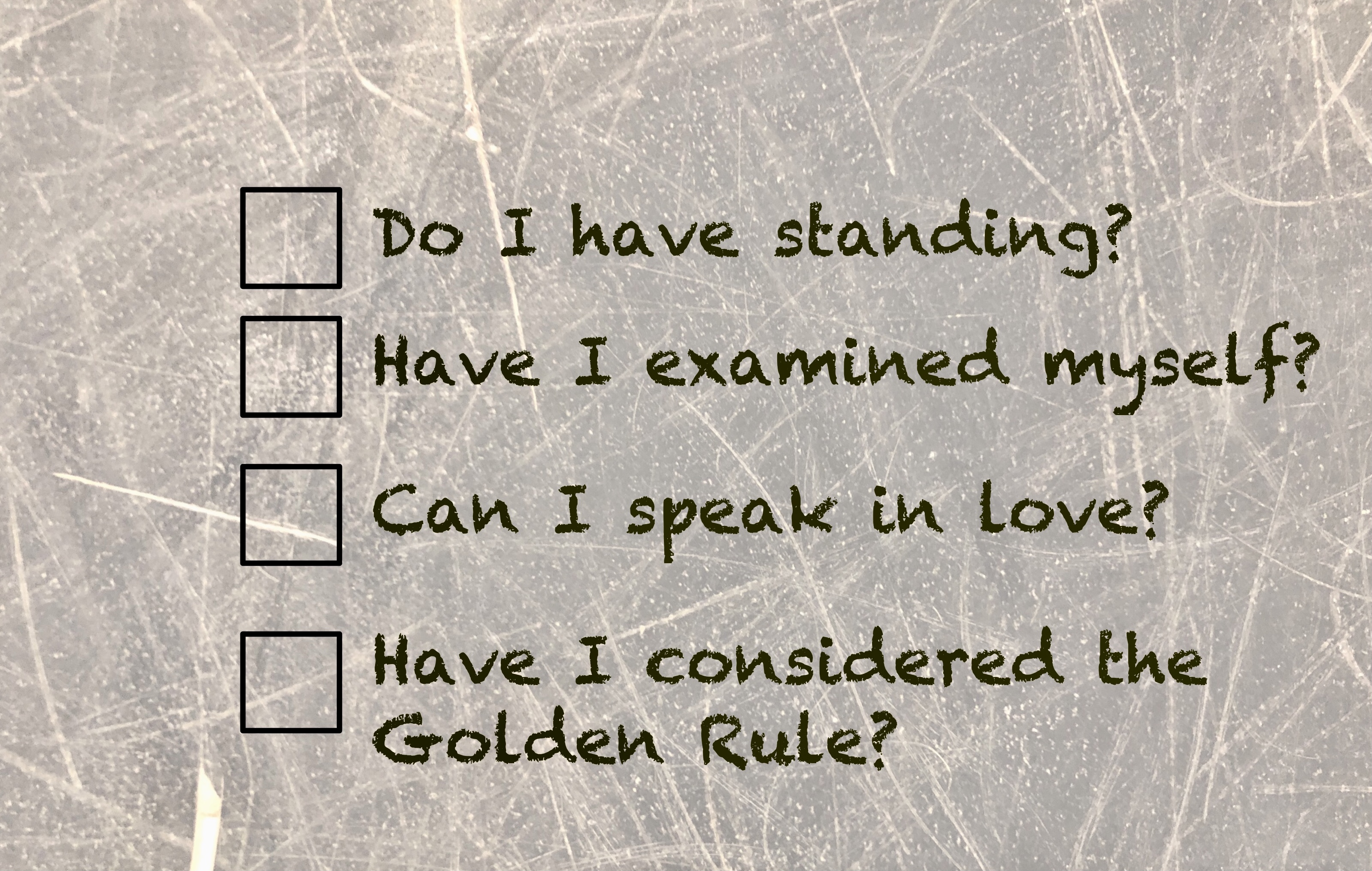
My checklist before speaking:
Do I have standing?
Have I examined myself?
Can I speak truth in love (and not just air my opinion)?
Have I considered the Golden Rule?
If I can answer “Yes” to all four questions, then speak; otherwise, it’s far more loving to remain silent.
Here’s the seed thought for this episode of Think On This…
Do to others what you would like them to do to you. (Matthew 7:12)
Think on this: Do I apply the Golden Rule negatively (just trying to avoid offending)? Or do I apply it positively (creatively trying to find ways to help others)?








 Craig T. Owens
Think On This…
September 4, 2020 — Craig T. OwensDo to others what you would like them to do to you. (Matthew 7:12)
Think on this: Do I apply the Golden Rule negatively (just trying to avoid offending)? Or do I apply it positively (creatively trying to find ways to help others)?
Share this: