The Nearness Of God

I think too often we’re in too big of a hurry when we read the Bible. 

Think with me for a moment how much longer it takes to sing the lyrics of a heart-stirring song than it does to just say the words. The psalms were written as songs, and although the melodies that accompanied them have been lost to the pages of history, we would still do well to move more slowly and deliberately and passionately through these inspired songs. 

Let’s slowly consider Psalm 46 from four different perspectives…

First, as a pause from the noise. Selah can be used three different ways: (1) a pause to reflect; (2) a deep breath to crescendo into something bigger; or (3) a contrast between two very different things. There are three selahs in this psalm, and all of them call us to a pause from something noisy. To pause from…

    • natural upheavals—the earth gives way, the mountains fall, the waters roar, the mountains quake
    • political upheavals—nations are in an uproar, kingdoms fall 
    • religious upheavals—God has to serve the judgment of desolation, as He breaks the bow, shatters the spear, burns the shield

Selah/Pause from these upheavals and reflect—God is our refuge … the Lord Almighty is with us.

Second, notice the contrasts. The songwriter takes us to man’s mountains that fall and quake, but reminds us that THE mountain of God is our sure fortress. In the imagery of water, we see man’s attempts at refreshing that are roaring and foaming, but we also see God’s river that brings life and makes people glad. And look at how man’s use of power results in an uproar, but God makes wars to cease. 

Selah/Pause and reflect—aren’t God’s ways better than man’s ways? 

Third, notice the nearness of God. Twice the songwriter reminds us “The Lord Almighty is with us.” And then we hear God Himself speak to our anxiety-prone hearts, “Be still and know that I am God.” Those words “be still” can also mean “let go.” Let go of earthly things, negative voices, fears, trying to control events. If your hands are full of that, how can you grab onto God?! 

Selah/Pause and reflect—God is calling me to go—and stay—near to Him! 

Fourth, see how God’s peace and protection surrounds AND permeates me. In our Western literature, we are used to the climax—or the payoff—being at the end of the story. The story builds and then comes to a conclusion where the hero prevails. But in Hebrew poetry, the climax—or the payoff—is typically in the middle. So when we read Psalm 46, it’s tempting to say, “Hallelujah! Verse 11 says God is my fortress. That’s the climax, the payoff!” But really the payoff—the most important part—is the middle. In this psalm, that is verse 6. Everything else builds to this and radiates out from this. 

Read this psalm for yourself by reading the verses in this order: 6, 5, 7, 4, 8, 3, 9, 2, 10, 1, 11.

Selah/Pause and reflect—God is not only IN me, He also surrounds me. I’m invited to come close to Him because He is already in me. Nations rage, but His voice in my heart silences the upheaval. He is with me. He is the Most High Sovereign God that controls the outcome of all nations. Earth quakes and kingdoms rumble, but I will have no fear; I will be still and know He is God. He is my refuge, my strength, my help, my fortress! 

Don’t rush the reading of the Psalms. Slowly “sing” these inspired lyrics and listen to how the Holy Spirit will whisper to your heart. 

I’ll be continuing our series on the Selahs in the Psalms this Sunday, and I would love to have you join me. 

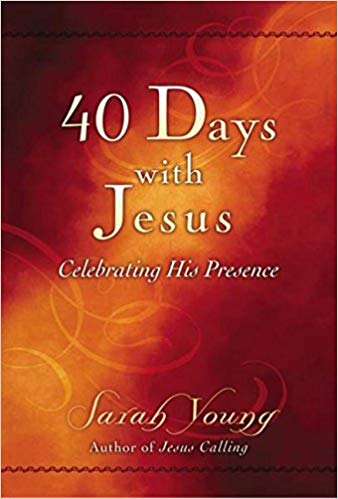
40 Days With Jesus (book review)

Martin Luther said, “The Bible is alive, it speaks to me.” Truly, the Bible is God’s Word speaking to us every time we peer into its pages, so I love how Sarah Young strings passages of Scripture together to allow us to hear Jesus speaking to us in a first-person voice. 

40 Days With Jesus was designed as a series of readings during the Lenten season, as we walk with Jesus to the Cross and His resurrection from the dead. But any time is a good time when we can walk with Jesus and hear His unmistakable voice reassuring our hearts. 

Are you walking through a dark time in your life? Know that Jesus is walking with you. 

Do you want to live a life of purpose and lasting value? Listen to Jesus counsel you. 

Are you standing at a crossroads trying to make the right decision? Let Jesus point the way. 

Each time I read a Sarah Young book, it reignites my heart to read the Bible as though Jesus is personally speaking to me. Because He is! 

40 Days With Jesus is a great starting point for you to learn to hear Jesus speaking to you every time you open your Bible. The Holy Spirit will then use those words read in your quiet time to continue to bring you direction and reassurance all throughout your day (John 14:26). 

I highly recommend this book (or any other book by Sarah Young)!

Does Self-Help Get God’s Help?

This is part 1 in our series looking at phrases that sound biblical and then asking, “Is that in the Bible? 

Statement #1—God helps those who help themselves. Is that in the Bible? No, it is not! 

The reason why I think people have accepted this as biblical is an incorrect view of God. 

  1. Humanism says God is us, which makes us believe, “If it’s going to be, it’s up to me.” 
  2. Fatalism says there is no God and therefore no meaning to life, which makes us believe, “The outcome is what it is and no one has any say in the matter.” 
  3. Deism says there is a God, but it’s hard to get His attention, which makes us believe “He is either disinterested in me or unapproachable. He’s only available for the ‘big’ things.” 

The Bible flat-out rejects all three of these isms. 

Instead, we see a loving, approachable God. One who is both all-powerful and all-loving. He says things like…

  • I made you and know everything about you, and I remain infinitely interested and intimately involved in your life 
  • Come to Me and I will give you rest
  • I want you to cast all your anxieties on Me
  • Don’t be anxious about anything, but tell Me about everything that troubles you (Psalm 139:1-18; Matthew 11:28-29; 1 Peter 5:7; Philippians 4:6)

Not only is “God helps those who help themselves” untrue, but the exact opposite is also true—God helps those who cannot help themselves! 

In Isaiah 40:28-29, we read that God gives strength to the weary and increases the power of the weak. 

“Yes, it is our strength, not our weakness, that is our hindrance and stumbling block.” —Horatius Bonar 

God gives power to the weak. He gives strength to those with no might of their own. God does NOT help those who think they can help themselves! God helps those who cannot help themselves! This is what Jesus came to do, and why we should rejoice in the fact that He does indeed help those who could never rescue themselves (Isaiah 53:4-5; 2 Corinthians 12:9)!

It is our can’ts that God uses as His opportunities to show how limitless He is. Our limitations magnify His love and His power. 

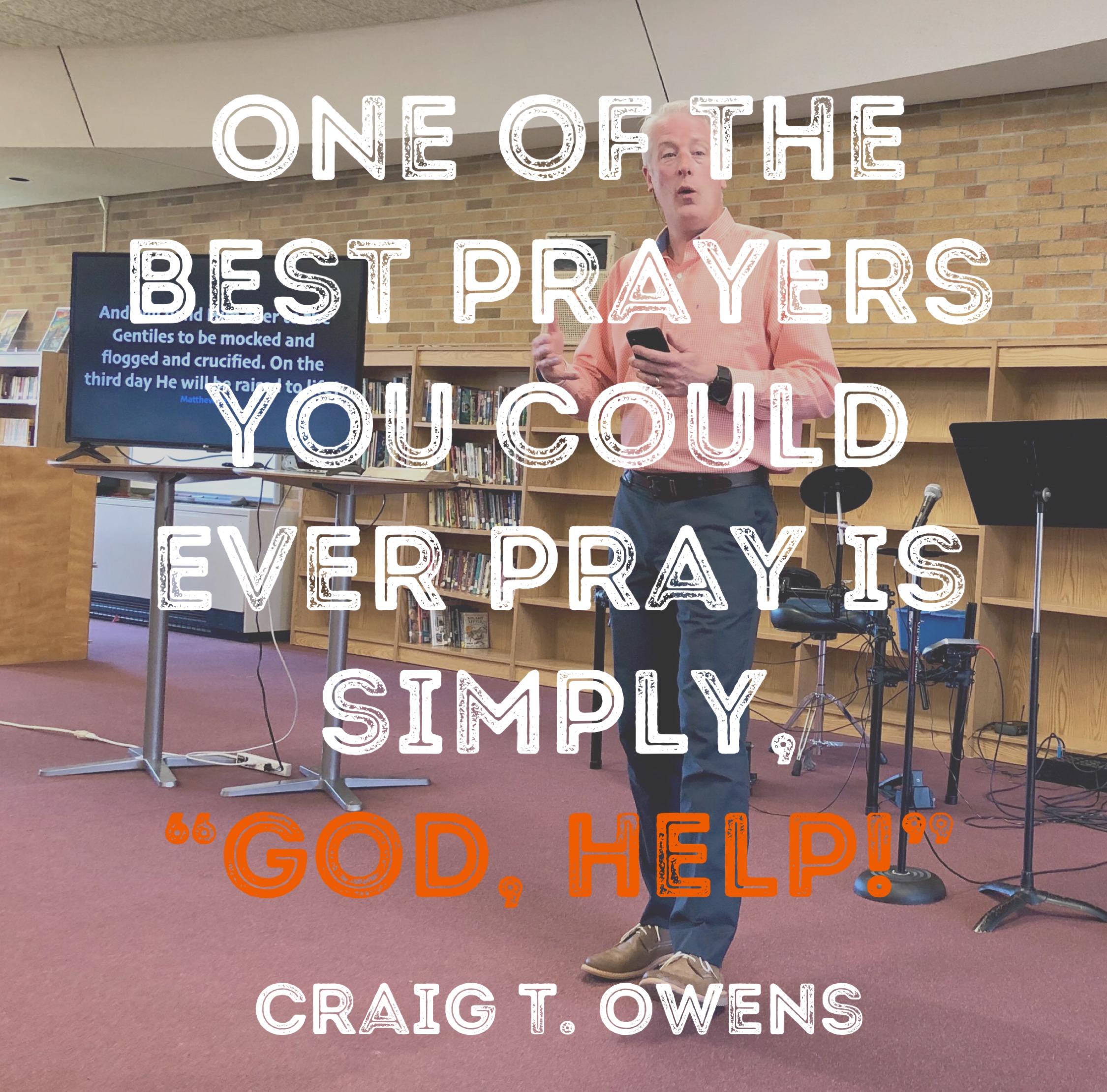
One of the best prayers you could ever pray is simply, “God, help!” This simple prayer acknowledges in just two words that you can’t but He most assuredly can! 

But those who wait for the Lord—who expect, look for, and hope in Him—shall change and renew their strength and power; they shall lift their wings and mount up close to God as eagles mount up to the sun; they shall run and not be weary, they shall walk and not faint or become tired. (Isaiah 40:31 AMP) 

Join me next week as we continue to explore various statements and ask, “Is that in the Bible? 

A Very Present Help

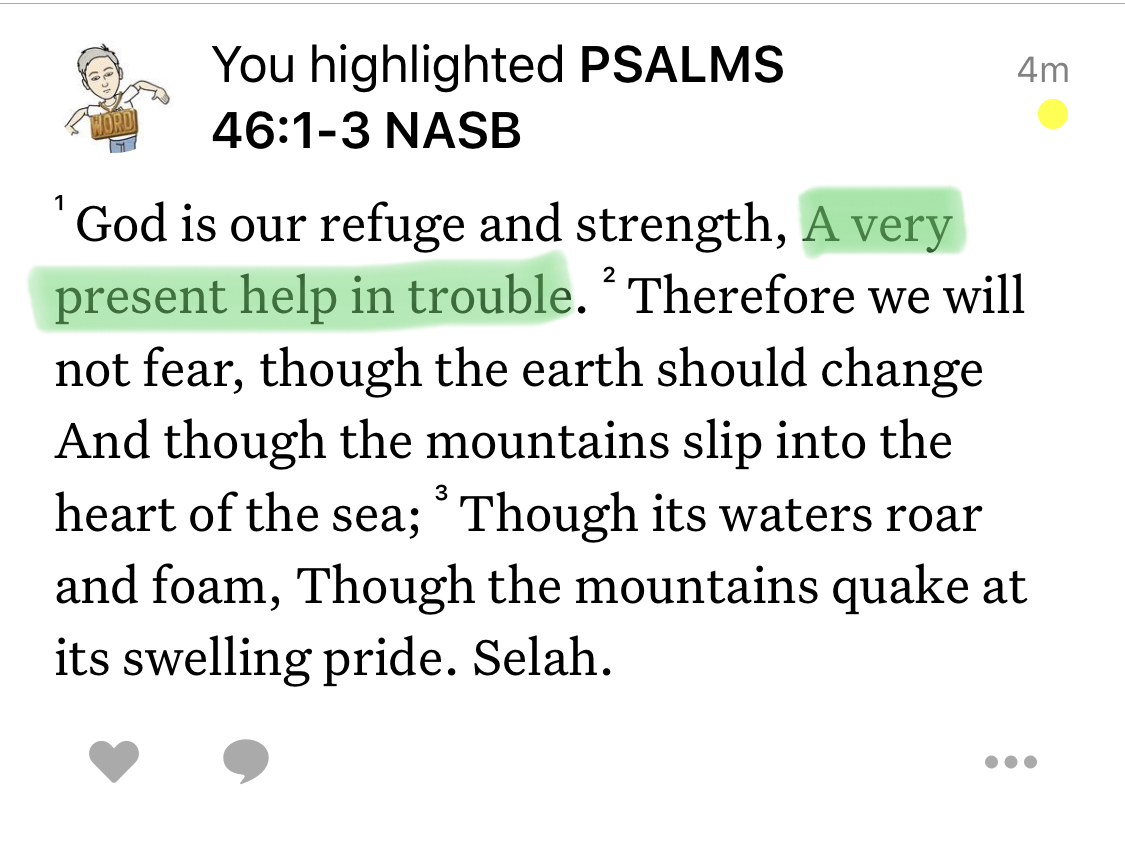
God is our refuge and strength, a very present help in trouble. (Psalm 46:1)

God is not just present—He is very present! 

God is not merely in the room with you, He is fully attentive to you. He’s never distracted, preoccupied, or disinterested. 

Regardless of the quaking or roaring around you, He is so very present that He knows your quietest sigh. You don’t have to look anywhere else for help because He is VERY present at this VERY moment. 

The rest of this psalm reiterates this promise:

  • God is in the midst
  • God will help
  • The Lord of hosts is with us
  • God is our stronghold 

God Himself speaks the words of the natural conclusion we should draw when we realize that He is VERY present at this VERY moment—

“Be still, and know that I am God!”

Stable In Any Circumstance

“Unstable people let circumstances control how they feel—cheerful in sunshine but depressed in rain. And this is the way of the unsound heart. A few trying situations weaken his spirit and destroy him as a cold winter kills feeble bodies. Afflictions, however, help the Christian grow by uniting him even more closely with Christ. Trouble sends him straight to the arms of the Lord, as the bee flies to her hive in a storm. He is glad who has such a comfortable pillow as the lap of Jesus.” —William Gurnall, in The Christian In Complete Armor

Poetry Saturday—God, Thou Art Love

If I forget,
Yet God remembers! If these hands of mine
Cease from their clinging, yet the hands divine
Hold me so firmly that I cannot fall;
And if sometimes I am too tired to call
For Him to help me, then He reads the prayer 
Unspoken in my heart, and lifts my care.

I dare not fear, since certainly I know
That I am in God’s keeping, shielded so 
From all that else would harm, and in His power;
I tread no path in life to Him unknown;
Lift no burden, bear no pain, alone.
My soul a calm, sure hiding place has found:
The arms my life surround.

God, Thou art love! I build my faith on that.
I know Thee who has kept my path and made
Light for me in the darkness, tempering sorrow
So that it reached me like a solemn joy;
It were too strange that I should doubt Thy love. —Robert Browning

When Fear Must Go

Listen to the podcast of this post by clicking on the player below, and you can also subscribe on AppleSpotify, or Audible.

I love the balancing thought of being humbly confident in God’s presence (or if you like: being confidently humble).

Humble to know I have nothing in myself that gives me access to God’s presence and love and power, but confident to know that God through Christ’s work on the Cross desires to have me with Him. 

C.S. Lewis wisely noted: “Humility is not thinking less of yourself, it’s thinking of yourself less.” Fear comes in when I’m thinking about me—how unworthy I am, how I messed up, how I wish I would have….

Fear leaves when I set my thoughts on Christ—how absolutely worthy He is, how He has accomplished everything for me, how He is working all things together for good. 

There is no fear in love—dread does not exist—but full-grown, complete, perfect love turns fear out of doors and expels every trace of terror! For fear brings with it the thought of punishment, and so he who is afraid has not reached the full maturity of love—is not yet grown into love’s complete perfection. (1 John 4:18)

It is humbly confident (and confidently humble) to keep my mind off me and take all my thoughts to His perfect love. That’s when fear must go!

“The mark of God’s people is not incapacitating fear, but rather contrite courageous confidence in God. … The good news of the Bible is not that we are not worms, but that God helps worms who trust Him.” —John Piper, commenting on Isaiah 41:14

►► Would you please prayerfully consider supporting this ministry? My Patreon supporters get behind-the-scenes access to exclusive materials. ◀︎◀︎

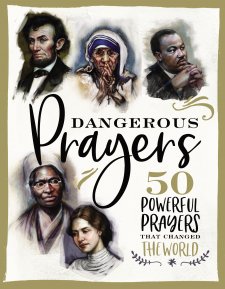
8 Prayers From “Dangerous Prayers”

Dangerous Prayers give a brief biography of 50 culture-shifting people, and the world-changing prayers they prayed. Check out my full book review by clicking here, and then enjoy just a few of the prayers from this excellent book. 

“Listen to my supplication, Master, so that my soul doesn’t stagger under Your instruction, so that I don’t stumble in testifying to Your mercies, by which You tore me away from all my ruinous pathways. Thus You’ll grow sweet to me beyond all that led me wrong, in my willingness to follow it. Thus I’ll love You most mightily, and grasp Your hand with all the strength of my inmost being. Thus You’ll tear me away from every trial, clear to the end.” —Augustine 

“Restore me to liberty, and enable me so to live now that I may answer before Thee and before the world. Lord, whatever this day may bring, may Thy name be praised. Amen.” —Dietrich Bonhoeffer, while awaiting execution in a Nazi concentration camp 

“Give us grace, O God, to dare to do the deed which we well know cries to be done. Let us not hesitate because of ease, or the words of men’s mouths, or our own lives. Mighty causes are calling us—the freeing of women, the training of children, the putting down of hate and murder and poverty—all these and more. But they call with voices that mean work and sacrifice and death. Mercifully grant us, O God, the spirit of Esther, that we may say: ‘I will go unto the king and if I perish, I perish.’” —W.E.B. DuBois 

“Because we have need continually to crave many things at Your hands, we humbly beg You, O heavenly Father, to grant us Your Holy Spirit to direct our petitions, that they may proceed from such a fervent mind as may be agreeable to Your holy will.” —John Knox 

“O keep us, we beseech Thee, Lord, for without Thy keeping we cannot keep ourselves.” —Charles Spurgeon 

“Oh Jesus, You who suffer, grant that today and every day I may be able to see You in the person of Your sick ones and that, by offering them my care, I may serve You. Grant that, even if You are hidden under the unattractive disguise of anger, of crime, or of madness, I may recognize You and say, ‘Jesus, You who suffer, how sweet it is to serve You.’” —Mother Teresa 

“I now make it my earnest prayer, that God would have you, and the State over which you preside, in His holy protection, that He would incline the hearts of the Citizens to cultivate a spirit of subordination and obedience to Government, to entertain a brotherly affection and love for one another, for their fellow Citizens of the United States at large, and particularly for their brethren who have served in the Field, and finally, that He would most graciously be pleased to dispose us all, to do Justice, to love mercy, and to demean ourselves with that charity, humility, and pacific temper of mind, which were the Characteristics of the Divine Author of our blessed Religion, and without an humble invitation of whose example in these things, we can never hope to be a happy Nation.” —George Washington 

“God give me a deep humility, a well-guided zeal, a burning love, and a single eye, and then let men or devils do their worst.” —George Whitefield 

10 More Quotes From “Yours, Jack”

I love reading C.S. Lewis’ books, and I loved learning more about Lewis himself through his personal correspondence. Here are a few more quotes from Yours, Jack. 

“Indeed the best thing about happiness itself is that it liberates you from thinking about happiness—as the greatest pleasure that money can give us is to make it unnecessary to think about money. And one sees why we have to be taught the ‘not thinking’ when we lack as well as when we have.” 

“Read your New Testament (preferably a modern translation) intelligently. Pray for guidance, obey your conscience, in small as well as great matters, as strictly as you can. Don’t bother much about your feelings. When they are humble, loving, brave, give thanks for them: when they are conceited, selfish, cowardly, ask to have them altered. In neither case are they you, but only a thing that happens to you.”

“The Bible itself gives us one short prayer which is suitable for all who are struggling with the beliefs and doctrines. It is: ‘Lord, I believe, help Thou my unbelief.’ Would something of this sort be any good: Almighty God, who art the Father of lights and who has promised by Thy dear Son that all who do Thy will shall know Thy doctrine: give me grace so to live that by daily obedience I daily increase in faith and in the understanding of Thy Holy Word, through Jesus Christ our Lord. Amen.” 

“I would prefer to combat the ‘I’m special’ feeling not by the thought ‘I’m no more special than anyone else’ but by the feeling ‘Everyone is as special as me.’ In one way there is no difference, I grant, for both remove the speciality. But there is a difference in another way. The first might lead you to think, ‘I’m only one of the crowd like anyone else.’ But the second leads to the truth that there isn’t any crowd. No one is like anyone else. All are ‘members’ (organs) in the Body of Christ. All different and all necessary to the whole and to one another: each loved by God individually, as if it were the only creature in existence. Otherwise you might get the idea that God is like the government which can only deal with the people as a mass.” 

“As to the ‘state of the world’ if we have time to hope and fear about it, we certainly have time to pray. I agree it is very hard to keep one’s eyes on God amid all the daily claims and problems. I think it wise, if possible, to move one’s main prayers from the last-thing-at-night position to some earlier time: give them a better chance to infiltrate one’s other thoughts.” 

“One can’t help momentary wishes: guilt begins only when one embraces them. You can’t help their knocking at the door, but one mustn’t ask them in to lunch.” 

“I take it as a first principle that we must not interpret any one part of Scripture so that it contradicts other parts: and specially we must not use an Apostle’s teaching to contradict that of Our Lord.” 

“Any honest workmanship (whether making stories, shoes, or rabbit hutches) can be done to the glory of God.” 

“It is important to keep on giving thanks. Otherwise, as one continues to pray for the others who have not yet been relieved, one simply fails to notice how many of one’s intercessory prayers have been granted—never notices how the list of Thank-you’s grows and perhaps outstrips the list of mere Please’s.” 

“The only thing one can usually change in one’s situation is oneself. And yet one can’t change that either—only ask Our Lord to do so.” 

You can read my review of Yours, Jack by clicking here. And be sure to check out the first set of quotes I shared from this book by clicking here. 

Saturday In The Proverbs—Self-Made People Get Robbed (Proverbs 18)

[Each chapter in the Book of Proverbs contains thoughts that fit into a theme; they are not just random thoughts gathered together. In this “Saturday In The Proverbs” series, I will share a theme that I see in each chapter. But the cool thing about God’s Word is that you may see an entirely different theme. That’s great! If you do, I would love for you to share it in the comments below.]

A man who isolates himself seeks his own desires; he rages against all wise judgment (Proverbs 18:1).

The self-absorbed, self-centered, self-made man only robs himself of…

  • …the wisdom others could give him (vv. 1, 15)
  • …understanding more deeply (vv. 2, 4)
  • …peaceful relationships (vv. 6, 7, 18, 19, 24)
  • …getting the full story (vv. 8, 13, 17)
  • …God’s help (v. 10)
  • …honor (v. 12)
  • …life (v. 21) 

Don’t get ripped off by thinking you already know it all!