Thursdays With Oswald—Prayerful Havoc

This is a weekly series with things I’m reading and pondering from Oswald Chambers. You can read the original seed thought here, or type “Thursdays With Oswald” in the search box to read more entries.

Prayerful Havoc

     There are supernatural powers and agencies of which we are unconscious which, unless we are garrisoned by God, can play with us like toys whenever they choose. The New Testament continually impresses this on us. “For we wrestle not against flesh and blood, but against principalities, against powers, against the rules of the darkness of this world, against spiritual wickedness in high places” (Ephesians 6:12). All that is outside the realm of our consciousness. 

     If we only look for results in the earthlies when we pray, we are ill-taught. A praying saint performs far more havoc amongst the unseen forces of darkness than we have the slightest notion of. “The effectual fervent prayer of a righteous man availeth much.” We have not the remotest conception of what is done by our prayers, nor have we the right to try and examine and understand it; all we know is that Jesus Christ laid all stress on prayer. “And greater works than these shall he do; because I go unto My Father. And whatsoever ye shall ask in My name, that will I do [John 14:12].” 

From Biblical Psychology (emphasis added)

What an amazing reminder! Prayer is doing havoc in the spiritual realm, but much of that realm is outside of my conscious awareness.

Prayer accomplishes much. I may not see it in the earthlies each time I pray, but I must remain confident that my prayers are always heard and always make an impact.

Don’t let the lack of “visible” results keep you from praying. You may not see with your natural eyes what is happening when you do pray, but you can be assured that nothing at all will happen if you don’t pray!

Remember: “A praying saint performs far more havoc amongst the unseen forces of darkness than we have the slightest notion of.”

Preying Or Praying

Listen to the podcast of this post by clicking on the player below, and you can also subscribe on AppleSpotify, or Audible.

I wrapped up our Ticked Off! series yesterday with a sad story. It appears right in the opening pages of the Bible, and it’s a story where one man’s anger preys on him, like a lion on a wounded animal.

Now Able kept flocks, and Cain worked the soil. In the course of time Cain brought some of the fruits of the soil as an offering to the Lord. But Able brought fat portions from some of the firstborn of his flock. The Lord looked with favor on Able and his offering, but on Cain and his offering He did not look with favor. So Cain was very angry, and his face was downcast. 

Then the Lord said to Cain, “Why are you angry? Why is your face downcast?” If you do what is right, will you not be accepted? But if you do not do what is right, sin is crouching at your door; it desires to have you, but YOU MUST MASTER IT.” (Genesis 4:2-7, emphasis added)

We’re not sure exactly why “the Lord looked with favor on Able and his offering, but not on Cain and his offering.” Except we know that the Bible says obedience is better than sacrifice. In other words, it’s not what they brought as a sacrifice, but how they brought their sacrifice. Apparently, Able’s heart was worshipful and Cain’s was begrudging.

Able’s heart was focused on God; Cain’s heart was focused on himself. That’s why Cain became so selfishly angry, because he wasn’t getting what he thought he deserved!

This anger was setting up Cain for disaster. Anger itself is not a sin, but unaddressed anger can put us on a slippery slope toward sin!

Notice God told Cain, “YOU must master it.” God can’t help us until we stop trying to help ourselves. God wants to help us defeat the crouching lion of sin, but we have to ask him to help us.

Sadly, there is no biblical record of Cain asking God for His help. Instead in the next verses Cain—so consumed by his anger that he cannot think straight—murders his own brother. Cain was preyed upon by anger because Cain didn’t pray about his anger.

The devil is looking for any opening at all where he can pounce on you. And Ephesians 4:26-27 says that unaddressed anger is just such an opening. Don’t let your anger defeat you as it did Cain. Confess your anger to God (Psalm 32:1-5) and let God help you defeat the crouching lion of anger.

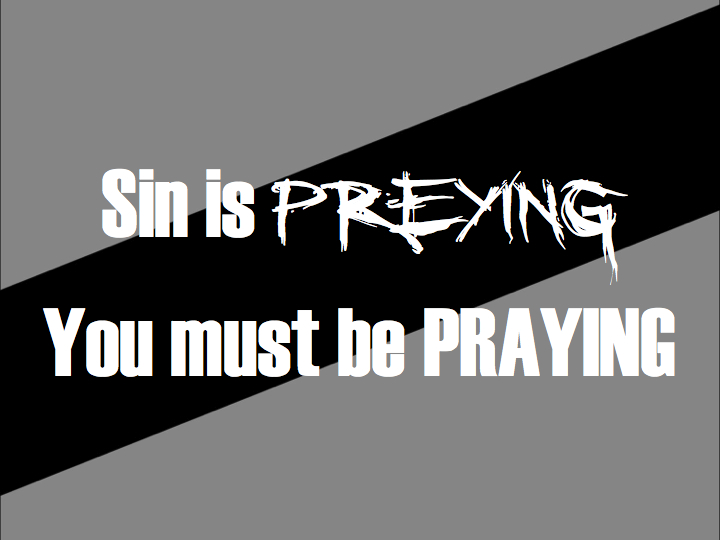
Sin is PREYing. You must be PRAYing.

If you want to check out the other messages in our series called Ticked Off! you may click here.

►► Would you please prayerfully consider supporting this ministry? My Patreon supporters get behind-the-scenes access to exclusive materials. ◀︎◀︎

10 Quotes From “Grace”

Max Lucado’s newest book Grace is a wonderful reminder of how extravagant God is toward us (you can read my full review by clicking here). Here are 10 of my favorite quotes from Grace

“God’s guilt brings enough regret to change us. satan’s guilt, on the other hand, brings enough to enslave us. … It boils down to this choice: Do you trust your Advocate or your accuser?”

“Sin is not a regrettable lapse or an occasional stumble. Sin stages a coup against God’s regime. Sin storms the castle, lays claim to God’s throne, and defies His authority. Sin shouts, ‘I want to run my own life, thank you very much!’ Sin tells God to get out, get lost, and not come back. Sin is insurrection of the highest order, and you are an insurrectionist. So am I. So is every single person who has taken a breath. … God didn’t overlook your sins, lest He endorse them. He didn’t punish you, lest He destroy you. He instead found a way to punish the sin and preserve the sinner. Jesus took your punishment, and God gave you the credit for Jesus’ perfection.”

“Grace-a-lots believe in grace, a lot. Jesus almost finished the work of salvation, they argue. In a rowboat named Heaven Bound, Jesus paddles most of the time. But every so often He needs our help. So we give it. We accumulate good works the way Boy Scouts accumulate merit badges on a sash. … We find it easier to trust the miracle of resurrection than the miracle of grace. We so fear failure that we create the image of perfection, lest Heaven be even more disappointed in us than we are. The result? The weariest people on earth. Attempts at self-salvation guarantee nothing but exhaustion. We scamper and scurry, trying to please God, collecting merit badges and brownie points, and scowling at anyone who questions our accomplishments. Call us the church of hound-dog faces and slumped shoulders. Stop it! Once and for all, enough of this frenzy. ‘Your hearts should be strengthened by God’s grace, not by obeying rules’ (Hebrews 13:9 NCV). Jesus does not say, ‘Come to Me, all you who are perfect and sinless.’ Just the opposite. ‘Come to Me, all who are weary and heavy-laden, and I will give you rest’ (Matthew 11:28 NASB).”

“Give the grace you’ve been given. You don’t endorse the deeds of your offender when you do. Jesus didn’t endorse your sins by forgiving you. Grace doesn’t tell the daughter to like the father who molested her. It doesn’t tell the oppressed to wink at injustice. The grace-defined person still sends thieves to jail and expects and ex to pay child support. Grace is not blind. It sees the hurt full well. But grace chooses to see God’s forgiveness even more. It refuses to let hurts poison the heart. ‘See to it that no one misses the grace of God and that no bitter root grows up to cause trouble and defile many’ (Hebrews 12:15 NIV). Where grace is lacking, bitterness abounds. Where grace abounds, forgiveness grows.

“Find a congregation that believes in confession. Avoid a fellowship of perfect people (you won’t fit in), but seek one where members confess their sins and show humility, where the price of admission is simply the admission of guilt. Healing happens in a church like this.”

“Plunge a sponge into Lake Erie. Did you absorb every drop? Take a deep breath. Did you suck the oxygen out of the atmosphere? Pluck a needle from a tree in Yosemite. Did you deplete the forest of foliage? Watch an ocean wave crash against the beach. Will there never be another one? Of course there will. No sooner will one wave crash into the sand than another appears. Then another, then another. This is a picture of God’s sufficient grace. Grace is simply another word for God’s tumbling, rumbling reservoir of strength and protection. It comes at us not occasionally or miserly but constantly and aggressively, wave upon wave. We’ve barely regained our balance from one breaker, and then, bam, here comes another. ‘Grace upon grace’ (John 1:16 NASB). We dare to hang our hat and stake our hope on the gladdest news of all: if God permits the challenge, He will provide the grace to meet it. We never exhaust His supply. ‘Stop asking so much! My grace reservoir is running dry.’ Heaven knows no such words. God has enough grace to solve every dilemma you face, wipe every tear you cry, and answer every question you ask.”

“How long has it been since your generosity stunned someone? Since someone objected, ‘No, really, this is too generous’? If it has been awhile, reconsider God’s extravagant grace. ‘Forget not all His benefits, who forgives all your iniquity’ (Psalm 103:2-3 RSV).”

“Your identity is not in your possessions, talents, tattoos, kudos, or accomplishments. Nor are you defined by your divorce, deficiencies, debt, or dumb choices. You are God’s child. You get to call Him ‘Papa.’ You ‘may approach God with freedom and confidence’ (Ephesians 3:12 NIV). You receive the blessings of His special love (1 John 4:9-11) and provision (Luke 11:11-13). And you will inherit the riches of Christ and reign with Him forever (Romans 8:17).”

“To live as God’s child is to know, at this very instant, that you are loved by your Maker not because you try to please Him and succeed, or fail to please Him and apologize, but because He wants to be your Father. Nothing more. All your efforts to win His affections are unnecessary. All your fears of losing His affection are needless. You can no more make Him want you than you can convince Him to abandon you. The adoption is irreversible. You have a place at His table.”

“Where there is no assurance of salvation, there is no peace. No peace means no joy. No joy results in fear-based lives. Is this the life God creates? No. Grace creates a confident soul who declares, ‘I know Whom I have believed, and am convinced that He is able to guard what I have entrusted to Him for that day’ (2 Timothy 1:12 NIV). … Trust God’s hold on you more than your hold on God. His faithfulness does not depend on Yours. His performance is not predicated on yours. His love is not contingent on your own.”

It’s Not Anger Management

Listen to the podcast of this post by clicking on the player below, and you can also subscribe on AppleSpotify, or Audible.

Aristotle had an insightful quote that was almost accurate—

“Anybody can become angry—that is easy; but to be angry with the right person, and to the right degree, and at the right time, and for the right purpose, and in the right way—that is not within everybody’s power and is not easy.”

I agree with most of this, but I would argue that it’s not within anybody’s power to express their anger in the right way.

The Bible says that our challenge is to not sin when we are angry (Ephesians 4:26). But most anger is selfishly provoked. That means, I’m angry because I have been offended, or my “rights” have been violated, or someone injured me.

If my anger has been selfishly provoked, how can I be expected to express my anger in any other fashion but selfishly?!

Instead of me trying to manage my anger, I need to listen to the Holy Spirit’s voice. There is one important question the Spirit asks us (which comes from Jonah 4:9)—

Do you do well to be angry?

  • Is it good for me to be angry with this? or should I let this go?
  • Is my anger righteously provoked? or is it selfishly provoked?
  • Does this grieve the Holy Spirit (Isaiah 63:10)?

God’s Spirit within you is never silent. He will either confirm that your anger is righteously provoked (as it was with Jesus in John 2:13-17), or it’s selfishly provoked (as it was with Jonah). That’s why you must ask yourself that question and allow the Holy Spirit to help you answer it: Do I do well to be angry?

If you answer “yes,” and the Holy Spirit confirms this in your heart, then He will help you to be angry with the right person, and to the right degree, and at the right time, and for the right purpose, and in the right way (as Aristotle said).

And if you answer “no,” the Holy Spirit is the only one who can help put out the flames of your anger in a healthy way.

So don’t try to manage your temper. Listen to the Holy Spirit asking you, “Do you do well to be angry?” And let Him guide you from there.

If you want to check out the other messages in our series called Ticked Off! you may click here.

►► Would you please prayerfully consider supporting this ministry? My Patreon supporters get behind-the-scenes access to exclusive materials. ◀︎◀︎

4 Myths About Your Temper

This morning I shared with my congregation—in part one of our Ticked Off! series—three myths about anger. I want to add a fourth here…

1.  Anger is a sin. 

God is angry numerous times; in fact, the Old Testament alone has hundreds of verses that mention God’s anger. In the New Testament, Ephesians 4:26 says, “…in your anger do not sin….” It doesn’t say, “don’t get angry,” but “when you’re angry, don’t sin.”

2.  Anger is always destructive. 

Some great advances have been brought about by people who got angry. For instance, Martin Luther, the father of the reformation, wrote, “When I am angry I can write, pray, and preach well, for then my whole temperament is quickened, my understanding sharpened, and all mundane vexations and temptations gone.”

3.  Anger doesn’t affect me.

Anger affects you physically. In one medical study researchers found that people who had strokes were more likely to have experienced anger in the two hours prior to having their stroke. It also affects your relationships. After you blow up, people close to you are injured and began to distance themselves from you.

4.  I can manage my anger.

Anger has a tendency to completely seize you, making it next to impossible to manage the furnace of emotions that is raging inside you. You cannot manage your anger! Instead, you need God’s help.

Check out the messages in this series by clicking here.

Counterculture

[koun-ter-kuhl-cher] noun the lifestyle of those people who reject or oppose the dominant values and behavior of society.

In Ephesians 4:17 Paul tells his audience “you must no longer live as the Gentiles do.” Okay, but his audience was made up of, um, Gentiles! Paul was not telling them to change their heredity, but to change their mindset.

He was asking them to live counterculture. 

If the Apostle Paul was writing to us in America today, no doubt he would tell us: you must no longer live as the Americans do.

Here is the Christian Counterculture:

  • Speak only what’s true
  • Deal with your anger quickly and productively
  • Have a strong work ethic
  • Only speak wholesome words
  • Please the Holy Spirit in all you do
  • Get rid of unbecoming behaviors
  • Be kind to everyone
  • Be compassionate toward everyone
  • Be forgiving of everyone
  • Imitate Christ
  • Remain sexually pure
  • Don’t be greedy
  • Don’t use obscenities
  • Be perpetually thankful

(You can find all of these in Ephesians 4:24-5:4.)

That’s a lot to work on! But as a Christian I want to exhibit a lifestyle that rejects the dominant values and behavior of American society.

With God’s help, I want to live counterculture.

Praying With Imagination

Check out Paul’s prayer in Ephesians 3:14-21. Seriously, go ahead and read it, I’ll wait for you…

Paul’s desire is for us to follow his lead and pray with greater imagination. He doesn’t want shallow, status quo, static prayers. He wants us to go into something deeper, dynamic, unexperienced!

God has glorious riches without end…

…why would we simply ask for table scraps?

The Holy Spirit has unlimited power to pour through our lives…

…why would we try to box Him in? 

Jesus has a deeper faith to come alive in us…

…why are we only dabbling in it?

God has no limit to His depth…

…why are we content with a surface experience?

The Holy Spirit can give us power to operate in a new dimension…

…why are we happy with our ordinary three dimensions?

Christ dies to bring us into an unimaginable love relationship…

…why would we keep Him at arm’s length?

God has no limit to His height…

…why don’t we raise the bar?

God can do more than we can ask or imagine…

…why is our imagination so limited?

Holy Spirit, expand my holy imagination! 

Lord, help my prayer life to be worthy of Your greatness!

Praying For Your Healthy Friends

When do people typically ask you to pray for them? My guess it’s when things aren’t going so well for them.

How about you? When do you usually ask others to pray for you? When things are going well, or when you’re in a tough spot.

Why is it that we usually only think about prayer for sick friends or for friends in desperate need?

The apostle Paul wrote a letter to the Christians at Ephesus to encourage them. This church, as far as we know, wasn’t asking Paul for advice, and they weren’t facing intense persecution. They were mostly a spiritually healthy group.

So Paul wrote this to his healthy friends—

I have not stopped thanking God for you. I pray for you constantly. (Ephesians 1:16)

Paul went on to share with us his prayer for strong, spiritually healthy people (vv. 17-22). He asked God to make his healthy friends even stronger. He asked God to give them:

  • a super-abundance of the Holy Spirit
  • more wisdom and revelation
  • deeper intimacy with God
  • greater hope
  • greater power
  • and more strength

I’m not suggesting we stop praying for people in need. We definitely need to keep doing that. But perhaps it’s time to make a list of your healthy friends, and ask God to give them even more of Himself!

More Glory For God

You may be aware of this statement from the Westminster Catechism: The chief end of man is to glorify God and enjoy Him forever.

I love how John Piper elaborates on this in his book Desiring God

“In view of God’s infinite power and wisdom and beauty, what would His love to a human being involve? Or, to put it another way: What could God give us to enjoy that would prove Him the most loving? There is only one possible answer: Himself! … So if God loves us enough to make our joy full, He must not only give us Himself; He must also win from us the praise of our hearts—not because He needs to shore up some weakness in Himself or compensate for some deficiency, but because He loves us and seeks the fullness of our joy that can be found only in knowing and praising Him, the most magnificent of all Beings.”

The cycle here is similar to the cycle I talked about last week, but it looks something like this: Glorifying God helps us enjoy Him, and enjoying Him helps us glorify Him.

God is delighted when we’re delighted in Him.

Why? If we are enthralled with Him, why would seek enjoyment in anything else? So as we glorify Him, He shows us more of Himself for us to delight in. And as we delight in the newly-revealed view of Himself—as we are more and more captivated by His greatness—we glorify Him even more.

Which starts the glorifying God and enjoying Him forever cycle all over again. I LOVE IT!! 

10 Quotes From The “Necessity Of An Enemy”

I was intrigued by the title of the book: The Necessity Of An Enemy. But I was even more intrigued by what I read in Ron Carpenter’s thought-provoking book. You can read my full review by clicking here.

Here are 10 quotes that caught my eye from this book:

“You will never be an exceptional person if you only fight ordinary battles.”

“Because you have a God-given purpose, this means the devil’s painted a bull’s-eye on your back. …It’s good to have enemies and the trouble they bring—it means you’re in the game.”

“When Paul wrote in his letter to the Ephesians that ‘we who first trusted in Christ should be to the praise of His glory’ (Ephesians 1:12), he didn’t tell them to just give God praise. He urged them to be a praise. … In New Testament terminology, glory actually means ‘likeness’ or ‘to resemble.’ In other words, for you to bring glory to God means that God is hard at work making you become something that resembles Him, something that more clearly bears His image. It comes as no surprise that this reality makes someone very upset: The devil isn’t concerned with fighting something that you’re doing; he fights who you’re becoming.”

“God’s definition of winning is fulfilled when you fight the battle and, after it’s over, you are even more established in the identity He designed for you.”

“God knows the end from the beginning (Isaiah 46:10). … So the fact that He started the area of your life where you’re now facing a challenge from an enemy is the very evidence that He’ll bring you through the battle to complete the thing.”

“A good teacher does not use a test to teach you something…a test measures what you already know.”

“Negative people, allowed to speak into your life, will become agents of destruction of your purpose. An enemy will always try to weaken your passion for your dream.”

“Sometimes it’s easier to super-spiritualize something and blame the devil than to understand a need or personal flaw and take ownership for it.”

“An enemy is someone who increases, strengthens, encourages, or enables an area of weakness in you that God wants to remove from your life.”

“In your progress toward God’s purpose for you, anything you hang onto that God wants you to drop is an enemy.”