Thursdays With Spurgeon—Navel-Gazing?

This is a weekly series with things I’m reading and pondering from Charles Spurgeon. You can read the original seed thought here, or type “Thursdays With Spurgeon” in the search box to read more entries.

Navel-Gazing?

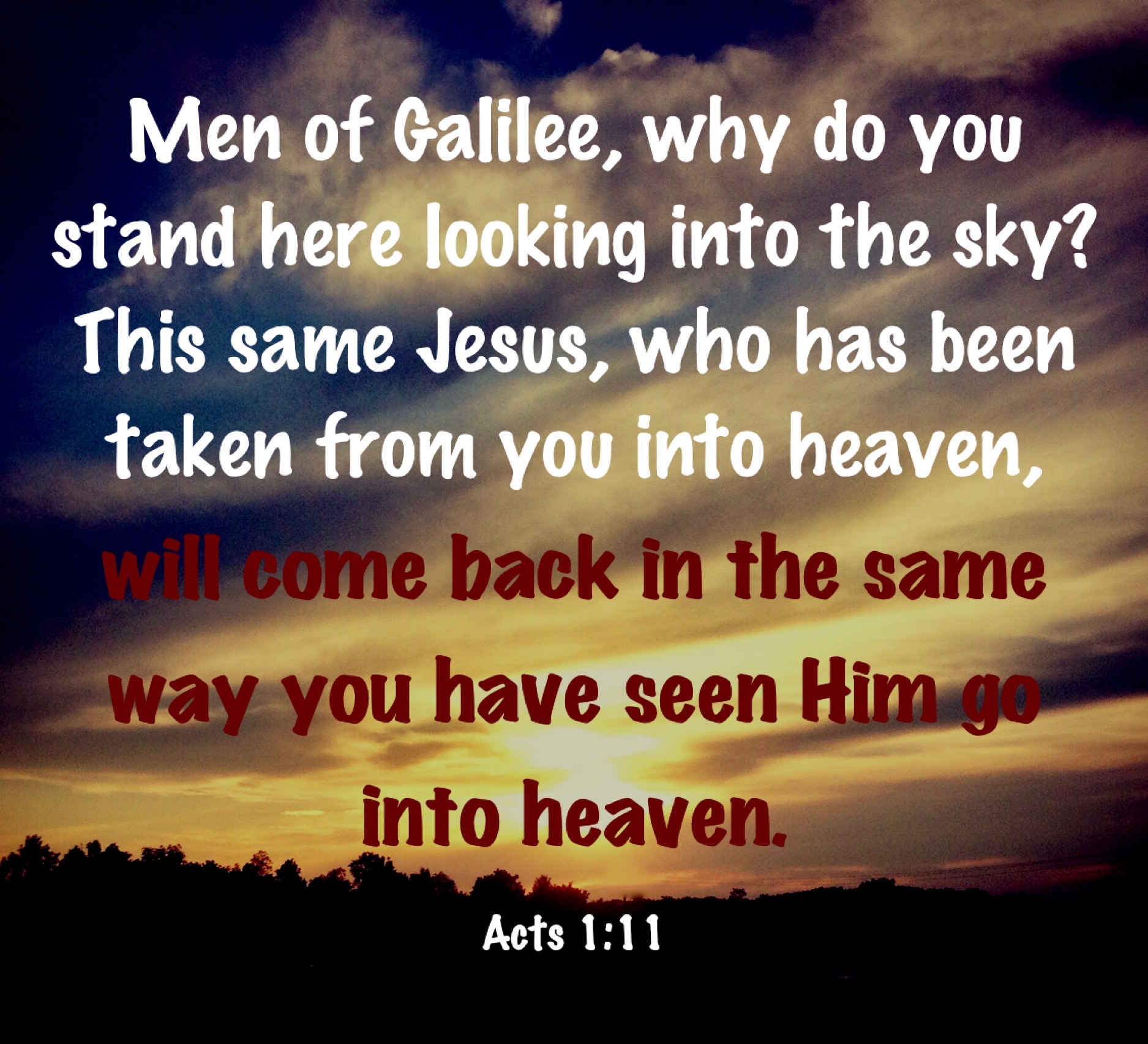
They were looking intently up into the sky as He [Jesus] was going, when suddenly two men dressed in white stood beside them. “Men of Galilee,” they said, “why do you stand here looking into the sky? This same Jesus, who has been taken from you into heaven, will come back in the same way you have seen Him go into heaven.” (Acts 1:10-11)

     It can never be wrong to look up; we are often bid to do so, and it is even a holy saying of the psalmist: ‘My voice you shall hear in the morning, O Lord; in the morning I will direct it to You, and I will look up’ (Psalm 5:3). And again, ‘I will lift up my eyes to the hills—from whence comes my help?’ (121:1). If it is right to look up into heaven, it must be still more right to look up while Jesus rises to the place of His glory! …  

     The truth is, there’s nothing wrong in their looking up into heaven. But they went a little further than looking—they stood gazing. A little excess in right may be faulty. … There is a gazing that is not commendable. This is when the look becomes not that of reverent worship but of an overweening curiosity; when there mingles with the desire to know what should not be known, a prying into that which it is for God’s glory to conceal. … 

     Thus certain things that you and I may do appear right and yet we may need to be chided out of them into something better—they may be right in themselves but not appropriate for the occasion, not seasonable or expedient. They may be right up to a point and then may touch the boundary of excess.

From The Ascension And The Second Advent Practically Considered

The word gazing reminds of another word: navel-gazing. The dictionary defines this as “excessive absorption in self-analysis or focus on a single issue.” This “excessive absorption” is, I believe, what caused the angels to chide the disciples of Jesus.  

Jesus was always on the move. Even His times of rest and recovery were strategic so that He could engage in ministry refreshed and refilled to do spiritual warfare effectively. The Gospels never show us a picture of Jesus wondering what to do next, or concerned about what people thought of Him, or even strategizing over His next ministry opportunities. He was empowered by the Holy Spirit to move forward. 

And this same forward momentum is exactly what Jesus commanded His disciples to undertake. “You will move forward into all the world, telling people about Me, baptizing them, and commissioning them to also be forward-looking to their mission field.” This mission was to be preceded by the baptism in the Holy Spirit, which was a 2-mile walk away from were the disciples were now gazing up into the heavens. 

The angels essentially said, “Your curiosity is on the verge of becoming procrastination. It’s time to head back to Jerusalem to wait for the empowerment that you will need to fulfill the mission on which Jesus sent you.” 

What about us? What “looking” can become unhealthy “gazing” for us? What excuses might we be making for our navel-gazing? What’s keeping us from being on-mission for Jesus? Let’s ask the Holy Spirit to show us where we have anything less than forward momentum for the sake of the Kingdom of God! 
Thursdays With Spurgeon—Are You Gazing Or Going?

This is a weekly series with things I’m reading and pondering from Charles Spurgeon. You can read the original seed thought here, or type “Thursdays With Spurgeon” in the search box to read more entries.

Are You Gazing Or Going?

     The resurrection of Christ is the morning star of our future glory! Equally delightful is the remembrance of His ascension. …

They were looking intently up into the sky as he was going, when suddenly two men dressed in white stood beside them. “Men of Galilee,” they said, “why do you stand here looking into the sky? This same Jesus, who has been taken from you into heaven, will come back in the same way you have seen Him go into heaven.” (Acts 1:10-11) 

     It is not the Lord’s will that [His disciples] should long remain inactive—the reverie is interrupted. They might have stood there till wonder saddened into fear. As it was, they remained long enough, for the angel’s words may be accurately rendered, ‘Why do you stand gazing up into heaven’? … 

     As they had once said to the women, ‘Why do you seek the living among the dead? He is not here, but is risen!’ (Luke 24:5-6), so did they now say, ‘Men of Galilee, why do you stand gazing up into heaven? This same Jesus who is taken up from you into heaven, will so come in like manner as you saw Him go into heaven.’ …

     They do not need twice telling, but hasten to Jerusalem. The vision of angels has singularly enough brought them back into the world of actual life again, and they obey the command, ‘Tarry in the city of Jerusalem’ (Luke 24:49). They seem to say, ‘The taking up of our Master is not a thing to weep about. He has gone to His throne and to His glory, and He said it was expedient for us that He should go away. He will now send us the promise of the Father….

From The Ascension And The Second Advent Practically Considered

Jesus was incarnated in human flesh so that we could know the way to Heaven. 

Jesus died on a Cross so that we could have our sins forgiven and go to Heaven. 

Jesus ascended into Heaven so that He could go to prepare a place for us. 

Jesus wants us to be empowered by the Holy Spirit so that we can take others to Heaven with us. 

Let us not imitate the disciples’ first reaction and simply gaze into Heaven hopefully and longingly after the ascended Jesus. Instead, let us imitate their next reactions: Waiting for the empowerment of the Holy Spirit on the Day of Pentecost so that we can take the Good News of salvation everywhere we can!

The Servant Of God

…Joshua, son of Nun, the servant of the Lord… (Joshua 24:29). 

There are not many people in the Bible called “the servant of the Lord”:

  1. Moses
  2. Joshua
  3. David (in the introduction to Psalms 18 and 36)
  4. Jesus (in Isaiah 42 and 49)

In Joshua’s final address to the Israelites, I believe he shares some common themes for anyone who wants to be called a servant of the Lord:

  • A firsthand, personal encounter of God’s miracles (Joshua 23:3; 24:7)
  • Constant recall of God’s provision (23:4; 24:7)
  • Awareness that my doing is only possible because of God’s doing (23:5, 10; 24:12)
  • Obedience to God’s Word (23:6; 24:21)
  • Wholehearted love for God (23:11; 24:23)
  • Reverent fear of God (23:12-13; 24:14, 19-20)
  • Based on what God has already done, trust in His future grace (23:14; 24:24)
  • Choosing to do all of the above every single day (24:15, 18)

All of these principles were fulfilled in the Ultimate Servant of the Lord: Jesus of Nazareth. And that Servant told us that His Spirit would empower us to live like He lived. It’s not impossible to live like this, but the Holy Spirit wants to empower us to live this out. The question is: will we let Him?

Sadly, the were no other leaders that came immediately after Joshua who were called “servant of the Lord.” Israel failed primarily because they violated the the very first principle—they had no first-hand, personal experience of God’s miracles. They lived off the miracles of their parents’ age: it was for them “the Lord your God” and never “the Lord my God” (see Joshua 24:31; Judges 21:25).

May our prayer today be: Heavenly Father, I want to be a legacy leader. Jesus, I want to be a servant of God just like You were. Holy Spirit, I invite you into my life to empower me to live this servant lifestyle every single day. 

Impossible To Empowered

In the Sermon on the Mount, Jesus outlined a “game plan” for His followers. He showed us how to correctly apply the Scripture to our daily lives with this repeated pattern: “You have heard it said [God’s Word], but I tell you [real-life application].”  Smack-dab in the middle of this sermon Jesus drops this on us, “Be perfect, therefore, as your heavenly Father is perfect” (Matthew 5:48). 

You might say, “But ‘perfect’ doesn’t really mean perfect, does it?” 

Actually, it does. The Greek word telios means the end goal of being complete in various applications of labor, growth, mental and moral character. In other words: complete in body, soul, mind, spirit—just like Jesus. 

Think about it: Jesus never misspoke, He never waited too long to act, He never acted too quickly, He never overstepped God’s boundaries, He never needed to apologize. 

Again, you might push back with, “Yes, but He is Jesus. He is God!” 

You are absolutely correct, but—miracle of miracles!—Jesus chose not to use His deity while He was on earth (Hebrews 2:17; Philippians 2:6-7). He lived a perfect life as a human, not playing His “God card,” to show us that it was possible. Jesus demonstrated that He needed to rely on the Holy Spirit (Luke 3:21-22, 4:1, 14; John 5:19-20, 12:49-50). 

This is what Jesus wants for us as well, which is why He told His disciples to wait for the empowerment that came with the baptism in the Holy Spirit. On our own, perfection is impossible. But when we baptized in the Holy Spirit, we are empowered to live perfectly. 

Remember the definition I gave for perfect (telios): complete in body, soul, mind, spirit. That’s exactly how Dr. Luke described Jesus, and it’s also how Jesus described our perfect love of God (Luke 2:52, 10:27). 

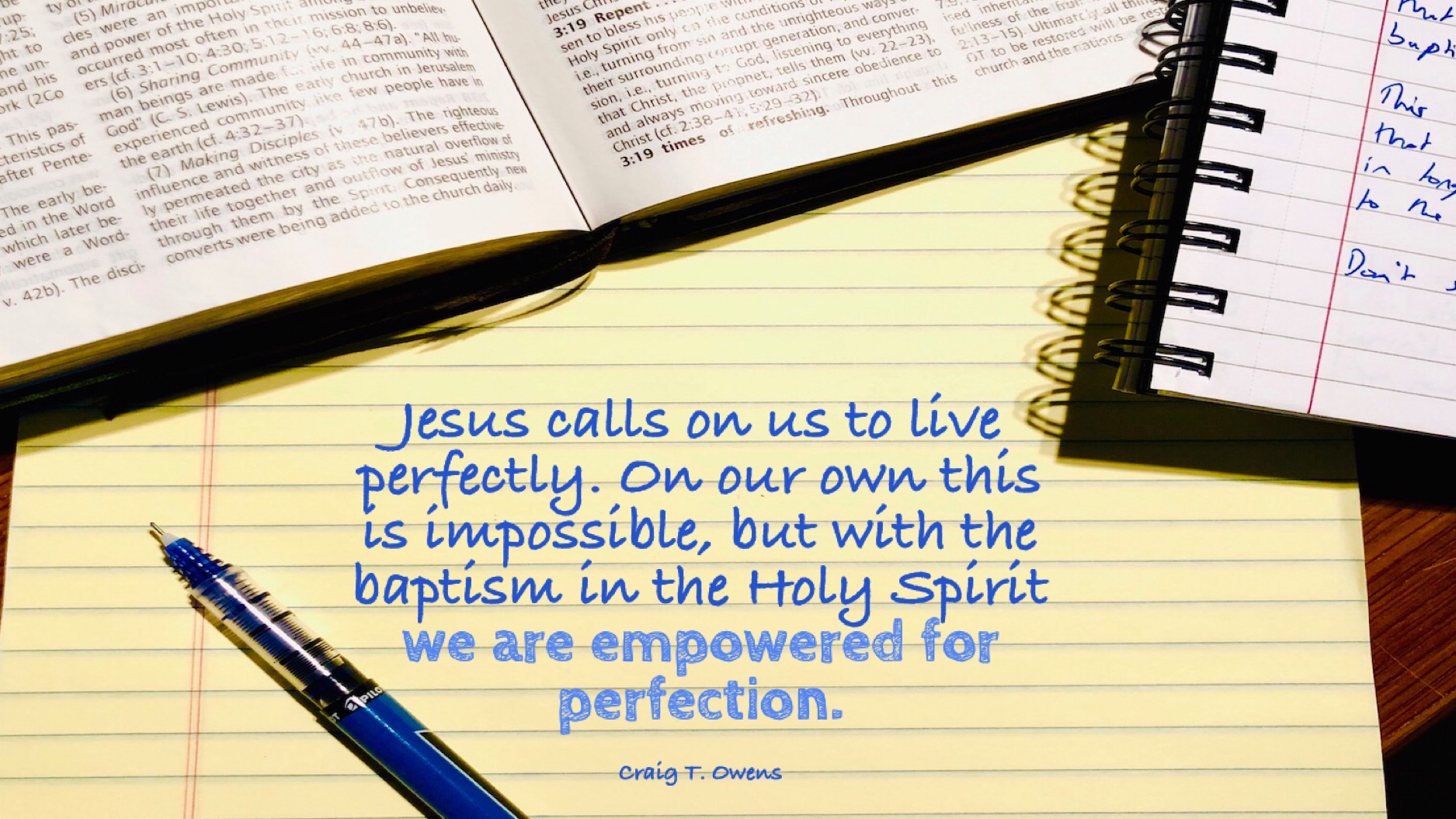
On our own: this is impossible. But with the baptism in the Holy Spirit: we are empowered for perfection. 

Don’t stop at salvation—press on to be baptized in the Holy Spirit. If Jesus was so reliant on the Holy Spirit, what would make us think we could live with anything less?! 

If you missed any of the other posts in this series, you can find them all listed here. 

Controlled By The Holy Spirit

Do not get drunk on wine, which leads to debauchery. Instead, be filled with the Spirit, speaking to one another with psalms, hymns, and songs from the Spirit. Sing and make music from your heart to the Lord, always giving thanks to God the Father for everything, in the name of our Lord Jesus Christ. Submit to one another out of reverence for Christ. (Ephesians 5:18-21) 

Jesus wanted His followers to be His missionaries throughout the world, but not until they were empowered with the baptism of the Holy Spirit. The new Testament writers elaborate on concepts that boil down to a Christian being controlled by the Spirit. What does that entail? I think these words from J. Oswald Sanders are well worth consideration—

“What does this apostolic injunction in Ephesians 5:18 mean? It is not an invitation to realize a privilege but a command to fulfill an obligation. … The clear teaching of Scripture is that we are filled with the Spirit when our human spirit is mastered and controlled by the Holy Spirit. The idea behind the command ‘be filled with the Spirit’ is not so much that of an empty vessel passively waiting for something to be poured into it, as water into a glass [here is a 3-minute video where I illustrate this idea]. It is rather the concept of a human personality voluntarily surrendered to the domination the Holy Spirit. … The Spirit’s control is not automatic but voluntarily and constantly conceded. 

“The fullness of the Spirit does not obliterate personality, as does hypnotism. In fact, the person who is filled with the Spirit only then realizes and discovers his true personality. It is not obliterated but released. We will never know the possibility of our redeemed personality until we definitely yield ourselves in full and undeserved surrender to His control. … 

“Paul’s personality was not obliterated by [Christ’s] indwelling. ‘I live,’ he said, ‘yet not I, but Christ liveth in me.’ He did not become any the less Paul because he was indwelt by Christ. Indeed, he became more and more the Paul God intended him to be; the ideal Paul who was a chosen vessel to the Lord. We need not fear the fullest surrender to Christ, for He enhances and ennobles personality. He imports qualities which are absent and brings into activity powers and possibility which were latent. He became a different Paul, but a greater and better Paul. Apart from the indwelling and mastery of Christ, the world would probably have heard little of him. Instead his influence has been one of the dominating features of the last two millennia.” —J. Oswald Sanders, in Cultivation of Christian Character (emphasis mine) 

If you would like to review some of the thoughts I have already shared in this current series, please click here and scroll down to the list of posts listed on that page.

Poetry Saturday—Trinitie Sunday

Lord, who hast form’d me out of mud,
    And hast redeem’d me through Thy bloud,
    And sanctifi’d me to do good;

Purge all my sinnes done heretofore:
    For I confesse my heavie score,
    And I will strive to sinne no more.

Enrich my heart, mouth, hands in me,
    With faith, with hope, with charitie;
    That I may runne, rise, rest with Thee. —George Herbert

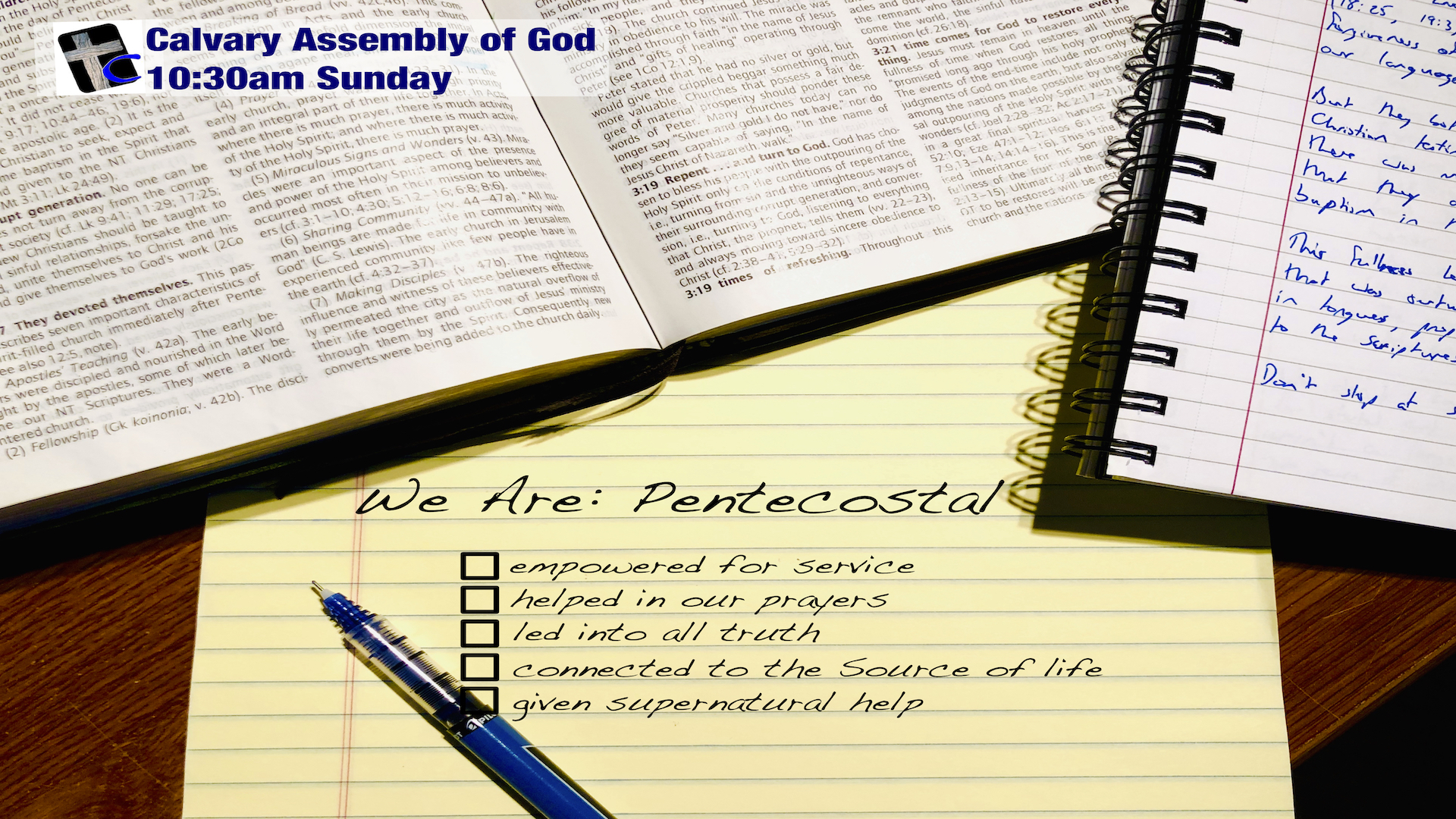
We Are: Pentecostal

Pentecost for over 1500 years was a celebration in Jerusalem that brought in Jews from all over the world. But on the Day of Pentecost that came just ten days after Jesus ascended back into heaven, the meaning of Pentecost was forever changed! 

Followers of Jesus—now empowered by an infilling of the Holy Spirit—began to take the good news of Jesus all over the world. These Spirit-filled Christians preached the Gospel and won converts to Christ even among hostile crowds, performed miracles and wonders, stood up to pagan priests and persecuting governmental leaders, and established a whole new way of living as Christ-followers. 

We, too, can be Pentecostal followers of Jesus Christ today. We can experience an anointing and an empowering in our lives that turns ordinary Christianity into extraordinary Christianity! 

Please join me this Sunday as we continue a series of messages we started last year called We Are: Pentecostal. You can check out what I taught in this series in 2019 by clicking here. And our current messages include:

Everyday Evidence

Last week we learned that speaking in tongues was one of the most noticeable and consistent characteristics of those who were baptized in the Holy Spirit. 

Speaking in tongues as the Spirit enables you is the unmistakable, objective, outward, initial physical evidence. The Bible makes clear that continuing to pray in tongues has huge benefits for both our personal prayer lives and for the corporate church body. But don’t stop there! 

The initial, outward evidence is primarily for the individual Christian—it’s a way of knowing that you know that you have indeed been baptized in the Spirit. But there also needs to be some everyday evidence for others that testifies to them that something is different about your life. 

Consider the disciples of Jesus before and after being baptized in the Holy Spirit…

Their vocabulary

Before being baptized in the Spirit they said stupid things because they didn’t know what to say (Mark 9:5-6) But after being baptized in the Spirit there was no more foot-in-mouth disease. Just as the Holy Spirit enabled them to praise God in an unlearned tongue, He also empowered their natural dialect. The same Greek word is used in Acts 2:4 (enabled by the Holy Spirit), 2:14 (Peter addressed the crowd), and 26:25 (what I am saying is true and reasonable). 

Their spiritual power

Before it was limited, and often thwarted, but afterward, it was limitless and effortless (Mark 9:17-18; Acts 3:1-8; 5:15; 6:8).

Their understanding of servanthood

Before they argued about who was the greatest. Afterward, they gladly gave all that they had to others (Mark 9:33-34; Acts 2:44-45). 

Their boldness in the face of adversity

Before they abandoned Jesus, ran away, and hid in locked rooms. Afterward, there was no intimidating or silencing them (Acts 4:8, 13, 18-20). 

Their understanding of Scripture

Before they had virtually no understanding of Scripture’s application. Afterward, they understood how to apply God’s Word in almost every situation (Acts 2:16, 33-35; 4:24-26). 

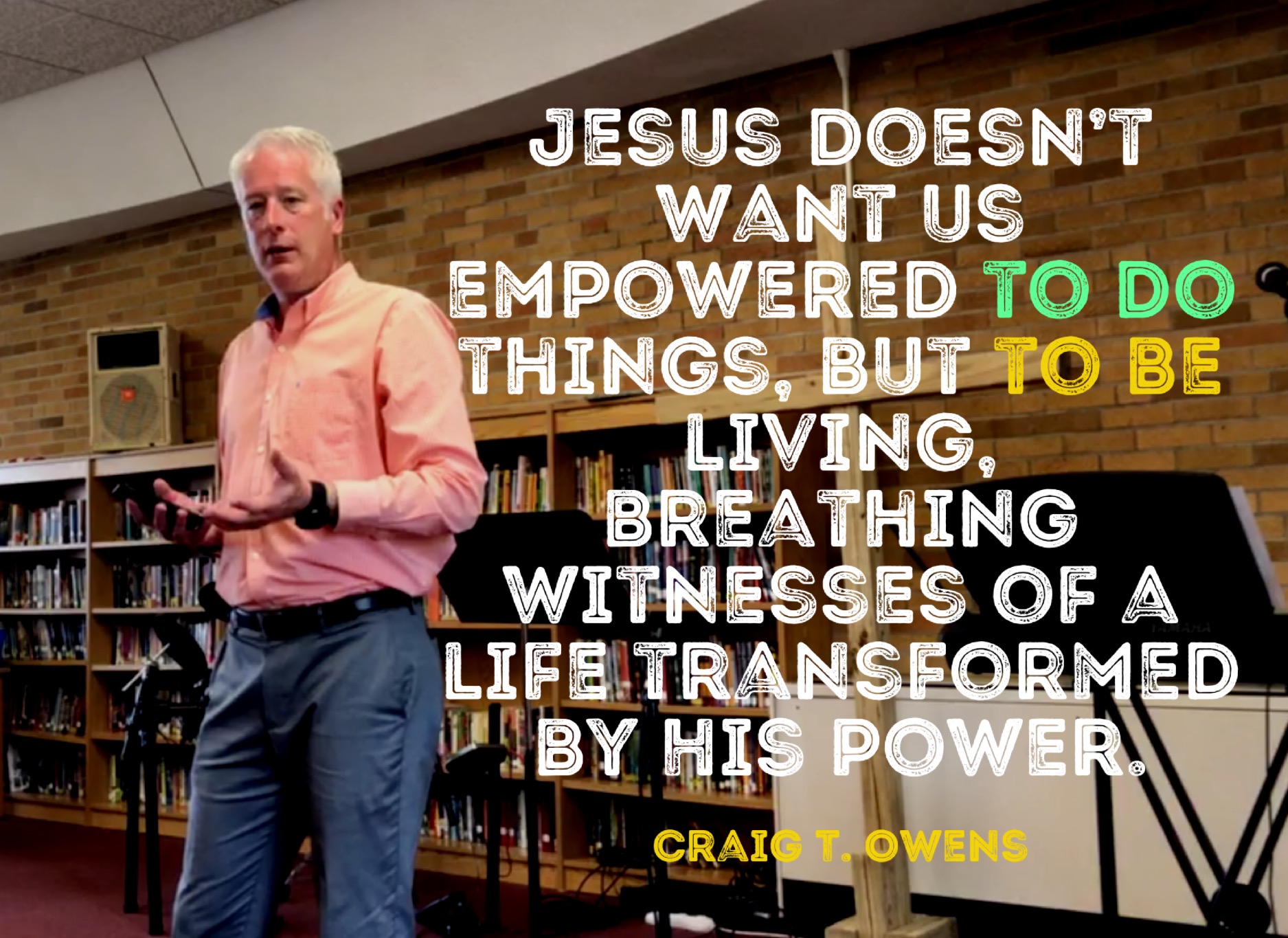
Jesus promised that the baptism in the Holy Spirit would empower us TO BE His witnesses (Acts 1:8). Not just to do things for Him. There’s nothing wrong about doing Jesus-glorifying things, but in themselves, they are too short-sighted. Jesus doesn’t want us empowered to do things, but TO BE a living, breathing, walking, talking witness of a life transformed by His power. That’s the reason why I say to you again and again: Don’t stop at salvation. Press on and press in to be baptized in the Holy Spirit so that you can BE an empowered, transformed and transforming witness for Jesus!

If you missed any of the messages in this series, you can access the full list of messages by clicking here

We Are: Pentecostal

Pentecost for over 1500 years was a celebration in Jerusalem that brought in Jews from all over the world. But on the Day of Pentecost that came just ten days after Jesus ascended back into heaven, the meaning of Pentecost was forever changed! 

Followers of Jesus—now empowered by an infilling of the Holy Spirit—began to take the good news of Jesus all over the world. These Spirit-filled Christians preached the Gospel and won converts to Christ even among hostile crowds, performed miracles and wonders, stood up to pagan priests and persecuting governmental leaders, and established a whole new way of living as Christ-followers. 

We, too, can be Pentecostal followers of Jesus Christ today. We can experience an anointing and an empowering in our lives that turns ordinary Christianity into extraordinary Christianity! 

Please join me this Sunday as we begin a series of messages called We Are: Pentecostal. You can find a map here, or if you live too far away to join us in person, be sure to check out our Facebook Live broadcasts every Sunday morning.

Here are the topics we covered in this series:

**We rejoined this series again in 2020. You can find a list of those topics by clicking here.

Thursdays With Oswald—The Power Is In The Solitude

Oswald ChambersThis is a weekly series with things I’m reading and pondering from Oswald Chambers. You can read the original seed thought here, or type “Thursdays With Oswald” in the search box to read more entries.

The Power Is In The Solitude

     If we want to know the universal sovereignty of Christ, we must get into solitude with Him. It is not sufficient for someone else to tell us about Him; we must perceive with our own eyes Who He is, we must know Him for ourselves. … 

     We must get to the place of real solitude with Christ. He is our mountain-height and our sea-calm; He is the recreating power; He is the universal Sovereign. He tells us to consider the lilies; we say—“No, we must consider life.” We mistake the mechanism of life for life itself, and that idea has become incorporated into Christian work. In the active work we do for God we do not really believe that Jesus Christ is sovereign Lord; if we did, we should fuss less and build more faith in Him. We cannot do the Savior’s work by fuss, but only by knowing Him as the supreme sovereign Lord. … 

     Our Lord’s word “go” simply means “live,” and Acts 1:8 describes the “going.” Jesus did not say to the disciples—“Go into Jerusalem, go into Judea, go into Samaria, go into the uttermost part of the earth”; but—“You shall be My witnesses” in all these places: He undertakes to establish the goings. So many people are obsessed with this idea—“What are you going to do?” I hope none of us are going to do anything: I hope we are going to be what He wants us to be. … 

     The key to the missionary is the absolute Sovereignty of the Lord Jesus Christ. We must get into real solitude with Him, feed our soul on His Word, and He will engineer our circumstances.

From So Send I You 

Jesus gave a command to all His followers—including all of us today—All authority in heaven and on earth has been given to Me. Therefore go (Matthew 28:18-19). Jesus is saying to us, “Preach and teach out of a living experience of Myself.” In this respect, we are all missionaries.

Oswald Chambers reminds us missionaries that the only way we will be effective in our goings is by spending adequate time in solitude and worship with Our Lord. If we don’t, then we are trying to do ministry on our own, trying to engineer our own circumstances. But the missionary who is spending time with Jesus finds that He directs all our goings and engineers all our circumstances.

The power to testify about Jesus comes from our time of solitude with Jesus.