When The World Fears Christians

Listen to the podcast of this post by clicking on the player below, and you can also subscribe on AppleSpotify, or Audible. 

Here’s an interesting interaction between King Saul and David—

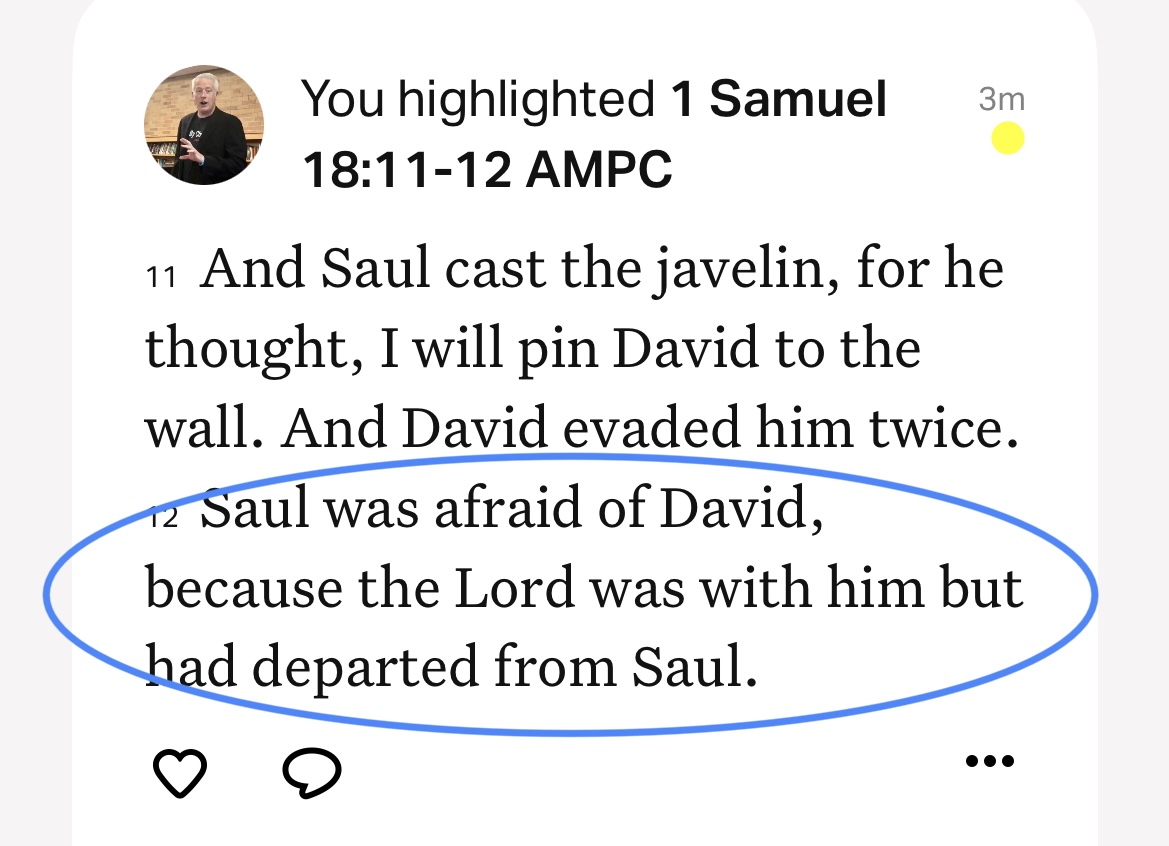
And Saul jealously eyed David from that day forward. … And Saul cast the javelin, for he thought, I will pin David to the wall. And David evaded him twice. Saul was afraid of David, because the Lord was with him but had departed from Saul. (1 Samuel 18:9, 11-12 AMPC)

This exchange in this well-known story got me wondering. I was thinking how Saul had the position of authority over David and he had a javelin in his hand, but the Bible still says that Saul “was afraid of David.” Why would that be? I think even the most atheistic of people intuitively know there is something other-worldly about those in whom the Spirit of God abides, which makes worldly people lash out at them in fear. 

But those who fear God—as David did—don’t fear mortals. Jesus said, “Don’t be afraid of those who want to kill your body; they cannot touch your soul. Fear only God, Who can destroy both soul and body in hell” (Matthew 10:28 NLT). This reverent fearlessness is what galls those who fear the unknown, so they try to silence confident God-followers. 

In these attacks, Jesus tells us not to respond naturally, but supernaturally. “But to you who are willing to listen, I say, love your enemies! Do good to those who hate you. Bless those who curse you. Pray for those who hurt you” (Luke 6:27-28 NLT). 

Peter picked up those words from Jesus and instructed Christians: “Be careful to live properly among your unbelieving neighbors. Then even if they accuse you of doing wrong, they will see your honorable behavior, and they will give honor to God when He judges the world. … For God called you to do good, even if it means suffering, just as Christ suffered for you. He is your example, and you must follow in His steps.” (1 Peter 2:12, 21 NLT). 

Although Saul feared the presence of God in David, he also had to acknowledge the success that came to David because of God’s abiding presence in him, and also, by extension, the success that came to Saul’s kingdom. On the one hand, Saul wanted David dead; on the other hand, he wanted David close by—

So Saul removed David from him and made him his commander over a thousand; and [David] went out and came in before the people. David acted wisely in all his ways and succeeded, and the Lord was with him. When Saul saw how capable and successful David was, he stood in awe of him. (1 Samuel 18:13-15 AMPC) 

When Christians are supernaturally empowered by God, they never have to respond in natural fight-or-flight from those who lash out at them. Let your faithfulness to God be your testimony that points others to Him. 

►► Would you please prayerfully consider supporting this ministry? My Patreon supporters get behind-the-scenes access to exclusive materials. ◀︎◀︎

Jesus said, “If the world hates you, know that it hated Me before it hated you. If you belonged to the world, the world would treat you with affection and would love you as its own. But because you are not of the world [no longer one with it], but I have chosen (selected) you out of the world, the world hates (detests) you.” (John 15:18-19)

Your Gratitude Strengthens Other Saints

Listen to the podcast of this post by clicking on the player below, and you can also subscribe on AppleSpotify, or Audible. 

Let me remind you of something I covered last week: 

  • If we start out thankful but then forget about our blessings, we become fearful and selfish, which makes us susceptible to the sin of grumbling against God. 
  • But if we start our thankful and then continually remember all that God has done for us, we remain joyful and secure, which fortifies us against giving in to the sin of grumbling against God. 

As I have shared with you during this series, medical science has discovered so many connections between gratitude and wellbeing—mentally, physically, emotionally, and relationally. Here’s another important finding from medical science: Chronic stress impairs memory formation. 

Remember this insight from George Santayana: “Those who do not learn from history are doomed to repeat it”? 

But what if we cannot learn the lessons from history because we cannot remember and recall those lessons? That’s one of the ways chronic stress ravages our ability to be grateful. Stress literally clogs up the amygdala in our brain so that these lessons cannot be filed away for future use. 

Where does this chronic stress come from? Stress can be a good thing—think of the stress we put on our lungs, heart, and muscles when we exercise. That good stress (eustress) prepares us to respond well in difficult situations. 

But chronic stress is unhealthy. It begins to make us withdraw into ourselves. We become self-protective. We start to see potential problems even behind blessings. 

Self-protective becomes self-focused, which is the exact opposite of the God-focus we looked at last week in Psalm 103:2. This also makes us want to isolate from people (see Psalm 42:1-4, especially the “used to” in v. 4). 

(Check out all of the Scriptures in this post by clicking here.) 

The enemy of our soul is prowling. He loves to see isolated saints because they are easier prey. This is why the New Testament again and again highlights the phrases “one another” and “each other” for the saints (for example: Colossians 3:15-16; Hebrews 10:19-25). When one saint struggles, all of the saints should feel that and respond quickly 

Consider the example of David’s life. David is in a stressful state where I am sure it is becoming increasingly difficult for him to find praiseworthy things. He is becoming more and more self-protective and therefore self-focused. 

  • Saul tries to kill him—1 Samuel 20:28-33 
  • The Philistines have him trapped—21:10-13; Psalm 56  
  • The people of Keilah reward David’s help with betrayal—23:10-12 
  • David is in a desert place (literally!) and sold-out by the Ziphites—23:14, 19-20 

Psalm 54 is written when David learns about the Ziphites’ plan. He begins to pour out his complaint to God in vv. 1-3, but then there is a totally different tone in vv. 4-7. What comes between is the word Selah—a pause to consider. 

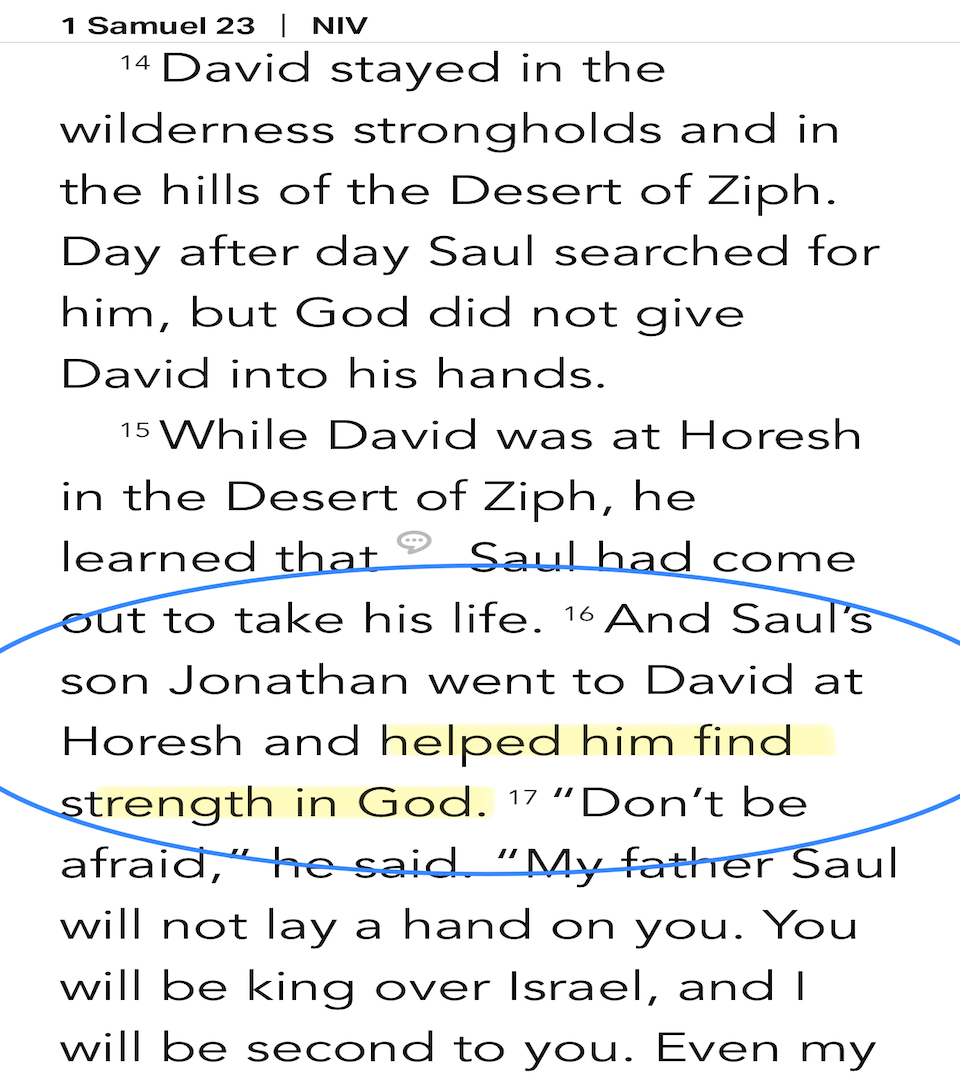
I believe at this time is when Jonathan shows up to encourages David—And Saul’s son Jonathan went to David at Horesh and helped him find strength in God (1 Samuel 23:16). 

David learned this lesson well because when he’s in another tight spot, we read that David found strength in the Lord his God, which allowed him to encourage his distraught men to seek God’s help. It was with God’s help that they recovered everything single thing that had been taken from them (1 Samuel 30:1-18)! 

Your gratitude fortifies you and helps you encourage other saints. As you encourage other saints, they will then be fortified to help other saints—maybe even you! 

I like how Eugene Peterson paraphrases 1 Thessalonians 5:11 in The Message: “So speak encouraging words to one another. Build up hope so you’ll all be together in this, no one left out, no one left behind. I know you’re already doing this; just keep on doing it.” 

Your gratitude could make all the difference in someone else’s life, so “just keep on doing it”!  

Make sure you check out all of the other messages in our Be Thankful series. 

►► Would you please prayerfully consider supporting this ministry? My Patreon supporters get behind-the-scenes access to exclusive materials. ◀︎◀︎

Aligning With God’s Word

Listen to the podcast of this post by clicking on the player below, and you can also subscribe on AppleSpotify, or Audible.

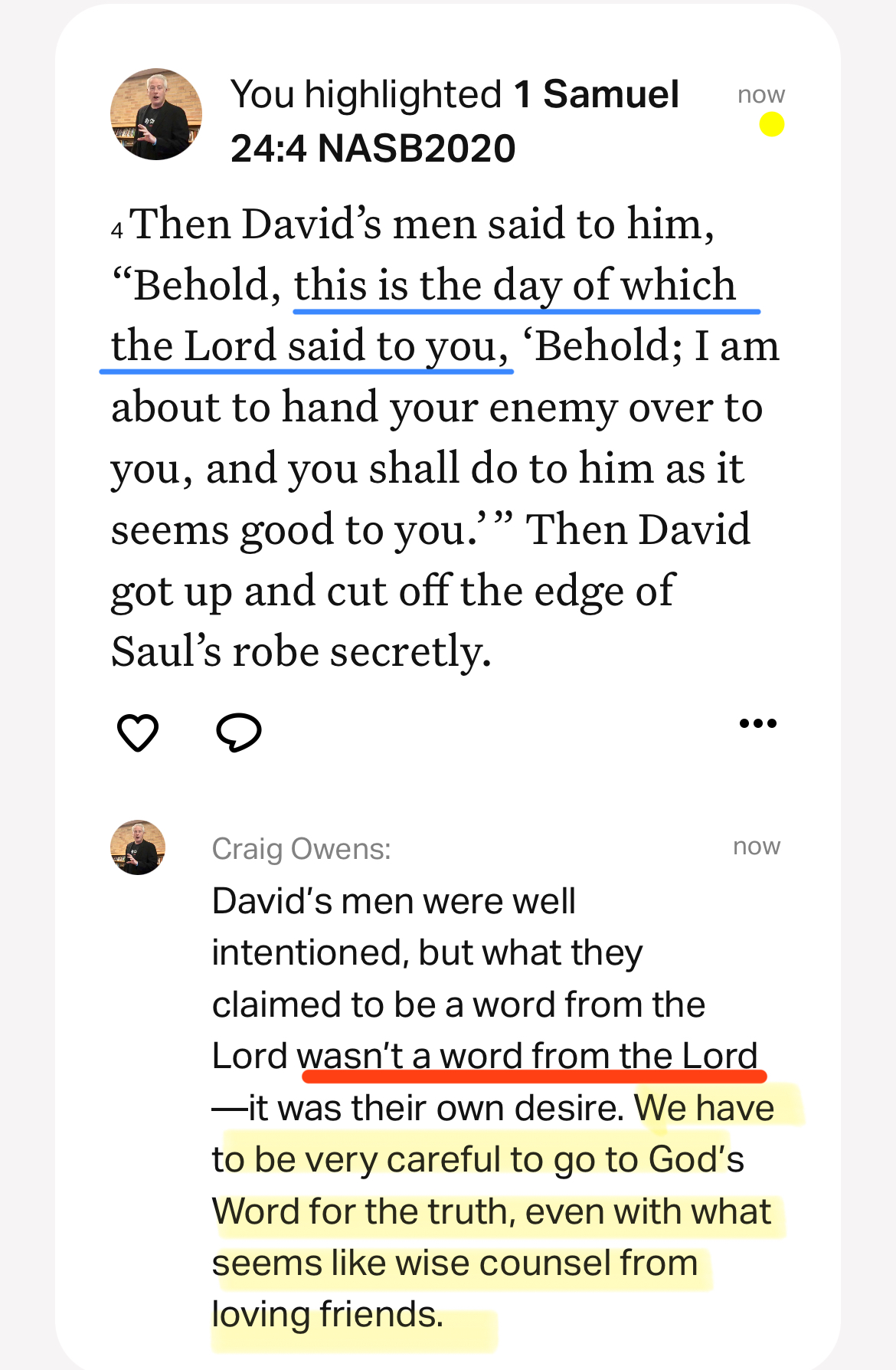
David was hiding from Saul in a cave when Saul walked into the same cave, totally oblivious to the danger that awaited him! David’s men tried to spur him to action by whispering, “Isn’t this what God said, that He would hand your enemy over to you?” (see 1 Samuel 24). 

David momentarily listened to his men and then acted on their words. He crept forward to cut off a corner of Saul’s robe. But then the Holy Spirit pricked his conscience. 

Why? 

Because God never said those words! 

From what David has learned, he now speaks this same lesson to Saul. He in essence asks Saul, “Are you listening to men or to God?” (vv. 9-11). 

David learned that without God as his Guide, he could easily be persuaded to act in a way that seemed right to men but was wrong before God. 

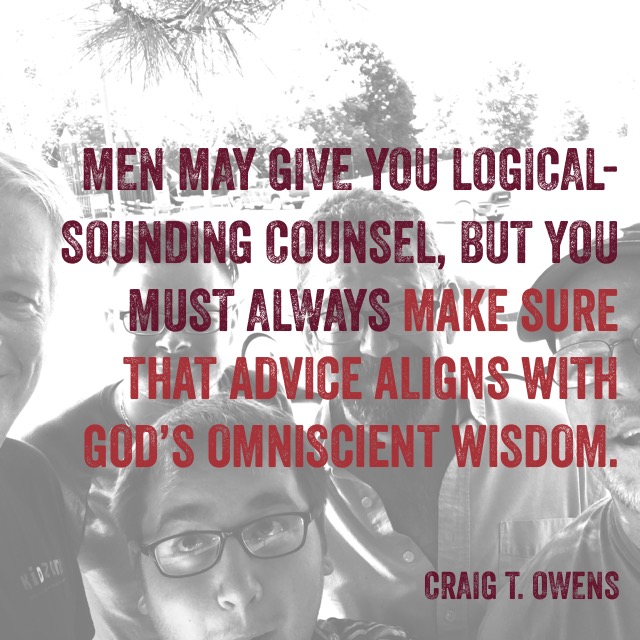
It’s still true for all of us today: Men may give you logical-sounding counsel, but you must always make sure that advice aligns with God’s omniscient wisdom. That means you need to be reading, studying, meditating on, and thinking about God’s Word. 

✔️ Keep God always before you 

✔️ Know His voice intimately 

✔️ Compare every word of man with God’s infallible Word 

🙏🏻 “Hear my prayer for help, O God, for I look to You alone as my Helper and the Sustainer of my soul. You will deal with my enemies as You know best, and You will deliver me from my troubles” (see David’s prayer in Psalm 54).

►► Would you please prayerfully consider supporting this ministry? My Patreon supporters get behind-the-scenes access to exclusive materials. ◀︎◀︎

Thwarting Infighting

Listen to the podcast of this post by clicking on the player below, and you can also subscribe on AppleSpotify, or Audible. 

Something from J.R.R. Tolkien and something from the Bible collided on the exact same day.

Check out this episode of The Podcast.

Here are some helpful resources from this episode:

The Scriptures I referenced are 1 Samuel 30:1-19 and John 10:10.

David learned how to find his encouragement in God from his friend Jonathan. Check out The Jonathan Experience.

I have a lengthy series of posts on the attributes of godly leaders which you can find here.

My new book When Sheep Bite is available for pre-order!

Here are a bunch of ways to get in touch with me and follow along with other projects on which I am involved

►► Would you please prayerfully consider supporting this ministry? My Patreon supporters get behind-the-scenes access to exclusive materials. ◀︎◀︎

Our Safe Healing Place

I cry out with my voice to the Lord; with my voice I implore the Lord for compassion. I pour out my complaint before Him; I declare my trouble before Him. (Psalm 142:2)

David knew the release and healing that would come after he poured out his complaint in God’s presence. The injuries others have done to us afflict our thoughts and emotions, and we need a safe place to get that poison out of our mind and heart.

God’s presence is that safe place, that healing place. 

God already knew what was in David’s heart, but David still verbalized it before God—not before his attackers or even his friends. We need to follow this example when we, too, are injured.

Walking Intimately

Listen to the podcast of this post by clicking on the player below, and you can also subscribe on AppleSpotify, or Audible. 

There’s an interesting verb used with both Enoch and Noah that denotes intimate fellowship—the word is “walked.”

Enoch walked with God; and he was not, for God took him. (Genesis 5:24) 

These are the records of the generations of Noah. Noah was a righteous man, blameless in his generation. Noah walked with God. (Genesis 6:9)

David uses this same verb when he prays, “Vindicate me, Lord, for I have walked in my integrity, and I have trusted in the Lord without wavering. Examine me, Lord, and put me to the test; refine my mind and my heart. For Your goodness is before my eyes, and I have walked in Your truth” (Psalm 26:1-3). 

And Solomon uses the same verb to say that anyone who walks in righteous integrity leaves a legacy of righteousness for his family: “A righteous person who walks in his integrity—how blessed are his sons after him” (Proverbs 20:7). 

There is something important that is implied in this walking. God tells us what it is in this question: How can two walk together unless they agree to do so? (Amos 3:3). 

But make no mistake, God doesn’t agree with whatever path I choose to walk, but I must agree to walk God’s path. 

I must agree that God’s path is best, despite what everyone else is doing—“Then the Lord saw that the wickedness of mankind was great on the earth, and that every intent of the thoughts of their hearts was only evil continually” (Genesis 6:5). Yet Noah didn’t walk with the wicked, but he was commended because he walked with God. 

In the New Testament, Enoch and Noah are listed as back-to-back examples of faith (Hebrews 11:5, 7). The verse that connects these two men speaks of the faith-filled integrity that kept them walking with God—

And without faith it is impossible to please Him, for the one who comes to God must believe that He exists, and that He proves to be One who rewards those who seek Him. (Hebrews 11:6) 

That word “seek” means to diligently crave. Enoch and Noah and David show us examples of men who diligently craved walking with God above all else. Their faithful, diligent walking made them stand out from all those around them. 

What about us? Hebrews 11:6 says we can follow their example. We can choose to walk with God by faith. We can diligently crave Him above all else. When we walk righteously with God, He “rewards those” who do—for ever and ever! 

►► Would you please prayerfully consider supporting this ministry? My Patreon supporters get behind-the-scenes access to exclusive materials. Like this exceptional Bible study tool to help with Creation apologetics. ◀︎◀︎

Beware Of “I’m Owed This”

Listen to the podcast of this post by clicking on the player below, and you can also subscribe on AppleSpotify, or Audible. 

On Mother’s Day, I shared a word of encouragement from a woman who interacted with the prophet Elisha. As I was studying for this message, I paused to consider an example—actually a warning—that comes from Elisha’s servant Gehazi. 

Because of the miraculous things that God had done through Elisha, word began to spread about God’s power that was on display through this godly prophet. In fact, word even spread to other countries, including the land of Aram where was a highly decorated military commander named Naaman lived. This revered leader was afflicted by leprosy. The king of Aram sent Naaman to Elisha to be cured of this disease (see 2 Kings 5). 

When Naaman came to Elisha, he was given instructions to bathe himself seven times in the Jordan River. Initially, Naaman balked at this, but eventually, he humbled himself in obedience and was miraculously healed of his leprosy! 

Naaman had come to Israel and Elisha with the intention of buying a miracle (just take a look at the treasures that he brought with him). Elisha would not accept money or gifts from Naaman. Not that there’s anything wrong with a prophet receiving gifts, but not when the intention of the giver is to give a bribe. 

This is where Gehazi makes a fatal mistake. Gehazi has a conversation with himself (notice the phrase “he said to himself”) that he should have had with Elisha. He determined that he and Elisha were owed something for their ministry work. Gehazi then compounded this unhealthy conversation by telling one lie after another lie to justify the conclusion he had reached. 

Elisha knew that God keeps track, that God keeps perfect records, that God will reward far better than any man ever could. He said, “Is this the time to take money or to accept clothes?” No! We need to let God determine the timing and the gift. 

As a result, the leprosy that had left Naaman now attacked Gehazi. In reality, it was a leprosy of his heart that merely appeared on his skin. Gehazi was then dismissed from his ministry position with Elisha. 

Sadly, I’ve witnessed many ministry leaders who have derailed their leadership with an “I deserve this” attitude. Thinking “I’m owed this” took their eyes off God and put them on the rewards they thought they should have received. How sad this is! 

We all need to be on guard. The “I’m owed this” lie didn’t just derail Gehazi, it’s also what turned Lucifer into satan. Is it any wonder, then, that satan uses this lying attitude as an effective weapon—from Adam and Eve, to King David, to Gehazi, to Ananias and Sapphira, all the way down to us. 

Our constant prayer should be, “Holy Spirit, guard my heart against the leprosy of entitlement. Help me keep the ‘I’m owed this’ attitude far, far away from my heart’s door.” 

►► Would you please prayerfully consider supporting this ministry? My Patreon supporters get behind-the-scenes access to exclusive materials. ◀︎◀︎

Thursdays With Spurgeon—Bragging About God

This is a weekly series with things I’m reading and pondering from Charles Spurgeon. You can read the original seed thought here, or type “Thursdays With Spurgeon” in the search box to read more entries.

Listen to the podcast of this post by clicking on the player below, and you can also subscribe on AppleSpotify, or Audible. 

Bragging About God

I will extol the Lord at all times; His praise will always be on my lips. I will glory in the Lord; let the afflicted hear and rejoice. Glorify the Lord with me; let us exalt His name together. (Psalm 34:1-3)

     Boasting is a very natural propensity, and if it were used as in this case, the more it were indulged the better. The exultation of this verse is no mere tongue bragging; the soul is in it, and the boasting is meant and felt before it is expressed. 

     What scope there is for holy boasting in Jehovah! His Person, attributes, covenant, promises, works, and a thousand things besides are all incomparable, unparalleled, matchless; we may cry them up as we please, but we shall never be convicted of vain and empty speech in so doing.

From Spurgeon And The Psalms

What is even more remarkable about the praise David offers up in this psalm is the setting. The introduction to the psalm tells us it is while David is running from Saul and trapped in a Philistine stronghold. 

And yet David still chooses to praise God.

It is a choice of his will. David didn’t wait until he felt like praising God, or until his circumstances were improved. We are more likely to act ourselves into feeling than we are to feel ourselves into action. So David says, “I will extol the Lord … His praise will be on my lips.” 

This bragging about God—when from a human standpoint there appears to be nothing to brag about—becomes a testimony. David’s personal pronouns “I” and “my” quickly turn into the plural pronoun “us” as David invites others to ponder the beauty of Jehovah! “Glorify the Lord with me; let us exalt His name together. 

Our bragging about God, especially in the face of difficult circumstances, is a powerful testimony that will draw others to Him. You may start out praising Him on your own, but it won’t be long until others join your worship chorus. 

Friends, your praising and bragging about God is more powerful than you may realize. When God is worshipped, He is lifted up for all to see, so keep on bragging about Him!

►► Would you please prayerfully consider supporting this ministry? My Patreon supporters get behind-the-scenes access to exclusive materials. ◀︎◀︎

True Friends

Listen to the podcast of this post by clicking on the player below, and you can also subscribe on AppleSpotify, or Audible. 

Wounds from a sincere friend are better than many kisses from an enemy (Proverbs 27:6 NLT). 

Proverbs 27 may have more wisdom about our friends than any other chapter in this book. But sprinkled throughout the entire book of Proverbs is outstanding wisdom about our closest relationships. Allow me to share just a few observations with you.

(Click here to see all of the verses I reference below.)

In a previous post where I noted the conjunctions “but” and “and,” I see this—The righteous choose their friends carefully, BUT the way of the wicked leads them astray (12:26). Righteous friends keep me on the right path. 

Friends love me through my worst moments (17:17) because they have committed to stick closer than a brother to me (18:24).

I must be careful not to make friends with a hot-tempered person (22:24), and to be cautious of people who want to be friends with me only for what I can give them (19:4). 

My true friends will wound me in love to help me become the best that God intended me to be (27:5-6, 9, 17), so I must never forsake these friends (27:10). 

False friends will gossip to me and about me, but my true friends will guard my secrets and guard my reputation (16:28; 17:9). 

In order to have true friends, I first have to be a true friend.

In my book Shepherd Leadership: The Metrics That Really Matter, I noted how true friends will help us go farther and avoid the stumbles that could cut short our leadership influence. 

David was the gold standard for every king of Israel who followed him. Numerous times throughout the history of Israel, we will see a note that a certain king either followed God like David, or turned from God unlike David. Yet there exists a wart on David’s portrait: an adulterous affair with the wife of a man in his inner circle, and then subsequent lies and a murder to cover up the affair. “The thing David had done displeased the Lord” (see 2 Samuel 11). 

But I’d like to turn your attention to when this affair occurred: “In the spring, at the time when kings go off to war…David remained in Jerusalem” (2 Samuel 11:1). He was without his usual comrades. The men who knew David best, who could probably sense if something was amiss, weren’t around to warn him. When David tried to find out the identity of the bathing beauty on the roof next door to his palace, an unnamed attendant tried to remind him, “Isn’t that Bathsheba, the wife of Uriah?” but David dismissed him. 

Elijah was arguably the most forceful and fearless prophet in Israel’s history. Not only did he stand up to the evil kings of Israel, but he spoke out against the kings of surrounding nations, too. In answer to Elijah’s prayer, God brought a drought on the land, and again in answer to Elijah’s prayer, God sent rain. Elijah challenged the 450 prophets of the god Baal and the 400 prophets of the goddess Asherah to a duel to the death, which ended up in a decisive victory for Yahweh. Yet, shortly after this massive victory, Elijah was depressed to the point that he wanted to die. 

What led to Elijah’s depression? Something very similar to David’s slide into adultery: He was alone. Elijah ran away from Queen Jezebel’s death threat, left his servant behind, and proceeded all by himself into the desert. It was when he was without a comrade that he prayed to God, “I’ve had enough. Take my life” (see 2 Kings 17–19). 

And what about Peter? He boldly claimed his loyalty to Jesus, even to the point of wielding a sword at the guards who came to arrest his Master. But when Peter was alone, after the other disciples fled, he denied three times that he knew Jesus (Matthew 26:33, 51, 69–75). 

God designed us to be in relationship with others. His statement to Adam in some of the earliest words of the Bible—“It is not good for you to be alone”—are words for us still today. —from the chapter “Going Farther” 

We need true, God-fearing friends close to us. Ask God to bring those friends around you, and ask the Holy Spirit to make you into that kind of friend for those He does bring around you. 

►► Would you please prayerfully consider supporting this ministry? ◀︎◀︎

Thursdays With Spurgeon—Wart Warning

This is a weekly series with things I’m reading and pondering from Charles Spurgeon. You can read the original seed thought here, or type “Thursdays With Spurgeon” in the search box to read more entries.

Listen to the podcast of this post by clicking on the player below, and you can also subscribe on iTunes or Spotify.

Wart Warning  

     At the instigation of his wife, Abraham adopted means that were not justifiable in order that he might obtain the promised heir [see Genesis 16]. He used means that may not be so vicious to him as they would be in men of modern times, but that were suggested by an unbelieving policy and were fraught with evil. He takes Hager to wife. He could not leave it to God to give him the promised seed. He could not leave it with God to fulfill His promise in His own time and justifies himself in turning aside from the narrow path of faith to accomplish, by doubtful methods, the end that God Himself had promised and undertaken to accomplish! How shorn of splendor is Abraham seen when we read, ‘And Abraham heeded the voice of Sarah’ (Genesis 16:2). That business of Hagar is to the patriarch’s deep discredit and reflects no honor at all upon either him or his faith. 

     Look at the consequences of his unbelieving! Misery soon followed. Hager despises her mistress. Sarah throws all the blame on her husband. The poor bondwoman is so harshly dealt with that she flees from the household. … One marvels that such a man as Abraham allowed one who had been brought into such a relationship with him to be heedlessly chased from his house while in a condition requiring care and kindness! 

     We admire the truthfulness of the Holy Spirit that He has been pleased to record the faults of the saints without extenuating them. Biographies of good men in Scripture are written with unflinching integrity—their evil recorded as well as their good. These faults are not written that we may say, ‘Abraham did so-and-so; therefore we may do it.’ No, brothers and sisters, the lives of these good men are warnings to us as well as examples, and we are to judge them as we should judge ourselves—by the laws of right and wrong.

From Consecration To God

In my book Shepherd Leadership: The Metrics That Really Matter, I also talk about the faults that we see in God’s leaders. In looking at David’s adulterous affair with Bathsheba, Elijah’s slide into depression, and Peter’s denial of Jesus, I see something similar: They were alone. 

David stayed in Jerusalem while his army went to fight, Elijah left his servant behind and went into the wilderness alone, and Peter was separated from his fellow disciples. Just like with Abraham, all of these other men were brought back into close fellowship with God. But all of these men now have a “wart” on their biography. 

“God designed us to be in relationship with others. His statement to Adam in some of the earliest words of the Bible—‘It is not good for you to be alone’—are words for us still today. As I mentioned earlier [in my book], you will not find the word ‘saints’ in the singular in the New Testament. Instead, you will find such phrases as ‘one another,’ ‘each other,’ and ‘all together’ prominently displayed throughout the New Testament church. Let me say it again: God designed us to be in relationship with others. If you want to go far in your shepherding, you cannot try to go alone.” —from the chapter in Shepherd Leadership called ‘Going Farther’ 

Let’s be forewarned by these examples. Stay close to God, but also stay close to godly friends that will help you in the hard times. Don’t let a wart blemish your record.

►► Would you please prayerfully consider supporting this ministry? ◀︎◀︎