G.K. Chesterton’s Fence

Some words well worth considering…

G.K. Chesterton“In the matter of reforming things, as distinct from deforming them, there is one plain and simple principle; a principle which will probably be called a paradox. There exists in such a case a certain institution or law; let us say, for the sake of simplicity, a fence or gate erected across a road. The more modern type of reformer goes gaily up to it and says, ‘I don’t see the use of this; let us clear it away.’ To which the more intelligent type of reformer will do well to answer: ‘If you don’t see the use of it, I certainly won’t let you clear it away. Go away and think. Then, when you can come back and tell me that you do see the use of it, I may allow you to destroy it.’

“This paradox rests on the most elementary common sense. The gate or fence did not grow there. It was not set up by somnambulists who built it in their sleep. It is highly improbable that it was put there by escaped lunatics who were for some reason loose in the street. Some person had some reason for thinking it would be a good thing for somebody. And until we know what the reason was, we really cannot judge whether the reason was reasonable. It is extremely probable that we have overlooked some whole aspect of the question, if something set up by human beings like ourselves seems to be entirely meaningless and mysterious. There are reformers who get over this difficulty by assuming that all their fathers were fools; but if that be so, we can only say that folly appears to be a hereditary disease. But the truth is that nobody has any business to destroy a social institution until he has really seen it as an historical institution. If he knows how it arose, and what purposes it was supposed to serve, he may really be able to say that they were bad purposes, or that they have since become bad purposes, or that they are purposes which are no longer served. But if he simply stares at the thing as a senseless monstrosity that has somehow sprung up in his path, it is he and not the traditionalist who is suffering from an illusion.” —G.K. Chesterton

17 Final Quotes From “Not Knowing Where”

Not Knowing WhereI’ve been sharing some of the amazing quotes from Oswald Chambers’ book Not Knowing Where. Here is the last set of quotes from this book.

“The natural life is not spiritual, it can only be made spiritual by deliberately casting it out and making it the slave instead of the ruler. … Jesus Christ cannot give me a meek and quiet spirit, I have to take His yoke upon me; that is, I have to deliberately discipline myself. … If we do not resolutely cast out the natural, the supernatural can never become natural in us.”

“Remember, Abraham had to offer up Ishmael before he offered up Isaac. Some of us are trying to offer spiritual sacrifices before we have sacrificed the natural. The only way we can offer a spiritual sacrifice to God is to do what He tells us to do, discipline what He tells us to discipline.”

“Common sense is not faith and faith is not common sense; they stand in the relation of Ishmael and Isaac, of the natural and spiritual, of individuality and personality, of impulse and inspiration. Faith in antagonism to common sense is fanaticism, and common sense in antagonism to faith is rationalism. The life of faith brings the two into right relationship.”

“We have the idea that the body, individuality, and the natural life are altogether of the devil; they are not, they are all of God, designed by God, and it is in the human body and in the natural order of things that we have to exhibit our worship of God. The danger is to mistake the natural for the spiritual, and instead of worshiping God in my natural life to make my natural life God.”

“How am I going to find out what the will of God is? In one way only, by not trying to find out. If you are born again of the Spirit of God, you are the will of God, and your ordinary common sense decisions are God’s will for you unless He gives an inner check. When He does, call a halt immediately and wait on Him. Be renewed in the spirit of your mind that you may make out His will, not in your mind, but in practical living. God’s will in my common sense life is not for me to accept conditions and say—‘Oh well, it is the will of God,’ but to apprehend them for Him, and that means conflict, and it is of God that we conflict. Doing the will of God is an active thing in my common sense life.”

“As Abimelech rebuked Abraham when he was in the wrong (see Genesis 20), and Abraham in his turn rebuked Abimelech, so in the same way the children of men from time to time rebuke the children of God, and the children of God rebuke the politics of natural men. Compromise with each other or unity between them is immoral. Arbitration until He comes Whose right it is to reign is the God-ordained program.”

“The very nature of faith is that it must be tried; faith untried is only ideally real, not actually real. Faith is not rational, therefore it cannot be worked out on the basis of logical reason; it can only be worked out on the implicit line of living obedience.”

“God does not further our spiritual life in spite of our circumstances, but in and by our circumstances.”

“To say ‘Here I am’ when God speaks, is only possible if we are in His presence, in the place where we can obey.” 

“God never fits His Word to suit me; He fits me to suit His Word.”

“True faith does not so much take God at His Word as take the Word of God as it is, in the face of all difficulties, and act upon it, with no attempt to explain or expounded.”

“The path to God is never the same as the path of God. When I am going on with God in His path, I do not understand, but God does; therefore I understand God, not His path.”

“Christ died in the stead of me. I, a guilty sinner, can never get right with God, it is impossible. I can only be brought into union with God by identification with the One Who died in my stead. No sinner can get right with God on any other ground than the ground that Christ died in his stead, not instead of him.” 

“The maturity of character before God is the personal channel through which He can bless others. If it takes all our lifetime before God can put us right, then others are going to be impoverished.”

“The genius of the Spirit of God is to make us pilgrims, consequently there is the continual un-at-home-ness in this world (cf. Philippians 3:20).”

“It is impossible for a saint, no matter what his experience, to keep right with God if he will not take the trouble to spend time with God. In order to keep the mind and heart awake to God’s high ideals you have to keep coming back again and again to the primal source.”

“Bitterness and cynicism are born of broken gods; bitterness is an indication that somewhere in my life I have belittled the true God and made a god of human perfection.”

You can read other quotes I’ve shared from Not Knowing Where by clicking here, here, and here.

And my book review of Not Knowing Where is here.

14 Quotes From “Not Knowing Where”

Not Knowing WhereNot Knowing Where is the first Oswald Chambers book I ever read, and I was instantly hooked. I recently re-read this book and found new gems I hadn’t seen before. You can read my full book review by clicking here, and then enjoy a few of the many, many quotes I highlighted this time around.

“To debate with God and trust common sense is moral blasphemy against God. … When God calls us He does not tell us along the line of our natural senses what to expect; God’s call is a command that asks us, that means there is always a possibility of refusal on our part. Faith never knows where it is being led, it knows and loves the One Who is leading.”

“The call of God only becomes clear as we obey, never as we weigh the pros and cons and try to reason it out.”

“God will never allow you to hold a spiritual blessing for yourself, it has to be given back to Him that He may make it a blessing to others. If you hoard it, it will turn to spiritual dry rot.”

“There is a difference between circumstances and environment. We cannot control our circumstances, but we are the deciders of our own environment. … ‘Circumstances over which I have no control’ is a perfectly true phrase, but it must never be made to mean that we cannot control ourselves in those circumstances.”

“At times it appears as if God has not only forsaken His Word, but has deliberately deceived us. We asked Him for a particular thing, or related ourselves to Him along a certain line, and expected that it would mean the fullness of blessing, and actually it has meant the opposite—upset, trouble and difficulty all around, and we are staggered, until we learn that by this very discipline God is bringing us to the place of entire abandonment to Himself.”

“God holds His children responsible for the way in which they interpret His will. We only discern God’s will by being renewed in the spirit of our minds in every circumstance we are in. We must learn to tell ourselves the truth on the basis of God’s Word.”

“In worship I deliberately give back to God the best He is given me that I may be identified with Him in it.”

“The greatest enemy of the life with God is not sin, but the good that is not good enough. … Many of us do not go on in our spiritual life because we prefer to choose what is our right instead of relying upon God to choose for us.”

“Reality is not found in logic; Reality is a Person.” 

“Spiritual fatigue comes from the unconscious frittering away of God’s time. When you feel weary or are exhausted, don’t ask for hot milk, but get back to God.”

“To say ‘I have got the victory’ is a selfish testimony; the testimony of the Spirit of God is that the Victor has got me.”

“A saint is not an angel and never will be; a saint is the flesh and blood theater in which the decrees of God are carried to successful issues. All of which means that God demands of us the doing of common things while we abide in Him.”

“Self-pity is satanic.”

“There is nothing more heroic than to have faith in God when you see so many better things in which to have faith.”

Thursdays With Oswald—Faith And Common Sense

Oswald ChambersThis is a periodic series with things I’m reading and pondering from Oswald Chambers. You can read the original seed thought here, or type “Thursdays With Oswald” in the search box to read more entries.

Faith And Common Sense 

     Common sense is not faith and faith is not common sense; they stand in the relation of Ishmael and Isaac, of the natural and the spiritual, of individuality and personality, of impulse and inspiration. Faith in antagonism to common sense is fanaticism, and common sense in antagonism to faith is rationalism. The life of faith brings the two into right relationship.

     How am I going to find out what the will of God is? In one way only, by not trying to find out. If you are born again of the Spirit of God, you are the will of God, and your ordinary common sense decisions are God’s will for you unless He gives you an inner check. When He does, call a halt immediately and wait on Him. Be renewed in the spirit of your mind that you may make out His will, not in your mind, but in practical living. God’s will in my common sense life is not for me to accept conditions and say—“Oh well, it is the will of God,” but to apprehend them for Him, and that means conflict, and it is of God that we conflict. Doing the will of God is an active thing in my common sense life.

From Not Knowing Where [italics in original; bold font added by me]

Have you ever considered that we find the will of God by not trying to find the will of God? I love Chambers’ conclusion that as a Christian you are the will of God, now we just need to be renewed in our spirits to hear His voice and direction for us.

Links & Quotes

link quote

Some good reading and watching from today…

“The worst form of ill association is ungodly marriage. I do not know anything that gives me more satisfaction than to see our brethren and sisters, who have walked in the faith of God, united in marriage—the husband and wife, both fearing and loving God. It is a delightful spectacle, and bids fair to be the means of building up the church with a generation which shall fear the Lord. But a very fruitful source of ruin to church members is that of a young man or a young woman choosing an ungodly partner in life. They never can expect God’s blessing upon it. They tell you sometimes they hope to be the means of their friend’s conversion. They have no right to hope such a thing; it so seldom occurs. The much more likely thing is that the ungodly one will drag the other down to his level, than that the godly one shall pull the other up.” —Charles Spurgeon

“If homosexuals are bullied, we need to protect them. If they’re unjustly discriminated against, we need to help them. If they’re treated with contempt, the person hurting them should be stopped. If a family member comes out as gay and then is belittled, harmed, or vilified, then the offending family needs to be corrected. If Christians ridicule people who identify as gay or lesbian, they need to admonished. If a church doesn’t welcome seekers of all stripes (including people who identify as gay, lesbian, or bisexual), then it needs to change. But none of these circumstances are reasons to reinterpret Scripture to affirm homosexuality.” This is from a fascinating article: Bad Reasons To Adopt Pro-Gay Theology.


“Prudence means practical common sense, taking the trouble to think out what you are doing and what is likely to come of it.” —C.S. Lewis

“Resentment simply cannot dwell in a loving heart. Before resentfulness can enter, love must take its flight and bitterness take over.” —A.W. Tozer

“No nation ancient or modern has ever lost the liberty of freely speaking, writing or publishing their sentiments, but forthwith lost their liberty in general and became slaves.” —John Peter Zenger (in 1735 after winning his case that established the precedent for our freedom of the press)

“Never leave growing till the life to come!” —Robert Browning

“Why should you turn from God when you turn to your books, or feel that you must turn from your books in order to turn to God? If learning and devotion are as antagonistic as that, then the intellectual life is in itself accursed and there can be no question of a religious life for a student, even of theology.” —B.B. Warfield

[VIDEO] John Maxwell has some great advice on conflict.

Did you know there is a right way to procrastinate? Yep! Check this out.

Links & Quotes

link quote

Some good reading from today…

“The reason God made man in His image was that he might appreciate God and admire and adore and worship; so that God might not be a picture, so to speak, hanging in a gallery with nobody looking at Him. He might not be a flower that no one could smell; He might not be a star that no one could see. God made somebody to smell that flower, the lily of the valley. He wanted someone to see that glorious image. He wanted someone to see the star, so He made us and in making us He made us to worship Him.” —A.W. Tozer

“Of course Heaven is leisure (‘there remaineth a rest for the people of God’): but I picture it pretty vigorous too as our best leisure really is. Man was created ‘to glorify God and enjoy Him forever.’ Whether that is best pictured as being in love, or like being one of an orchestra who are playing a great work with perfect success, or like surf bathing, or like endlessly exploring a wonderful country or endlessly reading a glorious story—who knows? Dante says Heaven ‘grew drunken with its universal laughter.’” —C.S. Lewis

Frank Viola shares 7 Reasons Why Christians Abandon The Faith.

Tim Dilena encourages pastors to preach and teach with Profound Common Sense.

More evidence that the Obama administration is covering up the tragedy in Benghazi.

“The Father loves you! It is at this point of understanding that multitudes of believers fail God. They are willing to be convicted of sin and failure, over and over again, but they will not allow the Holy Spirit to flood them with the love of the Father.” —David Wilkerson

20 Quotes From “The Highest Good”

The Highest GoodSome of my most highlighted books are Oswald Chambers’ books, so The Highest Good was no exception. It was difficult to narrow down, but here are 20 of my favorite quotes from this book. (If you would like to read my book review of The Highest Good, click here).

“If I am a child of God, distress will lead me to Him for direction. The distress comes not because I have done wrong, it is part of the inevitable results of not being at home in the world, of being in contact with those who reason and live from a different standpoint.” 

“Spiritual insight is not for the purpose of making us realize we are better than other people, but in order that our responsibility might be added to.”

“God expects us to be intercessors, not dogmatic fault-finders, but vicarious intercessors, until other lives come up to the same standard.” 

“In times of prosperity we are apt to forget God, we imagine it does not matter whether we recognize Him or not. As long as we are comfortably clothed and fed and looked after, our civilization becomes an elaborate means of ignoring God. … But remember God’s blessing may mean God’s blasting. If God is going to bless me, He must condemn and blast out of my being what He cannot bless. ‘Our God is a consuming fire.’ When we ask God to bless, we sometimes pray terrible havoc upon the things that are not of God. God will shake all that can be shaken, and He is doing it just now.”

“God intends our attention to be arrested, He does not arrest it for us. … We are apt to pay more attention to our newspaper than to God’s Book, and spiritual leakage begins because we do not make the effort to lift up our eyes to God.” 

“The majority of us do not enthrone God, we enthrone common-sense. We make our decisions and then ask the real God to bless our god’s decision.”

“When I wish I was somewhere else I am not doing my duty to God where I am.” 

“Let us not be so careful as to how we offend or please human ears, but let us never offend God’s ears.”

“We have not only lost Jesus Christ’s idea of righteousness, but we laugh at the Bible idea of righteousness; our god is the conventional righteousness of the society to which we belong.” 

“It is so absurd to put our Lord as Teacher first, He is not first a Teacher, He is a Savior first. He did not come to give us a new code of morals: He came to enable us to keep a moral code we had not been able to fulfill. … If He is a Teacher only, then He is a most cruel Teacher, for He puts ideals before us that blanch us white to the lips and lead us to a hell of despair. But if He came to do something else as well as teach—if He came to re-make us on the inside and put within us His own disposition of unsullied holiness, then we can understand why He taught like He did.”

“The only way to get out of our smiling complacency about salvation and sanctification is to look at Jesus Christ for two minutes and then read Matthew 5:43-48 and see Who He tells us we are to be like, God Almighty, and every piece of smiling spiritual conceit will be knocked out of us for ever, and the one dominant note of the life will be Jesus Christ first, Jesus Christ second, and Jesus Christ third, and our own whiteness nowhere. Never look to your own whiteness; look to Jesus and get power to live as He wants; look away for one second and all goes wrong.”

“For the past three hundred years men have been pointing out how similar Jesus Christ’s teachings are to other good teachings. We have to remember that Christianity, if it is not a  supernatural miracle, is a sham.”

“The point is that Jesus saw life from God’s standpoint, and we don’t. We won’t accept the responsibility of life as God gives it to us, we only accept responsibility as we wish to take it, and the responsibility we wish to take is to save our own skins, make comfortable positions for ourselves and those we are related to, exert ourselves a little to keep ourselves clean and vigorous and upright; but when it comes to following out what Jesus says, His sayings are nothing but jargon. We name the Name of Christ but we are not based on His one issue of life, and Jesus says, ‘What shall it profit a man, if he shall gain the whole world’—and he can easily do it—‘and lose his own soul.’” 

“It is remarkable how little Jesus directed His speech against carnal and public sins, though He showed plenty of prophetic indignation against the sins of a wholly different class, He preached His grandest sermon to a bad, ignorant woman (John 4:10-14), and one of His most prominent disciples was a publican named Matthew. The one man He ever said He wanted to stay with was another publican called Zaccheus, and some of the most fathomless things He said were in connection with a notoriously bad woman (Luke 7:36-50). … Jesus aroused the conscience of the very worst of them by presenting the highest good.”

“Ask yourself, then, what is it that awakens indignation in your heart? Is it the same kind of thing that awakened indignation in Jesus Christ? The thing that awakens indignation in us is the thing that upsets our present state of comfort and society. The thing that made Jesus Christ blaze was pride that defied God and prevented Him from having His right with human hearts.” 

“If we know that we have received the unmerited favor of God and we do not give unmerited favor to other people, we are damned in that degree.”

“‘If ye then, being evil…’ (Luke 11:13). Jesus Christ is made to teach the opposite of this by modern teachers; they make out that He taught the goodness of human nature. Jesus Christ revealed that men were evil, and that He came that He might plant in them the very nature that was in Himself. He cannot, however, begin to do this until a man recognizes himself as Jesus sees him.” 

“The holiest person is not the one who is not conscious of sin, but the one is more conscious of what sin is. … The purer we are through God’s sovereign grace, the more terribly poignant is our sense of sin. … Sin destroys the capacity of knowing what sin is. … We shall find over and over again that God will send us shuddering to our knees every time we realize what sin is, and instead of increasing hardness in us towards the men and women who are living in sin, the Spirit of God will use it as a means of bringing us to the dust before Him in vicarious intercession that God will save them as He has saved us.”

“‘God is able to make all grace abound toward you.’ Have you been saying, ‘I cannot expect God to do that for me’? Why cannot you? Is God Almighty impoverished by your circumstances? Is His hand shortened that it cannot save? Are your particular circumstances so peculiar, so remote from the circumstances of every son and daughter of Adam, that the Atonement and the grace of God are not sufficient for you? Immediately we ask ourselves these things, we get shaken out of our sulks into a simple trust in God. When we have the simple, childlike trust in God that Jesus exhibited, the overflowing grace of God will have no limits, and we must set no limits to is.” 

“The love of God rakes the very bottom of hell, and from the depths of sin and suffering brings sons and daughters to God.”

Thursdays With Oswald—Two Ways To Handle A Crisis

Listen to the podcast of this post by clicking on the player below, and you can also subscribe on AppleSpotify, or Audible. 

This is a weekly series with things I’m reading and pondering from Oswald Chambers. You can read the original seed thought here, or type “Thursdays With Oswald” in the search box to read more entries.

Two Ways To Handle A Crisis

     A man must decide whether he will be identified with the death of the Lord Jesus Christ, which will mean the turning out not only of the “old man,” but of the old responsible intelligence, the old bondage, the old legalism, the things which used to guide the life before, and the forming of a totally new mind. 

     It works out this way: in your practical life you come to a crisis where there are two distinct ways before you, one the way of ordinary, strong, moral, common sense and the other the way of waiting on God until the mind is formed which can understand His will. 

     Any amount of backing will be given you for the first line, the backing of worldly people and of semi-Christian people, but you will feel the warning, the drawing back of the Spirit of God, and if you wait on God, study His Word, and watch Him at work in your circumstances, you will be brought to a decision along God’s line, and your worldly “backers” and your semi-Christian “backers” will fall away from you with disgust and say, “It is absurd, you are getting fanatical.” 

From Biblical Psychology 

When you have to deal with a crisis, there are two options:

  1. Use your common sense and the good ideas of others
  2. Do it God’s way

God’s ways usually defy the world’s common sense.

“As the heavens are higher than the earth, so are My ways higher than your ways and My thoughts than your thoughts,” says God. (Isaiah 55:9)

For the foolishness of God is wiser than man’s wisdom, and…the wisdom of this world is foolishness in God’s sight. (1 Corinthians 1:25; 3:19)

If you want to try to do it the “common sense” way, go ahead. God will let you try it, and a lot of people will encourage you to keep at it. But I think you will quickly find that the “God sense” way is so much better! Although very quickly your former “backers” and “cheerleaders” will look at you as a fanatic.

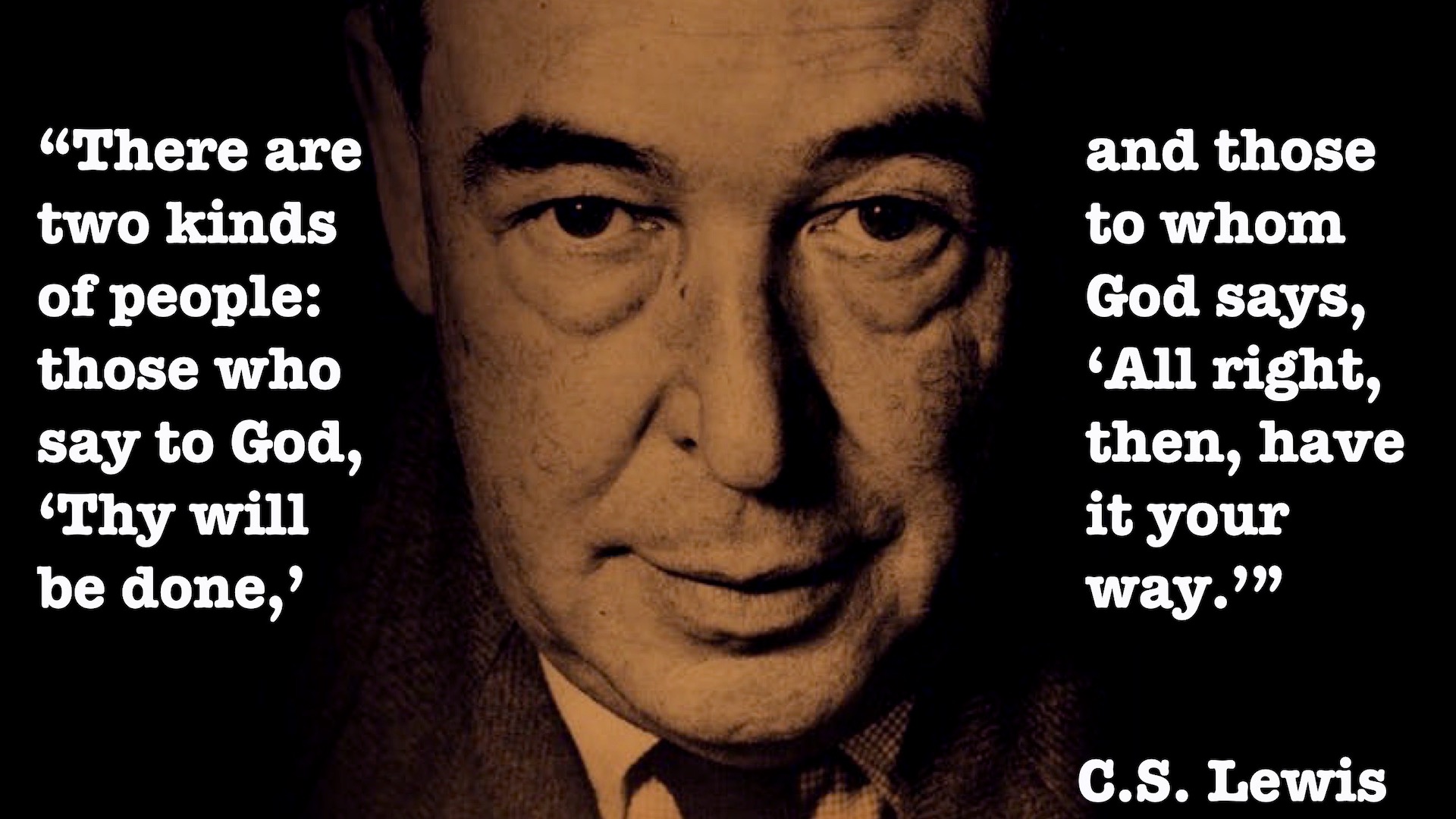
“There are two kinds of people: those who say to God ‘Thy will be done’ and those to whom God says, ‘All right then, have it your way.’” —C.S. Lewis

You must decide how you will respond in a crisis.

►► Would you please prayerfully consider supporting this ministry? My Patreon supporters get behind-the-scenes access to exclusive materials. ◀︎◀︎