The Holiest Moment

The holiest momentThe holiest moment of my week shouldn’t be singing songs.

It shouldn’t be listening to a profound sermon.

Not even partaking of Communion.

My holiest moment should be my going out to show Christ’s love to a hurting world.

“The holiest moment of the church service is the moment when God’s people—strengthened by preaching and sacrament—go out of the church door into the world to be the Church.” —Ernest Southcott 

To a man who lives unto God nothing is secular, everything is sacred. He puts on his workday garment and it is a vestment to Him. He sits down to his meal and it is a sacrament. He goes forth to his labor, and therein exercises the office of the priesthood. His breath is incense and his life a sacrifice. He sleeps on the bosom of God, and lives and moves in the divine presence. …  You housemaids, you cooks, you nurses, you ploughmen, you housewives, you traders, you sailors, your labor is holy if you serve the Lord Christ in it, by living unto Him as you ought to live. The sacred has absorbed the secular.” —Charles Spurgeon

The 7-Star Church

The 7-Star Church [web]Seven times in just two chapters of the book of Revelation, Jesus says, “He who has an ear, let him hear what the Spirit says to the churches.” That same Spirit is still speaking to the churches today.

As you may know, the number seven in the Bible stands for completion. Although there were many more churches in Asia minor, Jesus delivered a message to seven of them. In other words, He delivered a complete, well-rounded message to all churches by speaking to those seven. Those messages are still speaking to us today.

This Sunday I’m beginning a new series of messages called The 7-Star Church—Becoming The Church That Pleases Christ from this text in Revelation. It’s going to be a challenging word, but an encouraging word at the same time.

If you are near Cedar Springs, please join me at Calvary Assembly of God on Sunday morning at 10:30am. Come with an ear to hear what the Spirit is still saying to us today.

30 Quotes From “Raising Your Child To Love God”

Raising Your ChildIt’s a book I called a “must read for all parents” (you can read my full book review by clicking here). After typing up my notes of all the quotes I highlighted in this book, I ended up with 18 pages of notes, so these quotes from Andrew Murray’s book are, in my opinion, the cream of the crop. Tomorrow I will share some of the prayers Murray offered in his book.

“Example is better than precept. … Love that draws is more important than law that demands. … Let parents be what they want their children to be.”

“How terrible is the curse and power of sin! Through the father the child becomes a partaker of the sinful nature, and the father so often feels himself too sinful to be a blessing to his child; thus the home becomes a path to destruction rather than to eternal life. But—blessed by God!—what sin destroyed, grace restores. … Let God’s Father-heart and His Father-love be your confidence. As you know and trust Him the assurance will grow that He is fitting you for making your home, in ever-increasing measure, the bright reflection of His own.”

“God seeks a people on earth to do His will. The family is the great institution for this object; a believing and God-devoted father is one of the mightiest means of grace.” 

“What God says of Abraham gives us further insight into the true character of this grace: ‘For I have chosen him, so that he will direct his children and his household after him to keep the way of the Lord.’ The spirit of modern so-called liberty has penetrated even into our family life; and there are parents, who some from a mistaken view of responsibility, some from lack of thought as their sacred calling, somer from love of ease, have no place for such a word as ‘command.’ They have not seen the heavenly harmony between authority and love, between obedience and liberty. Parents are more than friends and advisers; God has clothed them with a holy authority to be exercised in leading their children in the way of the Lord.”

“Oh that Christian parents would realize, just as Judah did, what it means to stand in that place for their child! How often—when our children are in danger because of the prince of this world, when the temptations of the flesh or the world threatened to make them prisoners and slaves, holding them back from ever reaching the Father’s home—are we found careless or unwilling to sacrifice our ease and comfort in order to rescue them!” 

“Oh, that the eyes of God’s people might be opened to the danger that threatens the church! It is not infidelity or superstition, it is the spirit of worldliness in the homes of Christian families, sacrificing the children to the ambitions of society, to the riches or the friendship of the world—that is the greatest danger of Christ’s church. If every home once won for Christ were a training school for His service, we would find in this a secret of spiritual strength no less than all that ordinary preaching can accomplish.”

“With a parent’s love comes a parent’s influence. … The character of a child is formed and molded by impressions; continual communion with the parent can render these impressions deep and permanent. The child’s love for a parent rises to meet the parent’s love.” 

“The first four commandments have reference to God, the last five to our neighbor. In between stands the fifth. It is linked to the first four because to the young child the parent represents God; from him the child must learn to trust and obey God. And this command is the transition to the last five because the family is the foundation of society, and there the first experience comes of all the greater duties and difficulties with humankind at large.”

“The child can only honor what he sees to be ‘worthy of honor.’ And this is the parent’s high calling: always so to speak and act, so to live in the child’s presence, that honor may be spontaneously and unconsciously rendered. … Above all, let parents remember that honor comes from God. Let them honor Him in the eyes of their children, and He will honor them there too.”

“There is nothing that drive home the word of instruction as powerfully as a consistent and holy life. … The entrance of divine truth into the mind and heart, the formation of habits and the training of character—these are not attained by sudden and isolated efforts, but by regular and unceasing repetition.”

“Love knows no sacrifice, counts nothing a burden; love does not rest until it has triumphed.”

“We don’t want to be just another family with whom God dwells and is pleased. Ours must be wholly consecrated to God. And do not be afraid that strength will not be given to keep the vow. It is with the Father in heaven, calling and helping and tenderly working both to will and to do in us, that we are working.”

“We need renewed wisdom directly from above for the individual needs of each child. Daily prayer is the secret of training our children for God. … Those who have already communicated with God and received divine teaching about their children will be those who desire still more and pray earnestly for it.”

“Nothing open the fountains of divine love and renewed love for each other more than the prayerful desire to know how to raise our children to love God.”

“Not to restrain a child is to dishonor God and the child.”

“My duty is never measured by what I feel is within my power to do but by what God’s grace enables me to do.”

“Every thoughtful parent knows that there are times and places when the temptations of sin will be more apt to surprise even the most well-behaved child. Such are the times, both before and after the child goes into a situation or circumstance where he may be tempted, that a praying father and mother should do what Job did, bring the children before God in repentance and faith and where possible to confront them with questions concerning their behavior.”

“Let us ask God to make us very watchful and very wise in availing ourselves of opportunities to admonish our children and to pray audibly with them.”

“In our family’s life, the first thing of importance must not be our earthly happiness, or even the supply of our daily needs, nor seeing to the child’s education for a life of prosperity and usefulness, but rather the yielding of ourselves to God in order to be conveyors of His grace and blessing to our children. Let us live for God’s purpose: deliverance from sin. Thus our family life will forever be brightened with God’s presence and with the joy of our heavenly home to come, of which our earthly one is by the nursery and the image.”

“‘The children of Your servants will live in Your presence; their descendants will be established before You’ (Psalm 102:25-28). Death may separate one generation from another, but God’s mercy connects them as it passes on from one to another; His righteousness, which is everlasting, reveals itself as salvation from generation to generation. … It is God’s will that His salvation should be known from generation to generation in your family too, that your children should hear from you and pass on to their children the praises of the Lord.”

“God’s purpose is that the Holy Spirit should take possession of our sons and daughters for His service; that they should be filled with the Holy Spirit, consecrated for service. They belong to Him and He to them.” 

“Jesus desires that we rise above the experiences of fatherhood on earth to know more deeply the Father in heaven.”

“The earthly father must not only make the Father in heaven his model and guide, but he must so reflect Him that his child will naturally desire to emulate the One whom he so aptly represents. … In a Christian father a child ought to have a better picture than the best of sermons can give of the love and care of the heavenly Father and all the blessing and joy He wants to bestow.”

“If we are to watch over the heavenly quality of our children, we must ourselves be childlike and heavenly-minded. … Children lose their childlikeness all too soon because parents have so little of it.”

“Fathers, you have sons whom you would fain bring to Jesus to be saved, come and hear the lessons the Lord would teach you. Let these children first send you to Jesus in confession, prayer, and trust; your faith can bring them in.”

“Your motherhood is in God’s sight holier and more blessed than you realize.”

“The effect of the good advice parents give is more than neutralized by their own behavior.” 

“A child should never be allowed to feel that his immaturity is not taken into account, that his young reasoning is not regarded, that he has not received empathy, or help, or justice that he expects. This will take a kind of love and thoughtfulness that parents are all too short of.”

“If you feel that you do not know how to teach the Word to them, to make it interesting or exciting for them, take heart—God will make it come alive to them if you are faithful to read it and live it.”

“I am the giver of their physical life, the framer of their character, the keeper of their souls, the trustee of their eternal destiny. I was first blessed that I may bless them, first taught how my Jesus loved me and gave Himself for me that I may know how to love and how to give myself for them. … And the more tenderly my love to them is stirred up, the more I feel the need to be wholly and only the Lord’s, entirely given up to the love that loves and makes itself one with me. This will fill me with a love from which selfishness shall be banished, giving itself in a divine strength to live for the children that God has given me.”

The Church Goes

The church goesI think we in the church may have it backward. We are far too quick to judge the success of a church by how many people “came to church on Sunday.”

The church is not a building. The church is a living organism. The church is people living out the love of Jesus in a tangible way in their world.

You can’t go to church. But the church can—and should—go to the world.

Just before Jesus ascended into Heaven He said, “All authority in Heaven and on earth has been given to Me. Therefore, build a really nice building and invite everyone to come to it.”

Ummm, not so much!

Here’s what He really said, “All authority in heaven and on earth has been given to Me. Therefore, GO and make disciples of all nations” (Matthew 28:18-19).

We don’t go to church. We are the church. We go to the world. 

Instead of inviting the world to “Come to church” why don’t you think about how you can be the church and “Go” to the world this week.

UPDATE: This post was one of the seed thoughts that went into fashioning my book Shepherd Leadership: The Metrics That Really Matter.

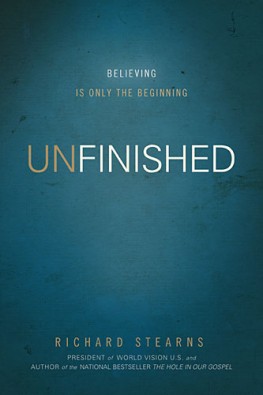
14 Quotes From “Unfinished”

UnfinishedI found Unfinished by Richard Stearns to be both confrontational and motivating. You can read my full book review by clicking here. These are some of the quotes I especially appreciated from this book. Unless otherwise marked, they are quotes from Stearns—

“God created you intentionally to play a very specific role in His unfolding story. God didn’t create any extras meant to stand on the sidelines and watch the story unfold; He created players meant to be on center stage. And you will feel fully complete only when you discover the role you were born to play.”

“You don’t have to go to the Congo or to Uzbekistan to change the world. You don’t have to be brilliant to change the world—or wealthy or a spiritual giant. But you do have to say yes to the invitation. You do have to be available and willing to be used, and you may have to pay the price that comes with following Jesus because changing the world and following Jesus isn’t easy, and it doesn’t come cheap.”

“Prosperity knits a man to the World. He feel that he is ‘finding his place in it,’ while really it is finding its place in him.” —C.S. Lewis

“Yet that is exactly how many Christians view the gospel of Christ. I do a deal with God, buy the fire insurance policy, put it in my drawer, and then I can go back to the party. Sure, it wouldn’t be a bad idea to go to church now and then to dip my feet into spiritual waters, and it wouldn’t hurt to pray from time to time, but, basically, with my salvation secured I can now get on with my life. This is what Dallas Willard refers to as the ‘gospel of sin-management.’”

“So we need to dispense with any notion that we can take this Jesus on our own terms, that we can simply add Him to the structure of our lives, fit Him into our plans, worship Him once a week for an hour or so, and offer Him a prayer when we find ourselves needing something. No, Jesus demands the total commitment of our lives in His service. We are called to enlist in His army and lay down every other priority in our lives at His feet. Our ambitions, our careers, our relationships, our possessions, even our families must be laid at His feet to do with as He wishes.”

“Authentic churches truly living together… offer a radically different and beguiling attractive alternative to every other model of human community.”

“God’s deepest desire is not that we would help the poor. God’s deepest desire is that we would love the poor; for if we love them, we will surely help them.”

“Love always requires tangible expression. It needs hands and feet. As followers of Christ we can too easily become overwhelmed by the complexity and depth of our Christian faith, and we can become confused by doctrine and theology. But the beautiful simplicity of our faith is that it distills down to the exact same bottom line for both the brilliant theologian and the five-year-old child: love God and love each other—period. Everything else derives from that.”

“Now, here is a really important thing to understand. If you lay down all of these things in the service of Christ and His kingdom, He won’t necessarily take them away from you. He doesn’t ask us all to quit our jobs, leave our homes, and have an estate sale to liquidate all our earthly possessions. No, He only asks that we turn all of those decisions over to Him. If you have built a business that can generate great wealth, He may leave you right there so that the business can be used to His glory and to accomplish His purposes. If you are an investment banker at Goldman Sachs, He may want you to stay put and become a kingdom builder right where you are stationed by letting your light shine in a place where a shining light may be desperately needed. If you love your community, He may use you to help transform it and reclaim it for His kingdom. He might even use your addiction as a powerful tool of His restorative power to transform human lives. But he does require that the certificates of title be signed over to Him. He becomes the owner, and we become the stewards, not of our possessions but of the Master’s possessions.”

“I am only one, but I am one;
I cannot do everything,
But I can do something.
What I can do I ought to do,
And what I ought to do
By God’s grace I will do.” —Edward Everett Hale

“Think of it this way: If we all worked for Boeing, our general calling would be to engage in the building of airplanes. But our specific calling might be to assemble the landing gear, wire and install the instruments, assemble the wings, or design the roomy and comfortable coach seats. And which of those specific tasks we were called to would be determined by the boss’s best judgment, taking into consideration our unique skills and abilities. … The same is true in building the kingdom of God. We all have the same general assignment but our specific roles within it will be unique to us as individuals and will take into account our gifts and talents but also our experience, our assets, our physical location, and our connections and associations.”

“The chief purpose of the church is to bring glory to God by accomplishing the Great Commission pronounced by Jesus. Everything else—worship, preaching, teaching, discipling, congregational care, the sacraments, feeding the hungry, caring for the poor, and so on—while valuable for us and pleasing to God in and of themselves, are ultimately means to the end of faithfully completing the assignment given to the church by Jesus just before He left.”

“Jesus envisioned these communities of believers would transform the world in which we live, much as springtime melts the cold and snow of winter and releases the exuberance of new life bursting forth. We would be drawn to the cold places, the broken places, the ragged edges of our world. We would be drawn to the open sores upon our societies: poverty, disease, hunger, injustice, and exploitation, becoming a healing balm to those who feel marginalized, excluded, and discarded. … Our generosity would astound, our determination amaze, and our love be irresistible.”

“The most important thing to remember is this: to be ready at any moment to give up what you are for what you might become.” —W.E.B. DuBois

Unfinished (book review)

UnfinishedRichard Stearns—as he did in The Hole In Our Gospel—delivers another stirring wake-up call to the Church in Unfinished: Believing is only the beginning.

As the title implies Unfinished is about what is still left for Christians to do. It’s not enough, Richard Stearns says, to just believe that Jesus is our Savior and Lord, we have to do something with that belief. And until we do, the work that Jesus gave us to do is unfinished.

The words in this book are both confronting and motivating. As I was, I believe you will be too, challenged to realize that God has made me and placed me where I am on purpose. He has a plan for my life, and I must honestly answer the question, “Am I fulfilling that plan, or is the work still unfinished?” Far from feeling condemned for anything yet unfinished, you will feel a renewed zeal to complete the work.

The first part of Unfinished is directed to individual Christians, and the second part to the corporate body of Christians known as the Church. The accompanying study guide and discussion questions at the back of the book will help you clarify your thoughts into action steps.

Unfinished is a great read!

Note: Because I had previously read and reviewed The Hole In Our Gospel (you can read my review by clicking here), I was given a free copy of Unfinished to read and review as well. My review of this book conforms with the standards I have for all of my book reviews.

Organization In The Church

A.W. Tozer“The man who would oppose organization in the church must needs be ignorant of the facts of life. Art is organized beauty; music is organized sound; philosophy is organized thought; science is organized knowledge; government is merely society organized. And what is the true church of Christ but organized mystery? … Many church groups have perished from too much organization, even as others from too little. Wise church leaders will watch out for both extremes. A man may die as a result of having too low blood pressure as certainly as from having too high, and it matters little which takes him off. He is equally dead either way. The important thing in church organization is to discover the scriptural balance between two extremes and avoid both.” —A.W. Tozer (emphasis added)

Pastor, what do you think of Tozer’s thoughts of organization in the church? How do you balance against the extremes?

13 Quotes From “Dear Abba”

Dear AbbaDear Abba is an intimate book of prayer and personal reflection; it’s thought-provoking and emotionally-moving. You can read my full book review by clicking here. Below are some of the quotes and prayers I found especially meaningful.

“Dear Abba, I’ve come to the place where I’m letting You love me more each day, but I still struggle with letting You like me.” 

“It would be comical if it wasn’t so sad: all of our desires to make ourselves worthy of this world but unfit for the world to come.”

“Peace and joy go a-begging when the heart of a Christian pants for one sign after another of God’s merciful love. Nothing is taken for granted, and nothing is received with gratitude.”

“I feel like the psalmist tonight—downcast. I was upcast, bright, enjoying the warmth of the day and then suddenly my joy was pickpocketed. It was a small thing, a minor misunderstanding that I could have let roll off like water, but I held on to it and nursed it awhile, and like sin always does, it grew. Now I find my mind completely disturbed, anxious, angry, and my imagination is conjuring up all sorts of somebody-done-me-wrong songs. Why do I not trust You? After so many demonstrations of Your infinitely tender hand, why do I not trust You?”

“Sin does not magnify the suffering of man’s plight; instead, it mitigates it. When I sin, I seek an escape from my humanity. I used to say to myself, ‘Well, you’re only human!’ But sin does not make me human; it compromises my humanity. The philandering husband with his mistress on business trips, the chemically addicted, the thieves who build ivory towers out of stolen money, the sensation-seekers and power brokers who seek substitutes. They do not drink the poverty of the human situation down to the last drop. They dare not stare it full in the face.” 

Yet. Those three letters stop me in my rutted tracks of besetting sins. For You were tempted as I am, yet You did not sin. The humbling point is that on a scale from 1 to 10, I usually give in when the heat reaches 3 or 4, yet You experienced the 10—the full-in-the-face of temptation—and did not give in. You are the friend of sinners, yet You are also the Great High Priest who invites us to come with confidence to Your throne and receive both our daily bread and extra rations for emergencies.”

“To practice poverty of spirit calls us not to take offense or be supersensitive to criticism.

“When the gift of a humble heart is granted, we are more accepting of ourselves and less critical of others. … For the humble person there is a constant awareness of his or her own weakness, insufficiency, and desperate need for God.”

“My friends in Christ, the simple truth is that the Christian Church in America is divided by doctrine, history, and day-to-day living. We have come a long sad journey from the first century, when pagans exclaimed with awe and wonder, ‘See how these Christians love one another!’” 

“Christ’s breakthrough into new life on Easter morning unfettered Him from the space-time limitations of existence in the flesh and empowered Him to touch not only Nepal, but New Orleans, not only Matthew and Magdalene, but me. The Lion of Judah in His present risenness pursues, tracks, and stalks us here and now.”

“I realized today that there is a third character who goes up to the temple to pray: the pharisaic tax collector—a ragamuffin who knows she’s a ragamuffin and wants to make sure everyone else knows she’s a ragamuffin. So she ends up using her sinner status not to cry out for mercy to You, but rather to seek out the attention of others as one who is real and authentic, when in reality she is nothing more than hubris in thrift-shop fashions. I realized this today because I looked in the mirror. God, be merciful to me.” 

“The tendency to continually berate ourselves for real or imaginary failures, to belittle ourselves and underestimate our worth, to dwell exclusively on our dishonesty, self-centeredness, and lack of personal discipline, is the influence of our negative self-esteem. Reinforced by the critical feedback of our peers and the reproofs and humiliations of our community, we seem radically incapable of accepting, forgiving, or loving ourselves.”

“If nobody remembers my name or the works of my hands, if everything that I’ve worked so hard to build over the years crumbles into insignificance, if I lose my health and my wits and even, heaven forbid, my memory, You are still my refuge and strength.” 

21 Quotes From “All In”

All InAll In by Mark Batterson is the sequel to his fantastic book on prayer called The Circle Maker. All In is the challenge to followup our prayer times with bold action. You can read my full book review by clicking here. These are some of the quotes I especially liked from All In—

“When did we start believing God wants to send us to safe places to do easy things?”

“You cannot be in the presence of God and be bored at the same time. For that matter, you cannot be in the will of God and be bored at the same time.”

“The Rich Young Ruler may rank as one of the most religious people in the pages of Scripture. The text tells us that he kept all the commandments. He did nothing wrong, but you can do nothing wrong and still do nothing right. By definition, righteousness is doing something right. We’ve reduced it to doing nothing wrong. … [Jesus] asks the Rich Young Ruler to ante up everything. Why? Because He loved the Rich Young Ruler too much to ask for anything less! We focus on what Jesus asked him to give up but fail to consider what He offered up in exchange.”

“God cannot reveal His faithfulness until we exercise our faith.”

“The first step is always the longest and the hardest. And you can’t just take a step forward into the future. You also have to eliminate the possibility of moving backward into the past.”

“One of our fundamental spiritual problems is this: we want God to do something new while we keep doing the same old thing.”

“When we cling too tightly to what God did last, we often miss what God wants to do next.”

“We all want to spend eternity with God. We just don’t want to spend time with Him. We stand and stare from a distance, satisfied with superficiality. We Facebook more that we seek His face. We text more than we study The Text. And our eyes aren’t fixed on Jesus. They’re fixed on our iPhone and iPads—emphasis on ‘i.’ Then we wonder why God feels so distant.”

“You cannot go to church because you are the church. … Your workplace is your mission field. Your job is your sermon. Your colleagues are your congregation.”

“Our lack of guts is really a lack of faith. Instead of playing to win, we play not to lose.”

“There are two kinds of people in the world—those who ask why and those who ask why not. Going all out is asking why not. Why people look for excuses. Why not people look for opportunities. Why people are afraid of making mistakes. Why not people don’t want to miss out on God-ordained opportunities.”

“We treat failure and success like their antonyms. Failure is a part of every success story. Think of it as the prologue.”

“No matter what tool you use in your trade—a hammer, a keyboard, a mop, a football, a spreadsheet, a microphone, or an espresso machine—using it is an act of obedience. It’s the mechanism whereby you worship God. It’s the way you do what you are supposed to do.”

“I’ve discovered that if I don’t take the first step, God generally won’t reveal the next step.”

“It doesn’t matter what you do, God wants to help you do it. He wants to favor your business plan, your political campaign, your manuscript, your lesson plan, your legal brief, your film, and your sales pitch. But you’ve got to position yourself for that favor by acting in obedience. And if God knows He’ll get the glory, He will bless you beyond your ability, beyond your resources.”

“Courage doesn’t wait until situational factors turn in one’s favor. It doesn’t wait until a plan is perfectly formed. It doesn’t wait until the tide of popular opinion is turned. Courage only waits for one thing: a green light from God. And when God gives the go, it’s full steam ahead, no questions asked.”

“Opportunities typically come disguised as impossible problems.”

“When it comes to sinful rationalizations, we are infinitely creative. But it’s our rationalizations that often annul His revelations. When we compromise our integrity, we don’t leave room for divine intervention. When we take matters into our own hands, we take God out of the equation. When we try to manipulate a situation, we miss out on the miracle.”

“Integrity won’t keep us from getting thrown into a fiery furnace, but it can keep us from getting burned.”

“It’s much easier to act like a Christian than it is to react like one!”

“There has never been and never will be anyone like you, but that isn’t a testament to you. It’s a testament to the God who created you. And that means no one can worship God like you or for you. You are absolutely irreplaceable in God’s grand scheme. And God is jealous for you—all of you.”

Got Problems? Good!

The absence of problems in a church does not mean that everything is fine. It might mean that the church is dead.

Check out these words from A.W. Tozer—

Tozer“Some misguided Christian leaders feel that they must preserve harmony at any cost, so they do everything possible to reduce friction. They should remember that there is no friction in a machine that has been shut down for the night. Turn off the power, and you will have no problem with moving parts. Also remember that there is a human society where there are no problems—the cemetery. The dead have no differences of opinion. They generate no heat, because they have no energy and no motion. But their penalty is sterility and complete lack of achievement. What then is the conclusion of the matter? That problems are the price of progress, that friction is the concomitant of motion, that a live and expanding church will have a certain quota of difficulties as a result of its life and activity. A Spirit-filled church will invite the anger of the enemy.” (emphasis added)

What do you think?