“Joy To The World” is a Christmas song, right? Well, we do often sing it during the Advent season, but T.M. Moore persuasively makes the case in his book Joy To Your World that this message is a year-round blessing.
Quite simply, Moore reminds us that “the Christian life is joy.” Joy is what distinguishes the Christians from others, and joy is what attracts others to the Christian faith more than anything else.
Jesus sent His followers out to make disciples, and the empowering force behind the Christian’s testimony is the joy that Jesus is the One who has conquered hell, death, and the grave. So of all people, Christians should be brimming over with joy.
T.M. Moore writes: “When, because of our knowledge of God, the joy that fills our souls comes to expression as joy lived, then our lives will make sense, our salvation will be visible to the watching world, and we can offer any who may ask, sound reasons for how that joy can be theirs as well.”
This is an excellent message to be read at anytime, not just at Christmas.
That first Christmas was supposedly a silent night and a holy night. Maybe there was some singing angels involved, but at least their message was about “peace on earth.”
Sometimes that idea of “peace” at Christmas time can make us feel like hypocrites. Sometimes it seems as if there is more turmoil than peace, and more ill-will than goodwill.
Even Henry Wadsworth Longfellow’s poem called I Heard The Bells On Christmas Day starts out in celebration, but then shifts to the dark words, “And in despair I bowed my head: ‘There is no peace on earth,’ I said, ‘for hate is strong and mocks the song of peace on earth, goodwill to men.’”
If you have had a hard time finding peace this Christmas, this short message will bring you hope and encouragement, so that you can truly say, “Merry Christmas!”
A couple of years ago as we were setting up for our Living Nativity, I was wrapping a towel around the doll we were going to use for the infant Jesus. A young boy from the community was carefully watching me and he asked, “Is that baby Santa?”
“No, it’s not Santa,” I said. “See this manger? We’re getting things setup to tell the story about the very first Christmas, long before St. Nick came on the scene. Maybe you’ve heard about Mary and Joseph?”
The young lad’s eyes lit up as he seem to get the answer. “Oh! Is that baby Moses?!”
Clearly, people don’t know all the facts surrounding the first Advent of Jesus. Sometimes things in culture and church get jumbled—what belongs to which? Is Christmas a pagan holiday? Where do Christmas trees come in? Was the birth of Jesus actually on December 25? What does it all matter anyway?
Instead of running from these questions, Christians should use them to point people in the right direction.
Have you heard the tune called Greensleeves? It’s been around longer than anyone knows. William Shakespeare referenced it in two of his plays and didn’t feel the need to explain it to his audience. The tune has been set to some pretty bawdy words about New Year’s Eve parties, and even as a mocking song to some folks about to go to the gallows. And then in the mid-1800s William Chatterton Dix used this tune to write words about Christ’s birth in What Child Is This?
What an excellent question! Who exactly is this Child? Is Jesus merely a line on the pages of history? Or is His birth something more? Oswald Chambers noted, “The tremendous revelation of Christianity is not the Fatherhood of God, but the Babyhood of God—God became the weakest thing in His own creation, and in flesh and blood He levered it back to where it was intended to be. No one helped Him; it was done absolutely by God manifest in human flesh.”
The first-century historian Luke simply records that Mary is pregnant with “a child.” That is, until Jesus is taken to the temple in Jerusalem eight days later, and we see that a man named Simeon didn’t just see this Child as any baby, but as a fulfillment of prophecy (see Luke 2:25-32; Isaiah 7:14 and 9:6).
This Child is much more than just a historic person. He not only split history into BC and AD, but He has changed my life, and countless others’ lives as well! That’s why the chorus of this Christmas carol joyfully announces, “This, THIS is Christ the King!”
People may be confused about what tradition belongs to culture or Christendom. You may even be confused about what belongs to which. But none of that should stop us from knowing the Child we celebrate this Christmas. None of that should stop us from helping seekers to find Jesus as their own Savior. None of that should stop us from enthroning Jesus Christ as King and giving Him the highest praise He deserves!
Jesus used common, everyday things—farmers, fish, trees, weather, children’s songs—to tell people about a Heaven that was prepared for them. Paul used the cultural idols and poets to point his community to Jesus. Philip used the Scripture a governmental official was reading to point him to Jesus.
So we, too, can use whatever is around us to point people to Jesus this Christmas! What Child is this? This, THIS is Christ MY King! Merry Christmas!!
When I worked in the business field, I was invited to be a teacher for a program called GROW (Grand Rapids Opportunities for Women), where I taught a class on marketing. Then later on, I served as a reviewer as the students turned in their marketing plans.
One of the main points I tried to drive home to my students is a basic Marketing 101 principle which says—you can’t be all things to all people. You have to pick a niche market and then try to dominate that market. There are two general ideas here: (1) Make your product or service pricey and therefore exclusive to a select group, or (2) Make your product or service affordable and accessible for the mass market.
The Incarnation of Jesus totally violates this Marketing 101 principle. (Which goes to show you that God knows more than all the world’s so-called “experts”!)
First, there was a marketing message to shepherds (see Luke 2:8-11). This would have been the “mass market” as shepherds represented the every-day, working-class man. The first two verses of The First Noël carol addresses these “certain poor shepherds in fields where they lay.”
But then there is this appearance of a very exclusive group of Magi (see Matthew 2:1-2, 11). These men were highly educated and had gained great influence and affluence. Verse 3 of The First Noël references these “wise men…from country far” who could present such lavish gifts to Jesus.
God did exactly what I told my GROW students they shouldn’t do if they wanted to be successful!
The Incarnation of Jesus is one of those rarest of rare things that actually can be all things to all people! Why? Because ALL people need what the Incarnation of Jesus brings. That’s why the final verse of The First Noël calls for ALL of us to join in singing our praise to God because of the salvation Jesus had purchased for ALL mankind.
…and the penalty for that straying from God is death for ALL sinners (Romans 6:23).
But Jesus came to ransom ALL from that penalty (Mark 10:45)…
…so that ALL who believe in Him will be saved (Romans 3:22)!
“The coming of Jesus was a search-and-save mission. ‘The Son of Man came to seek and save the lost.’ So Advent is a season for thinking about the mission of God to seek and to save lost people from the wrath to come. … ‘As the Father has sent Me, even so I am sending you’ (John 20:21). It’s the story of how the vertical Advent of God in the mission of Jesus bends out and becomes the horizontal Advent of Jesus in the mission of the church. In us.” —John Piper
You have been rescued, now go be a rescuer. Take this Noël message to ALL … young/old, rich/poor, Black/white, educated/illiterate, healthy/sick, friend/enemy…. the message in the First Noël and every Noël is for everyone!
Pastor Phillips Brooks visited Israel in the mid-1800s. While there he visited a small church just outside of Bethlehem. Listening to the worshipful songs being sung in that quiet countryside, he was inspired to pen the words to O Little Town Of Bethlehem.
Because of that quiet setting, notice how Rev. Brooks notices things we often miss—
little town on Bethlehem
in thy dark streets
while mortals sleep
no ear may hear His coming
But little does not mean insignificant. And just because we can’t see or hear something doesn’t mean it doesn’t exist or it isn’t important.
Sometimes we’ve looked and listened and waited and searched for so long that we have given up and we begin to drift off to sleep. We continue to live in our own “little town” surrounded by silence. And we are in danger of missing a miracle right in our midst!
We know today that Jesus was born in Bethlehem. But did you know that this little town was still so obscure in Christ’s day that many people in Israel were unaware of what went on there? (See John 7:41-43). Even after King Herod had gruesomely killed all the baby boys in Bethlehem, scarcely anyone outside of that town knew about it or cared about it.
But God cared. And He knew exactly what He was doing.
But when the proper time had fully come, God sent His Son (Galatians 4:4)—the exact right moment—to be born in Bethlehem—the exact right place (Micah 5:2). Notice even Micah says of Bethlehem though you are small among the clans of Judah, giving birth to the title of Rev. Brooks’ poem.
How small was it? Look at the description of the territory for the tribe of Judah (in Joshua 15), and you can easily glossed over the names of all of the towns. But look more closely and you will see something you didn’t read in that list of towns. Take a close look at all 38 cities: it’s still missing.
There are a couple of very notable figures that dominate the Old and New Testaments, and they have something in common—King David and Jesus both come from the tribe of Judah. And both of them were born in Bethlehem. But in the list of towns in Judah’s territory, there isabsolutely no mention of Bethlehem.
This town either didn’t exist, or it was so “insignificant” that Joshua didn’t even think to mention it. It would be almost another 500 years before David would be born in Bethlehem, and then another 900 years after that before Jesus would be born in this little town of Bethlehem.
God had in mind for the greatest earthly king in Israel’s history and the King of all kings to come from such humble origins… from a village that didn’t even make the list. Bethlehem was ready for these kings at just the right moment!
Jesus said heaven and earth will pass away, but His words will never pass away. What promise in His Word do you need to cling to?
Just as those awaiting the Messiah clung to Micah’s promise until it came to pass, you must find God’s promise for you in His Word, cling to it, and don’t let go until it comes to pass in your little town.
Of peace on earth, goodwill to men. (Henry Wadsworth Longfellow)
How many “old familiar carols” have you heard Christmas after Christmas, until the words have almost lost their meaning? If we’re not careful, any song repeated too often can lose the richness of its original intent.
There are some amazing messages in many of our old familiar Christmas carols, because many of those messages are saturated with the old familiar story of Redemption that the Bible tells over and over again.
Please join me this Sunday as we take a new look at the old familiar messages in our Christmas carols. These messages will bring a new appreciation of God’s love that was sung at Christ’s Advent, and reawaken the sweetness of meaning for this Christmas Day.
This has been an ongoing Advent series for us. To check out the Christmas carols we discussed in 2014, please click here, and the carols from 2015 are here. If you’ve missed any of the messages this Christmas, please check them out:
Imagine that I invited you to my house for a Christmas party. When you arrived, I greeted you at the door with a cheerful hello and warmly welcomed you into my home. But as you hung out with the other guests, you might begin to wonder if we were truly celebrating Christmas. After all, when you looked around my house, you saw no Christmas tree, no ornaments, no wrapped gifts, no mistletoe, no Christmas stockings, no manger scene. You might be tempted to say that you were invited to a non-Christmas Christmas party! (By the way: my house IS fully decorated for the season!)
One of our 300-year-old Christmas carols sounds remarkably like my make-believe party. Joy To The World has no mention of angels, no wisemen, no manger, no nativity scene, no virgin birth, no star in the east. It seems like a non-Christmas Christmas carol!
That’s because at this time of year, Christians aren’t celebrating Christmas, but we’re celebrating Advent. Actually we’re celebrating both Advents.
Jesus was born in a Bethlehem manger (His First Advent), but He is also coming again to bring all of earth’s history to a close (His Second Advent). So we celebrate the First Advent, and then look with hopeful anticipation to the Second Advent. That’s exactly what Joy To The World does!
Each of the stanzas of this well-known hymn looks forward with joy to Christ’s ultimate fulfillment of all the prophesies of the Bible. The final joy comes when He reigns as King of Kings and Lord of Lords. But we can still live with joy right now!
The third stanza of this hymn says that Christ has come to make His blessings known far as the curse is found. The Apostle Paul says the same thing—sin used to reign, but the grace of God far exceeds the thorns of sin (see Romans 5:19-21; 6:8-12).
Our ultimate joy comes at the Second Advent of Christ when “He will wipe away every tear from their eyes. There will be no more death or mourning or crying or pain, for the old order of things has passed away” (Revelation 21:4).
So the next time you hear the non-Christmas Christmas carol Joy To The World, be reminded that it’s not Christmas we are celebrating, but Christ’s First Advent. And it’s not some shapeless, indefinable future that awaits us, but we can live in the joy of anticipating Christ’s Second Advent.
Angels play a fairly visible role in the First Advent story. As a result, we can begin to piece together some facts about angels from the biblical accounts. In my series on The Carols Of Christmas, I was looking at Angels From The Realms Of Glory, and there is information about the angels in this carol that is well-support from the Scripture.
Angels were created before the Earth was created, and they celebrated as God created our universe (Job 38:4-7). The Christmas carol says, “ye who sang Creation’s story now proclaim Messiah’s birth,” which we see in Luke 2:8-14.
Angels are messengers sent from God, and they carry a message from God to turn people toward God (Daniel 10:12; Matthew 1:20-23; Luke 1:11-20, 26-38). In the Christmas carol they remind us to leave our contemplations and “seek the great Desire of nations.”
Angels are not to be worshiped, because they are created beings. Lucifer’s desire to be worshipped is what led to his rebellion against God and expulsion from Heaven (Isaiah 14:13-14). And he still tries to appear today as an angel of light (2 Corinthians 11:14).
Angels long to look into the Gospel that humans can know by personal experience (1 Peter 1:12).
We have been given an angelic responsibility to tell others about Christ’s First and Second Advents (notice that the messengers in the churches are called angels in Revelation 2:1, 8, 12, 18; 3:1, 7, 14; 22:16). The carol reminds us that it’s “all creation” (that includes us!) that joins the angels in praising God.
One of the biggest lessons we need to learn from this Christmas carol, and the corresponding verses about angels, is that we aren’t just celebrating the First Advent. We are anticipating and looking forward to the Second Advent as well!
Of peace on earth, goodwill to men. (Henry Wadsworth Longfellow)
How many “old familiar carols” have you heard Christmas after Christmas, until the words have almost lost their meaning? If we’re not careful, any song repeated too often can lose the richness of its original intent.
There are some amazing messages in many of our old familiar Christmas carols, because many of those messages are saturated with the old familiar story of Redemption that the Bible tells over and over again.
Please join me this Sunday as we once again take a new look at the old familiar messages in our Christmas carols. These messages will bring a new appreciation of God’s love that was sung at Christ’s First Advent, and reawaken the sweetness of meaning for this Christmas Day.
If you would like to check out some of the carols we have already looked at, check out these posts:
I’ve read these two passages of Scripture so many times during the telling of the Advent story, but I never saw this apparent mistake. I’ve highlighted the troubling phrases below—
Therefore the Lord Himself will give you a sign: The virgin will be with Child and will give birth to a Son, and will call Him Immanuel. (Isaiah 7:14)
But after he had considered this, an angel of the Lord appeared to him in a dream and said, “Joseph, son of David, do not be afraid to take Mary home as your wife, because what is conceived in her is from the Holy Spirit. She will give birth to a Son, and you are you to give Him the name Jesus, because He will save His people from their sins.” (Matthew 1:20-21)
Did the angel make a mistake? Was he supposed to tell Joseph “give Him the name Immanuel”? Or maybe Immanuel and Jesus mean the same thing?
The answer to all three of those questions is NO. There wasn’t a mistake; His name should be Jesus; and Immanuel and Jesus don’t mean the same thing.
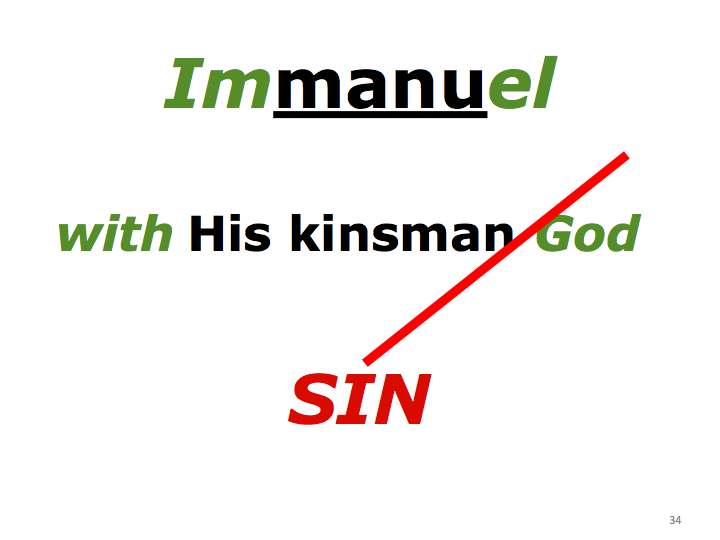
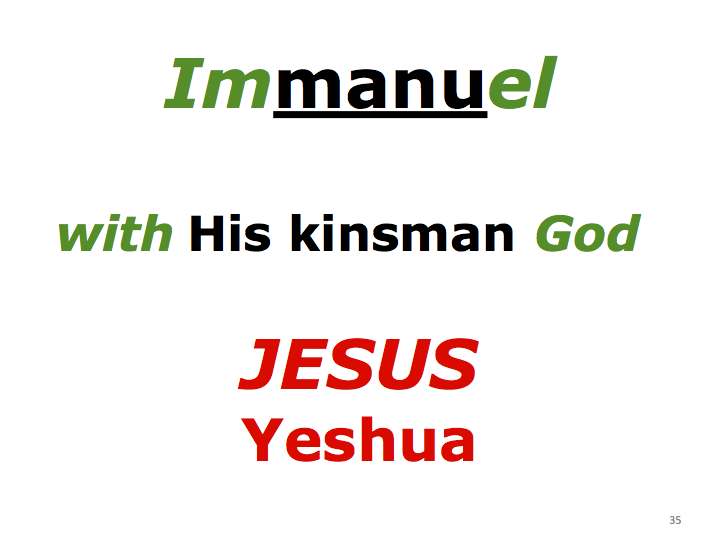
Immanuel is a cool name, appearing only three times in the Bible. The prefix “im” means with, and the suffix “el” means God. The root word in its broadest sense means people, but when we’re talking about God saving “HIS people from their sins,” the best translation would be His kinsman. Thus Immanuel = with His kinsman God.
Just before giving us the prophesy about Immanuel, Isaiah experienced the horror of being with God. When Isaiah was in God’s presence he said, “Woe is me! I am ruined! For I am a sinful man and I have seen God Almighty” (Isaiah 6:5-6). Here’s the simple fact: Our sin separates us from God’s presence. Jesus (in the Hebrew Yeshua = God saves) is the only One Who could remove the penalty of our sin!
Only Jesus could atone for our sin and remove our guilt (see Isaiah 6:7), so that God could stay with us (Immanuel)!
Jesus (our salvation) makes Immanuel (with His kinsman God) possible. So as the Christmas carol O Come, O Come, Emmanuel implores us: Rejoice! Rejoice! Immanuel shall come to thee!
May you live in the forgiveness of Jesus and the joy of His Immanuel presence this Christmas season!



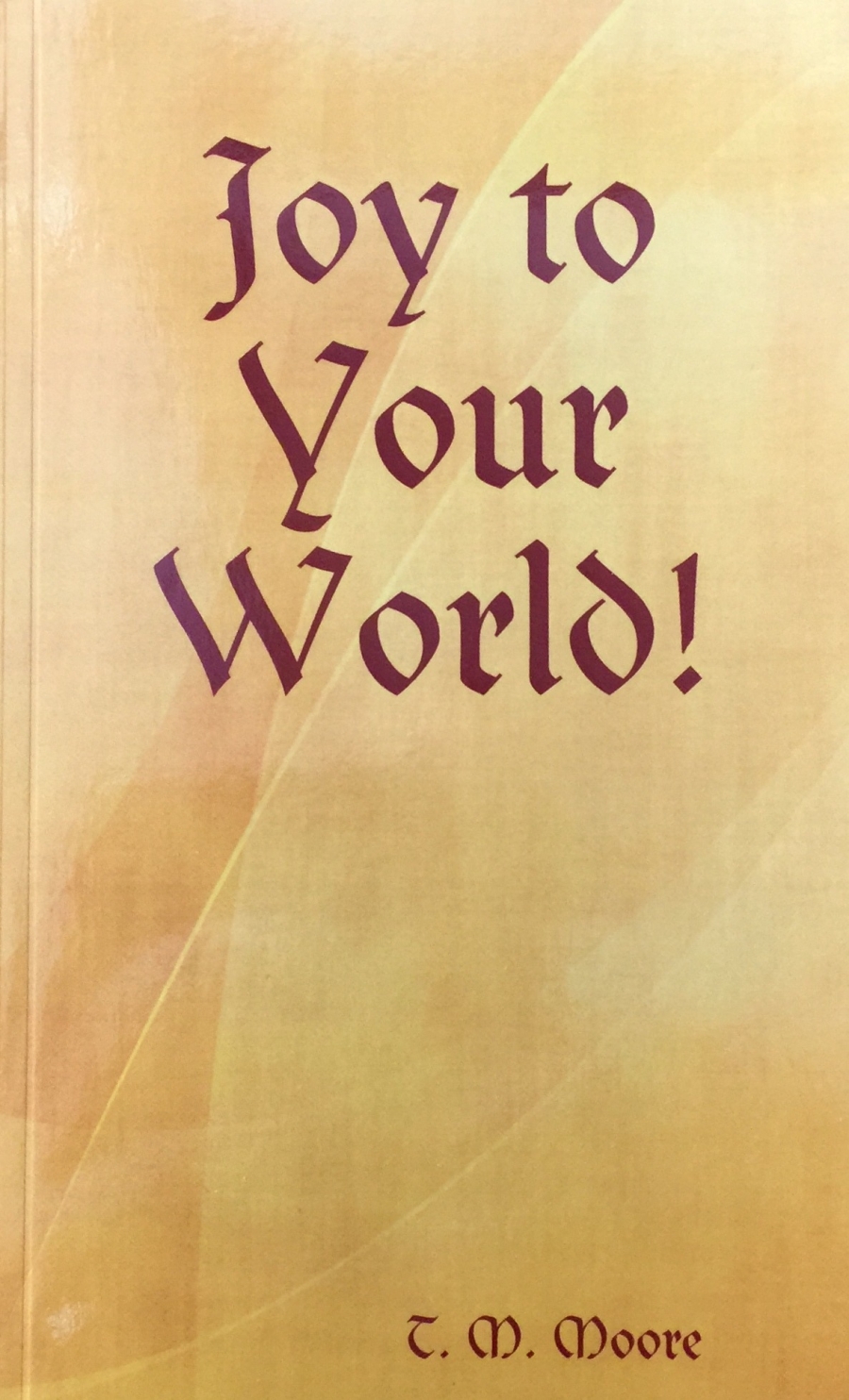 “Joy To The World” is a Christmas song, right? Well, we do often sing it during the Advent season, but T.M. Moore persuasively makes the case in his book Joy To Your World that this message is a year-round blessing.


 Craig T. Owens