14 Quotes From “Beyond IQ”

Beyond IQI found Beyond IQ by Garth Sundem to be engaging because of both the research he presents, and the engaging exercises he incorporates to make the research applicable to us. You can read my full book review by clicking here. Here are some of the quotes I especially appreciated.

“First, here’s why insight can be difficult: it requires a paradoxical mix of experience with openness. Usually, experience leads to set-in-stone ways of doing things. Typically, openness is only present when you’re forced by inexperience to remain available in your search for solutions. Experience mixed with openness is a rare cocktail. … Rather than opening your mind to insight, [John] Kounios and [Mark] Jung-Beeman show that if you want insight, the best thing you can do is to close it. A closed mind shows up on an fMRI as activation of the anterior cingulate cortex, your brain’s home of inhibiting distraction. It’s as if your ACC is a pair of noise-canceling headphones, and with these headphones in place you’re more able to hear your brain’s quiet, insightful whispers.” 

“Science has known that during sleep the brain’s hippocampus—the structure responsible for encoding new memories—replays the day’s experiences from short-term storage and filters them into the neocortex, where experiences are integrated into… ‘pre-existing knowledge representations.’ Insight is the novel connection of knowledge, and sleep knocks knowledge into new configurations.”

“[Robert] Sternberg and his frequent collaborator, Richard Wagner, showed that situational judgment tests…designed to measure practical intelligence are a much better predictor then IQ of job performance in business managers, bank managers, and graduate students. IQ doesn’t lead to success. Practical intelligence does.” 

“The language of problem-solving is: initial state, constraints, operations, and goal state. … [Richard] Mayer says that the most striking feature of people who successfully solve real-world problems is the time they spend studying the initial state and the constraints—the extra time they spend clarifying the problem.”

“University of California-San Bernardino researcher James Kaufman knows the recipe for creativity. It’s equal parts intrinsic motivation, experience, and something he calls low personal inhibition. Intrinsic motivation is pretty self-explanatory, but beware of the danger of ‘replacing intrinsic motivation and a natural curiosity with external rewards,’ says Kaufman. If a parent wants a child to become a creative pianist, the parent should encourage interest in the piano but not incentivize this interest with ice cream. Creativity blooms in fields you’re drawn to, not in fields into which you’re pushed. … Kaufman’s research has shown that creative people are hard workers with background knowledge and expertise in their creative domains. ‘It’s the “learn the rules so you can break them” approach,’ he says.” 

“Dean Keith Simonton of UC Davis found that the nineteenth-century scientists who wrote the most-cited papers also wrote the least-cited papers. … The more scientific papers or sonatas or sonnets a person writes, the greater chance that one or more will be especially creative.”

“In any kind of cognitive activity you have two kinds of things going on. You have intelligence, but there’s also learning and skill and knowledge based on practice. The more the second develops, the less important the first becomes. … Even more importantly, we’ve shown that with enough practice and hard work, you can actually change the neurophysiology of the brain. For example, practice can encourage the brain to grow greater myelin coating on neurons. Thus our behaviors become literally hard-wired. Developing expertise literally makes certain thought patterns more efficient than others.” —Paul Feltovich 

“Florida State researcher K. Anders Ericcson shows that it’s not only experience that creates expertise but a step-by-step method of sculpting experience that he calls deliberate practice. To Ericsson, famous for his theory that 10,000 hours of practice creates expertise in any field, the four-step path to expertise includes performing your skill, monitoring your performance, evaluating your success, and figuring out how to do it better next time. Completing only the first step—performing the skill itself—leads to automated, low-level, rote performance in which you perform the skill the same way every time. Monitoring, evaluating, and adjusting your skill allows you to modify it after every pass, helping skill evolved toward expertise.”

“The more you use your brain, the longer you’ll be able to use it. … People with ‘cognitively protected’ brains were those who challenge themselves through a lifestyle that included reading, writing, attending lectures, and doing word puzzles—in other words, they followed a self-imposed regimen of cognitive involvement. … Cognitive involvement is only one tine of a three-pronged approach to brain health in later life. The second tine is a healthy body. … In fact, your cardiovascular health in middle age is even more important for your later brain health than the same risk factors in old age itself. … The third tine: social interaction. … Nothing forces the brain to work like interacting with other brains.” 

“Moral reasoning and wisdom are linked. Specifically (and this is kind of cool albeit technical), for those who possess strong moral reasoning, wisdom increases with age. If you have lower moral reasoning, you gain no wisdom as you get older. So if you want wisdom later, train your moral reasoning now.”

“Wisdom requires thought and action without yourself in mind, and sociologist Monika Ardelt of the University of Florida shows that selflessness is also the best predictor of successful aging. In fact, the wisdom born of selflessness beats out physical health, income, socioeconomic status, physical environment, and even social relationships in predicting life satisfaction in old age.”

“Pressure…sits like a lead weight in your working memory, claiming space that could otherwise hold useful information. And because working memory is a mainline to general intelligence, space claimed by pressure makes you measurably dumber. … Pressure flips a mental switch from implicit to explicit thought, making you apply a layer of analysis to things that should be automatic. … Chronic pressure can make you chronically prioritize the quick rewards of drugs and alcohol while discounting their long-term risk. … So beware. Stress plugs your working memory, analysis paralysis forces you to try to use it anyway, and your dopamine circuits cry for a quick, risky solution.”

“Students with high emotional intelligence (EI) have lower rates of drug use and teachers with high EI get more support from their principals. Employees with high EI have higher job performance, especially when their IQ is low (implying that emotional intelligence can help compensate for low general intelligence—and also that these skills are distinct). EI is even implicated in resilience—the more EI you have, the higher your chances of bouncing back after trauma or negative life events.” 

“If IQ is the strength of the bulb in your lighthouse, willpower is the lens that focuses it into a beam.”

Beyond IQ (book review)

Beyond IQHow many times have you been told that your Intelligence Quotient (IQ) determines how smart you are? Probably quite often, but Garth Sundem’s new book Beyond IQ challenges that long-held assumption.

Sundem writes, “Raw intelligence is good: it helps shape your potential top speed. But there’s much, more more that goes into realizing it. This brain-training book for everything but IQ will teach you how to drive your mind—to get the most from what you’ve got under the hood.”

Indeed, Sundem not only shares the findings of top psychologists and other brain experts from around the world, but tells you the practical applications of those findings. Each chapter is loaded with brain-boosting exercises that you can do to tap into the intelligence that God has given you.

I found this book to be not only educational, but a lot of fun too! The exercises were engaging and challenging in a way that made me want to bookmark them and come back again and again. That, says Sundem, is what will allow you to harness the greatest potential in your brain power.

I am a Three Rivers Press book reviewer.

Links & Quotes

link quote

Some interesting reading from this weekend…

A very informative piece on the history of Israel.

Some ministers today preach only a positive message. To hear them tell it, every Christian is getting instant answers to prayer and receiving miracles; everybody is feeling good, living well; and the whole world is bright and rosy. I like to hear that kind of preaching because I really desire all those good and healthy things for God’s people. But that is not the way things are for a great number of very honest, sincere Christians.” Read more in David Wilkerson’s post At The Breaking Point.

[PHOTO] 100 random acts of kindness almost anyone could do.

Judgment is God’s job. To assume otherwise is to assume God can’t do it. God has not asked us to settle the score or get even. Ever!” Read more in Max Lucado’s post Judgment Is God’s Job.

Pretty cool: researchers are discovering ways to restore brain function after an injury.

You may have seen the headlines that claimed children with same-sex parents fared better than children in traditional homes. Hold on a second: the research was flawed.

Regis Nicoll asks a great question: How Should Churches Receive Same-Sex Couples?

These kinds of atrocious reports about Planned Parenthood’s irresponsibility make me angry! Any why are my tax dollars funding this?!?

One of the basic propositions that supposedly makes evolution work is that things remain relatively the same over long periods of time. Yet here is another scientific study telling us that things haven’t remained the same.

“The people with the calculators have seen the problem, but they have not seen God. They have figured things out, but they have not figured God in.” —A.W. Tozer 

Links & Quotes

link quote

Some good reading for today…

What you do with television in your home will help determine whether you and your family will be dumbed down. Let me suggest that you not watch (or let your kids watch) shows that play to the lowest common denominator in humanity… shows that are written and produced for, yes, I’ll say it…dumb people.  You might think they’re harmless and amusing, but are they really the best use of your time and, more importantly, your brain?” Read more from Mark Atteberry in his post The Dumbing Down Of America.

A great question: Where is the outrage over the bombardment of civilians in Israel?

David Wilkerson reminds us of the loving heart of Jesus our Shepherd.

A really cool story about the Cadbury family (who founded the Cadbury Chocolate company).

Tim Elmore shares the good news and bad news in his post Teen Trends.

Links & Quotes

link quote

Some interesting reading (and watching and listening) from the last couple of days.

Great D-Day history! You can listen to CBS Radio as they reported the D-Day invasion on June 6, 1944.

Watching porn not only decreases brain size, but it also weakens the watcher’s ability to make good long-term decisions.

Parents: kids can download apps to hide pictures and videos on their electronic devices. Check out the latest news from uknowkids.com.

The Congressional Budget Office now reports that ObamaCare costs are so outrageous that it is impossible for them to calculate the total economic impact.

“It is delightful to worship God, but it is also a humbling thing; and the man who has not been humbled in the presence of God will never be a worshiper of God at all. He may be a church member who keeps the rules and obeys the discipline, and who tithes and goes to conference, but he’ll never be a worshiper unless he is deeply humbled. … There’s an awesomeness about God which is missing in our day altogether; there’s little sense of admiring awe in the Church of Christ these days.” —A.W. Tozer

[VIDEO] Clay Christensen on the importance of religious freedom to democracy.

“The most paralyzing thing we can do for our relationship is to define our spouse by their past, rather than by who they are in the present.” Read more from this post Top 10 Relationship Killers.

Fasting is beneficial spiritually and physically: Fasting can regenerate immune system.

Links & Quotes

link quote

Great reading (and watching) today.

[VIDEO] John Maxwell reminds us of the value of delays.

Dr. James Dobson defends his comments at the National Day of Prayer address.

[VIDEO] Dr. Brian Mattson discusses the place of the Apocrypha.

[INFOGRAPHIC] Exercise helps your memory.

“The surprise comes for many people that such a tiny little brain is able to form such a rich memory described as a cognitive map,” says co-author Randolf Menzel. Actually, the surprise for me is that many people refuse to believe this amazing little brain was created by an amazing Creator. See how bees build mental maps to get back home.

Singing Your Prayer

Be honest: have you ever crammed for an exam? You’re up late into the night “cramming” info into your brain, then chugging Coke or Mt. Dew or coffee the next morning to try to wake up.

You get to class and fly through your test, trying to get all of the information out of your brain before it evaporates. Perhaps you do well on the test, but if someone were to quiz you on the same material a week later, you’d probably recall very little of what you studied. If the teacher asks you the next school year what you remember from that exam, your mind might be blank.

Music & the brainYears later you might be flipping through the radio dial, and a song comes on that you haven’t heard for years. You turn up the volume, and start singing along to the song, recalling that this was the very song you were listening to the night you were cramming for that exam.

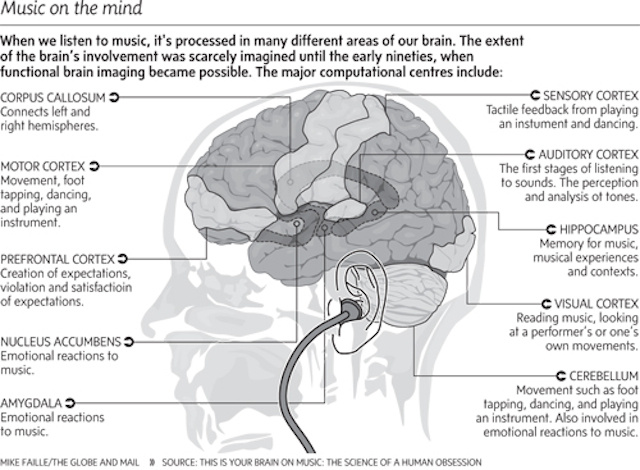
Why is it that can you recall everything about this song, and very little about what you studied? The answer is that music engages the whole brain. Both the left hemisphere of your brain (which remembers facts) and the right hemisphere (which remembers music) work together as a powerful memory tool.

Did you know this can be just as powerful in your prayers?

There is a  Hebrew word (tephillah) for prayer which means a prayer set to music; a poetic prayer; a sacred song. This is the word used heavily in the first 72 psalms.

In other words, the psalmists linked words and melodies—left and right brain hemispheres—together to help our songful prayers get locked into our memory banks. The more we remember what God has done for us in answering our prayers, the more likely we are to keep on praying and keep on trusting Him in the future. 

Many times when I am reading Scripture, a song or hymn will come to my mind, and I pause to hum that melody. Maybe God will give you a new song to sing, or perhaps you will write your own personal melody as you pray. There’s no wrong way to sing your prayers.

However you do it, it’s a powerful memory tool when we sing our prayers to our Heavenly Father.

867-5309

MeditatingI know I’m showing my age with this example: But how many of you remember the song by Tommy Tutone that contained Jenny’s phone number. That song hit #4 on the charts in 1982, and yet after all of these years if you start singing the song, people can tell you that Jenny’s number is 867-5309.

Why do we remember such trivial things?!

The way God designed the human brain is absolutely astounding! Electrical impulses from our five senses filter into the brain and are saved as short-term memories, with the emphasis on short. Short-term memories usually last 20-30 seconds. But we can reset the timer by repeating the information again and again.

If we repeat it enough or think about it more, our brain realizes that it has some significance to us, and begins to “solidify” the information in our intermediate memory banks. These intermediary memories last 5-8 hours.

But in order for the intermediary memories to be stored away in our long-term memory—where they can be stored indefinitely—there needs to be an added component from us. That component is emotion.

The more important the information is to us, the greater the likelihood it will be filed in the “do not delete” section of our brain.

People tell me all the time how difficult it is for them to memorize Scripture, but the keys to memorization are built into the Scripture itself.

First, you have to approach it with a passion. Oh, how I love your law! … Therefore I hate every wrong path (Psalm 119:97, 104). The “bookends” of this section show passionate emotion.

Second, you need to sing the Word. Twice the psalmist said he mediated on God’s Word all day long (vv. 97, 99). At the root of this word is to hum. Singing God’s Word attaches emotion to it, and the emotion tells your brain to move it to long-term storage.

Third, you need to realize just how important it is to have the Scripture stored away in your memory banks. In one section of the 119th Psalm we see benefits like: makes me wiser, gives me more insight, I have greater understanding, I can avoid evil paths (vv. 98-102).

C.S. Lewis commented, “All that is not eternal is eternally useless.” Jenny’s phone number won’t keep us out of trouble, or draw us closer to God, or even give us insight into helping a friend. But God’s Word will do all of those things … and so much more!

These steps will help you store and retrieve eternally useful truths, and not just fictional phone numbers! Try it and let me know how it works for you.

If you have missed any of the messages in our P119 series, you can access them all by clicking here.

Worry Unlearned

We started a new series yesterday called The Stranglehold Of Worry. The word worry originated with shepherds. When a wild dog or a wolf had killed a sheep by grabbing it by its throat and choking it to death, the shepherds said that sheep had been worried to death.

In modern times, researchers at Purdue University found that worrying can chop 16 years off of someone’s life. Not only does worry rob your life of years, but it can also rob your years of life.

What exactly is worry? Fear is our natural response to real threats, like a car heading toward you in your lane of traffic. Worry is our response to perceived threats (to unseen things), like the car that may head toward your kids’ car when they are driving.

Get this clear: worry is being fearful of the unseen.

Compare that to the Bible’s definition of faithNow faith is being sure of what we hope for and certain of what we do not see. Worry and faith both operate in the unseen dimension.

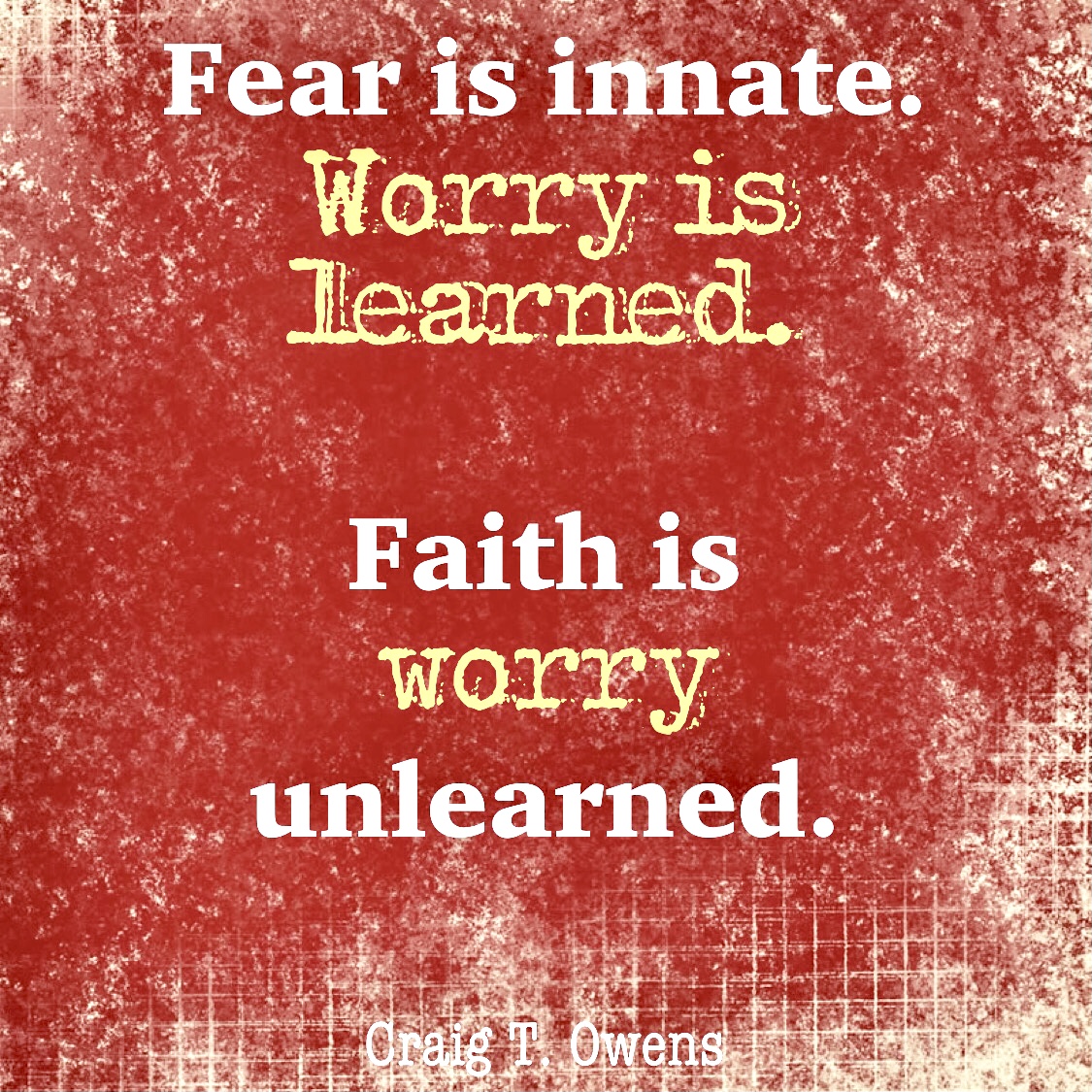
Fear is innate, but worry is learned.

Faith is worry unlearned.

Worry tells your brain a story about bad things that may happen.

Faith tells your brain a story about good things that should happen. Based on what you’ve already experienced of God’s power, what you’ve already seen in God’s provision, or what you already know of God’s promises, your faith in God can help you unlearn your worry.

The prophet Jeremiah tended to be a worrywart. Maybe that’s why he’s been called the “weeping prophet.” But in the middle of his worrying, he unlearns his worry by using his faith to tell a different story about God’s provision, power, and promises:

I well remember [the bad things], and my soul is downcast within me. Yet this I call to mind and therefore I have hope: Because of the LORD’s great love we are not consumed, for His compassions never fail. They are new every morning; great is Your faithfulness. I say to myself, “The LORD is my portion; therefore I will wait for Him.”

Did you notice that Jeremiah talked to himself? He wrote, “I say to myself.” If you have a tendency to worry, it’s time to start talking to yourself and telling yourself a different story. Instead of being fearful of the bad things you cannot see, why not be hopeful of the good things of God you can see?

Let your faith in God help you unlearn your worry. You can overcome worry and anxiety by telling yourself a new faith-filled, hope-oriented story. You can recall God’s faithfulness in the past, and apply it to your current circumstance.

What stories are you telling yourself today? Share with others how you overcame, or are in the process of overcoming worry now. Your faith story will help others overcome and unlearn their worry too.

Interruptions: The Relationship Killer

Listen to the podcast of this post by clicking on the player below, and you can also subscribe on AppleSpotify, or Audible. 

Don’t you hate it when…

…someone finishes your sentences.

You’ve got a brilliant thought to share and…

…your friend shares it for you.

Like that killer joke with…

…the great punch line.

Yeah, the one about…

…the guy running to the restroom.

Sometimes it can…

…work.

But sometimes…

…it doesn’t.

No, it gets really…

…creepy?

Annoying. Like when I’m trying to tell you about…

…that great ski weekend.

The great church service where…

…the band really rocked it.

Where the pastor totally connected with me. And I realized…

…he’s a great speaker.

That I really need to make some changes in my…

…prayer life.

Listening skills.

Oh, um, yeah.

Scientists estimate that our brains can process up to 25,000 words per minute, but a normal speaking pace is only 140-160 words per minute. Since my brain is zipping along about 150 times faster than my friend is speaking, I really have to guard against jumping to conclusions.

Interruptions never build intimate relationships.

But you can reverse this tendency. Resist the urge to run ahead, to interrupt, to anticipate where your conversation partner is going. You can do it. You can reverse the tendency to interrupt.

I shared a series of messages on Relationship Builders And Killers, if you want to dig deeper into this topic.

►► Would you please prayerfully consider supporting this ministry? My Patreon supporters get behind-the-scenes access to exclusive materials, like this recent video where I explain how God reveals previously-unknown truths to us. ◀︎◀︎