“When we go through the trial of faith we gain so much wealth in our heavenly banking account, and the more we go through the trial of faith the wealthier we become in the heavenly regions.” —Oswald Chambers
“The promise that frees us from an unforgiving, bitter, vengeful spirit is the promise that God will settle our accounts. He will do it more justly and more thoroughly than we ever could. Therefore we can back off and leave room for God to work.” —John Piper, commenting on Romans 12:19
“‘Revenge is sweet;’ but not to the man who has tasted Christ, for he says, ‘How can I have vengeance upon my fellow, when Christ has put away my sin?’ Now, forgiveness is sweet, and he loathes malice, and turns aside from it as from venom itself.” —Charles Spurgeon
The Isaiah 53:5 Project reblogged one of my all-time favorite blog posts: The Parable Of The Lifeguard. Thanks, James!
Melinda Penner reminds us of the dangers of abusing our freedom. “If there is nothing objective to constrain our freedom, then there’s nothing objective to constrain the government. Our rights become whatever we declare them to be and whatever the government at any time and place declares them to be, changing with the fashions of the day.”
Listen to the podcast of this post by clicking on the player below, and you can also subscribe on Apple, Spotify, or Audible.
I love the United States of America! As we celebrate our country’s birthday, here are 10 quotes from my files about America.
“Throughout our history Americans have put their faith in God and no one can doubt that we have been blessed for it. The earliest settlers of this land came in search of religious freedom. Landing on a desolate shoreline, they established a spiritual foundation that has served us ever since.” —Ronald Reagan
“America was not built on fear. America was built on courage, on imagination and an unbeatable determination to do the job at hand.” ―Harry Truman
“A patriot must always be ready to defend his country against his government.” —Edward Abbey
“If ever a time should come, when vain and aspiring men shall possess the highest seats in Government, our country will stand in need of its experienced patriots to prevent its ruin.” —Samuel Adams
“If American democracy is to remain the greatest hope of humanity, it must continue abundantly in the faith of the Bible.” —Calvin Coolidge
“The strength of a country is the strength of its religious convictions.” —Calvin Coolidge
“It is the duty of all Nations to acknowledge the providence of Almighty God, to obey His will, to be grateful for His benefits, and humbly to implore His protection and favors. … The Hand of Providence has been so conspicuous in all this, that he must be worse than an infidel that lacks faith, and more than wicked, that has not gratitude enough to acknowledge his obligations.” —George Washington
“We have been the recipients of the choicest bounties of Heaven. We have been preserved, these many years, in peace and prosperity. We have grown in numbers, wealth and power, as no other nation has ever grown. But we have forgotten God. We have forgotten the gracious hand which preserved us in peace, and multiplied and enriched and strengthened us; and we have vainly imagined, in the deceitfulness of our hearts, that all these blessings were produced by some superior wisdom and virtue of our own. Intoxicated with unbroken success, we have become too self-sufficient to feel the necessity of redeeming and preserving grace, too proud to pray to the God that made us!” —Abraham Lincoln
“We’ve staked the whole future of American civilization, not upon the power of government. Far from it. We have staked the future upon the capacity of each and every one of us to govern ourselves, to sustain ourselves according to the Ten Commandments of God.” —James Madison
“There is not a single instance in history in which civil liberty was lost, and religious liberty preserved entire.” —John Witherspoon
“Our ordinary views of prayer are not found in the New Testament. We look upon prayer as a means of getting things for ourselves; the Bible idea of prayer is that we may get to know God Himself.” —Oswald Chambers
“It is impossible to conduct your life as a disciple without definite times of secret prayer.” —Oswald Chambers
“Prayer is not simply getting things from God, that is a most initial form of prayer; prayer is getting into perfect communion with God.” —Oswald Chambers
“The men with God’s ‘go’ in them have these three characteristics—a saving experience, the evidence of supernatural power at work, and the spiritual efficacy of success in prayer.” —Oswald Chambers
“God never hears prayer because a man is in earnest; He hears and answers prayer that is on the right platform—we have ‘boldness to enter into the holy place by the blood of Jesus,’ and by no other way. It is not our agony and our distress, but our childlike confidence in God.” —Oswald Chambers
Someone wrote to C.S. Lewis about the profound and moving spiritual experience they had just experienced, and wondered what Lewis thought about it. His reply is very insightful—
“It is quite right that you should feel that ‘something terrific’ has happened to you (it has) and be ‘all glowy.’ Accept these sensations with thankfulness as birthday cards from God, but remember that they are only greetings, not the real gift. I mean, it is not the sensations that are the real thing. The real thing is the gift of the Holy Spirit which can’t usually be—perhaps not ever—experienced as a sensation or emotion. The sensations are merely the response of your nervous system. Don’t depend on them. Otherwise when they go and you are once more emotionally flat (as you certainly will be quite soon), you might think that the real thing had gone too. But it won’t. It will be there when you can’t feel it. May even be most operative when you can feel it least.” —C.S. Lewis (emphasis added)
The spiritual experiences are great, but let them use you to turn to the Bible to find the facts behind your experience. Lewis is quite right that feelings come and go, but the Holy Spirit never does.
“Criticism serves to make you harsh, vindictive, and cruel, and leaves you with the soothing and flattering idea that you are somehow superior to others. You must constantly beware of anything that causes you to think of yourself as a superior person. Criticism is one of the ordinary activities of people, but nothing is accomplished by it.” —Oswald Chambers
“The problem of reconciling human suffering with the existence of a God who loves, is only insoluble so long as we attach a trivial meaning to the word ‘love,’ and look on things as if man were the center of them. Man is not the center. God does not exist for the sake of man. Man does not exist for his own sake. ‘Thou hast created all things, and for thy pleasure they are and were created’ [Revelation 4:11]. We were made not primarily that we may love God (though we were made for that too) but that God may love us, that we may become objects in which the Divine love may rest ‘well pleased.’ To ask that God’s love should be content with us as we are is to ask that God should cease to be God: because He is what He is, His love must, in the nature of things, be impeded and repelled, by certain stains in our present character, and because He already loves us He must labor to make us lovable.” —C.S. Lewis
“In Biblical parlance anyone is a fool who denies the existence or relevance of God and who thus becomes a law unto himself in trying to make his way in life (cf. Psalm 14:1; Ephesians 5:15-17). The fool, as opposed to the wise person, is the one who has no use for God in any area of his life (cf. Proverbs 3:5-6). The Hebrew word for ‘fool’ appears to mean something like living within one’s own little world—like naïve or silly or idiotic people do, or those who make decisions and choices from the gut rather than from careful consideration of all the facts.” —T.M. Moore
“I say to every suffering parent: You must lay hold of spiritual authority yourself. Even if your child shuts you out, you still can attain power in your secret closet of prayer.” —David Wilkerson
J. Warner Wallace writes, “As Christians, we need to consider the entire counsel of God before we determine whether or not God’s Word approves or condemns a particular behavior.” Read more in his post If This Is Such Grievous Sin, Jesus Would Have Mentioned It, where he discusses hot-button topics like homosexuality and abortion.
Jesus loved being around kids! In fact, it still is the childlike nature that Jesus wants to see in all of us, and that’s one of the roles of the Holy Spirit as our Counselor.
There is a huge difference between being childish and childlike. Childish is being aware that what you’re doing is foolish; childlike is being innocently unaware.
Some of His interactions with His adversaries were playful—Mark 11:27-33.
And when He described the way to Heaven—
He called a little child to Him, and placed the child among them. And He said: “Truly I tell you, unless you change and become like little children, you will never enter the kingdom of heaven. Therefore, whoever takes the lowly position of this child is the greatest in the kingdom of heaven. (Matthew 18:2-4)
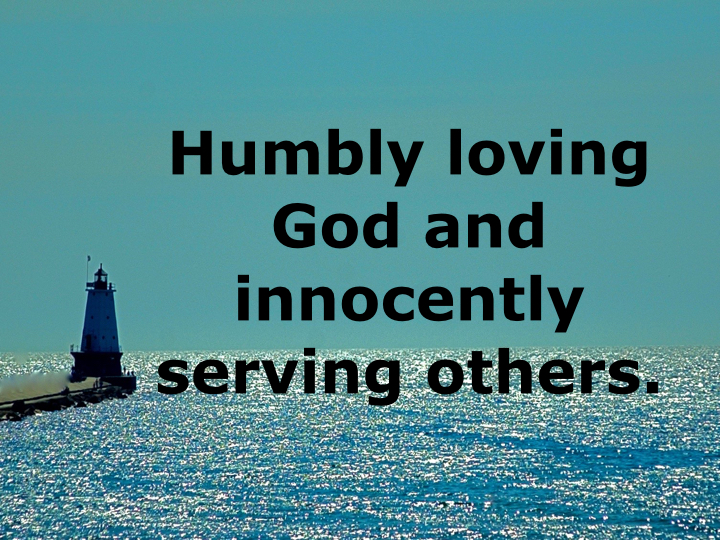
Humbly loving God and innocently serving others. Isn’t that the essence of what Jesus taught us the Kingdom of Heaven was? Loving God and loving others in a childlike way.
Here’s how The Counselor trains us to be childlike:
The Counselor will teach us Christ-like childlikeness; He will reprove us when we are too “adult” in our thinking; He will continually correct us when we cross the line into childishness; and He will train us to love God and love others in a childlike way.
This is a periodic series with things I’m reading and pondering from Oswald Chambers. You can read the original seed thought here, or type “Thursdays With Oswald” in the search box to read more entries.
Standing In A Crisis
If, when no one is watching us, we are building ourselves up in the Word of God, then, when a crisis comes, we shall stand; but if we are not building on the Word of God, when a crisis comes we shall go down, no matter what our wills are like. …
We may be able to give a testimony as to what God has done for us, but does the life we live evidence that we are not listening now, but living only in the memory of what we once heard? We have to keep our ears trained to detect God’s voice, to be continually renewed in the spirit of our mind. If when a crisis comes we instinctively turn to God, we know that the habit of harkening has been formed. … We have to learn to hearken to Jesus in everything, to get into the habit of finding out what He says. … The Holy Spirit will bring back to our remembrance a certain word of our Lord’s and apply it to the particular circumstance we are in, the point is—are we going to obey it?
From Our Brilliant Heritage
Standing in a crisis involves two things: (1) Reading the Word of God regularly, and (2) Obeying the Word of God every time the Holy Spirit illuminates it to our heart and mind. It’s not a matter of ifa crisis will come in your life, but when. Will you be ready?
“Such is the Christ with Whom we have to do, full of grace and truth. Let us draw near; let us keep near; let us allow Him to pour out His love on us; let us bring others to Him to be partakers of the same overflowing love.” —Horatius Bonar
“O soul, if you trust Christ, the blood is on your brow today; before the eye of God there is no condemnation. Why, then, do you need to fear? You are safe, for the blood secures every soul that once is sheltered thereby. Believe in the Lord Jesus Christ, and you shall be saved, but if you believe not, trust where you may, you shall be damned.” —Charles Spurgeon
“I can’t believe that there are any heights that can’t be scaled by a man who knows the secrets of making dreams come true. This special secret, it seems to me, can be summarized in four Cs. They are curiosity, confidence, courage, and constancy, and the greatest of all is confidence.” —Walt Disney
“You have a body. But it is not yours. ‘You have been bought with a price: therefore glorify God in your body’ [1 Corinthians 6:20]. You are always in a temple. Always worship [1 Corinthians 10:31].” —John Piper
I was preparing for a prayer gathering at our church and reading some insights on prayer from noted author and pastor E.M. Bounds, when I read this passage:
“It is not an easy task for the lips to try to pray while the heart is absent from it. The charge which God at one time made against His ancient Israel was, that they honored Him with their lips while their hearts were far from Him. The very essence of prayer is the spirit of devotion. Without devotion prayer is an empty form, a vain round of words. Sad to say, much of this kind of prayer prevails, today, in the church.
“This is a busy age, bustling and active, and this bustling spirit has invaded the church of God. Its religious performances are many. The church works at religion with the order, precision and force of real machinery. But too often it works with the heartlessness of the machine. There is much of the treadmill movement in our ceaseless round and routine of religious doings. We pray without praying. We sing without singing with the Spirit and the understanding. We have music without the praise of God being in it, or near it. We go to church by habit, and come home all too gladly when the benediction is pronounced. We read our accustomed chapter in the Bible, and feel quite relieved when the task is done. We say our prayers by rote, as a schoolboy recites his lesson, and are not sorry when the Amen is uttered. Religion has to do with everything but our hearts. It engages our hands and feet, it takes hold of our voices, it lays its hands on our money, it affects even the postures of our bodies, but it does not take hold of our affections, our desires, our zeal, and make us serious, desperately in earnest, and cause us to be quiet and worshipful in the presence of God.” —E.M. Bounds (emphasis added)
The Bible says that early in the morning, while it was still dark, Jesus went off by Himself to a solitary place to pray. Do you find a quiet, uninterrupted place to be alone with God, or is your prayer time busy?