
Our Musical Testimony

Listen to the podcast of this post by clicking on the player below, and you can also subscribe on AppleSpotify, or Audible.  

As these songs of ascent are reminding us, we’re trying to ascend into God’s presence. But it seems like the forces pulling us back downward are so strong! The lyrics in the most popular songs are getting more and more raunchy, the blockbuster movies routinely celebrate sin, TV shows increasingly push a decidedly unbiblical agenda, government leaders are caught in scandals, and church leaders are “de-transitioning” from their Christian testimony. 

It doesn’t seem like there is much to celebrate. 

Just like the Jews who found themselves defeated and living in a foreign land, or fighting opposition to rebuild their way of life, or contending with occupying forces that were hostile to their religion, we, too, find ourselves in a very similar place—even in a country that was supposedly built on godly principles. 

The worldly-minded and irreligious have always tried to pull down the godly. When they do, it makes it hard to even worship God (Psalm 137:1-4). 

I’ve been reminding you that in Hebrew literature we can usually get our perspective from the middle of the story. So before we look at this next song of ascent, let’s look at the middle of the Jewish story—the middle of their time of exile, when things seemed darkest. 

Jeremiah wrote a book of Lamentations which was in the middle of the exile. In the middle of his tears and gall and bitterness he wrote this—

I remember my affliction and my wandering, the bitterness and the gall. I well remember them, and my soul is downcast within me. Yet this I call to mind and therefore I have hope: Because of the Lord’s great love we are not consumed, for His compassions never fail. They are new every morning; great is Your faithfulness. I say to myself, “The Lord is my portion; therefore I will wait for Him.” … I called on Your name, Lord, from the depths of the pit. You heard my plea: “Do not close your ears to my cry for relief.” You came near when I called You, and You said, “Do not fear.” (Lamentations 3:19-24, 55-57) 

Jeremiah said when he called God, He came near. He’s not saying that God had left him, but instead, Jeremiah is saying that he got his eyes off the ever-present God. As soon as he put his eyes back on God, he could feel His nearness. 

Our next song of ascent (Psalm 126) opens with the word “when.” This is a celebration of how God kept His word that the exiles would be released from Babylon and return to Jerusalem. As the Jews praised God for keeping His Word, then the surrounding nations saw and heard the testimony in the songs of joy that were being sung. 

God’s people were both singing for joy for God’s deliverance AND they were singing in joyful anticipation of what was still to come. 

They make a request in prayer for God to “restore our fortunes” (v. 4). This phrase always means that God is going to bring back everything that was taken away and then some. 

We have a promise two times in the next two verses that God will (not might) bring in these restored fortunes. In the midst of darkness or drought, it may seem hopeless to keep sowing seed. God sees your tears, and He will use your tears to water that seed and He will bring a harvest. 

The New Testament assures us of the same promise: “Let us not become weary in doing good, for at the proper time we will reap a harvest if we do not give up” (Galatians 6:9). 

We show our faith in God’s eternal victory by lifting up our voices in song today. That song is a testimony to the nations around us and an encouragement to other saints who may be struggling with weariness (see Ephesians 5:18-20). We keep on singing these songs of joy in anticipation of the final and eternal song we will sing in Heaven. 

God is near. He hears your sighs. He sees your tears. He is watering the seeds you are sowing, and He will bring a harvest. As you sow in tears, sow also with songs of joy! 

If you’ve missed any of the other messages in our Ascending series, you can find them all here. 

►► Would you please prayerfully consider supporting this ministry? My Patreon supporters get behind-the-scenes access to exclusive materials. ◀︎◀︎

Links & Quotes

Salvation doesn’t arrive on Air Force One. This simple but profound reminder from Chuck Colson should send Christians to prayer instead of seeking a merely political solution. Check out my full message about trusting God vs. trusting the government hereI have lots of new content every week, which you can check out on my YouTube channel.

Matthew Walker, director of the Center for Human Sleep Science, says, “Sleep is the universal health care provider: whatever the physical or mental ailment, sleep has a prescription it can dispense.” It’s not just medical science, but the Bible also talks about the value of sleep, as Scott Hubbard explains in this post. I’ve also shared some posts about sleep here, here, and here.

Don’t you love the beautiful melody of songbirds? Being a percussionist, I’m attracted to the woodpeckers. Scientists have found that woodpeckers are the only non-songbird that share an identical genetic marker in their brains with songbirds. That means that the drumming of woodpeckers is actually a song!  Check out some additional fascinating insights about our drumming friends in this post. 

I love this story from the early 1900s! Small prayer meetings began to converge to become a Pentecostal revival in the Pacific Northwest. 

“What is the best thing in the world? To please its Creator. What is His will? To fulfill what He commanded, that is, to live rightly and dutifully to seek the Eternal; for duty and justice are the will of Him Who is dutiful and right. How do we seek this goal? By application. Then we must apply ourselves in duty and justice. What helps to maintain this practice? Understanding, which, while it winnows the remainder and finds nothing solid to rest in amongst those things which the world possesses, turns in wisdom to the one thing which is eternal.” —Columbanus

“Jesus taught us to pray that the Kingdom would come on earth in the same way that it exists in heaven. … Jesus made praying for the Kingdom the highest priority in our prayers after praising and honoring God. The Kingdom is more important than our daily needs. The Kingdom is more to be desired than that our sins should be forgiven or that we should be rescued through temptation [Matthew 6:9-13].” —T. M. Moore

Stephen O. Presley wrote, “If our modern world resembles the ancient one, perhaps we could glean some wisdom from the ways the early church navigated these murky waters. As Polycarp testifies, the Scriptures were essential to the early Christian apologetic. Passages such as Romans 13:1 and Matthew 22:21, alongside the examples of Old Testament figures such as Joseph and Daniel, guided the church’s vision for engaging the unbelieving world.” His post especially caught my eye after I shared a very similar message to my flock this past Sunday.

Sean McDowell sits down with an Old Testament professor to discuss 10 of the most bizarre OT passages (as selected by Sean’s X followers).

Re-evaluating Fear

Listen to the podcast of this post by clicking on the player below, and you can also subscribe on AppleSpotify, or Audible.

On a recent episode of The Craig and Greg Show, Greg and I discussed the fears that can paralyze leaders. In this short clip, I talk about an acronym I learned years ago that has helped me tremendously in evaluating my fears.

Check out the full Craig And Greg Show episode on fear by clicking here.

►► Would you please prayerfully consider supporting this ministry? My Patreon supporters get behind-the-scenes access to exclusive materials. ◀︎◀︎

The Seed Of Revival

Listen to the podcast of this post by clicking on the player below, and you can also subscribe on AppleSpotify, or Audible.

The London Times asked, “What’s wrong with the world today?”

In his characteristic wit and candor, G.K. Chesterton responded with a letter:

“Dear Sir,

I am. 

Yours, G.K. Chesterton”

I hear the same humble honesty in Ezra’s prayer:

O my God, I am ashamed and embarrassed to lift up my face to You, my God, for our iniquities have risen above our heads and our guilt has grown even to the heavens. … Now, our God, what shall we say after this? For we have forsaken Your commandments (Ezra 9:6, 10). 

This isn’t a word for “back then” or exclusively for Israelites—this is still a word for all of us today. 

Several years ago I was asked to sign a joint letter from local pastors condemning a couple of headline-making heinous activities. In part of my response to these pastors, I wrote,

“I’m not sure if a letter to the editor is an appropriate response or not. But if this is the correct response for us, I am very hesitant to sign my name to a letter that calls out merely one of many sins. The problem we face is a singular one: sin. 

“The solution is also a singular one: Jesus. 

“A response that merely denounces evil acts is not, in my mind, effective. Such a letter is only highlighting sins, but not the solution.”

This, also, is what I see Ezra doing. It may have been one particular sin that got his attention (in this case, intermarriage with non-believers) but he then confesses their universal condition: the sin of departing from God’s commandments. 

It’s so easy to spot sins in society, shake our heads in disgust, and say, “They should know better! What’s wrong with the world today? Someone should do something about that!” 

Instead, any and every sinful expression we observe should send us to our knees saying, “But for the grace of God, I would be guilty of the same thing. God, be merciful to me, a sinner. I confess my sin and plead for Your mercy and forgiveness.” 

Revival will never be a widespread response until it is first an individual response.

When we began as individuals to confess “my sin,” others will soon join with us in confessing “our sin” (see Ezra 9:4). That attitude is the seed of revival.

If you are a pastor and would like to join other pastors in a weekly prayer time for revival, please email T.M. Moore to get plugged into this strategic online gathering.

Check out some other thoughts I have shared about revival here.

►► Would you please prayerfully consider supporting this ministry? My Patreon supporters get behind-the-scenes access to exclusive materials. ◀︎◀︎

The Key To Staying Power

Listen to the podcast of this post by clicking on the player below, and you can also subscribe on AppleSpotify, or Audible. 

Staying power is something special. It especially stands out to us when someone holds their position for years and continues to remain one of the go-to people in the organization. For Christians, the key to staying power may not be as difficult to obtain as you may think. 

Check out this episode of The Podcast.

Resources to go along with this podcast:

  • The biblical passages I mentioned: Daniel 5-6; 2 Chronicles 36:22-24; Matthew 13:52
    • The timeline between Nebuchadnezzar and Belshazzar:
    • Nebuchadnezzar died in 562 and was succeeded by his son Amel-Marduk.
    • Amel-Marduk was assassinated by his brother-in-law, Nergal-Sharezer, two years later (560 BC), who then assumed the throne.
    • Four years later (556 BC) Nergal-Sharezer died, and he was succeeded by his son, Labashi-Marduk.
    • Before a year had passed, Labashi-Marduk was assassinated by a group of malcontents headed up by Nabonidus, who then assumed the throne.
    • Five years later (550 BC), Nabonidus died and was succeeded by his son, Belshazzar. 
  • Darius—a common name for Medo-Persian rulers. “Darius the Mede” (Daniel 5:31) is a more mysterious figure who, so far, appears only in the Bible. Historians think he may have been Gubaru, an officer in Cyrus’ army who became governor of the Persian province of northern Babylon. In this case, he’s the military leader who invaded Babylon, killed Belshazzar, and effectively ended the reign of Babylon. Persia was now the new world power. 
  • Darius I, called the Great, reorganized the government into satraps and extended the boundaries of the empire (Daniel 6:1-3). Daniel was appointed as one of three presidents over the 120 satraps but was being considered as the chief of the three. 
  • Cyrus the Great was king of Persia from 550-529 BC. When Cyrus became ruler of the Persian district of Anshan, the district was subject to the Medes; five years later he led a rebellion against the Medes that resulted in the capture of King Astyages and the overthrow of the Median Empire. Thereafter Cyrus called himself king of Persia. In 539 BC the kingdom of Babylon fell to Cyrus. 

►► Would you please prayerfully consider supporting this ministry? My Patreon supporters get behind-the-scenes access to exclusive materials. ◀︎◀︎

Don’t Fight Fire With Fire

Listen to the podcast of this post by clicking on the player below, and you can also subscribe on AppleSpotify, or Audible. 

The events in the Bible are rooted in history. These are actual events in which real people lived in a moment in recorded history. The songs of ascent were sung both pre-exile and post-exile. The post-exile pilgrims were returning to Jerusalem after the edict of King Cyrus (2 Chronicles 36:22-23). 

The first pilgrims to go up to Jerusalem after the exile were the rebuilders of both Jerusalem and the temple, and they faced heavy opposition (Ezra 4:1-5; Nehemiah 4:1-3, 7-8). In light of these events, I think the song of ascent in Psalm 125 is especially pertinent to this situation. 

The middle verse of Psalm 125 contains a warning to godly people. God’s followers may be tempted to grab earthly political power to try to make things right—to “fight fire with fire.” The phrase “the scepter of the wicked” symbolizes the royal authority of a foreign conqueror. In other words, we might justify using the scepter of the wicked because we think “the ends justify the means.” But notice the warning if we do: “the righteous might use their hands to do evil.” 

You can see this in a couple of other biblical translations. The Amplified Bible says, “lest the righteous (God’s people) stretch forth their hands to iniquity and apostasy,” and the New Living Translation says, “the godly might be tempted to do wrong.” 

Instead, we are called to look to God for our security. Psalm 125:1-2 sounds like an echo of Psalm 121, in which we are reminded that our God is unshakable, unrivaled, and eternal. Political parties come and go, even evil dictators and tyrannical regimes come and go, but the Sovereign God remains forever. All of History is His story! 

Chuck Colson used to frequently remind his audiences, “Salvation does not arrive on Air Force One!” 

The motto on our US currency is still accurate: In God we trust! Psalm 125:4 says the same thing: God does good to those who trust Him. 

Earlier I mentioned the opposition that Ezra and Nehemiah recorded. Let me also share with you how these God-fearing men instructed the Jewish people to respond. Ezra says that the prophets called them to remember “the name of the God of Israel, who was over them,” and three times Nehemiah records that their response was prayer to God (Ezra 5:1; Nehemiah 4:4, 9; 6:9). 

In God we trust, not in political power. On the flip side, Psalm 125:5 warns us that God treats as evildoers those who look to the worldly scepter to try to get ahead. 

So when opposition and even persecution come, we should pray to God and ask for Him to remove the scepter of the wicked. Let’s pray for God to put His favor in the hearts of even ungodly leaders. Ezra recognized this when he said—

Praise be to the Lord, the God of our ancestors, who has put it into the king’s heart to bring honor to the house of the Lord in Jerusalem in this way and who has extended His good favor to me before the king and his advisers and all the king’s powerful officials. Because the hand of the Lord my God was on me, I took courage and gathered leaders from Israel to go up with me. (Ezra 7:27-28)

The New Testament calls on Christians to pray for those in governmental leadership over us (1 Timothy 2:1-2). But perhpas you ask, “What exactly are we to pray for these leaders?” Solomon wrote, “The king’s heart is like channels of water in the hand of the Lord; He turns it wherever He wishes” (Proverbs 21:1). So perhaps a God-honoring prayer is to ask for our leaders’ hearts to be moved as King Cyrus’ heart was. 

Commenting on this verse from Proverbs 21, Dick Brogden wrote:

“God is King of kings and ultimately always wins, always gets His way. Even when it seems that earthly authorities continually rebel against the Lord and His Anointed, the reality is that even their most heinous acts are turned against them. It must be very frustrating to be the devil and to constantly see how God turns situations to gospel good and God’s unique glory. God is so wise that He turns the hearts of authorities without them knowing it. Smug on their decaying thrones, the power brokers of this world revel in their supposed autonomy and imagined resistance, never realizing how foolish they look to the angel hosts who are privy to God’s unmatched strategic dominance.”

Let’s never try to fight fire with fire, but let’s turn repeatedly to God in prayer whenever opposition arises against God-fearing people anywhere. 

If you’ve missed any of the messages in our Ascending series, you can find all of the previous messages here. 

►► Would you please prayerfully consider supporting this ministry? My Patreon supporters get behind-the-scenes access to exclusive materials. ◀︎◀︎

Links & Quotes

We can look back to learn or we can look back to relive. Looking back to learn is healthy, but looking back in regret to try to relive our past is unhealthy and unproductive. Learning vs. reliving makes all the difference. See my full message on this mental health thought hereI have lots of new content every week, which you can check out on my YouTube channel.

“I’ve learned one thing: You only really get to know a person after a fight. Only then can you judge their true character.” —Anne Frank

Lenny Esposito is an outstanding Christian apologist. Check out this podcast where Lenny discusses the historical facts about the crucifixion and resurrection of Jesus Christ.

“Life with God is not immunity from difficulties, but peace in difficulties.” —C.S. Lewis

“I believe it will only be known on the Last Day how much has been accomplished in missionary work by the prayers of earnest believers at home.” —James Fraser

John Piper expounds on why God would make mankind in His image, and why He would create such a vast and beautiful universe in which to place mankind.

Speaking of our amazing Creator. I’ve always been fascinated by honeybees! Professor Andrew Barron, in describing the results of an amazing study on bees’ decision-making process, said, “A honeybee has a brain smaller than a sesame seed. And yet she can make decisions faster and more accurately than we can. A robot programmed to do a bee’s job would need the back up of a supercomputer.”

This is a good reminder from Axis for parents with students returning to school. The heading of this section of Axis’ weekly Cultural Teanslator is “Back to Backpacking.” 

“What it is: As a new school year begins, teens might have mixed feelings of excitement, anxiety, and feeling overwhelmed.

How to approach this season: As Hannah King writes in Christianity Today, all seasons of transition bring with them an element of loss. Starting a new school year might mean making new friends, meeting new teachers, or starting a new curriculum. It can also mean the loss of free time, increased stress levels, and more difficulty creating intentional moments as a family. For parents, the beginning of a new school year might also feel like a reminder that time with their teens living at home is dwindling down, a feeling which can bring its own set of griefs, pressures, and regret. King recommends allowing space for teens and adults to name the things they’re disappointed about or not looking forward to, noting that repressed sadness can keep us from ‘entering freely into [the] joy’ of a new thing.

“Start the conversation: What will you miss the most about this summer?”

“Either you deal with what is the reality, or you can be sure that the reality is going to deal with you.” —Alex Haley

The Craig And Greg Show: The Leadership Lessons Of “Sage Advice”

Listen to the audio-only version of this podcast by clicking on the player below, or scroll down to watch the video.

On this episode, we are celebrating Greg! His new book Sage Advice has just been released, and everyone at Maximize Leadership is incredibly excited for you to be able to finally get your hands on the finished product. In this episode, Greg and I discuss the new book, and talk about how each chapter pairs a story from Greg’s childhood with a helpful leadership lesson.

  • [0:50] I encouraged Greg to write this book. 
  • [1:49] Each chapter combines a story from Greg’s life, a helpful leadership lesson, and an interview with a modern-day leader.
  • [3:50] How did Greg find the leadership lessons?
  • [6:00] A chapter that I especially relate to has to do with toilets! (It is another reminder of Plungerman!)
  • [9:06] What if you don’t have parents and grandparents that could give you sage advice? Where would you go to get wisdom?
  • [11:37] There are more people out there that want to invest in both emerging and seasoned leaders than most people think.
  • [13:58] We can really trust mentors who have a “limp.”
  • [15:27] Every chapter in Sage Advice is a stand-alone leadership lesson.
  • [16:08] I share my favorite chapter in this book.
  • [17:09] Greg shares a great tip for all leaders who are readers.
  • [18:02] What does a girl in a red bikini have to do with leadership?
  • [20:10] You can get an autographed copy of Sage Advice here

Check out my totally(!) unbiased book review of Sage Advice here.

Check out this episode and subscribe on YouTube so you can watch all of the upcoming episodes. You can also listen to our podcast on Spotify and Apple.

Power-Packed Sermons

Listen to the podcast of this post by clicking on the player below, and you can also subscribe on AppleSpotify, or Audible. 

Jesus began to speak to them in parables… (Mark 12:1). 

What Jesus relates here in the 12th chapter of Mark’s Gospel is only the fourth parable that Mark records, and as the final parable that Jesus shares, it brings His public ministry to a close. 

Jesus concludes this parable by quoting from Psalm 118. This Psalm is the last of the “Hallel Psalms” that were sung at the conclusion of the Passover celebration. This song specifically looks eagerly forward to the arrival of the Messiah. It contains the words that the crowd used on Palm Sunday: “Lord, save us! Lord, grant us success! Blessed is He who comes in the name of the Lord” (Psalm 118:25-26). By quoting from the same Psalm—that was perhaps hundreds of years old, but had just been sung and shouted by the crowd—Jesus was claiming to be the Messiah longed for in that Hallel Psalm. 

As you may recall, these shouts from the crowd and the activities of Jesus as He cleansed the temple got the religious leaders riled up! They, in essence, asked Jesus, “Who do You think You are?!” His answer is contained in this parable of Mark 12. 

At the conclusion of this parable, the religious leaders “knew He had spoken this parable against them” (Mark 12:12).

Mark’s observation about the response of the religious leaders is, in a nutshell, the essence of a Holy Spirit-anointed sermon. The connection of Scripture to current events is powerful! The Holy Spirit is also the One who brings the application of Scripture to bear on the hearts of the audience.

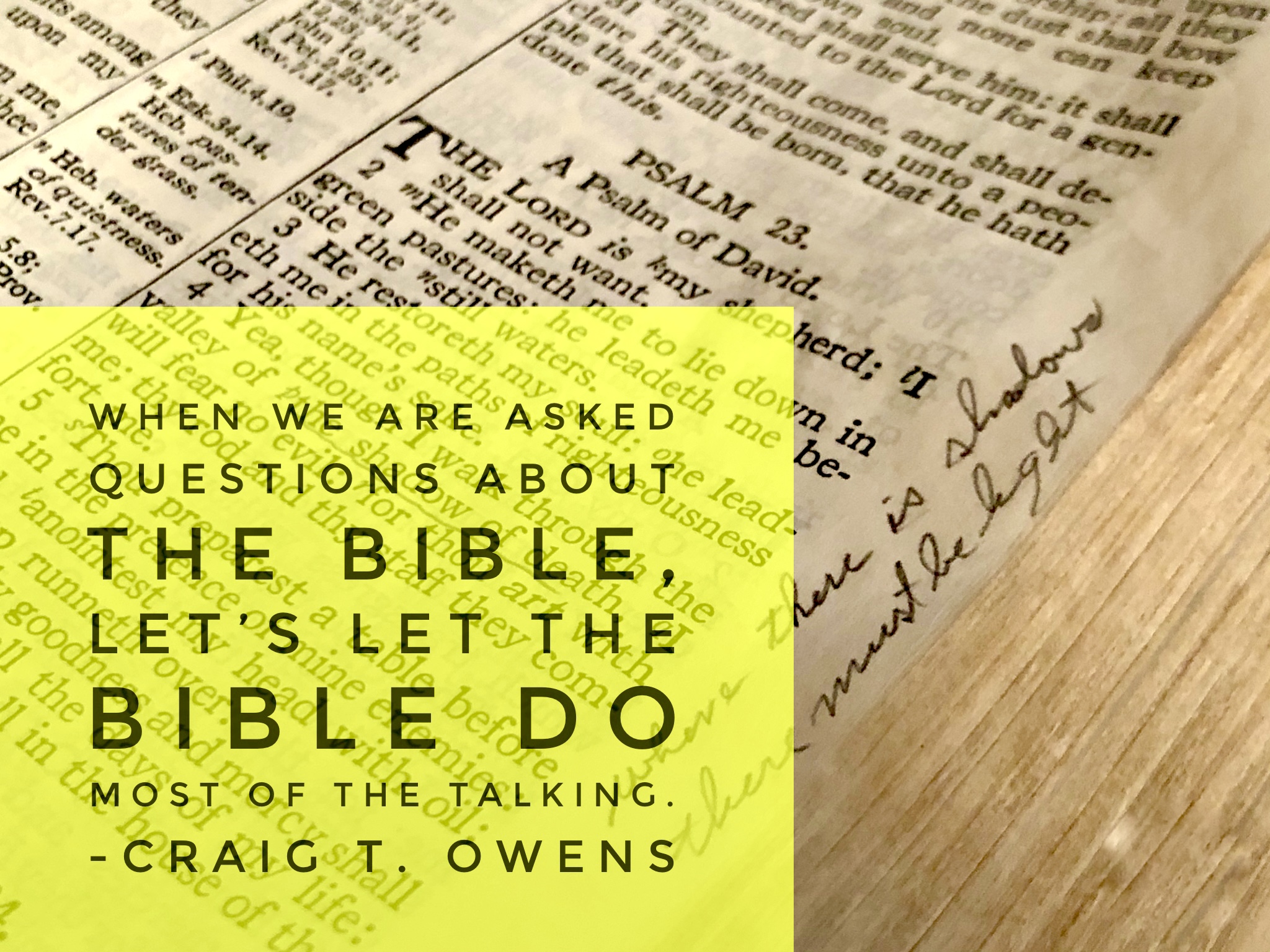
Pastors, if you want to deliver soul-shaking, life-transforming, eye-opening, heart-melting sermons, you must follow this example of Jesus: Stick with the Scripture! 

We don’t need to try to be clever or witty or even memorable. We just need to speak the Word of God that is inspired by the Holy Spirit, and then allow the Holy Spirit to illuminate that inspired Word to each person’s needs. As Randy Pope noted, “Preaching is not talking to people about the Bible; it is talking to people about themselves from the Bible.” 

I don’t want to try to make my voice impress people, but I am desperate for God’s voice to impact people. Nearly every week as I prepare a sermon, I’ll pray this prayer from Oswald Chambers: “In my preaching, cause Thy glorious voice to be heard, Thy lovely face to be seen, Thy pervasive Spirit felt.” My dear pastor, I would encourage you to make this your prayer as well. 

►► Would you please prayerfully consider supporting this ministry? My Patreon supporters get behind-the-scenes access to exclusive materials. ◀︎◀︎
Putting It All On The Line

Listen to the podcast of this post by clicking on the player below, and you can also subscribe on AppleSpotify, or Audible. 

What are you doing with the opportunities that God has given you? 

Check out this episode of The Podcast. 

Resources to go along with this podcast:

►► Would you please prayerfully consider supporting this ministry? My Patreon supporters get behind-the-scenes access to exclusive materials. ◀︎◀︎