Absalom said to Ahithophel, “Give us your advice. What should we do?” … Ahithophel said to Absalom, “I would choose twelve thousand men and set out tonight in pursuit of David. I would attack him while he is weary and weak. I would strike him with terror, and then all the people with him will flee. I would strike down only the king and bring all the people back to you….” This plan seemed good to Absalom and to all the elders of Israel.
But Absalom said, “Summon also Hushai the Arkite, so we can hear what he has to say as well.” When Hushai came to him, Absalom said, “Ahithophel has given this advice. Should we do what he says? If not, give us your opinion.”
Hushai replied to Absalom, “The advice Ahithophel has given is not good this time….”
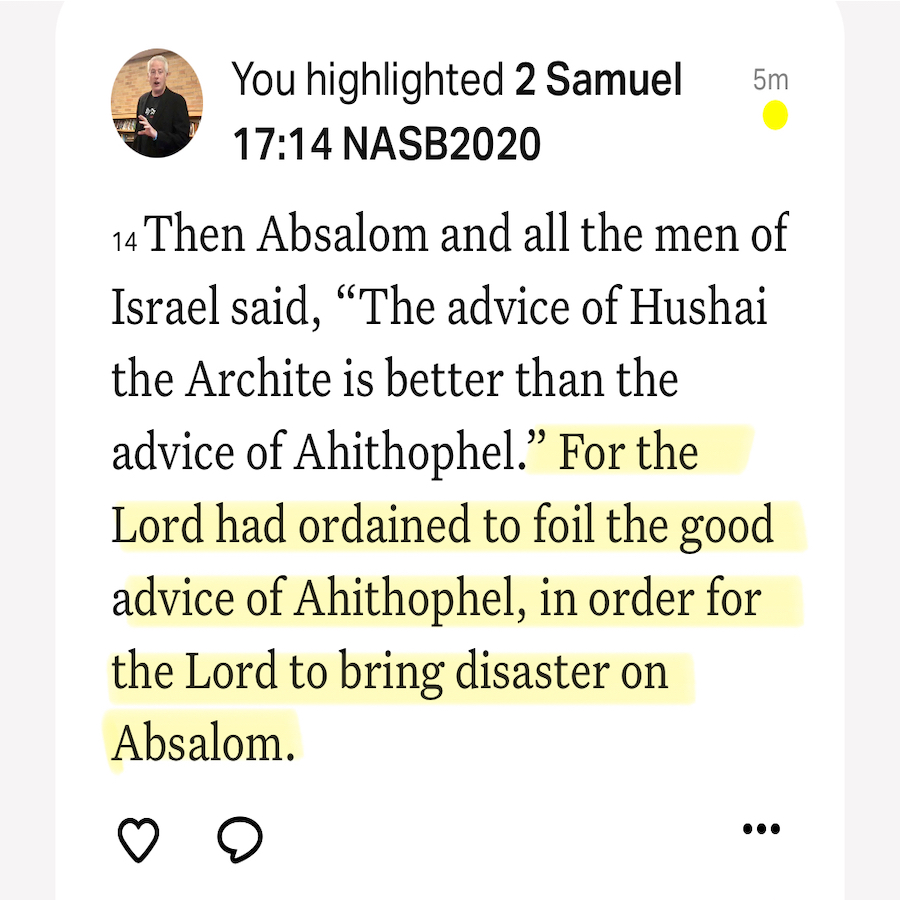
Absalom and all the men of Israel said, “The advice of Hushai the Arkite is better than that of Ahithophel.” For the Lord had determined to frustrate the good advice of Ahithophel in order to bring disaster on Absalom. (2 Samuel 16:20; 17:1-7, 14).
Absalom (unlike his father) didn’t consult God, but consulted men.
Ahithophel had a personal agenda. All he wanted to do is get revenge on David for what he had done to Uriah and Bathsheba. Notice Ahtihophel’s wording: “I will kill only the king” (v. 2).
What was Ahithophel’s beef with David? Uriah—the man whose wife David stole, the man whom David had killed to cover up his affair—was Ahithophel’s son (2 Samuel 23:34, 11:3)!
Hushai, the the other man who gave Absalom counsel, also had an agenda. Hushai is repeatedly given one description: Friend of David (2 Samuel 15:37, 16:16-17; 1 Chronicles 27:33). So Hushai’s sole focus is saving his friend’s life.
Humans always give their advice with their own bias or agenda.
Listen to the podcast of this post by clicking on the player below, and you can also subscribe on Apple, Spotify, or Audible.
When we have a difficult coworker or team member, it’s very easy to fall into the trap of talking about them to others and avoid talking directly to them.
Getting counsel from others about this difficult person is important, but then we must use those insights to have a productive conversation directly with that team member. If we don’t talk directly to them, we’re ultimately gossiping about them, which is never productive. In fact, that gossiping will actually make the situation worse.
Listen to the podcast of this post by clicking on the player below, and you can also subscribe on Apple, Spotify, or Audible.
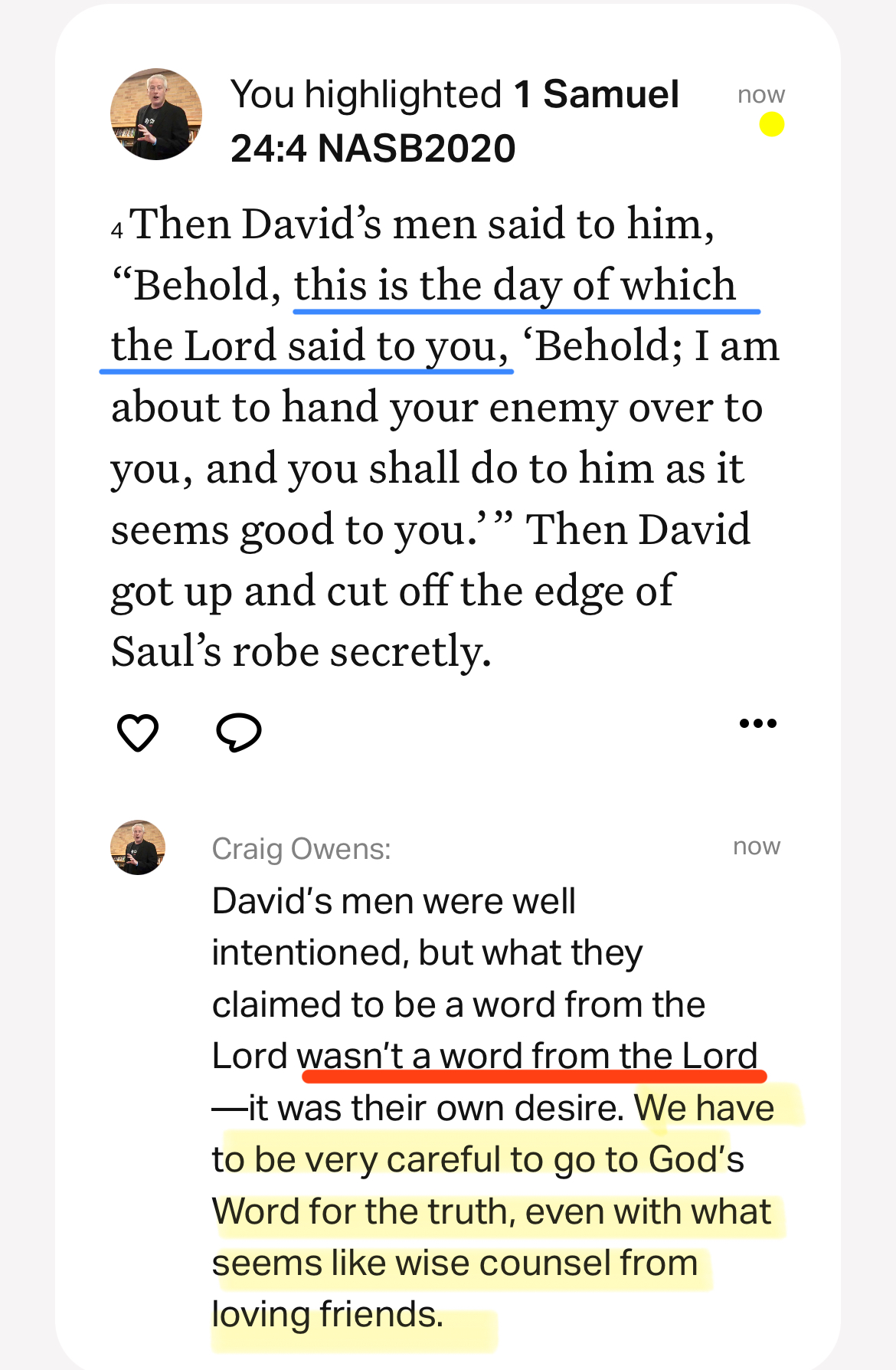
David was hiding from Saul in a cave when Saul walked into the same cave, totally oblivious to the danger that awaited him! David’s men tried to spur him to action by whispering, “Isn’t this what God said, that He would hand your enemy over to you?” (see 1 Samuel 24).
David momentarily listened to his men and then acted on their words. He crept forward to cut off a corner of Saul’s robe. But then the Holy Spirit pricked his conscience.
Why?
Because God never said those words!
From what David has learned, he now speaks this same lesson to Saul. He in essence asks Saul, “Are you listening to men or to God?” (vv. 9-11).
David learned that without God as his Guide, he could easily be persuaded to act in a way that seemed right to men but was wrong before God.
It’s still true for all of us today: Men may give you logical-sounding counsel, but you must always make sure that advice aligns with God’s omniscient wisdom. That means you need to be reading, studying, meditating on, and thinking about God’s Word.
✔️ Keep God always before you
✔️ Know His voice intimately
✔️ Compare every word of man with God’s infallible Word
🙏🏻 “Hear my prayer for help, O God, for I look to You alone as my Helper and the Sustainer of my soul. You will deal with my enemies as You know best, and You will deliver me from my troubles” (see David’s prayer in Psalm 54).
Listen to the podcast of this post by clicking on the player below, and you can also subscribe on Apple, Spotify, or Audible.
As missionaries, we are people sent on a mission. We are sent to everyone everywhere. We are to take Him to every street where God sends us.
“Main Street” (or Jerusalem) is a great place to start, and probably a place where we will always have work to do. These will typically be the people that are most like us—people with whom we will have the most in common.
There are others that need to hear the Good news of forgiveness that Jesus has made available. As our circle of witness widens, we may have less in common with those with whom we are interacting. This may take us out of our comfort zone, but since the Holy Spirit is in us we will never be out of our empowerment zone!
But you will receive power when the Holy Spirit comes on you; and you will be My witnesses in Jerusalem, and in all Judea… (Acts 1:8).
We need to ask two questions:
What did it mean then? Judea was still compromised of Jewish people, but it was the area slightly outside the neighborhood of Jerusalem.
What does it mean now? These are people very similar to people on Main Street, but we are starting to see more differences. These differences often become the source of controversies.
I’m going to describe some people in our Judea as cultural Christians but not biblical Christians. In the time of Jesus we could think of the Pharisees: People who would call themselves godly because they have set their own standards.
Lombard Street in San Francisco is a short, curvy street. This is a one-way street and motorists are only supposed to drive 5 mph, and still there are frequent controversies on the right-of-way between homeowners, motorists, work crews, bicyclists, and pedestrians. Everyone thinks their way is the right way.
How do we take the message of Jesus to those on our “Lombard Street”?
(1) Distinguish the biblical from the non-biblical.
Both the Pharisees that interacted with Jesus and today’s cultural Christians seem to quote more from their own traditions than they do from the Scripture, so we need to distinguish that the source of our beliefs is from God’s inspired Word. (I share more about the concept of biblical, unbiblical, and non-biblical in this post.)
A great example for us is how Jesus answered two questions from an expert in the Mosaic law: How do I earn eternal life? Who is my neighbor? See Luke 10:25-37.
(2) Stick to Scripture and your personal story.
Remember that the person with an experience is never at the mercy of the person with an argument. When the Sanhedrin questioned the legitimacy of the healing of a lame man, Luke wrote, “But since they could see the man who had been healed standing there with them [Peter and John], there was nothing they could say” (Acts 4:14)!
Love the personal story of the healed blind man in John 9!
Judea can be translated “he shall be praised.” We glorify Jesus not by arguing with those on Lombard Street, but by simply proclaiming biblical truth and our personal testimony.
Sing to the Lord, all the earth; proclaim good news of His salvation from day to day. Tell of His glory among the nations, His wonderful deeds among all the peoples. (1 Chronicles 16:23-24)
As we stick with the Scripture and our personal testimony, the Holy Spirit will use our witness to open minds to the Good News of Jesus (2 Corinthians 3:18-4:5).
Follow along with all of the streets we are looking at in our series Takin’ Him to the streets by clicking here.
In the fourth year of King Hezekiah, which was the seventh year of Hoshea son of Elah, king of Israel, Shalmaneser king of Assyria came up against Samaria and besieged it (2 Kings 18:9). The Bible Archeology Report puts together wonderful biographies of biblical characters based on archeological discoveries that corroborate the account in Scripture. Here is the biography of Assyrian King Shalmaneser V.
Meteorologist Dr. Roy Spencer writes, “Atmospheric CO2 levels will start to fall even with modest reductions in anthropogenic CO2 emissions. Why is that? The reason is due to something called the CO2 ‘sink rate.’ It has been observed that the more CO2 there is in the atmosphere, the more quickly nature removes the excess.” Imagine that! It’s almost as if the Creator of the Universe knew exactly what He was doing.
J. Warner Wallace makes the case that the origin of the universe points to a Creator—but he does so without using Scripture.
“You will not be able to extemporize good thinking unless you have been in the habit of thinking and feeding your mind with abundant and nourishing food.” —Charles Spurgeon
Then David came to Baal-perazim and defeated them there; and he said, “The Lord has broken through my enemies before me like the breakthrough of waters.” Therefore he named that place Baal-perazim. And the Philistines abandoned their idols there, so David and his men carried them away. Now the Philistines came up once again and overran the Valley of Rephaim. So David inquired of the Lord… (2 Samuel 5:20-23).
David was facing the same enemy on the same battlefield. Yet David did presume that God wanted him to attack the Philistines in the same way as before, or even that he was supposed to attack them at all.
“So David inquired again of God.”
The Philistines carried out yet another raid in the valley. David inquired again of God, and God said to him, “You shall not go up after them; circle around behind them and come at them in front of the baka-shrubs.” … David did just as God had commanded him, and they defeated the army of the Philistines from Gibeon even as far as Gezer (1 Chronicles 14:13-14, 16).
It was the same situation and same enemy, but David asked God how to proceed. God gave David a new strategy for this second situation, “David did just as God had commanded him” and won another victory.
Listen to the audio-only version of this podcast by clicking on the player below, or scroll down to watch the video.
Have you thought about what you’d like said at your funeral? Stick with me here, this isn’t an episode about contemplating your death. In this episode, Greg and I want to encourage you to begin with the end in mind, and live as the type of leader that you picture yourself being remembered as.
[0:15] Hang with us on this one: We’d like you to take a moment to think about your funeral.
[3:15] We could think of our own epitaph like we’re building a house.
[4:14] Greg asks me what I would like on my epitaph.
[6:00] We aren’t talking about planning our funeral, but about doing lasting and beneficial things with “the dash” between our birth date and our death date.
[9:20] There is a leadership caution when we’re thinking about this topic.
[10:21] Greg has been thinking about one word that could sum up his life.
[13:31] Here’s what we need to live for today.
[15:41] I give an example of someone whose character and reputation didn’t align.
[18:09] I brag on something special Greg does for others.
[20:54] How do leaders get beyond themselves?
[24:05] We need to be living our leadership story every single day.
Check out this episode and subscribe on YouTube so you can watch all of the upcoming episodes. You can also listen to our podcast on Spotify and Apple.
Listen to the podcast of this post by clicking on the player below, and you can also subscribe on Apple, Spotify, or Audible.
A young man came to Jesus and asked Him, “What must I do to inherit eternal life?”
Jesus initially replied by listing some of the Ten Commandments that should be followed, and the young man quickly replied, “I have kept all of these since I was a boy!”
Then Jesus said, “There is just one more thing: sell everything you have and give to the poor, you will have treasure in Heaven. Then come, and follow Me.”
Even though this young man had received the answer that he was seeking, Luke records, “he became very sad because he was very wealthy.” (Check out this full exchange here.)
The word “very” is used twice by Luke (Luke 18:23). It speaks of a greatness or heaviness of something. It appears that when we are very wealthy, it is very hard to trust anything other than that wealth. The opposite also appears to be true: When worldly wealth is scant, our trust in God for our daily bread is high. This is what mathematicians would refer to as an inverse proportion.
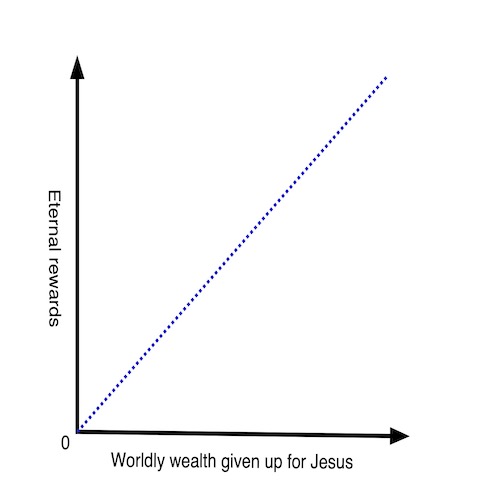
On the other hand, Jesus promised eternal rewards for those who replaced trust in possessions with trust in God (also see Matthew 6:19-21; Luke 18:28-30). This is what mathematicians would referred to as proportional.
Both this proportional treasure and the inverse proportional trust in God are God’s indisputable realities.
As this young man shows us, it’s not about what we do or about what commands we have kept. In fact, it’s not about us at all! It’s all about a total trust in the only One who is eternally trustworthy!
Listen to the podcast of this post by clicking on the player below, and you can also subscribe on Apple, Spotify, or Audible.
Without a doubt, a leader plagued by feelings of guilt is a leader that is operating well-below his or her full potential.
One of the best ways to avoid these feelings of limiting guilt is for the leader to admit that he or she isn’t an expert in every aspect of their organization.
In this short clip, Karl Vaters and I are specifically addressing pastoral leaders, but the principles can be applied to leaders of any organization.
You can check out more clips from this interview by clicking here.
The two related blog posts I made reference to in this video are:



 Absalom said to Ahithophel, “Give us your advice. What should we do?” … Ahithophel said to Absalom, “I would choose twelve thousand men and set out tonight in pursuit of David. I would attack him while he is weary and weak. I would strike him with terror, and then all the people with him will flee. I would strike down only the king and bring all the people back to you….” This plan seemed good to Absalom and to all the elders of Israel.