You Can’t Give What You Don’t Have

It seems like a pretty simple concept. If I don’t possess something, as much as I may want to give it away to someone else, I can’t do it.

We know this, don’t we? If my best friend really needs $20, and I really want to give him $20, I cannot help him if I only have $12 in my wallet. I cannot give what I do not have.

So when you take the time to strengthen yourself physically—by getting enough sleep, by exercising, by eating a healthy diet—you are simply preparing yourself to be able to give your physical strength to another.

When you take the time to recharge yourself emotionally—by taking some solitude time, by getting around positive people—you are preparing yourself to be able to give your emotional strength to another.

When you take the time to expand your mind—by reading a book, by taking a class—you are preparing yourself to be able to give your intellectual strength to another.

And when you take the time to renew yourself spiritually—by reading your Bible, by praying, by going to church—you are preparing yourself to be able to give your spiritual strength to another.

“Brethren, let us look well to our own steadfastness in the faith, our own holy walking with God. Some say that such advice is selfish; but I believe that, in truth, it is not selfishness, but a sane and practical love of others which leads us to be mindful of our own spiritual state.” —Charles Spurgeon

Look at the life of Jesus. He never apologized for taking time away to pray, to sleep, to talk with His Father. Then He was never at a loss when someone needed physical, emotional, intellectual, or spiritual strength.

What are you doing to recharge your batteries? It’s never selfish to take the time you need to gather the strength you will need to help others. In fact, being prepared mentally, physically, emotionally and spiritually is one of the most loving things you can do.

Baby, I’m On Board

The theme for this year’s Lifewalk for Alpha Family Centers was Baby, I’m On Board! And I was so glad that Calvary Assembly of God was on board to help this wonderful pro-life organization in Cedar Springs! This year our worship team provided music prior to the walk, we had several from our congregation participating in Lifewalk, and our church was a sponsor for Lifewalk 2012.

Here are some pictures of the day —

Courageous Enough To Interfere

King David was brilliant as a king, and a disaster as a father. One of the things that is very telling is what is not written when his kids mess up. The Bible tells us that David felt strong emotions, but he simply didn’t act on them. In fact, one of the most telling verses of inaction comes when his son Adonijah is trying to put himself on David’s throne—

His father had never interfered with him by asking, “Why do you behave as you do?” (1 Kings 1:6)

It takes courage to interfere with our kids when they are misbehaving.

So why don’t some dads interfere? I can think of a few reasons…

  • They didn’t have a good relationship with their own father. In David’s case, his father Jesse didn’t think too highly of David. In fact, David was the overlooked, almost-forgotten son (1 Samuel 16:8-11).
  • They’re too tired. David was so focused on building up Israel’s defenses, and defeating the bad guys, that he had nothing left emotionally and physically to interact with his kids. We need to make it our priority! John wrote: I have no greater joy than knowing my children all walk in the truth (3 John 4). Now that’s a great priority!
  • Their past sins haunt them. David sinned against Bathsheba (like Amnon did against Tamar); David murdered Uriah (like Adonijah did Amnon). So perhaps he felt like he didn’t have the moral authority to interfere with his sons. But if you read some of the wise sayings in Proverbs 6:20-29 and 7:1-5, they sound like a man who has had experience. Let your hindsight (good or bad) be your kids’ foresight.
  • They think it’s too late. It’s never too late! Never! Apparently, David learned this lesson in time and taught his son Solomon (read Proverbs 1:1 and 4:3-4). As long as there is breath in your lungs, you should be your kids’ dad!

Dads, will you be courageous enough to lovingly interfere with your kids if they are getting off track?

Will you be courageous enough to make some changes in your schedule so that you can invest the time and energy and creativity necessary to raise them up?

Will you be courageous enough to confess your past sins, and not let them hold you back from speaking into your kids’ lives?

Will you be courageous enough to start today?

Dad, you kids need you to be involved! Be courageous enough to step into their lives.

“The Bridge Builder”

I shared this poem in my Father’s Day message this morning, and several folks have asked me to share it. I’m happy to do so!

An old man walking a lonesome road,
Came at the evening, cold and gray,
To a chasm vast and wide and deep.
The old man crossed in the twilight dim,
The rolling stream had no fears for him;
But he turned when safe on the other side,
And built a bridge to span the tide.
“Old man,” said a fellow traveler near,
“You are wasting your strength with building here,
Your journey will end with the passing day,
You never again will pass this way,
You’ve crossed the chasm, deep and wide,
Why build you this bridge at eventide?”
The builder lifted his old gray head,
“Good friend, in the path I have come,” he said,
“There followeth after me today,
A youth whose feet must pass this way.
The chasm that was naught to me,
To the fair headed youth may a pitfall be.
He too must cross in the twilight dim –
Good friend, I am building this bridge for him.” —W.A. Dromgoale

I am thankful for all of the fathers who said they would be courageous enough to be a bridge-builder for their kids! May God bless you as you follow through on this noble calling.

5 Quotes From “Questions Christians Hope No One Will Ask”

Earlier this week I reviewed Questions Christians Hope No One Will Ask Them (you can read my review here).

I wanted to share some of my favorite quotes from this book:

“When we fail to answer someone’s questions and objections, we become just one more excuse for them to disbelieve.” —Walter Martin

“I cannot believe that our existence in this universe is a mere quirk of fate. … We are truly meant to be here.” —Paul Davies, a physicist, cosmologist, and atheist

“Consider what you’d need for a protein molecule to form by chance. First, you need the right bonds between the amino acids. Second, amino acids come in right-handed and left-handed versions, and you’ve got to get only left-handed ones. Third, the amino acids must link up in a specified sequence, like letters in a sentence. Run the odds of these things falling into place on their own and you find that the probabilities of forming a rather short functional protein at random would be one chance in a hundred thousand trillion trillion trillion trillion trillion trillion trillion trillion trillion trillion. That’s a ten with 125 zeroes after it! And that would only be one protein molecule—a minimally complex cell would need between three hundred and five hundred protein molecules. … To suggest chance against those odds is really to invoke a naturalistic miracle.” —Stephen Meyer, a Cambridge-trained philosopher of science

“Here’s the key point to remember: there never was a time when the earliest community of followers of Jesus did not regard Him as far, far more than a good teacher.” —Mark Mittelberg

“If a good God made the world, why has it gone wrong? … My argument against God was that the universe seemed so cruel and unjust. But how had I got this idea of just and unjust? A man does not call a line crooked unless he has some idea of a straight line. What was I comparing this universe with when I called it unjust? If the whole show was bad and senseless from A to Z, so to speak, why did I, who was supposed to be part of the show, find myself in such violent reaction against it? … Thus in the very act of trying to prove that God did not exist—in other words, that the whole of reality was senseless—I found I was forced to assume that one part of reality—namely my idea of justice—was full of sense. Consequently, atheism turns out to be too simple. If the whole universe has no meaning, we should never have found out that it has no meaning: just as, if there were no light in the universe and therefore no creatures with eyes, we should never know it was dark. Dark would be without meaning.” —C.S. Lewis

Be A Foolish Preacher

Pastor, do you realize how clever we try to be?

  • We come up with a catchy sermon series and add some stylish graphics.
  • Then we labor over sermon titles that sound so compelling.
  • As we write our sermons we try to dream up memorable patterns, like all three of our main points start with “S,” or we spell out the word “P.E.A.C.E.”

When the truth of the matter is, what we’re saying is foolishness.

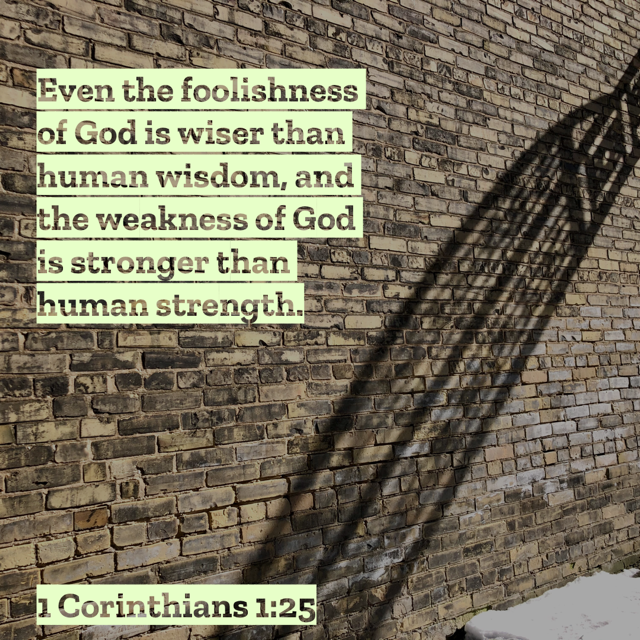
Where is the wise man? Where is the scholar? Where is the philosopher of this age? Has not God made foolish the wisdom of the world? For since in the wisdom of God the world through its wisdom did not know Him, God was pleased through the foolishness of what was preached to save those who believe. Jews demand miraculous signs and Greeks look for wisdom, but we preach Christ crucified: a stumbling block to Jews and foolishness to Gentiles, but to those whom God has called, both Jews and Greeks, Christ the power of God and the wisdom of God. For the foolishness of God is wiser than man’s wisdom, and the weakness of God is stronger than man’s strength. (1 Corinthians 1:20-25)

You don’t have to try to make God’s Word clever. It is already profound!

You don’t have to try to make it memorable. The Holy Spirit makes it memorable (John 14:26)!

You don’t have to make the Bible relevant. It is the most relevant, applicable wisdom that humanity has ever known! 

D.L. Moody said it this way:

“If God has given you a message, go and give it to the people as God has given it to you. It is a stupid thing for a man to try to be eloquent. Make your message, and not yourself, the most prominent thing. Don’t be self-conscious. Set your heart on what God has given you to do, and don’t be so foolish as to let your own difficulties or your own abilities stand in the way.”

Don’t try to be clever. Just be Spirit-led and you will utter the most profound, compelling, and memorable words ever spoken by a preacher!

Questions Christians Hope No One Will Ask (book review)

Apologetics is not the right way to ask forgiveness. Apologetics is the art and science of defending what you believe. One of the most accessible apologists we have is Mark Mittelberg and his very helpful book Questions Christians Hope No One Will Ask.

I have taken a passage from the Bible as my guideline for defending the Christian faith. The Apostle Peter wrote:

But in your hearts set apart Christ as Lord. Always be prepared to give an answer to everyone who asks you to give the reason for the hope that you have. But do this with gentleness and respect, keeping a clear conscience, so that those who speak maliciously against your good behavior in Christ may be ashamed of their slander. (1 Peter 3:15-16)

Focus on Christ … Be prepared to answer … Answer gently and respectfully. In this book, Mark Mittelberg arms Christians with information to help them do just that. He doesn’t shy away from the tough questions like the apparent disharmony between Science and the Bible, or God’s existence, or Christ’s divinity. All of these he addresses using Scripture, philosophy, science, and logic. Mittelberg frequently quotes both Christian and atheist apologists to help make his point. And he does so very winsomely.

Each chapter is designed as sort of a lecture and lab. Mittelberg teaches, and then he walks through some possible conversations and objections an atheist or non-Christian may have about Christian’s beliefs. s

It’s a helpful and enjoyable read.

Thursdays With Oswald—Seeing And Hearing “Holy”

This is a weekly series with things I’m reading and pondering from Oswald Chambers. You can read the original seed thought here, or type “Thursdays With Oswald” in the search box to read more entries.

Seeing And Hearing “Holy” 

     The Bible places in the heart everything that the modern psychologist places in the head. … 

     God does alter the desire to look at the things we used to look at; and we find our eyes are guarded because He has altered the disposition of our soul life. …I will always hear what I listen for, and the ruling disposition of the soul determines what I listen for, just as the ruling disposition either keeps the eyes from beholding vanity or makes them behold nothing else. 

From Biblical Psychology

Solomon wrote, “Above all else, guard your heart, for it is the wellspring of life” (Proverbs 4:23). This is where Chambers gets the thought about our hearts doing what psychologists want our heads to do.

The more I fill my heart with God’s Word (Psalm 119:11), the more the Holy Spirit can remind me of that Word (John 14:26). The more I am tuned in to that sanctifying instruction of the Holy Spirit (Ephesians 5:26), the more holy I will live (Romans 8:4; Galatians 5:16; 1 Thessalonians 4:7).

This “tuning in” in the spiritual realm (the heart) absolutely affects the physical realm (the head). I have written before about the reticular activating system (RAS) in our brains (you can read about this here and here). The combination of the Word and the Spirit reprograms our RAS so that our eyes and ears are looking and listening for what pleases and glorifies God.

Do you want to live a holy life? Start by guarding your heart. You do this by filling your heart with the Word of God.

10 Quotes from The Gospel Of Yes

I really loved this book by Pastor Mike Glenn. Check out my review here. These are 10 quotes I loved from this book:

“Following Jesus is much more than being careful not to do wrong. …Defining your life by what you oppose makes your life small….”

“For too many of us, Christianity has been narrowed down to sin management. Sure, we all want to go to Heaven. But under the sin-management paradigm, getting to Heaven is no longer about Jesus’ sacrifice on our behalf and His invitation to follow Him in a new life. The focus on sin makes getting to Heaven a matter of keeping score. You get points for doing good things and lose points for doing bad things. Being a Christian becomes a spiritual frequent-flier program. If you work at it hard enough and accumulate enough points, you can fly for free.”

“As long as our first thought is What do I need to avoid?, the guiding influence in our lives is sin, not Christ. To be sure, we are working hard to avoid things that God disapproves of, but we are missing God in the process. The hard work of avoiding a mistake or misstep looms so large that God gets blocked from our view. If all we think about is sin, even when we’re thinking of ways to avoid it, we increase our chance of failure. This is the irony of sin-management Christianity.”

“No matter how much [your circumstances] look like ‘no,’ God does everything possible to turn then into a ‘yes.’”

“God said ‘no’ to sin because it violates His holiness, but wanting us not to break His laws is not His number-one reason for opposing sin. He hates sin because it destroys the people He loves. Jesus took into Himself the ‘no’ of our sin and died in God’s mercy so we might find our ‘yes.’” 

“Christianity is not an escape from the past but redemption of the past.”

“Why do we think that we alone committed a sin so horrible it exceeds Jesus’ ability to forgive? This kind of thinking is the ultimate heresy. What we are saying is the death of Jesus was payment enough for everyone else’s sin, but our sin is so monstrous that His death isn’t enough to cover it.”

“The gospel message isn’t ‘Do these ten things, and you can get to God.’ The gospel message is ‘The Shepherd is still looking for lost sheep.’”

“The Christian teaching is that people are extremely valuable indeed. But our value is not based on the promise of exceptional achievement or a positive feeling about ourselves. It is grounded in the reality of Who God is and what He has done for us in Christ.”

“What unifies us as believers is our shared relationship with Jesus Christ, not the protocol of a particular discipleship process.”

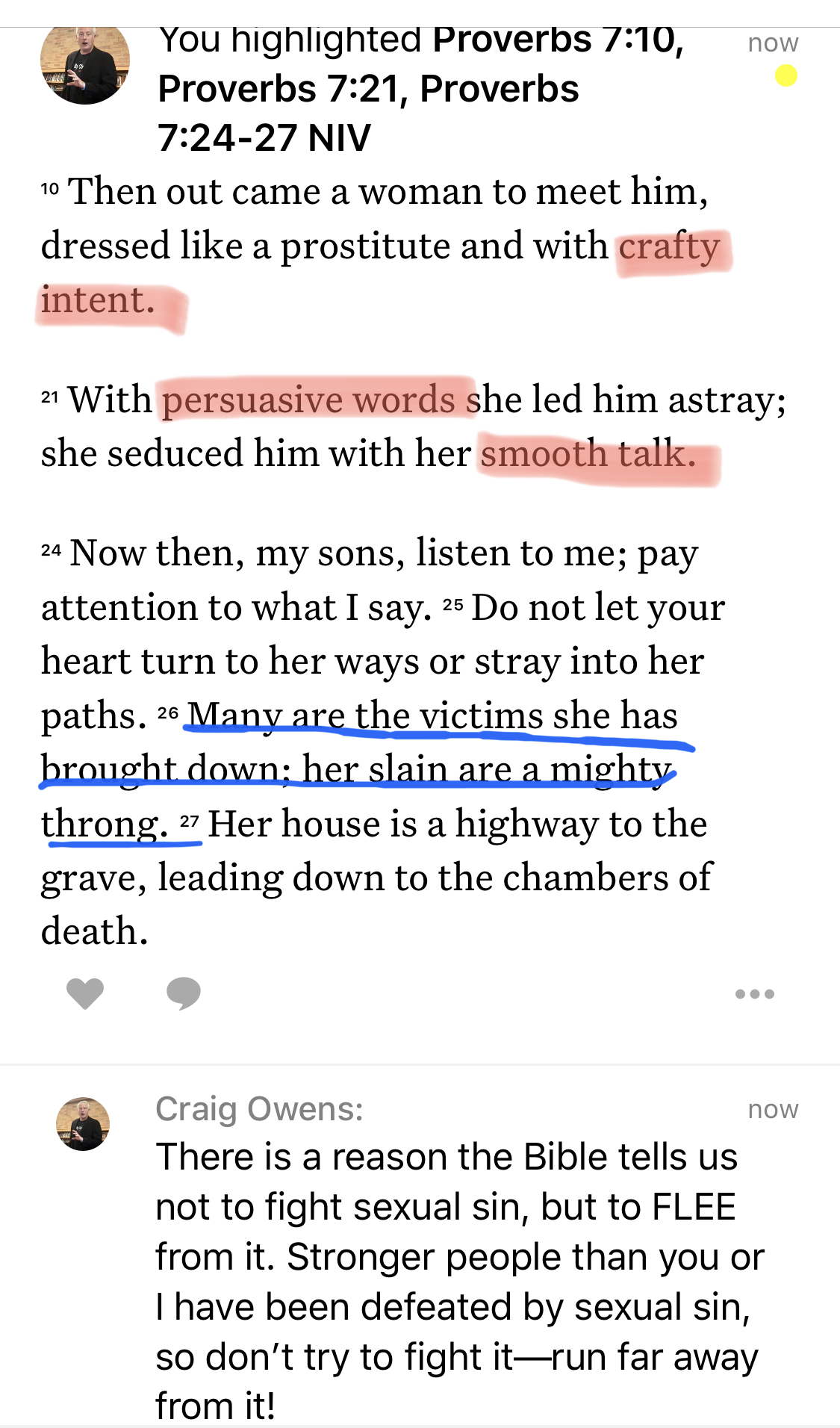
FLEE!!

Many times pastors point to passages of Scripture that tell us to fight the enemy. Put on the full armor of God! Take your stand! Storm the gates of Hell! You are more than a conqueror!

Those are all true, but

There is also a time to run away from a battle. 

Flee from sexual immorality … Flee from idolatry … (1 Corinthians 6:18; 10:14).

These two enemies usually form a two-headed monster. Look throughout the Bible and you will see that when the Israelites worshipped anything other than God, they did it with idols and illicit sexual practices.

The Greek word for “sexual immorality” is porneo. This is where we get our word pornography. And isn’t pornography nothing more than idolatry of the naked human body?

Porneo is defined as:

  • Prostituting one’s body to the lust of another
  • Unlawful sexual activity
  • Being drawn away by another into idolizing something illicit
  • Defiling yourself sexually

What do we do with this? FLEE!!

You cannot fight the two-headed monster of Porneo with your willpower. You must run away! 

Porneo is not something to be tamed or controlled. It’s a monster from which you must flee! 

This is not a temptation you can control. It’s one you must avoid at all costs! 

Look at Joseph: He left his cloak in her hand and ran out of the house.

Don’t resist the urge—FLEE!!

Don’t take a cold shower—RUN AWAY!!

Get out. Stay out. Get as far away as possible from this two-headed monster.

You cannot win this fight; you must by all means avoid this battle.