God had an important message to deliver to not only the people currently alive but all the people who would walk the face of the Earth from that moment onward. God chose Ezekiel to deliver this message.
But here’s the important concept for all leaders—A leader cannot take people anywhere unless he has gone there himself.
And it’s corollary—A godly leader cannot take people anywhere that God is blessing unless he lets God take him there first.
If a leader tries to take people where he hasn’t been himself, at best he’s a tourist; at worst he’s a hypocrite.
When God prepared to take Ezekiel to where He needed Ezekiel to take other people, God wanted Ezekiel fully engaged:
Son of man, LOOK with your eyes and HEAR with your ears, and FIXyour mind on everything I show you; for you were brought here so that I might show them to you. Declare to the house of Israel everything you see (Ezekiel 40:4).
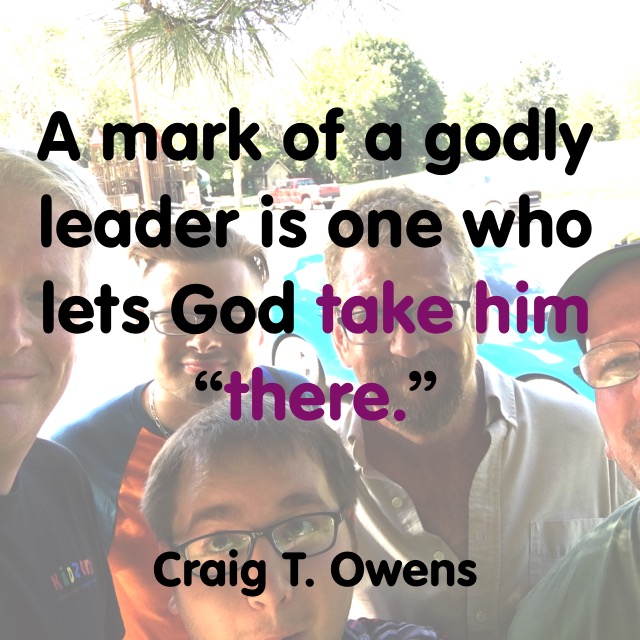
A mark of a godly leader is one who lets God take him “there” before he tries to take anyone else there.
This is part 25 in my series on godly leadership. You can check out all of my posts in this series by clicking here.
“One of the greatest curses of the modern evangelical movement, in my opinion, is that we are somehow becoming ‘popular.’ Just as soon as you become popular, something goes out of your life, or more accurately, something has gone out of your life before you get popular.
“Historically, the Christian had to be emphatic. He had two words: yea or nay. When God was talking to him, he said yes, and when the devil was talking to him he said no. When God said, ‘Do this,’ he said, ‘Yes, Lord.’ When sinners tempted him to stray, he said an emphatic no.
“The trouble with us now is that we are double-minded. That is why we are weak. Scripture speaks of the double-minded man. He is ‘unstable in all his ways’ (James 1:8). Elijah illustrated this when he said, ‘How long halt ye between two opinions? If the Lord be God, follow Him: but if Baal, then follow him’ (1 Kings 18:21). We need to be on one side or the other. Wholly committed to our high calling in Christ Jesus.” —A.W. Tozer, in The Wisdom Of God
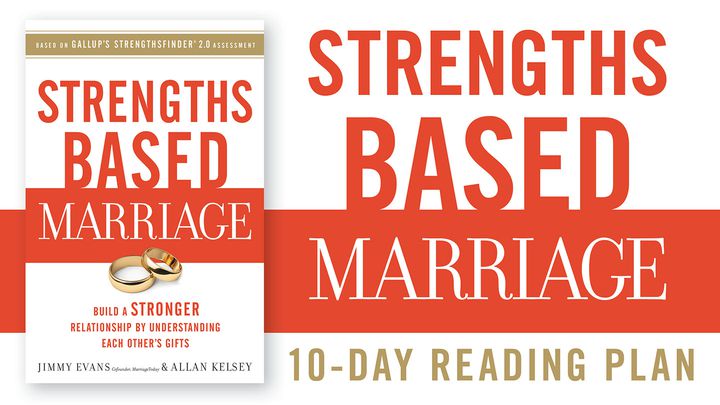
Normally on Tuesdays, I post book reviews here, but I’ve been reading a couple of YouVersion reading plans with my wife this summer that I felt I must share with you. Both of them are by Jimmy Evans—One: A Marriage Devotional and Strengths-Based Marriage.
If you are unfamiliar with YouVersion Bible, there is both a web-based site and a mobile app that you really should check out. I spend a lot of quality time in the Scripture using the app on my iPhone each day. One of the cool features YouVersion has recently introduced is the ability to read devotional plans with friends. This offers:
accountability with your reading partners
a set schedule of reading assignments
access to all the biblical texts that correspond with the day’s devotional reading
a place to share your thoughts just with your reading partners, and inaccessible to anyone else on YouVersion
Strengths-Based Marriage focuses on exactly what the title leads you to expect—the strengths in you and your spouse. Instead of trying to “fix” something in your spouse, Jimmy Evans turns your attention toward the God-implanted strengths in your spouse, and then gives you some practical counsel for calling out those strengths.
For example, in one of the devotions he wrote, “Each of us is remarkably unique, and to minimize that irreplaceable uniqueness is to rob the world of a contribution that cannot come any other way.” And in another devotional he says, “You cannot separate your treasures from your passions. In other words, you will always be most passionate about the people, pursuits, and places where you are investing the best of your life. Your passions will always follow the investments of your time, energy, and strengths.”
One: A Marriage Devotional is a much more daily nuts-and-bolts approach to our marriages. In this devotional he shares relationships principles, and then gives us a “Talk It Out” and a “Walk It Out” assignment to put into practice.
In one of these devotionals he writes, “God created marriage to operate as the most important human relationship in our lives, and it only succeeds on that level. … Priority must be proven daily in real terms and not just in words. Good intentions mean very little in marriage. The only thing that matters is what you do and continue to do consistently. For your marriage to work, you must establish it as the first priority and be willing to protect it against good or bad things that try to distract you.”
Whether your marriage is in need of urgent attention, it could use some minor improvements, or it’s already pretty great, both of these devotionals will give you practical tips, time with your spouse in God’s Word, great conversation-starting questions, and some highly practical tips you can use right now.
If I were to ask you if we should we pray for our friends in need, I think I’d probably get a universal “yes.” Even non-Christians might say we should “send good thoughts” or “best wishes” to our friends.
But if I were to ask, “How long should we pray for them?” we might get a lot of different answers.
What about if we’re praying for a friend to get a job (and he gets it), or a friend to be healed (and she is), or a marriage to be restored (and it is)—do we stop praying then?
Psalm 20 and 21 appear to be companion psalms: with Psalm 20 being David’s prayer of petition, and Psalm 21 being his prayer of praise. But there is also something quite interesting in each of these psalms about the placement of the word Selah.
Remembering that Selah means some sort of pause, I find it very interesting where David tells us to pause in both of these psalms. In Psalm 20 we see the prayer request “may” either 6 or 7 times in the first five verse, but the Selah pause is right in the middle of them. Why would David start making his requests to God, tell us to pause in the middle, and then continue making his requests?
I believe this Selah means to “pause and consider” that…
God invites us to participate with Him in fulfilling His plans.
God loves us so much that He wants to hear from us.
God is powerful enough to grant what we ask of Him.
It’s as if in the middle of all of his petitions, David says, “Hold on a second. Do you realize what we are in the midst of doing? We are actually communing with the All-Knowing, All-Loving, All-Power Creator and Sustainer of the Universe!!”
In Psalm 21 David is offering up a prayer of praise for God’s answers to his prayers (note the similar language in Psalm 20:4 and 21:2), and once again he tells us to Selah pause right in the middle of those prayers of gratitude.
I asked earlier, “When do we stop praying for a friend or for ourselves?” Is it when we get the job, or experience the healing, or have the breakthrough or restoration? What if the job, the healing, the restoration was just the beginning of what God wanted to do? The Selah in Psalm 21 is an accentuation: an explosion into so much more!!
David prayed for victory in battle, but God gave him an everlasting victory; David prayed for long life, but God gave him eternal life (21:4); David prayed for blessings on his battle, but God gave him His eternal blessings (21:6).
Jesus said our Heavenly Father has gifts for us beyond our asking (Matthew 7:11), and the Apostle Paul said the same thing in Ephesians—
Now glory be to God, who by His mighty power at work within us is able to do far more than we would ever dare to ask or even dream of—infinitely beyond our highest prayers, desires, thoughts, or hopes. (Ephesians 3:20 TLB)
These two Selahs tell me:
Don’t quit praying when times are tough.
Don’t quit praying when you’ve prayed a long time.
Don’t quit praying when it seems like God has answered.
Keep on praying. Always. About everything!
Please join me this coming Sunday as we continue to look at the Selahs in the Psalms. You can join me in person or via Facebook Live.
[Each chapter in the Book of Proverbs contains thoughts that fit into a theme; they are not just random thoughts gathered together. In this “Saturday In The Proverbs” series, I will share a theme that I see in each chapter. But the cool thing about God’s Word is that you may see an entirely different theme. That’s great! If you do, I would love for you to share it in the comments below.]
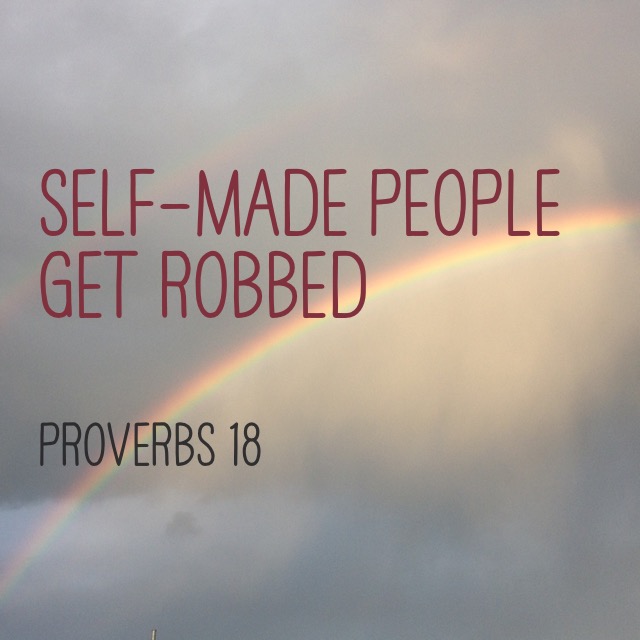
A man who isolates himself seeks his own desires; he rages against all wise judgment (Proverbs 18:1).
The self-absorbed, self-centered, self-made man only robs himself of…
…the wisdom others could give him (vv. 1, 15)
…understanding more deeply (vv. 2, 4)
…peaceful relationships (vv. 6, 7, 18, 19, 24)
…getting the full story (vv. 8, 13, 17)
…God’s help (v. 10)
…honor (v. 12)
…life (v. 21)
Don’t get ripped off by thinking you already know it all!
This is a weekly series with things I’m reading and pondering from Oswald Chambers. You can read the original seed thought here, or type “Thursdays With Oswald” in the search box to read more entries.
Jeremiah 13
[These are notes from Oswald Chambers’ lecture on Jeremiah 13.]
When a man is afraid of God the only right thing for him to do is to run straight to God and not wait to dress himself. The further we get away from God the more we want to dress ourselves up in prayer, etc., but if we fly, just as we are, God will take us and remove the unclean thing. …
Spiritually when an individual builds his confidence on anything less than God inevitably there will be a perishing of the ground of confidence. … Beware of building your faith on your experience of God’s grace instead of on God Who makes the experience possible. …
Never succumb to believing in an inevitable fate, but fly to God, then you will never know the darkness or the judgments on sin (cf. John 3:19). Judgment comes because of conscious rejection or a conscious neglect. If we see and do not obey, there will be the wandering in the shadows, by God’s decree. There is always a way back to God, and that is to fly as you are, not as you want to be. …
Never trust innocence of outlook in yourself or in other people when the statements of God’s Word are directly opposite (see Mark 7:21 and Jeremiah 17:19). … It is difficult when convicted to turn to Jesus Christ; we turn to vowing; but unless we turn to Jesus in obedience and let His life enter in, it is hopeless, for we build again on the same old foundation.
From Notes On Jeremiah
When the Holy Spirit convicts us, our natural human tendency is to (a) justify, (b) make excuses, (c) vow that we will never do that again, (d) ask a friend to help hold us accountable to better behavior, or (e) try to cover up with a lot of religious activity.
What God wants instead is for us to run to Him. Just as we are. No pretenses. No excuses. No delay. He alone has the healing and restoration we desperately need.
“For the Christian, citizenship is about stewardship. That’s especially true in a country where our most important governing document begins with ‘We the People.’ That means we have a lot of responsibility. …
“God has ordained a government as one way that He shows grace to all people. Government should recognize the God-given duty of human beings and respect the roles and responsibilities of family and church. Government is to keep the peace through the rule of law and to use force to punish those who break it. The role of government is to maintain justice and peace in society so other institutions, especially the family in the church, can do what they are designed to do. …
“Christians should enter the public square with a biblically shaped perspective. To apply a Christian worldview to questions of public policy is not exercising self-interest. It is simply serving our neighbor by testifying to the way God has made the world.” —Jennifer A. Marshall
For the Christian, citizenship is about stewarding the responsibilities God has given us to the countries in which we live. Those include things like:
Showing proper respect to those in leadership positions (Romans 13:1-6)
“All the opportunity for self-government through the rule of the people depends upon one single factor. That is the ballot box. . . . The people of our country are sovereign. If they do not vote they abdicate that sovereignty, and they may be entirely sure that if they relinquish it other forces will seize it, and if they fail to govern themselves some other power will rise up to govern them.” —President Calvin Coolidge
“Jesus risked Himself on me. How can I not risk my life on you? You may not love me back. You may humble me, humiliate me, reject me, shatter my heart, and drive the shards into my soul—but this is not the part that matters. What matters is that in the act of loving we become more like the givenness of Love Himself. What matters most is not if our love makes other people change, but that in loving, we change. What matters is that in the sacrificing to love someone, we become more like Someone. Regardless of anything or anyone else changing, the success of loving is in how we change because we kept on loving. …
“Love is always worth the risk because the reward of loving is in the joy of loving itself. Love is a risk that’s never a risk. Loving itself is the greatest outcome because loving makes one more beautiful, more like brokenhearted Beauty Himself.
“No matter what the outcome looks like, if your love has poured out, your life will be success-full.” —Ann Voskamp, in The Way Of Abundance
Please read my review of The Way Of Abudnance by clicking here, and check out some other quotes from this life-changing book here.
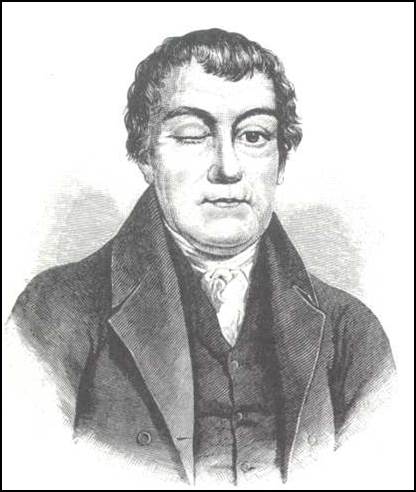
Christmas Evans tells us in his diary that one Sunday afternoon he was traveling a very lonely road to attend an appointment, and he was convicted of a cold heart. He wrote,
“I tethered my horse and went to a sequestered spot, where I walked to and fro in an agony as I reviewed my life. I waited three hours before God, broken with sorrow, until there broke over me a sweet sense of His forgiving love. I received from God a new baptism of the Holy Ghost.
“As the sun was westering, I went back to the road, found my horse, mounted it and went to my appointment. On the following day I preached with such new power to a vast concourse of people gathered on the hillside, that a revival broke out that day and spread through all Wales.”
Christmas went on to write 13 covenants to God. You can read all 13 of them by clicking here, but here are six of them that especially resonated with me—
V. O Jesus Christ, Son of the living God, take for the sake of Thy cruel death, my time, and strength and the gifts and talents I possess; which, with a full purpose of heart, I consecrate to Thy glory in the building up of Thy Church in the world, for Thou art worthy of the hearts and talents of all men.
VI. I desire Thee, my great High Priest, to confirm, by Thy power from Thy High Court, my usefulness as a preacher, and my piety as a Christian, as two gardens nigh to each other; that sin may not have a place in my heart to becloud my confidence in Thy righteousness, and that I may not be left to any foolish act that may occasion my gifts to wither, and I be rendered useless before my life ends….
VIII. … Grant that I may experience the power of Thy Word before I deliver it, as Moses felt the power of his own rod, before he saw it on the land and waters of Egypt. Grant this, for the sake of Thine infinitely precious blood, O Jesus, my hope, and my all in all.
IX. Search me now, and lead me into plain paths of judgment. Let me discover in this life what I am before Thee, that I may not find myself of another character when I am shown in the light of the immortal world, and open my eyes to all the brightness of eternity….
X. Grant me strength to depend upon Thee for food and raiment, and to make known my requests….
XII. Grant, O blessed Lord, that nothing may grow and be matured in me to occasion Thee to cast me off from the service of the sanctuary, like the sons of Eli; and for the sake of the Thine unbounded merit, let not my days be longer than my usefulness….(emphasis mine)
If you want to do great things for God—if you want Him to do great things through you—then you must be wholly committed to Him. Perhaps Christmas Evans’ covenant statements will help you draft your own, or adopt a couple of his, to consecrate yourself to God’s service.
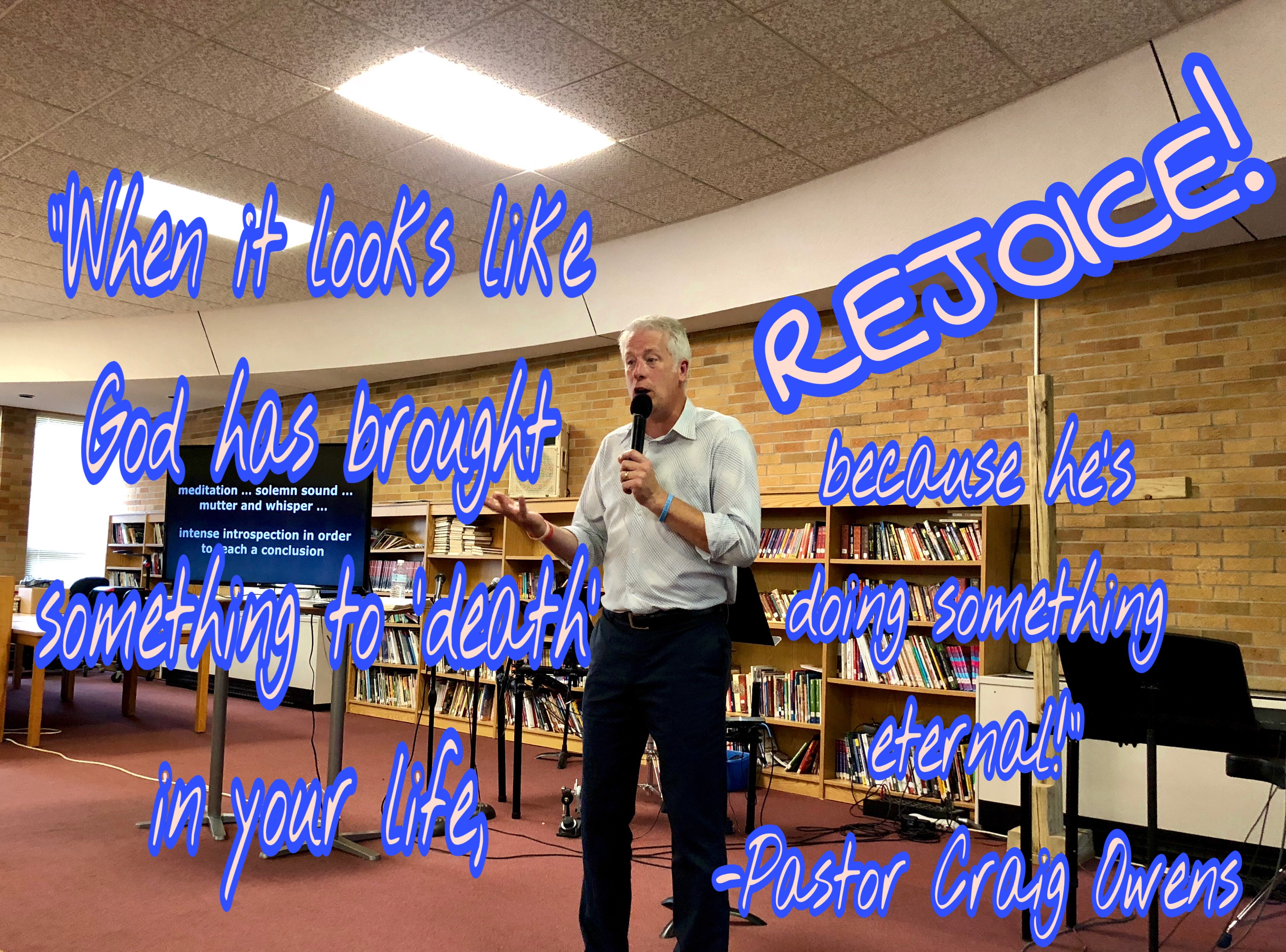
Well, this isn’t what I expected! David says his song in Psalm 9 is supposed to be sung to the tune of “Death Of The Son,” so I’m expecting a prayer that is loaded with minor notes. But instead, David gives us … this!
The opening verses show us David exploding in praise to God. Check out his vocabulary—
I will praise You—this literally means David is pumping his hands in the air
I will tell of all Your wonders—David is not doing this just one time but is ticking off a long list of God’s praiseworthy deeds and attributes
I will be glad—his face lights up with joy
I will rejoice—this word means a roar of praise (see 1 Chronicles 16:32)
I will sing praise—there is a new melody with every praise David lifts to God
Why this loud, exuberant, unexpected praise? Because David has noticed that whatever has “died” on earth is only a temporary loss, but God is forever!
There is an unusual word pairing at the end of verse 16: Haggaion and Selah. This is the only time these two words appear like this in all of Scripture, and it’s also the only time Haggaion is used without being translated.
Haggaion appears just four times in the Bible—(a) in Psalm 19:14 where it is translated meditation; (b) in Psalm 92:3 where it is translated solemn sound; (c) in Lamentations 3:62 where it is translated whisper and mutter; and (d) here in Psalm 9 where it is untranslated.
By combining Haggaion and Selah, David is wanting us to solemnly meditate on an important contrast: God’s way vs. man’s way. In verses 3-16, David uses huge and eternal terms for God like righteous Judge, reigns forever, refuge, stronghold, merciful, and prayer-answerer.
Side-by-side with these eternal terms for God, David lists the temporary terms for man like stumble, perish, ruined, forgotten, and trapped. In fact, David ends this Psalm by reminding us evil men who do evil things are “mere men.” Other translations fill in the details:
make them realize their frail nature (AMP)
show them how silly they look (MSG)
merely human (NLT)
puny men (TLB)
Then David ends with a final Selah—one more call for us to allow this message to resonate with us, especially during the times others may call dark, depressing times. The message that should resonate in our hearts and cause us to throw our hands up in joyful celebration of God is…
these earthly things are temporary and God is eternal. He has never forsaken those who seek Him, and He has never forgotten those who call on Him for help.
When a dark time—a “death of a son”—tries to rock your world, don’t do what puny mortals expect, but throw your hands up in the air, and sing and roar a praise to the Almighty God Who cares for you!
Join me this coming Sunday as we continue our looks at the Selahs in the Book of Psalms. You can join me in person or on Facebook Live.



 God had an important message to deliver to not only the people currently alive but all the people who would walk the face of the Earth from that moment onward. God chose Ezekiel to deliver this message.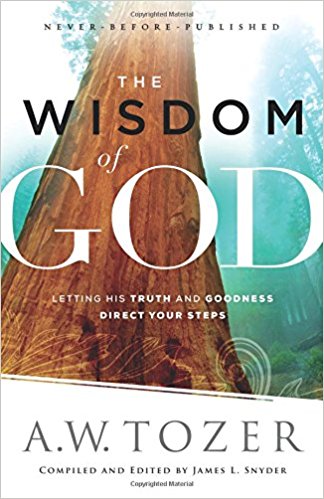





 Craig T. Owens