Listen to the podcast of this post by clicking on the player below, and you can also subscribe on Apple, Spotify, or Audible.
Those who regularly follow my book reviews have probably noticed that I read very few fiction books. If I do read fiction, I want it still to be something that engages my brain as well as my heart. Leo Tolstoy’s Father Sergius definitely hit those marks!
This is a story about a spiritual journey that started out anything but spiritual. Stepan Kasatsky becomes a monk not because he wanted to pursue God, but because he wanted to run away from carnal heartache.
Kasatsky’s journey started out just as escapism from the world. In fact, Tolstoy describes it as, “Our feet have reached the holy places, but our hearts may not have done so.” Yet somewhere along the way, Father Sergius (as Kasatsky now called himself) discovered true piety.
Father Sergius’ spiritual “success”—if it can be called that—resulted in carnal pride. His journey that had become spiritual now became corrupted by pride. Sergius realized he had lost his way, and yet he struggled with giving up the popularity and acclaim he had now acquired.
The book closes with Sergius rediscovering humility and true spirituality from a peasant woman he had mocked and belittled when they were both children.
There is something in Kasatsky’s journey that can both warn and encourage all of us spiritual people on our journeys.
I am so stoked about the “Leading From Alignment” podcast that dropped on September 6! Our conversation was supposed to cover some things from my book Shepherd Leadership but we got into so many other topics.
Listen to the podcast of this post by clicking on the player below, and you can also subscribe on Apple, Spotify, or Audible.
Max Lucado wrote,
“The United States economy endured ten recessions between 1948 and 2001. These downturns lasted an average of ten months apiece and resulted in the loss of billions of dollars. Every five years or so, the economy dumps its suitors and starts over. What would you think of a man who did the same with women? What word would you use to describe a husband who philandered his way through nine different wives over fifty years? And what word would you use to describe wife number ten? How about this one? Fool. Those who trust money are foolish. They are setting themselves up to be duped and dumped into a dystopia of unhappiness.” —Max Lucado, Fearless
Yikes! It sounds like money can be a scary thing. So let’s consider statement #12 in our series asking “Is that in the Bible?”—Money is the root of all evil. Is that in the Bible? No!
That phrase is close to one that is in the Bible, but “close” misses the real meaning. What Paul actually wrote to Timothy is, “For the love of money is a root of all kinds of evil” (1 Timothy 6:10).
That three-word phrase “love of money” is actually just one word in Greek, and it means “friend of silver.”
The Bible teaches that money itself is neither good nor evil. It’s merely a tool like a hammer that is used for building something or for destroying something. If the hammer builds or destroys, it’s not the hammer that is good or evil but the attitude of the one gripping the hammer determines the good or evil outcome.
So too with money. Money keeps the lights on, puts gas in our car, clothes on our backs, and food in our stomachs, it even helps people share the Gospel here and around the world. It’s our attitude toward money that leads us to good or evil thoughts and actions.
In describing people who were a friend of silver, Paul uses phrases like this to describe them: teaches false doctrine … does not agree to sound instruction…and godly teaching … who think godliness is a means to financial gain … want to get rich … eager for money (1 Timothy 6:3-5, 9-10).
In 1923 a group of the world’s most successful financiers gathered at the Edgewater Beach Hotel in Chicago. Together these men controlled more wealth than the United States Treasury! They met together to discuss how they could use their present wealth to gain even more wealth. Their plan was put into place and it began to reap the results they planned: they expanded their influence and their bank accounts.
Then six years later, on October 29, 1929, Black Tuesday happened. The worst day for the New York Stock Exchange ever and the beginning of the Great Depression in the USA.
What about that group of wealthy financiers who wanted more, more, more?
Charles Schwab—president of Carnegie Steel Company—lived the last years of his life on borrowed money and died penniless
Arthur Cutten—the world’s largest wheat speculator—died insolvent
Richard Whitney—president of the NYSE—served a prison term for embezzlement
Albert Fall—a member of the president’s cabinet—also went to prison
Jessie Livermore—the “bear of Wall Street,” Leon Frazer—president of the Bank of International Settlements, and Ivar Kreuger—head of the world’s largest monopoly (a match company)—all committed suicide
Their friendship with silver—their love of Money—led to their disastrous downfalls.
Jesus said, “No one can serve two masters. Either you will hate the one and love the other, or you will be devoted to the one and despise the other. You cannot serve both God and Money” (Matthew 6:24).
The word Jesus used for “Money” is Mammon: wealth personified and deified. When we make Money our god—Money (with a capital “M”)—we naturally begin to covet what isn’t ours. Nothing satisfies and so we covet to possess more and more and more.
Remember Jesus we cannotserve two masters. If we replace God with Mammon, it is inevitable that we will break all of the Ten Commandments. Has anyone ever made an idol to their Money, or murdered for money, or committed adultery, or stolen, or told lies? They sure have!
Paul described those who worship Mammon this way—
Those who want to get rich fall into temptation and a trap and into many foolish and harmful desires that plunge people into ruin and destruction. For the love of money is a root of all kinds of evil. Some people, eager for money, have wandered from the faith and pierced themselves with many griefs. (1 Timothy 6:9-10)
But those who worship God, Paul described like this—
But godliness with contentment is great gain. For we brought nothing into the world, and we can take nothing out of it. But if we have food and clothing, we will be content with that. (1 Timothy 6:6-8)
Simply put: Contentment with God kills Mammon’s covetousness!
Want to know how to check your attitude toward money? When you think about giving God His tithe, or when the Holy Spirit prompts you to give to a missionary, what thought comes to your mind? Do you think, “Ugg, I have to give this” or do you rejoice to say, “Yes, I get to give this”? The answer to that question will give you a really good indication of how much pull Mammon has over your heart.
We all have a choice to make: yield to God or yield to Mammon. But remember only God can give us contentment today and pleasures that last for eternity.
“This is one of the rewards of reading the Old Testament regularly. You keep on discovering more and more what a tissue of quotations from it the New Testament is; how constantly Our Lord repeated, reinforced, continued, refined, and sublimated the Judaic ethics, how very seldom He introduced a novelty.” —C.S. Lewis, Reflections On The Psalms
The folks at Fight The New Drug provide excellent research on the dangers of pornography as well as many helpful resources for folks to break free from a porn addiction. Pornography often attracts people when they are emotionally drained, but viewing porn actually increases feelings of loneliness and isolation.
If we ever start to think the Church is one or two ministers and a whole bunch of parishioners, it really won’t be a Church. According to Ephesians 4, all Christians should be ministers.
You can check out the full message that this clip is from by clicking here.
Here is a word of encouragement for anyone in a time of spiritual warfare—
Wow, this post from T.M. Moore on how we respond to God’s “call” is a much-needed reminder. In the post, he wrote,
“Probably most Christians treat the calling of God as a kind of punctuated equilibrium. He breaks into their lives to ‘call’ them to some activity or task, but only from time to time, and only for that activity or task. He ‘calls’ us to believe the Gospel, and we do. He ‘calls’ us to this or that church, and we go. He ‘calls’ us to some ministry or other Christian activity, and so we participate. He ‘calls’ us to make a special gift, go on a mission trip, send a note of encouragement to a friend, and so forth. Our lives run on their own schedules, so whenever God ‘calls’ us to do something, we’ll try to get it done.
“But most of the time, other things have prior claims on our lives. We have jobs, families, friends, responsibilities, things we like to do or must do. We can’t respond to every calling from God because, well, there just isn’t enough time. We say, when friends press us to consider this or that Christian opportunity, ‘If God calls me to it, I will.’ But aren’t we just using the language of piety to relieve the discomfort of pressure to do something we’d rather not do?
“We are called of God. Of this there is no doubt. But for most Christians, the way they understand God’s calling is not the same as the way God issues it. And they have not yet learned to value His calling as He intends, as the defining and guiding value of our lives.”
This is a weekly series with things I’m reading and pondering from Charles Spurgeon. You can read the original seed thought here, or type “Thursdays With Spurgeon” in the search box to read more entries.
Listen to the podcast of this post by clicking on the player below, and you can also subscribe on Apple, Spotify, or Audible.
Holy Longings
My soul is consumed with longing for Your laws at all times. (Psalm 119:20)
One of the best tests of a man’s character will be found in his deepest and heartiest longings. You cannot always judge a man by what he is doing at any one time, he may be under constraints that compel him to act contrary to his true self, or he may be under an impulse from which he will soon be free. He may, for a while, back off from that which is evil, yet he may be radically bad. … A man’s longings are more inward and more nearer to his real self than his outward acts—they are more natural in that they are entirely free and beyond compulsion or restraint.
As a man longs in his heart, so is he. I mean not every idle wish, as I now speak, but strong desires of the heart. These are the true life of a man’s nature. You will know whether you yourself are evil by answering this question: To what have you the greatest desire? … So then, dear hearers, your heart longings may furnish you with helps for self-examination, and I beg you to apply them, as things of the heart touch the root of the matter.
From Holy Longings
Jesus was constantly taking us back to the examination of our heart. He knew that “out of the heart come evil thoughts—murder, adultery, sexual immorality, theft, false testimony, slander” (Matthew 15:19). He further demonstrated this when He made anger in the heart the same as murder, and lust in the heart the same as adultery (Matthew 5:21-30).
We can try to change our behaviors all day long, but if we don’t address the heart longings that are prompting those behaviors, we are fighting a losing battle.
Sigmund Freud called them “Freudian slips” when we said or did something that seemed out of character. I think we should call them eye-opening insights—we just had an opportunity to glimpse what heart longing is at the root of that inappropriate word or action. Thankfully, the same Holy Spirit that reveals these carnal longings to us will also lead us to repentance and a heart change that brings about God-honoring heart longings.
Don’t try to excuse or cover up what may have slipped out, but use that as a merciful warning of heart longings that need the sanctification of the Holy Spirit. We are all a work-in-progress, which is why I like to remember the word sanctification by saying it “saint-ification.” Let’s yield to the Holy Spirit to bring out greater saintliness by saint-ifying our heart longings.
Listen to the podcast of this post by clicking on the player below, and you can also subscribe on Apple, Spotify, or Audible.
I had a great time on the Ailbe Podcast with Rusty Rabon.
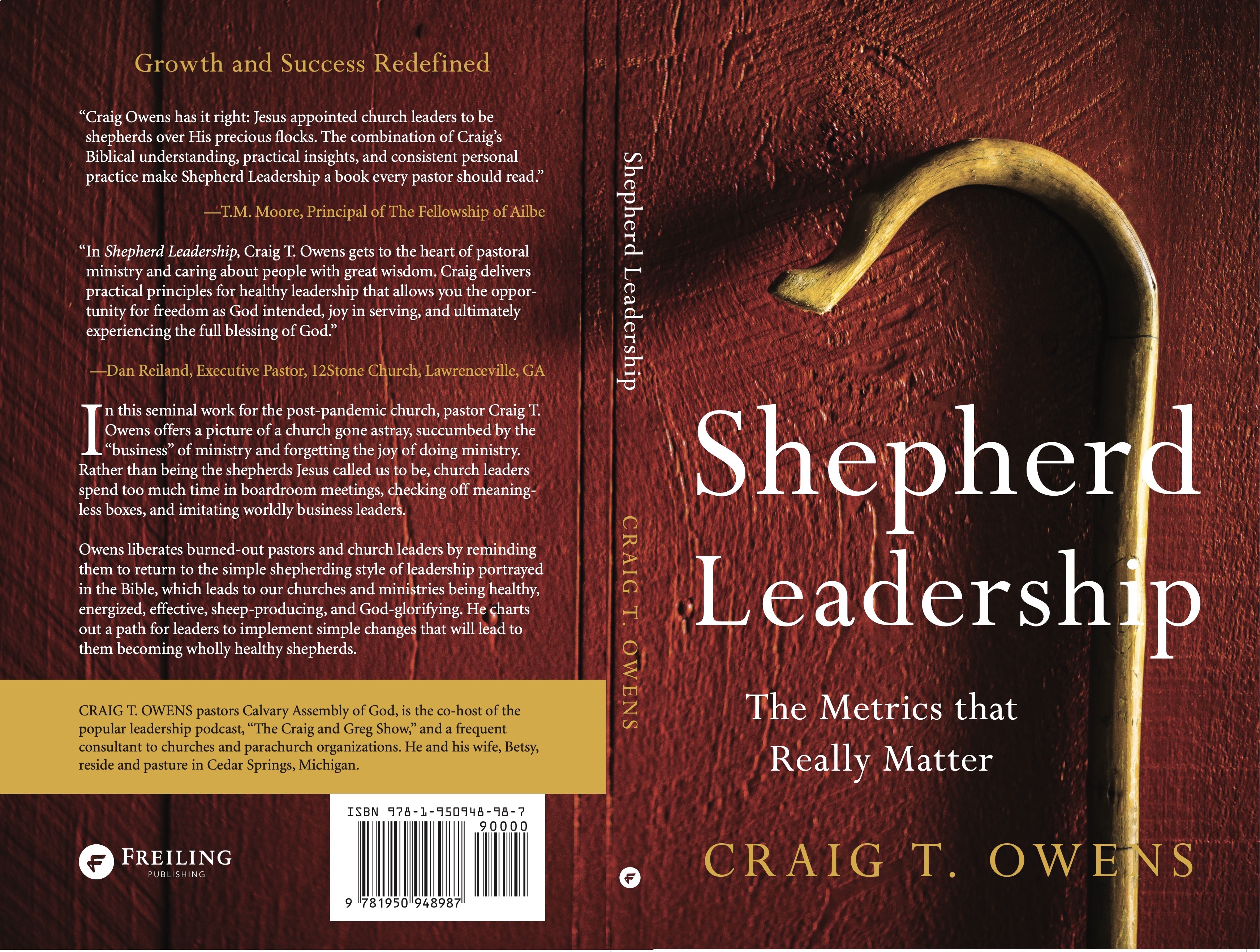
The reason I wrote Shepherd Leadership is because my heart was aching for my fellow pastors who were feeling frustrated maybe even to the point of contemplating resigning their churches. The principles I teach in this book are ones that will get all of us back to a biblical standard of what God says is successful in our ministries.
Toward that end, I love praying for pastors. Every week I send a Sunday morning prayer to my fellow pastors in my hometown to encourage them to find satisfaction in serving the sheep the Chief Shepherd has placed under their care.
As we wrapped up our time together, Rusty referred to a prayer I shared in my chapter entitled ‘Stick-to-it-iveness.’ This prayer is adapted from Psalm 23 and is intended to be a source of strength for pastors.
Take a listen…
I hope this prayer is helpful and energizing to you. I also hope that you will pick up a copy of Shepherd Leadership to infuse some more encouragement into your ministry efforts.
If you would like to check out the other clips I have already shared from this podcast, please check them out here. Shepherd Leadership: The Metrics That Really Matter is available in print or ebook, and in audiobook through either Audible or Apple.
In my book Shepherd Leadership, I tell a humorous but very enlightening story of a student who called me “Pasture Craig.” It was done innocently enough, but it taught me an invaluable lesson.
Check this out…
And since that day, I have never minded being called Pasture Craig because it reminds me of what I’m really supposed to be doing!
If you want to check out another hilarious story about my alter-ego Plungerman, please click here.
Shepherd Leadership: The Metrics That Really Matter is an excellent resource for both pastors and non-profit ministry leaders and is available in print or ebook, and in audiobook through either Audible or Apple.
Question marks invite a conversation; whereas, periods or exclamation points tend to end the conversation. Clearly, God enjoys dialogue.
God sometimes asks questions to get Zechariah to evaluate his surroundings or the prevailing culture. Sometimes God asks Zechariah a question to get him to clarify what he is seeing or thinking.
But without a doubt, most of the questions are posed by Zechariah to either God or to the angelic messenger who sometimes serves as Zechariah’s guide. Not once does God nor the angel tell Zechariah to hold his tongue. Zechariah’s questions are never belittled nor treated as though they were a bother. Nor are his questions ignored.
Rather, every single question is answered.
God enjoyed talking with Adam and Eve in the garden of Eden, He walked and talked with Enoch, He listened to the questions asked by Job and the psalmists, and here He engages Zechariah in conversation too.
Prayer is never designed to be a monologue—with us just speaking to God—nor is Bible reading designed to be a monologue—with just God speaking to us. Both prayer and Bible reading are used by the Holy Spirit to keep a dialogue active and engaging. You and I should never be afraid to approach God with our questions, nor should we be afraid to listen to the questions God asks us.
The dialogue between us and God builds an intimacy that cannot be developed in any other way. So keep asking those questions!
Listen to the podcast of this post by clicking on the player below, and you can also subscribe on Apple, Spotify, or Audible.
I’m a bit of a nut about the exactness of words, so one of my pet peeves is the incorrect use of imply and infer. “Imply” is something I do as the speaker; “infer” is something you do as the listener. Or you might say implying is like throwing and inferring is like catching.
A big problem arises when I infer something that you didn’t imply. Or even worse, when I infer something based on something you didn’t say. People will often say something like this, “Since Jesus didn’t specifically talk about ________ then it must be okay.” In logic, this would be called an argument from ignorance: concluding that an action must be acceptable because it has not been specifically stated to be unacceptable.
Statement #10 in our series asking “Is that in the Bible?” is—Love your neighbor. Is that in the Bible? Yes!
Later on, Jesus would add to this Deuteronomy 6:5—Love the Lord your God with all your heart and with all your soul and with all your strength—to answer the question about the greatest commandment of all.
In Leviticus 19, the Hebrew word for love means love in the broadest sense of the word, and neighbor means a friend or a fellow citizen. Unfortunately, the rabbis inferred that someone not a Jew was therefore an enemy and therefore not worthy of love. They further inferred that the opposite of love was hate.
Matthew Henry commented, “They were willing to infer what God never designed.”
Statement #11 is—Hate your enemy. Is that in the Bible? Yes, in the fact that it appears in print in Matthew 5:43, but it doesn’t appear in the Scripture that Jesus knew. It had become so ingrained in the thinking of people that they now assumed it was in the Bible.
In many ways, the Old Testament laws were easier to live out because they were all external and easy to measure, like don’t murder or don’t sleep with someone who isn’t your spouse. But Jesus made it a heart issue—He said lust is the same as adultery and hate is the same as murder.
Jesus also made love for enemies a heart issue. The word He used for love in the Greek is agape—the same word describing God’s love for His enemies in John 3:16—For God so LOVED the world, that He gave His one and only Son, that whoever believes in Him would not perish but would have everlasting life.
Jesus said our enemies were really our neighbors and were worthy of sacrificial love because they, too, were loved by God.
Matthew 5:44 is shortened in the NIV and has a footnote explaining that the longer verse was not seen in the earlier manuscripts. But given the fact that Jesus demonstrated everything found in the longer version of this verse, I think we are safe in using it. So let’s look at the response Jesus calls us to from the NKJV: But I say to you, love your enemies, bless those who curse you, do good to those who hate you, and pray for those who spitefully use you and persecute you.
Here’s what Jesus says it means for us to love our enemies:
(2) Help the haters. Jesus said we are to do those things that are beautiful and excellent—like the Good Samaritan did for his enemy-turned-neighbor (see Luke 10:25-37).
(3) Pray for the persecutors. Talk to God about them; don’t talk to others about them.
This response from Christians toward people whom others would call an enemy is totally unexpected by the world. This unexpected response will begin to draw enemies toward Jesus (1 Peter 2:12). If we will treat enemies and neighbors, they may soon become brothers and sisters in the family of God!
When the world hits us Christians out of hate, let’s respond with unexpected love: blessing those who curse us, helping those who hurt us, and praying for those who persecute us.



 Those who regularly follow my book reviews have probably noticed that I read very few fiction books. If I do read fiction, I want it still to be something that engages my brain as well as my heart. Leo Tolstoy’s Father Sergius definitely hit those marks!










 Craig T. Owens